
Subject
The patriarchs
Abraham, Isaac, Jacob, Joseph: one family carrying the promise.
Part of Where in the story
On this page, 7 sections
The one drawing
Across the canon
12 passages
Where Scripture speaks
The passages this subject stands on, in canon order.
Then the LORD said to Abram, “Leave your country, your kindred, and your father’s household, and go to the land I will show you.Abram believed the LORD, and it was credited to him as righteousness.No longer will you be called Abram, but your name will be Abraham, for I have made you a father of many nations.“Take your son,” God said, “your only son Isaac, whom you love, and go to the land of Moriah. Offer him there as a burnt offering on one of the mountains, which I will show you.”After this, his brother came out grasping Esau’s heel; so he was named Jacob. And Isaac was sixty years old when the twins were born.May God give to you the dew of heaven and the richness of the earth—an abundance of grain and new wine.And there at the top the LORD was standing and saying, “I am the LORD, the God of your father Abraham and the God of Isaac. I will give you and your descendants the land on which you now lie.Then the man said, “Your name will no longer be Jacob, but Israel, because you have struggled with God and with men, and you have prevailed.”So when the Midianite traders passed by, his brothers pulled Joseph out of the pit and sold him for twenty shekels of silver to the Ishmaelites, who took him to Egypt.Then Joseph said to his brothers, “Please come near me.” And they did so. “I am Joseph, your brother,” he said, “the one you sold into Egypt!As for you, what you intended against me for evil, God intended for good, in order to accomplish a day like this—to preserve the lives of many people.Then He said, “I am the God of your father, the God of Abraham, the God of Isaac, and the God of Jacob.” At this, Moses hid his face, for he was afraid to look at God.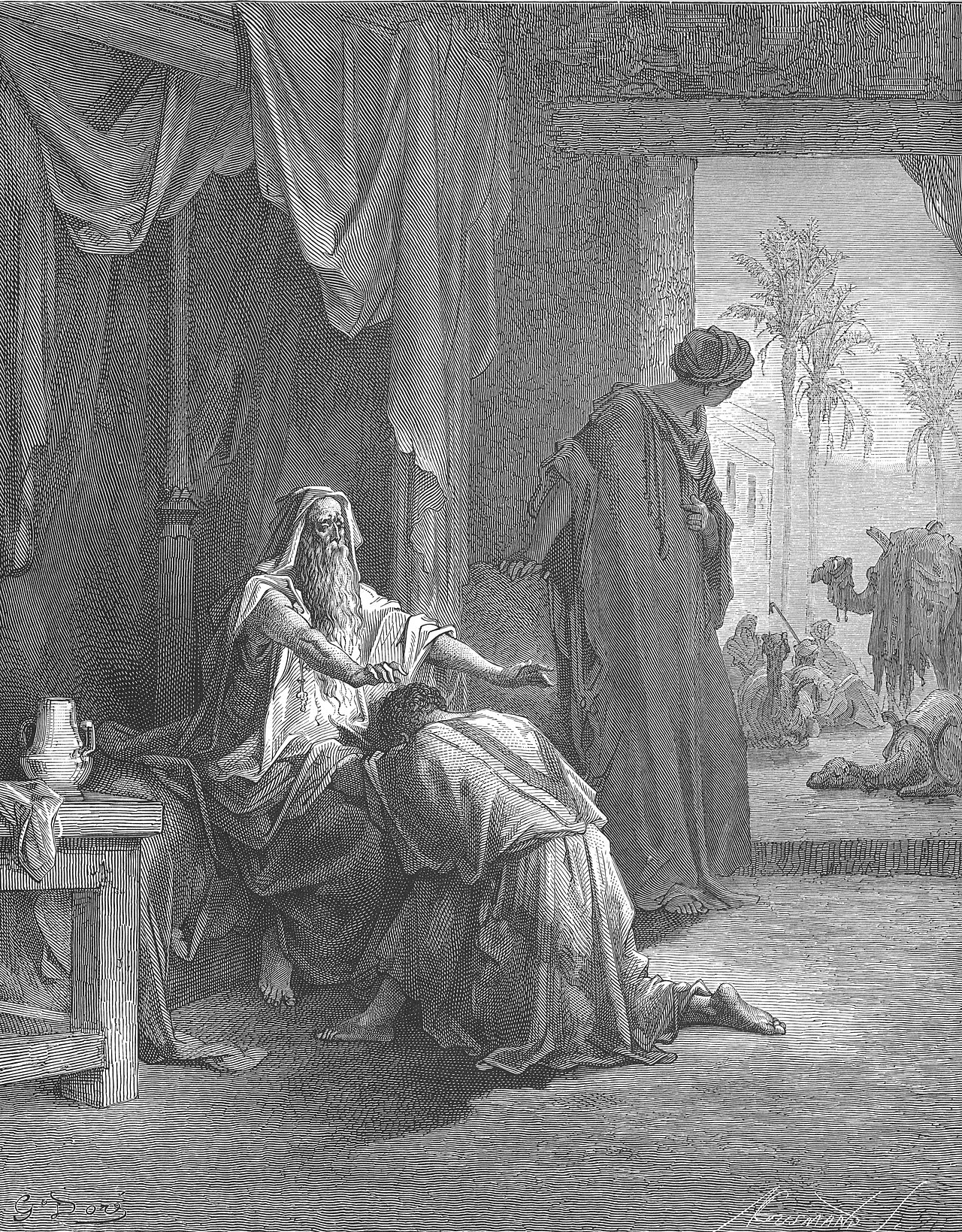
The patriarchs in Scripture, in full
The story of the patriarchs starts with a call, not a resume. God speaks to a man named Abram in a foreign land and tells him to leave his country, his people, and his father's house for a place he has not yet seen (Genesis 12:1-3). Abram has done nothing yet to deserve this. The promise comes first, entirely from God's initiative, and everything that follows in Genesis grows out of that one call.
Abram's response becomes one of the most important verses in the whole Bible: he believed the LORD, and God counted it to him as righteousness (Genesis 15:6). Long before the law was given at Sinai, before there was a temple or a priesthood, a man was made right with God simply by trusting what God had said. Paul later builds much of his argument in Romans and Galatians directly on this one verse (Romans 4:3; Galatians 3:6).
That faith is tested at its hardest point on a mountain called Moriah. God asks Abraham for the very son the promise depended on, and Abraham obeys, trusting that God could raise Isaac from the dead if it came to that (Genesis 22:2; Hebrews 11:17-19). The angel stops his hand at the last moment, and a ram takes Isaac's place: a scene that later generations could not help but read forward, toward another Father, another only son, and another mountain.
The promise passes to Isaac, and through him to a son who is marked as a fighter from birth, grasping his twin brother's heel on the way out of the womb (Genesis 25:26). Jacob spends years scheming and running, tricking his father into a blessing meant for his brother (Genesis 27:27-29), fleeing from Esau's anger, and meeting God unexpectedly at a lonely place he names Bethel (Genesis 28:10-17). The patriarchs are not presented as flawless men. Scripture tells their failures as honestly as their faith.
Jacob's turning point comes alone, at night, wrestling with a mysterious figure until daybreak. He will not let go without a blessing, and he receives a new name instead: no longer Jacob, but Israel, because he has struggled with God and with men and prevailed (Genesis 32:24-28). The nation that would carry God's name into the world is born out of that one struggle.
Jacob's own sons carry the story into its next chapter, and the most dramatic turn belongs to Joseph. Sold into slavery by his own brothers and sent down into Egypt, Joseph rises through betrayal and imprisonment to become second only to Pharaoh (Genesis 37:28; 41:41). When his brothers finally stand before him, starving and unaware who he is, he reveals himself and says the words that summarize the whole patriarchal story: they meant it for evil, but God meant it for good, to save many people alive (Genesis 50:20).
Centuries later, at a burning bush, God introduces himself to Moses not by a new name but by an old family, naming himself the God of Abraham, the God of Isaac, and the God of Jacob (Exodus 3:6). The patriarchs were long dead, but their God was still speaking, still keeping the promise he had made to one man leaving his country for a place he could not yet see.
That promise runs all the way to Christ. Matthew opens the New Testament by tracing his lineage back through Jacob, Isaac, and Abraham (Matthew 1:1-2), the seed promised to bless all the families of the earth (Genesis 12:3; Galatians 3:16). One family, carried through failure and faith across four generations, became the road God chose to walk into the world.
4 voices
What teachers have said
Now it was that Abraham rejoiced to see Christ's day. Now he saw it and was glad
Matthew Henry · Commentary on the Whole Bible, 1710
What terror of death can assail us, now that life has abolished death? Christ is the resurrection and the life.
Cyril of Alexandria · Commentary on Luke, Homily 87
Written before 444.
Paul says that Abraham "gave glory to God" when he was attacking those who were seeking their own glory in the sight of men by doing the works of the law.
Augustine of Hippo · Augustine on Romans 25
Written before 430.
The words of Jacob to his father, "I have done as you told me," demonstrate that the Word is always obedient to his Father, as is confirmed by what he says in Ezekiel: "I did just as I was commanded."
Hippolytus of Rome · On the Blessings of Issac and Jacob 6
Written before 235.
The words underneath
Each card is one Hebrew or Greek word behind the patriarchs. It gives the sense, the count across the canon, and the number in Strong's 1890 concordance.
Yitschaq: Isaac
Hebrew · H3327Strong's entry: Jitschak (or Isaac), son of Abraham
named for Sarah's laughter at the promise fulfilled
108 times in the Old Testament · Yitschaq, in full →
Abraham: Abraham
Hebrew · H85Strong's entry: Abraham, the later name of Abram
the name God gave when he made his covenant
175 times in the Old Testament · Abraham, in full →
Yisrael: Israel
Hebrew · H3478Strong's entry: Jisrael, a symbolical name of Jacob; also (typically) of his posterity
the name Jacob receives after wrestling with God
2,507 times in the Old Testament · Yisrael, in full →
Yaaqob: Jacob
Hebrew · H3290Strong's entry: Jaakob, the Israelitish patriarch
the name he wrestled to outgrow
350 times in the Old Testament · Yaaqob, in full →
1 verses
The complete list
This subject carries 13 curated verses. 12 of them are quoted above, and the other 1 stand here, book by book. Open a book to read the references with a clause of each verse.
Where in the story
The subjects beside it
On this page