
Genesis 45:3
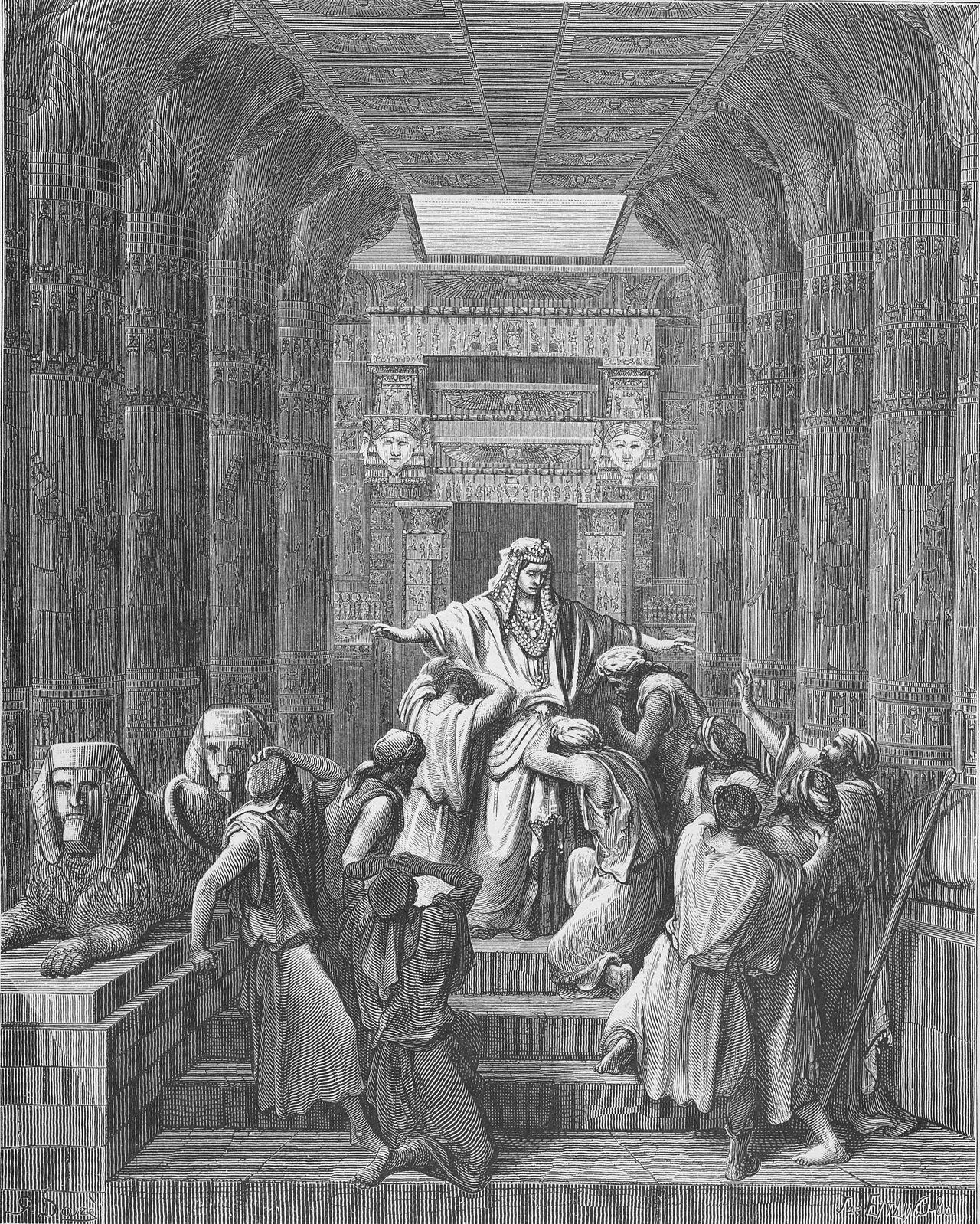
in Genesis 45Joseph said to his brothers, “I am Joseph! Is my father still alive?” But they were unable to answer him, because they were terrified in his presence.
BSB
The same verse in ASV and KJV ▾
ASV
And Joseph said unto his brethren, I am Joseph; doth my father yet live? And his brethren could not answer him; for they were troubled at his presence.
KJV
And Joseph said unto his brethren, I am Joseph; doth my father yet live? And his brethren could not answer him; for they were troubled at his presence.
⋯
This verse in Genesis 45
Commentary
12 notes on this verseAnd Joseph ordered all to withdraw so that he could be recognized by his brothers. For, even as Jesus said, he had not come except to the lost sheep that were the lost of the house of Israel. And lifting up his voice with weeping he said, "I am Joseph. Is my father still alive?" This means, Jesus stretched out his hands to an unbelieving and contradicting people, for he did not seek an envoy or messenger but, as their very Lord, desired to save his own people.
This site's exposition
I am Joseph! Is my father still alive?
on Genesis 45:3-4
His first question is about the old man at home, whether his father is still alive. The brothers were unable to answer, terrified in his presence. He calls them near and names the crime with the kinship, I am Joseph, your brother, the one you sold into Egypt. Ambrose of Milan read come near me as the voice of Christ calling a people who had refused him, and Acts 7:13 marks the timing, the second visit.
The record, by era
The Church Fathers1 voice
I cannot but be amazed here at this blessed man's remarkable fortitude in putting up with the strain of concealing his identity to this point and not letting on. And [I] am particularly surprised at the way they could stand there and gape without their soul parting company with their body, without their going out of their mind or hiding themselves in the ground. "His brothers were unable to say anything to him in reply. They were dumbfounded." No wonder! Aware of the way they had treated Joseph, of his position in comparison with theirs and realizing the high office he had attained, they feared for their very lives, so to say.
The Reformation1 voice
By this example we are taught to take heed lest sadness should overwhelm those who are truly and seriously humbled under a sense of shame. So long as the offender is deaf to reproofs, or securely flatters himself, or wickedly and obstinately repels admonitions, or excuses himself by hypocrisy, greater severity is to be used towards him.
The Puritans and the Awakening2 voices
I am Joseph - They knew him only by his Egyptian name, Zaphnath-paaneah, his Hebrew name being lost and forgot in Egypt; but now he teaches them to call him by that, I am Joseph: nay, that they might not suspect it was another of the same name, he explains himself.
And Joseph said unto his brethren, I am Joseph,....
The Nineteenth Century1 voice
A commentator
Jamieson, Fausset & Brown1802–1910
Commentary Critical and Explanatory on the Whole Bible (1871)
proposed
I am Joseph--or, "terrified at his presence." The emotions that now rose in his breast as well as that of his brethren--and chased each other in rapid succession--were many and violent. He was agitated by sympathy and joy; they were astonished, confounded, terrified; and betrayed their terror, by shrinking as far as they could from his presence.
5 more voices on this verse
The Nineteenth Century5 voices
JOSEPH is a very eminent type of Christ. When he was hated of his brothers because he protested against their sins, and when they sold him for twenty pieces of silver, he was doubtlessly a portrait of the despised and rejected of men whom His disciple betrayed. Afterwards in his temptations in the house of Potiphar, in the slander and consequent imprisonment in the round house of Pharaoh's prison, in his after advancement, till he became lord over all the land of Egypt, we clearly see our blessed Lord right well portrayed. Indeed, so well is the picture drawn, that there is scarcely a stroke even though it should seem to be a mere accidental incident of the picture which has not its symbolic meaning. You shall read the history of Joseph through twenty times and yet you shall not have exhausted the type. You shall begin again, and find still some fresh likeness between this despised son of Rachel and the Son of Mary who is also God over all, blessed forever. Amen. It is not, however, my business this morning to enter into a full description of Joseph as the type of Christ. I have a rather more practical object in hand. I shall endeavor, in the Lord's strength, to deal with tried and troubled consciences, and if it shall be my happy lot to be the means of cheering some sorrowing heart and opening some blind eye to see the personal beauties and the intense affection of the Lord Jesus, I shall be but too glad to have been God's messenger to your hearts. To tarry no longer, but to proceed at once to so good an errand, hopeful that God will help us to accomplish it, I shall direct your attention to the picture before us as being a representation of the way in which the Lord Jesus Christ deals with His erring Brethren, those whom His Father has given Him and whom He has purchased with His blood.
A commentator
Charles Spurgeon1834–1892
The Metropolitan Tabernacle Pulpit, Sermon No. 2516: “Jesus and His Brethren” (lightly modernized text, CCEL edition) · Written before 1892.
proposed
I NEED not say to you, Beloved, who are conversant with Scripture, that there is scarcely any personal type in the Old Testament which is more clearly and fully a portrait of our Lord Jesus Christ than is the type of Joseph. You may run the parallel between Joseph and Jesus in very many directions, yet you need never strain the narrative so even much as once. I am not about to attempt that task on the present occasion, but I am going to take this memorable portion of the biography of Joseph and show you how, in making himself known to his brethren, he was a type of our Lord revealing himself to us. It seems that, at last, Joseph could bear the suspense no longer. He knew who his brethren were, he knew which was Benjamin and which was Reuben, Simeon, Levi, Judah and the rest, and he remembered all the story of their early days together. But they did not know him. They thought him some mysterious potentate, some great ruler of the land of Egypt—as indeed he was—but they did not know so much about him as he knew about them. Consequently, there was a distance between him and them and his loving heart ached to bridge that gulf by manifesting himself to them. It is the way of love to desire to make itself known. Now, in a still higher sense, the Lord Jesus Christ knows all about those in this place whom He has redeemed with His precious blood. The Father gave them to Him from before the foundation of the world and He took them into Covenant relationship with Himself before the earth was. Often has He thought of these as His beloved ones. His delights have been with the sons of men and He has looked forward and foreseen all that would happen to them.
A commentator
Charles Spurgeon1834–1892
The Metropolitan Tabernacle Pulpit, Sermon No. 2516: “Jesus and His Brethren” (lightly modernized text, CCEL edition) · Written before 1892.
proposed
I NEED not say to you, Beloved, who are conversant with Scripture, that there is scarcely any personal type in the Old Testament which is more clearly and fully a portrait of our Lord Jesus Christ than is the type of Joseph. You may run the parallel between Joseph and Jesus in very many directions, yet you need never strain the narrative so even much as once.
JOSEPH is a very eminent type of Christ. When he was hated of his brothers because he protested against their sins, and when they sold him for twenty pieces of silver, he was doubtlessly a portrait of the despised and rejected of men whom His disciple betrayed. Afterwards in his temptations in the house of Potiphar, in the slander and consequent imprisonment in the round house of Pharaoh's prison, in his after advancement, till he became lord over all the land of Egypt, we clearly see our blessed Lord right well portrayed.
I am Joseph - Mr. Pope supposed that the discovery of Ulysses to his son Telemachus bears some resemblance to Joseph’s discovery of himself to his brethren. The passage may be seen in Homer, Odyss. l. xvi., ver. 186-218. A few lines from Cowper’s translation will show much of the spirit of the original, and also a considerable analogy between the two scenes: - “I am thy father, for whose sake thou lead’st A life of wo by violence oppress’d. So saying, he kiss’d his son; while from his cheeks Tears trickled, tears till then perforce restrain’d.
The words behind it
17 Hebrew wordsEvery Hebrew word of this verse in the order it stands, with what it means and the door to its own study. The last column counts the times a word stands in the whole Bible: the rarer the word, the more the places it appears belong together.
| Hebrew | Sound | Meaning | Word study | In the Bible |
|---|---|---|---|---|
| וַיֹּ֨אמֶר | vaiyomer | and he said | H559 → | 5305 times |
| יוֹסֵ֤ף | yosef | Joseph | H3130 → | 213 times |
| אֶל־ | ʾel- | to | H413 → | 5510 times |
| אֶחָיו֙ | ʾechav | brothers his | H251 → | 630 times |
| אֲנִ֣י | ʾani | I | H589 → | 874 times |
| יוֹסֵ֔ף | yosef | [am] Joseph | H3130 → | 213 times |
| הַע֥וֹד | haod | ¿ still | H5750 → | 490 times |
| אָבִ֖י | ʾavi | [is] father my | H1 → | 1212 times |
| חָ֑י | chai | living | H2416 → | 498 times |
| וְלֹֽא־ | velo'- | and not | H3808 → | 5168 times |
| יָכְל֤וּ | yakhelu | they were able | H3201 → | 194 times |
| אֶחָיו֙ | ʾechav | brothers his | H251 → | 630 times |
| לַעֲנ֣וֹת | laanot | to answer | H6030 → | 331 times |
| אֹת֔וֹ | ʾoto | <obj.> him | H853 → | 10935 times |
| כִּ֥י | ki | for | H3588 → | 4482 times |
| נִבְהֲל֖וּ | nivhalu | they were terrified | H926 → | |
| מִפָּנָֽיו׃ | mipanav | of <before> him | H6440 → | 2123 times |
וַיֹּ֨אמֶרand he said
vaiyomerH559 →5305 times
יוֹסֵ֤ףJoseph
yosefH3130 →213 times
אֶל־to
ʾel-H413 →5510 times
אֶחָיו֙brothers his
ʾechavH251 →630 times
אֲנִ֣יI
ʾaniH589 →874 times
יוֹסֵ֔ף[am] Joseph
yosefH3130 →213 times
הַע֥וֹד¿ still
haodH5750 →490 times
אָבִ֖י[is] father my
ʾaviH1 →1212 times
חָ֑יliving
chaiH2416 →498 times
וְלֹֽא־and not
velo'-H3808 →5168 times
יָכְל֤וּthey were able
yakheluH3201 →194 times
אֶחָיו֙brothers his
ʾechavH251 →630 times
לַעֲנ֣וֹתto answer
laanotH6030 →331 times
אֹת֔וֹ<obj.> him
ʾotoH853 →10935 times
כִּ֥יfor
kiH3588 →4482 times
נִבְהֲל֖וּthey were terrified
nivhaluH926 →
מִפָּנָֽיו׃of <before> him
mipanavH6440 →2123 times
A shaded row is a word that stands 400 times or fewer in the Bible.
The walk
8 stopsEach card is a verse this one points to, and under it the verses that one points to in turn. Where several paths arrive at the same place, that place is listed first: the text keeps returning to it.
Through
Zechariah 12:10Then I will pour out on the house of David and on the people of Jerusalem a spirit of grace and prayer, and they will look on Me, the One they have pierced. They…
it leads to
- Revelation 1:7
Behold, He is coming with the clouds, and every eye will see Him—even those who pierced Him. And all the tribes of the earth will mourn because of Him. So shall it be! Amen.
- Ezekiel 39:29
And I will no longer hide My face from them, for I will pour out My Spirit on the house of Israel, declares the Lord GOD.”
- John 19:34–37
Instead, one of the soldiers pierced His side with a spear, and immediately blood and water flowed out.
- Joel 2:28–29
And afterward, I will pour out My Spirit on all people. Your sons and daughters will prophesy, your old men will dream dreams, your young men will see visions.
- Jeremiah 6:26
O daughter of my people, dress yourselves in sackcloth and roll in ashes. Mourn with bitter wailing, as you would for an only son, for suddenly the destroyer will come upon us.
- Revelation 1:7
Through
Luke 5:8When Simon Peter saw this, he fell at Jesus’ knees. “Go away from me, Lord,” he said, “for I am a sinful man.”
it leads to
- Isaiah 6:5
Then I said: “Woe is me, for I am ruined, because I am a man of unclean lips dwelling among a people of unclean lips; for my eyes have seen the King, the LORD…
- Isaiah 6:5
Through
Mark 6:50for they all saw Him and were terrified. But Jesus spoke up at once: “Take courage! It is I. Do not be afraid.”
it leads to
- Matthew 14:27
But Jesus spoke up at once: “Take courage! It is I. Do not be afraid.”
- Isaiah 43:2
When you pass through the waters, I will be with you; and when you go through the rivers, they will not overwhelm you. When you walk through the fire, you will not be scorched;…
- Matthew 14:27
About Genesis
Who and where
1 name in this verse with a page on the site.
This page draws on 11 works. Open the list of works
This page draws on Adam Clarke, Commentary on the Bible; Ambrose of Milan, ON JOSEPH 12.67; Ambrose of Milan, On Joseph; Charles Spurgeon, The Metropolitan Tabernacle Pulpit, Sermon No. 449: “Joseph And His Brothers” (lightly modernized text, CCEL edition); Charles Spurgeon, The Metropolitan Tabernacle Pulpit, Sermon No. 2516: “Jesus and His Brethren” (lightly modernized text, CCEL edition); Jamieson, Fausset & Brown, Commentary Critical and Explanatory on the Whole Bible; John Calvin, Commentaries; John Chrysostom, HOMILIES ON GENESIS 64.27; John Gill, Exposition of the Old Testament (1748-1763); John Wesley, Explanatory Notes upon the Old Testament and Matthew Henry, Commentary on the Whole Bible.