
Subject
Courage
Standing when it costs something: from the shepherd boy to the martyrs.
Part of Character
On this page, 8 sections
The one drawing
Across the canon
Old Testament
New Testament
The other 53 books of the canon carry none.
12 passages
Where Scripture speaks
The passages this subject stands on, in canon order.
Be strong and courageous; do not be afraid or terrified of them, for it is the LORD your God who goes with you; He will never leave you nor forsake you.”Have I not commanded you to be strong and courageous? Do not be afraid; do not be discouraged, for the LORD your God is with you wherever you go.”But David said to the Philistine, “You come against me with sword and spear and javelin, but I come against you in the name of the LORD of Hosts, the God of the armies of Israel, whom you have defied.Wait patiently for the LORD; be strong and courageous. Wait patiently for the LORD!When I am afraid, I put my trust in You.“Go and assemble all the Jews who can be found in Susa, and fast for me. Do not eat or drink for three days, night or day, and I and my maidens will fast as you do. After that, I will go to the king, even though it is against the law. And if I perish, I perish!”If the God whom we serve exists, then He is able to deliver us from the blazing fiery furnace and from your hand, O king.But even if He does not, let it be known to you, O king, that we will not serve your gods or worship the golden statue you have set up.”But Jesus spoke up at once: “Take courage! It is I. Do not be afraid.”I have told you these things so that in Me you may have peace. In the world you will have tribulation. But take courage; I have overcome the world!”When they saw the boldness of Peter and John and realized that they were unschooled, ordinary men, they marveled and took note that these men had been with Jesus.The following night the Lord stood near Paul and said, “Take courage! As you have testified about Me in Jerusalem, so also you must testify in Rome.”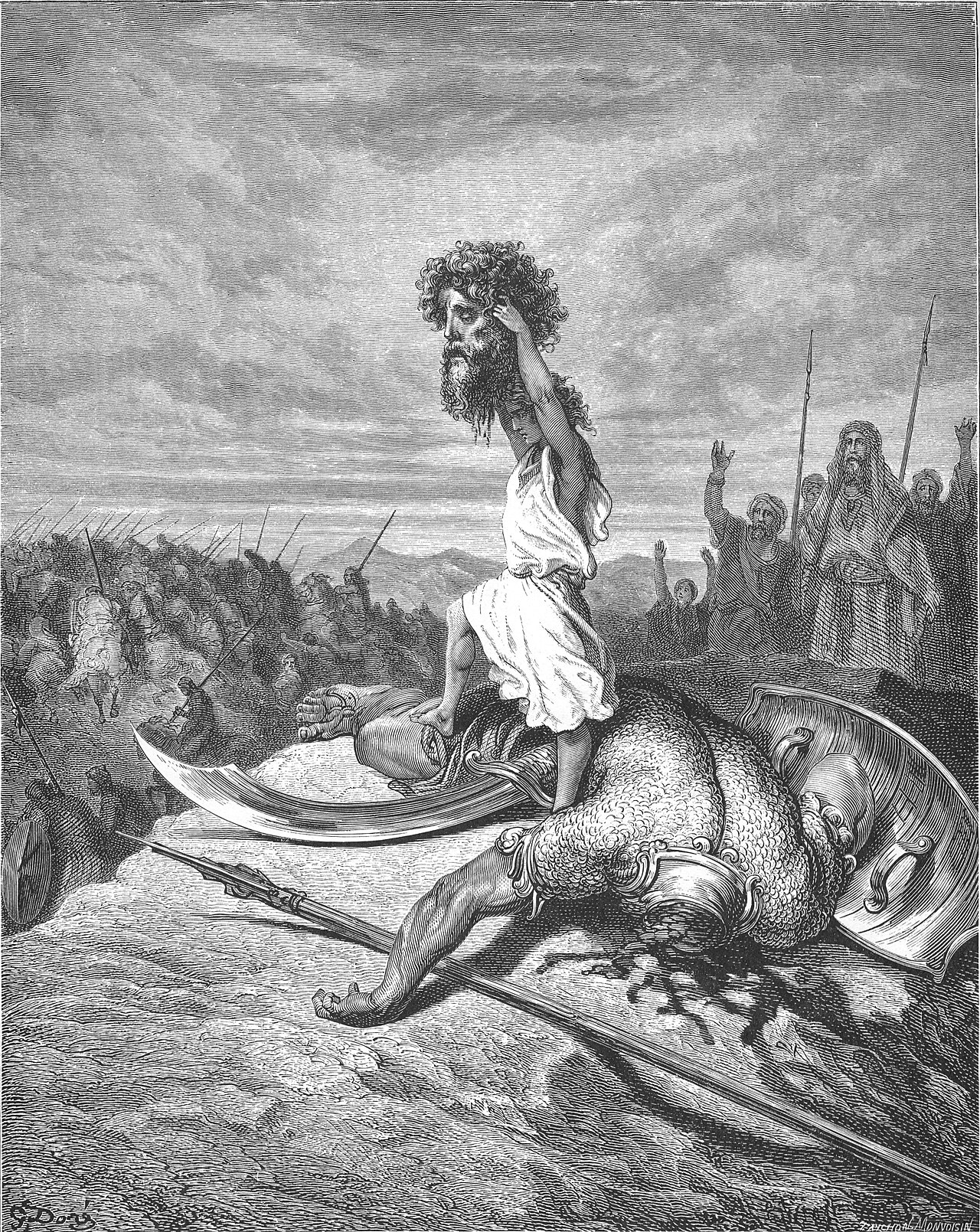
Courage in Scripture, in full
Courage in the Bible is never the absence of fear; it is a command given precisely where fear is. The Hebrew pairing is chazaq ve'ematz, "be strong and courageous": chazaq, to be strong, to take firm hold; amats, to be bold and resolute. Moses says it to all Israel on the edge of the land ("do not be afraid or terrified of them, for it is the LORD your God who goes with you"
(Deut 31:6)) and when Joshua takes command, God Himself repeats it three times in nine verses (Josh 1:6, 7, 9), grounding it the same way every time: "for the LORD your God is with you wherever you go." The command never asks the fearful to feel differently. It asks them to move, because of who is present.
The Psalms supply the inner mechanics. "Wait patiently for the LORD; be strong and courageous" (Psa 27:14) uses the very same word-pair: courage as a discipline of waiting, addressed by the psalmist to his own soul. And Psalm 56:3 may be the most honest sentence about courage in Scripture: "When I am afraid, I put my trust in You." Fear and trust are not opposites in David's grammar; fear is the raw material trust works on. The Bible's brave people are not the unafraid, but the afraid who moved anyway.
The furnace and the palace show courage's full logic. Under a death sentence, Daniel's three friends confess that God "is able to deliver us", and then add the bravest clause in the Old Testament: "But even if He does not" (Dan 3:17–18), they will not bow. Esther walks into the throne room uninvited on the same terms: "And if I perish, I perish!" (Est 4:16). Biblical courage is not confidence about the outcome; it is obedience with the outcome surrendered.
In the New Testament the word is tharseō ("take courage," "take heart") and its distribution is the teaching: of its seven occurrences, six are spoken by Jesus Himself, and the seventh is a crowd relaying His summons ("Take courage! He is calling you," Mark 10:49). He says it to a paralyzed man being forgiven, to a bleeding woman touching His robe, to twelve terrified sailors: "Take courage! It is I. Do not be afraid."
(Matt 14:27), and, on the last night, to every disciple since: "In the world you will have tribulation. But take courage; I have overcome the world!" (John 16:33). When Paul sits in Roman custody, the risen Lord stands beside him at night and uses the same word (Acts 23:11). In the New Testament, "take courage" is less a call to summon something within than an announcement of Someone present.
After Pentecost the church's courage acquires its own word: parrēsia: boldness, open speech under pressure. The council "saw the boldness of Peter and John and realized that they were unschooled, ordinary men… and took note that these men had been with Jesus" (Acts 4:13). That is the Bible's final anatomy of courage: not temperament, but company. It belongs on the list of ordinary Christian virtues: "Be on the alert. Stand firm in the faith. Be men of courage. Be strong." (1 Cor 16:13), and it carries the longest horizon of any of them: "Be faithful even unto death, and I will give you the crown of life" (Rev 2:10).
4 voices
What teachers have said
Those that have grace have need to be called upon again and again to exercise grace and to improve in it.
Matthew Henry · Commentary on the Whole Bible, 1710
Be strong therefore, and play the man to the uttermost. Though God had promised him that no man should be able to stand before him, yet it was on condition that he should use all his military skill, and avail himself to the uttermost of all the means, natural and providential, which God should place within his reach.
Adam Clarke · Commentary on the Bible
Written before 1832.
And how should Christ, who said to Abraham, "Fear not, for I am with you," and encouraged Moses against Pharaoh and said to the son of Nun, "Be strong and of a good courage," himself be terrified before Herod and Pilate?
Athanasius of Alexandria · Discourses Against the Arians 3.29.54
Written before 373.
And whereas being beaten at Philippos, [Philippi,] and scarce escaping out of great danger, he preached Christ at Thessalonica, it appeareth thereby how courageous he was to keep the course of his calling, and how bold he was ever now and then to enter into new dangers.
John Calvin · Commentaries, 1554
Where it leads
Everything the site holds on courage
On this page
The words underneath
Each card is one Hebrew or Greek word behind courage. It gives the sense, the count across the canon, and the number in Strong's 1890 concordance.
gibbor: mighty man
Hebrew · H1368Strong's entry: powerful; by implication, warrior, tyrant
the word behind "mighty man"
158 times in the Old Testament · gibbor, in full →
chazaq: to strengthen: strengthen
Hebrew · H2388Strong's entry: to fasten upon; hence, to seize, be strong (figuratively, courageous, causatively strengthen, cure, help, repair, fortify), obstinate; to bind, restrain, conquer
the verb behind every call to courage
291 times in the Old Testament · chazaq, in full →
oz: strength
Hebrew · H5797Strong's entry: strength in various applications (force, security, majesty, praise)
the courage that carries into battle
92 times in the Old Testament · oz, in full →
chayil: Helech
Hebrew · H2428Strong's entry: probably a force, whether of men, means or other resources; an army, wealth, virtue, valor, strength
a "mighty man of valour"
246 times in the Old Testament · chayil, in full →
7 verses
The complete list
This subject carries 19 curated verses. 12 of them are quoted above, and the other 7 stand here, book by book. Open a book to read the references with a clause of each verse.
1 Corinthians1
Joshua2
1 Chronicles1
Character
The subjects beside it
On this page
Subjects28