
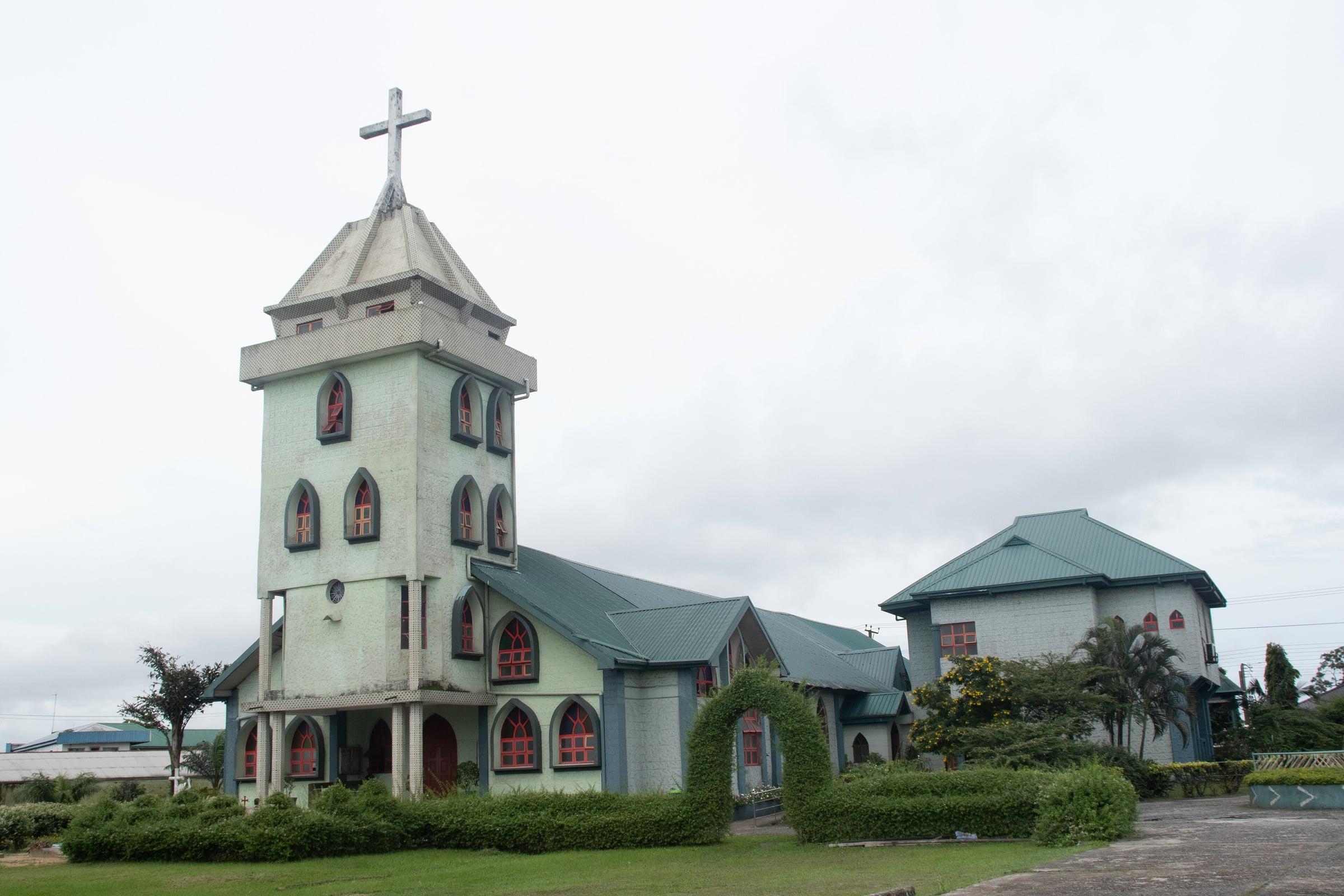
St. Stephens Anglican church, Bonny kingdom, Umasoyee, 2022. CC BY-SA 4.0.
Bakana and Bonny in the Niger Delta, 1915 to 1918 · Story · Featured Study
Garrick Braide, 1915
A man of Bakana was welcomed by his bishop, condemned by him, and jailed by the British.
- Where
- Bakana, Bonny, the Niger Delta
- Who
- Garrick Sokari Braide, James Johnson, Bishop Lasbrey
- When
- 1915 to 1918 (probable)
Bishop James Johnson told his board in 1916 he had heard that very many people of the interior “would not buy any class of gin” in the markets.
Behold, I will send you Elijah the prophet before the coming of the great and awesome Day of the LORD.
Summary
Garrick Sokari Braide of Bakana in the Niger Delta led a movement of prayer and healing from about 1915. He was in prison by July 1916 and dead by the end of 1918.
- The witnesses differ on who first gave him the title Elijah the Second.
- They give different charges for his prison term, and its length is unknown.
- By the mission's report, most of the Anglican congregation at Bonny left for him.
- N. Brockman says his disciples founded the Christ Army Church while he was in prison.
The Text of the Title
Bishop Johnson's address, as the mission printed it, names Malachi 4:5, and no witness names a text he preached.
No witness of his time sets these three verses beside his story, and they are comparisons only.
And if you are willing to accept it, he is the Elijah who was to come.
Jesus spoke this of John the Baptist, and it is the first thing a reader must weigh against a second Elijah.
Answer me, O LORD! Answer me, so that this people will know that You, the LORD, are God, and that You have turned their hearts back again.”
Brockman alone says Braide bested traditional priests in a rainmaking contest by calling on God, and this prayer on Carmel is the nearest comparison.
Is any one of you sick? He should call the elders of the church to pray over him and anoint him with oil in the name of the Lord.
The witnesses describe healing by prayer, and this verse is the one that commands prayer for the sick.
James 5:14BSB
1 Kings 18:37, James 5:14
What He Was Charged With
The one charge named in print at the time is false pretences, and no charge sheet has been found.
Each later witness names a different charge.
| Year | Witness | The charge |
|---|---|---|
| 1917 | The Church Missionary Society's Proceedings, and The Times of 1916 as The International Review of Missions reports it | Obtaining money under false pretences |
| 1928 | Bishop Lasbrey of the Niger, in Gollock | Creating a riot |
| 1994 | N. Brockman | Sedition |
| 2020 | C. C. Ekebuisi | Disturbing the peace, on what he calls trumped up charges |
From Bakana to Bonny
The witnesses tell of healing, the destruction of idols and the people who left for him.
N. Brockman puts his birth in 1882 and H. W. Turner in 1880. G. A. Gollock, summarizing Bishop Johnson's statement, describes a young African of Bakana in the New Calabar district. He was humble and quiet, and unable to read or write.
Ekebuisi has him baptized with his wife and first daughter in 1910 and confirmed by Bishop James Johnson in 1912. Brockman calls him an Anglican catechist.
The start differs because the witnesses date different things. Brockman has people coming to him for cures and prophecies from 1908. Ekebuisi has a revival movement from 1914, and Turner a revival with mass baptisms in 1915.
Gollock writes that sick and whole people prayed in the court of his compound. They prayed from ten to seventeen times a day for two or three weeks. A Norwegian survey of 1924 reads the figure as hours.
Gollock says chiefs brought out their ancestral idols and destroyed them. The Times of London, which was hostile, called it a holocaust of juju articles that took valuable ivory with it.
The International Review of Missions of 1917, following Bishop Johnson, calls him a young Christian worker of promise. It says he was much used in healing the sick by prayer. Gollock, again from Johnson, says he also taught that medical aid was sinful. The Missionary Review of the World, from the same bishop, reports that confession was required before healing.
What was reported against him2 paragraphs
Gollock says the water he washed in came to be treated as sacramental. The Times claimed that he sold it as a cure and claimed to raise the dead.
Gollock reports a man he had healed and warned off strong liquor, who drank and died. She reports more than a hundred of his preachers sent to prison for several weeks for trespass and extortion.
The Church Missionary Society's Proceedings, reporting a loss to its own communion, gives the congregation at St Stephen's Cathedral Church, Bonny. It says that three-fourths of them yielded to his influence. A herald ringing a bicycle bell went before him on the march, Gollock says.
Brockman says the fall in drinking cost the government its excise on alcohol. He says it listed the decline in revenue among its charges, and no figure of the lost revenue has been found.
The Bishop and the Prophet
James Johnson's objection was to his doctrine, and his appeal was to the colonial government.
Gollock says that at first Braide worked with his pastor's guidance and encouragement. Brockman says Johnson kept up his support while the converts gave up their idols. Johnson told his board that “the requisite prominence is not given to the gospel of redemption through the atoning death of Christ.”
Brockman writes that Johnson proscribed the movement for heresy and asked the British colonial authorities to investigate.
Johnson himself called it an “upheaval in the Niger Delta Church,” the Proceedings of 1917 reports. Turner says that it led to Anglican indigenizing reforms.
Turner writes that fear of unrest led twice to his imprisonment. The Proceedings adds that his influence somewhat waned after prison.
The church that followed2 paragraphs
Brockman says the Christ Army Church was founded by his disciples. Ekebuisi says that Braide took no interest in organising his converts into a church.
Lasbrey wrote that his followers split into two bodies, the Prophet Movement and Christ's Army.
How the Key Verse Was Taught
Three writers, from the third century to the nineteenth, read the Elijah of Malachi against the Gospels.
Origen of Alexandria (died 253)
COMMENTARY ON THE GOSPEL OF JOHN 6:62
Origen asked how John could deny that he was Elijah while Jesus called him so.
“Who of those who hear Jesus say of John, ‘If you wish to receive it, he is Elijah who is to come,’ would not inquire how John says to those who ask, ‘Are you Elijah?’ ‘I am not’? Will he not also inquire how one ought to consider John himself to be Elijah who is to come, according to Malachi's statement: … ‘And behold, I am sending you Elijah the Tishbite before the great and renewed Day of the Lord comes, who will restore the heart of the father to his son and the heart of a man to his neighbor, lest I come and smite the earth utterly’?”
on Malachi 4:5Patristic
John Wesley (1703 to 1791)
Explanatory Notes upon the Old Testament, on Malachi 4:5
Wesley held that the name Elijah passes to John because John came with his spirit.
“Namely John the Baptist, who came in the spirit and power of Elijah, Luke i, 17, and therefore bears his name.”
Evangelical
Adam Clarke (1762 to 1832)
Commentary on the Bible, on Malachi 4:5
Clarke leaves no later Elijah still to come.
“This is meant alone of John the Baptist, as we learn from Luk 1:17 (note), in whose spirit and power he came.”
Methodist
In Their Own Words
No sermon or letter of Braide's has been found. One saying is attributed to him, and the rest belong to those who judged, defended or watched him.
Garrick Sokari Braide (died 1918)
Attributed by P. A. Talbot, lecture of 21 June 1916, in the African Mail, as quoted in C. C. Ekebuisi, The Life and Ministry of Prophet Garrick Sokari Braide, chapter 3 (2015)
As for this war
“As for this war, I could stop it at once, but let the White men suffer a bit. The power is now passing from them to the Blacks.”
Prophet of the Niger Delta
About this saying1 paragraph
Talbot spoke in 1916 for the Nigeria Political Service, the government that jailed Braide, and the words reach us only through his lecture.
The Times of Nigeria
As quoted in C. C. Ekebuisi, The Life and Ministry of Prophet Garrick Sokari Braide, chapter 3 (2015)
Bigotry and self-interest
“Our local readers will be able to judge for themselves whether there is any real ground for the hullabaloo which has been raised, see for themselves the lengths to which bigotry, self-interest and political intrigues can be carried”
West African newspaper
About this saying1 paragraph
The paper named church dignitaries, merchants and officials as the interested alarmists in 1916.
W. T. Groves
Report of 1916, as quoted in C. C. Ekebuisi, The Impact of Garrick Braide's Revival on the Growth of Methodism in Eastern Nigeria, Holiness 6:1 (2020)
Strange things
“beginning in this area and spreading through the various districts of the Ibo speaking people, strange things have been seen and heard. Recent happenings in such a short space of time that so vitally affected the lives of the people have never before been known.”
Primitive Methodist missionary in eastern Nigeria
About this saying1 paragraph
Groves wrote in 1916 of the Igbo districts, from the mission that gained their converts, and his words do not name Braide.
Bishop Lasbrey of the Niger
As quoted in G. A. Gollock, Sons of Africa, pages 199 to 203
Others felt he was a martyr
“The prophet, however, was taken up for creating a riot and was imprisoned. One day while doing some work he was struck by lightning and killed. Many of the people, feeling he had been led astray, believed that this was God's judgment upon him, and a number who had left the church returned to it. Others felt he was a martyr.”
Anglican bishop on the Niger
About this saying1 paragraph
Lasbrey's church had lost these people to Braide, and Gollock printed his account in 1928.
What the Witnesses Dispute
The title, the numbers, his death and his place in the prophet movements are each told in more than one way.
On the title, Johnson's address as the mission printed it says he called himself the prophet of Malachi. Gollock says people called him a prophet and he then announced himself the second Elijah. The Journal of African Christian Biography says he was popularly called Elijah II by his followers.
The early witnesses for his own claim are his bishop, the mission papers reading him and a hostile British press. No word of his own on it has been found.
On the numbers, the mission counted one congregation at Bonny. A Norwegian survey of 1924 says a million followers, and Brockman says more than a million. The African Mail, which wanted the movement crushed, refused to believe the millions in the daily papers. None of them names a counter.
On his death, Brockman says an accident in 1918, and Lasbrey's account names lightning at his work after his imprisonment and gives no year.
On his place, J. D. Y. Peel as Ekebuisi reports him calls Braide the earliest of the great West African prophets. He puts him ahead of Harris by about a year. Harris had left Cape Palmas in July 1913, by D. A. Shank, and none of the works cited here shows contact between the two movements.
The Christ Army Church's own memory of him is known here only from a catalogue entry. It records an address to the church by Tasie on 15 November 1972.
Books to Read Next
The Impact of Garrick Braide's Revival on the Growth of Methodism in Eastern Nigeria
C. C. Ekebuisi · 2020
Ekebuisi follows the revival into Igboland, with W. T. Groves's report.
Read Ekebuisi free at Reference GlobalSons of Africa
G. A. Gollock · 1928
Her pages on Braide close on Bishop Lasbrey's account of his end.
Read Gollock free at the Internet ArchiveProceedings of the Church Missionary Society, 1916 to 1917
The Church Missionary Society · 1917
The Proceedings gives the mission's report of the upheaval at Bonny and the charge.
Read the Proceedings free at the Internet ArchiveWhat Braide Left
Lasbrey, printed in 1928, still found many congregations in the Delta following his teaching.
Sources
Scripture is the Berean Standard Bible.
- The Holy Bible, Berean Standard Bible (read 2026)
- G. A. Gollock, Sons of Africa (New York: Friendship Press, 1928), pages 199 to 203, summarizing James Johnson's statement of 1916 and quoting Bishop Lasbrey.
- Proceedings of the Church Missionary Society for Africa and the East, 118th year, 1916 to 1917 (1917), pages 96 to 97.
- The International Review of Missions 6 (1917), the survey of 1916, citing Johnson, Tugwell, The Times of 19 July and The Bible in the World.
- An Elijah II. Movement in Nigeria, The Missionary Review of the World 39:11 (November 1916), quoting Johnson.
- The Inquirer (London, 1916), printing the Church Missionary Society's communication from Johnson's address.
- The Nigerian Prophet: Native Bishop's View of the Movement, Hong Kong Daily Press, 15 August 1916, printing the same communication.
- N. Brockman, An African Biographical Dictionary (1994), the entry on Braide.
- H. W. Turner, Biographical Dictionary of Christian Missions (1998), the entry on Braide.
- C. C. Ekebuisi, The Impact of Garrick Braide's Revival on the Growth of Methodism in Eastern Nigeria between 1910 and 1932, Holiness 6:1 (2020), pages 11 to 20.
- C. C. Ekebuisi, The Life and Ministry of Prophet Garrick Sokari Braide (Peter Lang, 2015), the publisher's open page of chapter 3, quoting The Times of 22 June 1916, the African Mail, P. A. Talbot and The Times of Nigeria.
- Kirke og Kultur 31:5-6 (1924), pages 253 to 254, in Norwegian, in translation.
- The University of Birmingham's catalogue, record XHT/B/42/263, G. O. M. Tasie's address at the Christ Army Church on 15 November 1972, the catalogue entry only.
- David A. Shank, The Legacy of William Wadé Harris, International Bulletin of Missionary Research 10:4 (1986)
- Journal of African Christian Biography 2:3 (2017)
Keep Studying
Studies1
People and groups5
Subjects1
Church history5
Trials of life1