
Matthew 17:3
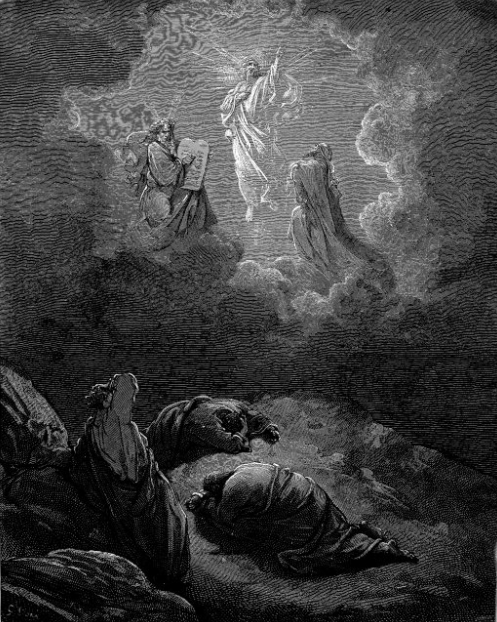
in Matthew 17Suddenly Moses and Elijah appeared before them, talking with Jesus.
BSB
The same verse in ASV and KJV ▾
ASV
And behold, there appeared unto them Moses and Elijah talking with him.
KJV
And, behold, there appeared unto them Moses and Elias talking with him.
⋯
This verse in Matthew 17
Commentary
17 notes on this verseIt is to be remembered also, that when the Scribes and Pharisees asked signs from heaven, He would not give any; but now, to increase the Apostles' faith, He gives a sign; Elias descends from heaven, whither he was gone up, and Moses arises from hell; (Is. 7:10.) as Ahaz is bidden by Esaias to ask him a sign in the heaven above, or in the depth beneath.
This site's exposition
Moses and Elias talking with him
Moses and Elijah stand together as the Law and the Prophets in living representation, and the older commentators add a further pairing, one who died and was buried by God's own hand in a grave no man knows, the other who never tasted death at all, so that both patterns of departure from this life stand present at once around the one who will conquer death itself. Their conversation, given by Luke as concerning his decease which he should accomplish at Jerusalem, ties the scene of glory directly to the road that leads to the cross. Their appearance also answers, in the disciples' own sight, the very question the previous chapter raised about who Jesus is beside Moses and the prophets.
The record, by era
The Church Fathers5 voices
However, if any man discerns a spiritual sense in the Law agreeing with the teaching of Jesus, and in the Prophets finds the hidden wisdom of Christ, (1 Cor. 2:7.) he beholds Moses and Elias in the same glory with Jesus.
Also that Moses and Elias only out of the whole number of the saints stood with Christ, means, that Christ, in His kingdom, is between the Law and the Prophets; for He shall judge Israel in the presence of the same by whom He was preached to them.
Now, not even to His apostles was His nature ever a matter of deception. He was truly both seen and heard upon the mount; true and real was the draught of that wine at the marriage of (Cana in) Galilee; true and real also was the touch of the then believing Thomas.
Since, therefore, He reserves to some future time His presence and speech face to face with Moses-a promise which was afterwards fulfilled in the retirement of the mount (of transfiguration), when as we read in the Gospel," Moses appeared talking with Jesus" -it is evident that in early times it was always in a glass, (as it were, )and an enigma, in vision and dream, that God, I mean the Son of God, appeared-to the prophets and the patriarchs, as also to Moses indeed himself.
A commentator
John ChrysostomHomily on the Gospel of Matthew 56 · Written in the 5th century.
proposed
Having taken therefore the leaders, "He bringeth them up into a high mountain apart, and was transfigured before them: and His face did shine as the sun, and His raiment was white as the light. And there appeared unto them Moses and Elias talking with Him." But wherefore doth He also bring forward Moses and Elias? One might mention many reasons. And first of all this: because the multitudes said He was, some Elias, some Jeremias, some one of the old prophets, He brings the leaders of His choir, that they might see the difference even hereby between the servants and the Lord; and that Peter was rightly commended for confessing Him Son of God. But besides that, one may mention another reason also: that because men were continually accusing Him of transgressing the law, and accounting Him to be a blasphemer, as appropriating to Himself a glory which belonged not to Him, even the Father's, and were saying, "This Man is not of God, because He keepeth not the Sabbath day;" and again, "For a good work we stone Thee not, but for blasphemy, and because that Thou, being a man, makest Thyself God:" that both the charges might be shown to spring from envy, and He be proved not liable to either; and that neither is His conduct a transgression of the law, nor His calling Himself equal to the Father an appropriation of glory not His own; He brings forward them who had shone out in each of these respects: Moses, because he gave the law, and the Jews might infer that he would not have overlooked its being trampled on, as they supposed, nor have shown respect to the transgressor of it, and the enemy of its founder: Elias too for his part was jealous for the glory of God, and were any man an adversary of God, and calling himself God, making himself equal to the Father, while he was not what he said, and had no right to do so; he was not the person to stand by, and hearken unto him. A […]
10 more voices on this verse
The Church Fathers1 voice
(Verse 3.) And behold, Moses and Elijah appeared to them, talking with him. When the scribes and Pharisees tested him, seeking signs from heaven, he did not want to give them, but refuted their wicked request with a prudent response. But in order to increase the faith of the apostles, he gives a sign from heaven, with Elijah descending from where he had ascended, and with Moses rising from the dead. This is also commanded to Ahaz through Isaiah, to ask for a sign from above or from below (Isaiah 7 and 2 Kings 2). For what was said: Moses and Elias appeared to them, speaking with him; and in another Gospel it is reported that he announced what he would suffer in Jerusalem (Luke IX): The law and the prophets are shown, who announced with frequent voices both the passion of the Lord and his resurrection.
The Medieval Church2 voices
And behold there appeared to them Moses and Elijah. And why did they appear? Chrysostom assigns the reasons. The first reason is to confirm the faith of the disciples. He had asked above: whom do men say that the Son of man is? etc. And …
And, behold, there appeared unto them Moses and Elijah talking with Him. What were they talking about? "The ending," says Luke, "which He should accomplish in Jerusalem" (Lk. 9:31), namely, the Cross. Why did Moses and Elijah appear? To show that He is Lord of …
The Puritans and the Awakening3 voices
And behold there appeared unto them,.... The disciples: Moses and Elias; Moses the giver of the law, and Elias one of the chief of the prophets: one of them had been dead near a thousand and five hundred years, and the other had been caught up to heaven, about nine hundred years before this. The Jews sometimes speak of these two as together.
There appeared Moses and Elijah - Here for the full confirmation of their faith in Jesus, Moses, the giver of the law, Elijah, the most zealous of all the prophets, and God speaking from heaven, all bore witness to him.
Note, Communion with Christ is the delight of Christians. All the disciples of the Lord Jesus reckon it is good for them to be with him in the holy mount. It is good to be here where Christ is, and whither he brings us along with him by his appointment; it is good to be here, retired and alone with Christ; to be here, where we may behold the beauty of the Lord Jesus, Ps. xxvii.
The Nineteenth Century4 voices
A commentator
Albert Barnes1798–1870
Notes, Explanatory and Practical, on the Old and New Testaments (1832-1869)
And behold there appeared unto them Moses and Elias - Moses, a distinguished servant of God, by whom the law was given, and whose institutions typified the Messiah. It was particularly proper that he should appear, when his prophecies and types were about to be fulfilled, and the rites which he had instituted were about to be done away. Elias, or Elijah, a distinguished prophet, taken to heaven without seeing death. See 2Ki 2:
These verses contain one of the most remarkable events in our Lord’s earthly ministry, the event commonly called the transfiguration. The order in which it is recorded is beautiful and instructive. The latter part of the last chapter showed us the cross; here we are graciously allowed to see something of the coming reward. The hearts which have just been saddened by a plain statement of Christ’s sufferings are at once gladdened by a vision of Christ’s glory. Let us mark this. We often lose much by not tracing the connection between chapter and chapter in the Word of God.
These verses contain one of the most remarkable events in our Lord’s earthly ministry, the event commonly called the transfiguration. The order in which it is recorded is beautiful and instructive. The latter part of the last chapter showed us the cross; here we are graciously allowed to see something of the coming reward. The hearts which have just been saddened by a plain statement of Christ’s sufferings are at once gladdened by a vision of Christ’s glory. Let us mark this. We often lose much by not tracing the connection between chapter and chapter in the Word of God. There are some mysterious things, no doubt, in the vision here described. It must needs be so. We are yet in the body. Our senses are conversant with gross and material things; our ideas and perceptions about glorified bodies and dead saints must necessarily be vague and imperfect. Let us content ourselves with endeavoring to mark out the practical lessons which the transfiguration is meant to teach us. In the first place we have in these verses a striking pattern of the glory in which Christ and his people will appear when he comes the second time. There can be little question that this was one main object of this wonderful vision. It was meant to encourage the disciples by giving them a glimpse of good things yet to come. That face “shining as the sun” and that raiment “white as the light” were intended to give the disciples some idea of the majesty in which Jesus will appear to the world when he comes the second time, and all his saints with him. The corner of the veil was lifted up to show them their Master’s true dignity. They were taught that if he did not yet appear to the world in the guise of a King, it was only because the time for putting on his royal apparel was not yet come. It is impossible to draw any other conclusion from St. Peter’s language when writing on the subject.
Moses and Elias - Elijah came from heaven in the same body which he had upon earth, for he was translated, and did not see death, 2Ki 2:11. And the body of Moses was probably raised again, as a pledge of the resurrection; and as Christ is to come to judge the quick and the dead, for we shall not all die, but all shall be changed, 1Co 15:51, he probably gave the full representation of this in the person of Moses, who died, and was thus raised to life, (or appeared now as he shall appear when raised from the dead in the last day), and in the person of Elijah, who never tasted death. Both their bodies exhibit the same appearance, to show that the bodies of glorified saints are the same, whether the person had been translated, or whether he had died. It was a constant and prevalent tradition among the Jews, that both Moses and Elijah should appear in the times of the Messiah, and to this very tradition the disciples refer, Mat 17:10. We may conceive that the law in the person of Moses, the great Jewish legislator, and the prophets in the person of Elijah, the chief of the prophets, came now to do homage to Jesus Christ, and to render up their authority into his hands; as he was the End of the law, and the grand subject of the predictions of the prophets. This appears more particularly from what St. Luke says, Luk 9:31, that Moses and Elijah conversed with our Lord on his death, which he was about to accomplish, (πληρουν to fulfill), because in it, all the rites, ceremonies, and sacrifices of the law, as well as the predictions of the prophets, were fulfilled.
The words behind it
10 Greek wordsEvery Greek word of this verse in the order it stands, with what it means and the door to its own study. The last column counts the times a word stands in the whole Bible: the rarer the word, the more the places it appears belong together.
| Greek | Sound | Meaning | Word study | In the Bible |
|---|---|---|---|---|
| καὶ | kai | And | G2532 → | 9120 times |
| ἰδοὺ | idou | behold | G2400 → | 200 times |
| ὤφθη | ophthe | it appeared | G3700 → | 54 times |
| αὐτοῖς | autois | to them | G846 → | 5565 times |
| Μωϋσῆς | mouses | Moses | G3475 → | 78 times |
| καὶ | kai | and | G2532 → | 9120 times |
| Ἠλίας | elias | Elijah | G2243 → | 29 times |
| συλλαλοῦντες | sullalountes | talking | G4814 → | |
| μετ᾽ | met᾽ | with | G3326 → | 461 times |
| αὐτοῦ.¶ | autou | Him. | G846 → | 5565 times |
καὶAnd
kaiG2532 →9120 times
ἰδοὺbehold
idouG2400 →200 times
ὤφθηit appeared
ophtheG3700 →54 times
αὐτοῖςto them
autoisG846 →5565 times
ΜωϋσῆςMoses
mousesG3475 →78 times
καὶand
kaiG2532 →9120 times
ἨλίαςElijah
eliasG2243 →29 times
συλλαλοῦντεςtalking
sullalountesG4814 →
μετ᾽with
met᾽G3326 →461 times
αὐτοῦ.¶Him.
autouG846 →5565 times
A shaded row is a word that stands 400 times or fewer in the Bible.
The walk
8 stopsEach card is a verse this one points to, and under it the verses that one points to in turn. Where several paths arrive at the same place, that place is listed first: the text keeps returning to it.
Through
Luke 24:44Jesus said to them, “These are the words I spoke to you while I was still with you: Everything must be fulfilled that is written about Me in the Law of Moses, the Prophets,…
it leads to
- Zechariah 12:10
Then I will pour out on the house of David and on the people of Jerusalem a spirit of grace and prayer, and they will look on Me, the One they have pierced. They…
- Luke 24:26–27
Was it not necessary for the Christ to suffer these things and then to enter His glory?”
- Zechariah 9:9
Rejoice greatly, O Daughter of Zion! Shout in triumph, O Daughter of Jerusalem! See, your King comes to you, righteous and victorious, humble and riding on a donkey, on a colt, the foal of…
- Psalms 110:1–7
The LORD said to my Lord: “Sit at My right hand until I make Your enemies a footstool for Your feet.”
- Acts 13:33
He has fulfilled for us, their children, by raising up Jesus. As it is written in the second Psalm: ‘You are My Son; today I have become Your Father.’
- Zechariah 12:10
Through
Malachi 4:5Behold, I will send you Elijah the prophet before the coming of the great and awesome Day of the LORD.
it leads to
- Luke 1:17
And he will go on before the Lord in the spirit and power of Elijah, to turn the hearts of the fathers to their children and the disobedient to the wisdom of the righteous—to…
- Matthew 17:10–13
The disciples asked Him, “Why then do the scribes say that Elijah must come first?”
- Mark 9:11–13
And they asked Jesus, “Why do the scribes say that Elijah must come first?”
- Luke 1:17
Where this verse is studied
About Matthew
Who and where
2 names in this verse with a page on the site.
This page draws on 16 works. Open the list of works
This page draws on Adam Clarke, Commentary on the Bible; Albert Barnes, Notes, Explanatory and Practical, on the Old and New Testaments (1832-1869); Hilary of Poitiers, Catena Aurea by Aquinas; J.C. Ryle, Expository Thoughts on the Gospels: Matthew; Jamieson, Fausset & Brown, Commentary Critical and Explanatory on the Whole Bible; Jerome, Catena Aurea by Aquinas; Jerome, Commentary on Matthew; John Chrysostom, Homily on the Gospel of Matthew 56; John Gill, Exposition of the New Testament (1746-1748); John Wesley, Explanatory Notes upon the New Testament; Matthew Henry, Commentary on the Whole Bible; Origen of Alexandria, Catena Aurea by Aquinas; Tertullian, A Treatise on the Soul; Tertullian, Against Praxeas; Theophylact of Ohrid, Commentary on Matthew and Thomas Aquinas, Commentary on Matthew.