
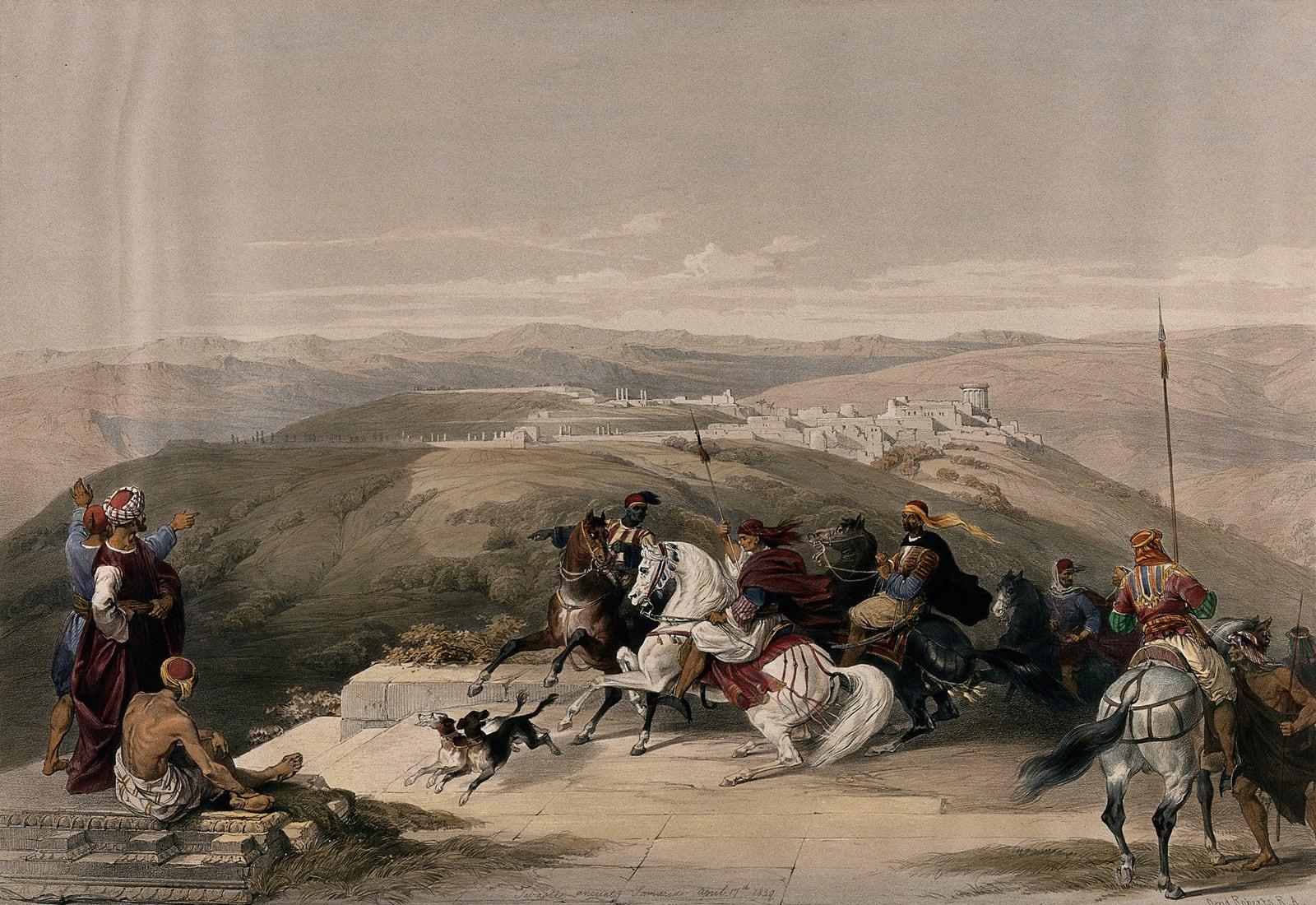
Louis Haghe after David Roberts, Sebaste, Ancient Samaria, 1842. CC BY 4.0.
1 Kings 16:24 · Place · Featured Study
Samaria
Samaria was the royal city of the kings of Israel, and later its name passed to the land around it.
He bought the hill of Samaria from Shemer for two talents of silver and built a city there, calling it Samaria after the name of Shemer, who had owned the hill.
- Today
- Sebustieh
- Region
- Samaria stands in the hill country of Ephraim.
- First named
- 1 Kings 13:32 “…places in the cities of Samaria will surely…”
- Last named
- Acts 15:3 “…they passed through Phoenicia and Samaria, recounting the…”
Amos called the women of Mount Samaria cows of Bashan.
Summary
Samaria first appears in a prophecy against the shrines in its towns (1 Kings 13:32).
- Micah names Samaria as the sin of Jacob (Micah 1:5).
- Ahab had seventy sons in Samaria (2 Kings 10:1).
- Paul and Barnabas passed through Samaria and told of new believers (Acts 15:3).
The Hill of Shemer
Omri bought a hill for two talents of silver and named the city after its owner.
This study asks why Israel's kings ruled from Samaria and what the prophets said of the city. It maps the capitals of the north and follows Samaria through Kings and the prophets. It then weighs which city Philip preached in.
Easton's Bible Dictionary (1897) describes the hill as standing alone, a few miles north-west of Shechem. It is oblong, with steep sides and a long flat top.
The study of Omri tells his reign. The study of the Fall of Samaria tells the Assyrian siege.
The Capitals of Israel on the Map
Four places in the hills of Ephraim and the valley of Jezreel tie Samaria to Israel's throne.
The kings of Israel ruled first from Shechem, then from Tirzah and then from Samaria, and Ahab kept a palace at Jezreel.
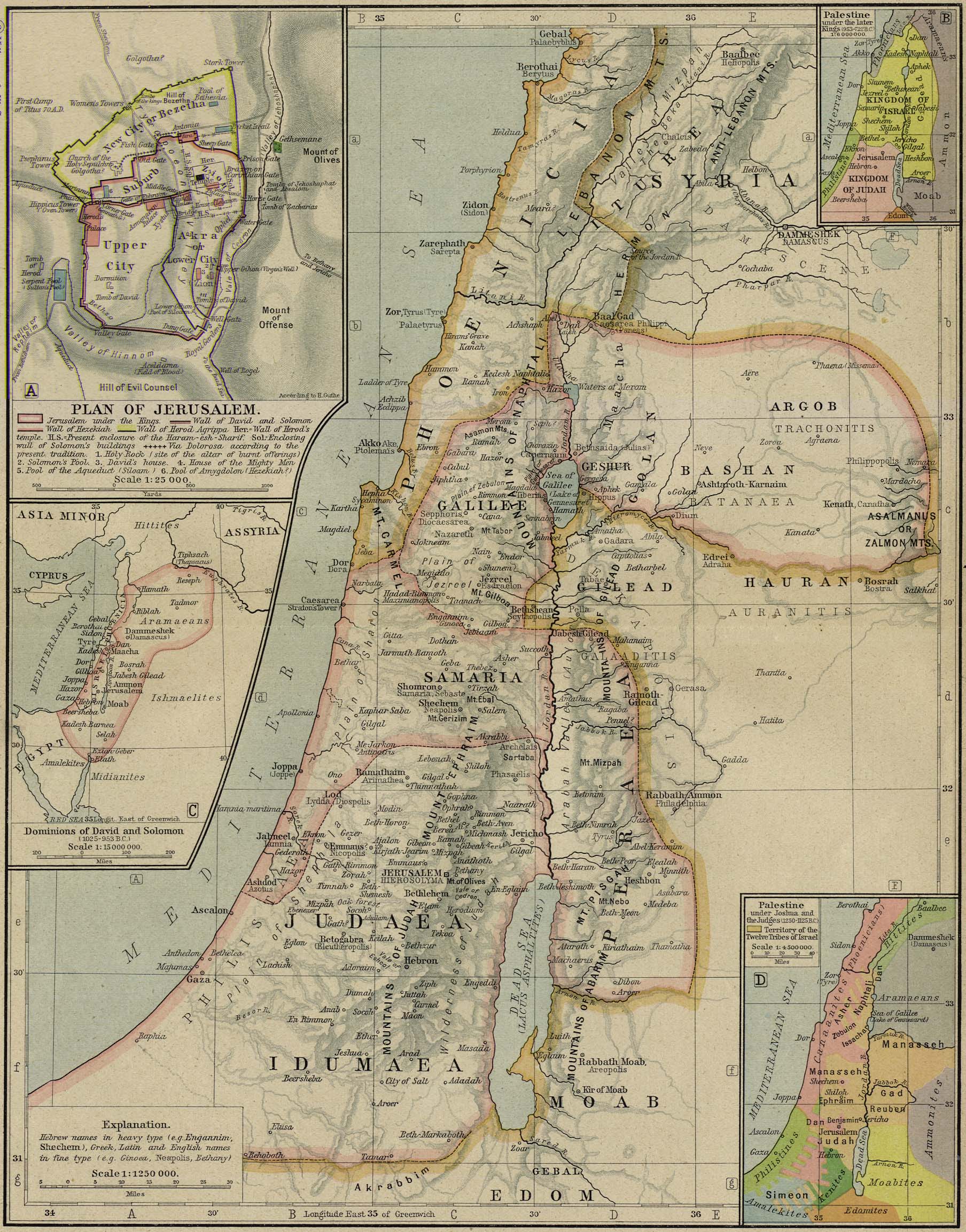
- Located: the site is known
- Identified: the point stands for an area, or is rounded
- The route, in the order the text gives
- 1Shechem, Jeroboam built Shechem in the hill country of Ephraim and lived there. 1 Kings 12:25
- 2Tirzah, Jeroboam's wife went home to Tirzah, and the boy died as she crossed the threshold of the house. 1 Kings 14:17
- 3Samaria, Ahab died in battle and was brought to Samaria for burial. 1 Kings 22:37
- 4Jezreel, Naboth's vineyard lay next to the palace of Ahab king of Samaria. 1 Kings 21:1
Base map: Reference map of ancient Palestine, Rand McNally reference map (1926), public domain. Places with a place page stand at its coordinates and the others at the point cited for each, set on the plate by Jerusalem and Damascus, as the plate prints them.
Four places, each with its verse. The line joins the three capitals in the order the kings ruled from them; Jezreel stands off the line. OpenBible scores Tell el Farah 834 of 1,000 for Tirzah.
Samaria in Scripture, in Order
Kings records the city's idols and its famines, and the prophets speak to the people on the hill.
Four of the eight moments concern the city's idols, and two are famines.
- The reign of AhabAhab sets up an altar for Baal in the temple of Baal he built in Samaria1 Kings 16:32
- The drought of ElijahElijah goes to meet Ahab while the famine is severe in Samaria1 Kings 18:2
- The death of AhabAhab's chariot is washed at the pool of Samaria, and the dogs lick his blood1 Kings 22:38
- The siege in Elisha's dayA donkey's head sells for eighty shekels of silver in the starving city2 Kings 6:25
- The end of Baal's templeJehu's men tear down the temple of Baal and make it a latrine2 Kings 10:27
- The reign of JehoahazThe Asherah pole still stands in Samaria2 Kings 13:6
- The word of HoseaThe calf of Samaria will be broken to piecesHosea 8:6
- The word of AmosWoe to those secure on Mount SamariaAmos 6:1
Eight moments from 1 Kings to Amos in the order of the canon, each with its verse.
The word of Hosea, The word of Amos
The study of Elijah tells the prophet who stood against Ahab. The study of Syria tells the sieges the Arameans laid against the city.
The Ivory Palace and Sebaste
Kings, Amos and Josephus record the city's great houses from Ahab to Herod.
As for the rest of the acts of Ahab, along with all his accomplishments and the ivory palace and all the cities he built, are they not written in the Book of the Chronicles of the Kings of Israel?Kings points the reader to the royal chronicles for the rest of Ahab's building.
I will tear down the winter house along with the summer house; the houses of ivory will also perish, and the great houses will come to an end,” declares the LORD.Amos turns the luxury of the capital into the ground of its judgment.
Barnes, on Amos 3:15, cites Jerome for the two kinds of houses. The winter house faced south and the summer house north, to suit the seasons.
Josephus, in Antiquities 13.10.2, records that John Hyrcanus besieged Samaria. In Antiquities 15.8.5 he records that Herod the Great fortified the city and called it Sebaste. Herod settled there many who had fought for him.
What the Text Leaves Unsaid
Kings tells nothing of Shemer beyond the sale of his hill.
Shemer appears in Kings only as the man who owned the hill. Strong's dictionary lists three Israelites of the name, and the other two stand in the lists of Chronicles.
A Heap in the Field
Micah and Isaiah picture the proud city brought down to the ground it stood on.
Therefore I will make Samaria a heap of rubble in the open field, a planting area for a vineyard. I will pour her stones into the valley and expose her foundations.Micah's sentence on the capital answers the sins of the whole kingdom.
Woe to the majestic crown of Ephraim’s drunkards, to the fading flower of his glorious splendor, set on the summit above the fertile valley, the pride of those overcome by wine.Isaiah aims his woe at the city that crowned the northern kingdom's pride.
Voices on Samaria
Matthew Henry asked why Hosea calls the idol the calf of Samaria.
Matthew Henry (1662 to 1714)
“The calf they worshipped is here called the calf of Samaria, because it is probable that when Samaria, in Ahab's time, became the metropolis of the kingdom, a calf was set up there to be near the court, besides those at Dan and Bethel, or perhaps one of those was removed thither; for those that are for new gods will still be for newer.”
Matthew Henry · Commentary on the Whole Bible · on Hosea 8:6Puritan
Philip's City in Acts 8:5
Readers differ on whether Philip preached in the city on Omri's hill or in another town of the region.
Philip went down to a city in Samaria and proclaimed the Christ to them.The question turns on the article: the Berean text reads a city in Samaria, and the King James Version reads the city of Samaria.
Herod's Sebaste on the old hillJohn Gill and Jamieson, Fausset and Brown
John Gill, the Baptist commentator, reads the verse as the city once called Samaria and then called Sebaste. Hyrcanus destroyed it, and Herod rebuilt it. Jamieson, Fausset and Brown judge the city of Samaria the likelier reading.
The objection: Acts 8:14 says Samaria had received the word, which names the region.
Another town of the regionAlbert Barnes and Adam Clarke
Albert Barnes, the American commentator, holds that no city named Samaria stood in Philip's day. Samaria was a region, and Hyrcanus had destroyed its old capital. Clarke makes the same case from Josephus.
The objection: Josephus also records that Herod rebuilt the city on the same hill, so a city stood there under a new name.
The study of the Samaritans teaches the people of the region. The study of the Woman at the Well tells how Jesus met one of them.
Witnesses in Samaria
The kings' city fell, and the region that kept its name heard the gospel.
But you will receive power when the Holy Spirit comes upon you, and you will be My witnesses in Jerusalem, and in all Judea and Samaria, and to the ends of the earth.”The Lord's last charge sends the gospel to the people of the fallen capital's region.
Sources
Scripture is the Berean Standard Bible.
- James Strong, Exhaustive Concordance of the Bible (1890), Hebrew dictionary, entries 8106 and 8111.
- M. G. Easton, Illustrated Bible Dictionary, third edition (1897), article Samaria.
- Flavius Josephus, Antiquities of the Jews 13.10.2 and 15.8.5, translated by William Whiston (1737)
- OpenBible.info, Bible Geocoding Data, ancient.jsonl.
- Matthew Henry, Commentary on the Whole Bible (1710), on Hosea 8:6.
- Albert Barnes, Notes, Explanatory and Practical, on the Old and New Testaments (1832 to 1869), on Amos 3:15.
- John Gill, Exposition of the New Testament (1746 to 1748), on Acts 8:5.
- Jamieson, Fausset and Brown, Commentary Critical and Explanatory (1871), on Acts 8:5.
- Albert Barnes, Notes, on Acts 8:5.
- Adam Clarke, Commentary on the Bible (1832), on Acts 8:5.
Keep Studying
Studies5
People and groups6
Doctrines1