

2 Kings 2–13 · Elisha's Ministry · Featured Study
Elisha and the Double Portion
At the Jordan, watching his master ascend, Elisha asks for one thing: a double portion of Elijah's spirit, the language of a firstborn's inheritance, not a bid for twice the wonders. What follows anyway is a miracle-catalog that doubles Elijah's in scope, genre for genre, and reaches, in Naaman's healing, the single verse Jesus himself will cite as proof that grace was never meant to stop at Israel's border.
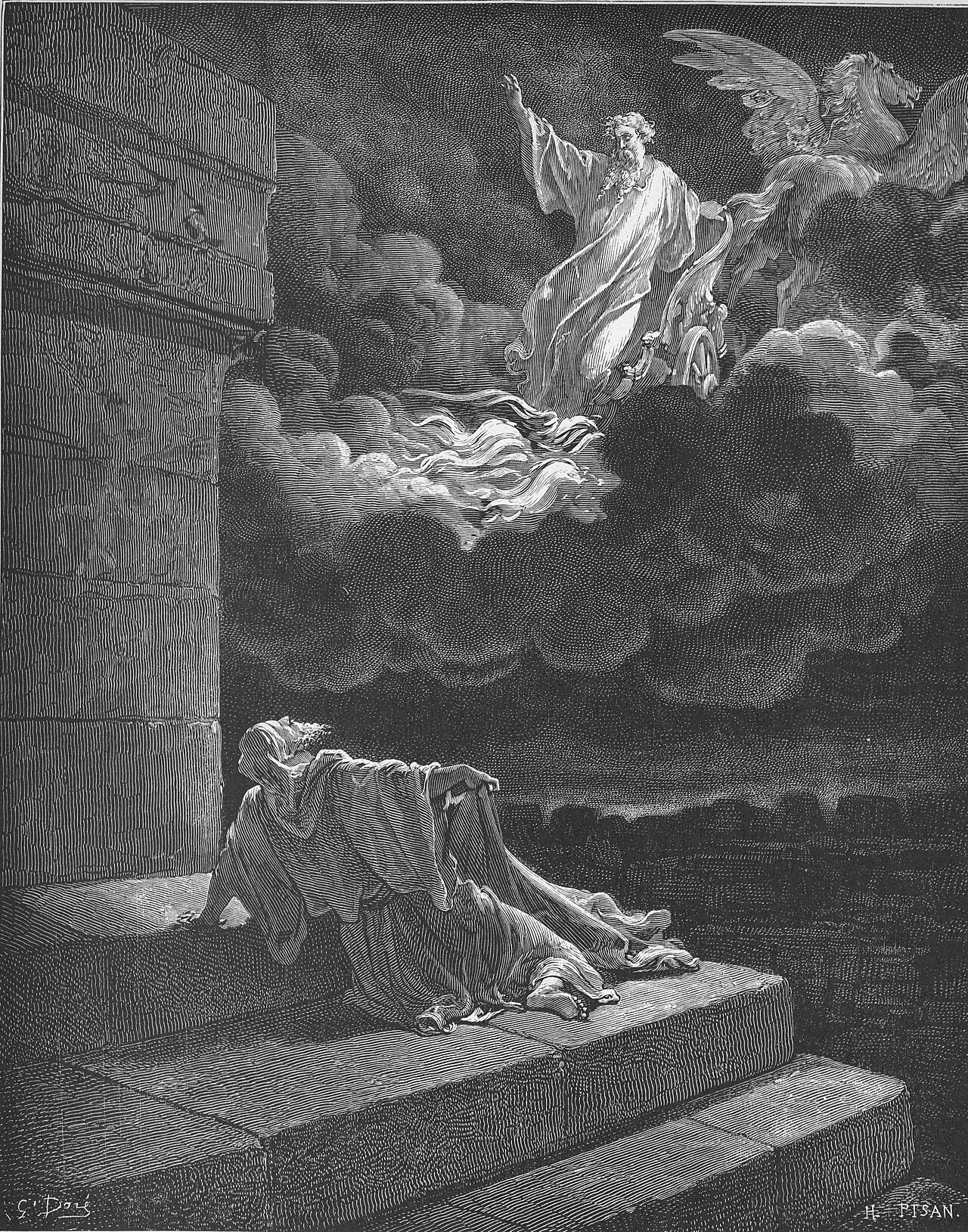
Gustave Doré, Elijah Ascends to Heaven in a Chariot of Fire (1866) — Public domain, via Wikimedia Commons
Summary
The page pairs every miracle of Elisha's with its match in Elijah's ministry, then walks the full ten-episode catalog that follows the Jordan handoff.
- What "double portion" actually means: a firstborn's inheritance share, not a claim to double the wonders
- Elijah's and Elisha's miracles matched genre for genre as proof the portion was granted
- Ten episodes in the miracle catalog, from the widow's oil to a posthumous miracle at Elisha's tomb
- Naaman's healing, and Jesus's own use of it to defend grace reaching past Israel
- Three of Elisha's miracles echoed at greater scale in the Gospels
The Handoff
2:1–14 — Gilgal to the Jordan, and back across it alone
Three times Elijah tells Elisha to stay behind (Gilgal, Bethel, Jericho) and three times Elisha refuses to leave him (2:2, 4, 6). At the Jordan, Elijah's mantle parts the water; on the far side, with fifty sons of the prophets watching, Elijah asks what he can do for his successor before he is taken. “Let a double portion of thy spirit be upon me” (2:9): pi shenayim, the fixed legal idiom for a firstborn's inheritance share (Deut 21:17). Elisha is not asking to out-perform Elijah; he is asking to be received as his spiritual firstborn heir.
A chariot of fire and horses of fire part the two, and Elijah goes up in a whirlwind. Elisha's cry, “My father, my father, the chariots of Israel, and the horsemen thereof” (2:12), names what Israel is actually losing: not a weapon, but a man whose word had been worth more to the nation's defense than any army. He takes up the fallen mantle, strikes the Jordan, and the water parts a second time: the sign that the request was granted before a single new miracle has happened.
Doubled, Genre for Genre
the structure the book itself builds
Multiply a widow's food supply
Elijah
1 Ki 17:8–16: the jar of meal and cruse of oil
Elisha
2 Ki 4:1–7: the widow's borrowed vessels, filled
Raise a dead child
Elijah
1 Ki 17:17–24: the widow of Zarephath's son
Elisha
2 Ki 4:32–37: the Shunammite's son
The pairing is deliberate, not coincidental: the same two miracle-types, in the same order of magnitude, on either side of the Jordan handoff. It is the narrative proof that the double portion was granted.
The Miracle Catalog
ten episodes, 2 Kings 4–13 — every one a door
Her creditor threatens to take her sons as slaves; the oil fills every vessel she can borrow, and stops exactly when the vessels run out.
Promised, then given, then raised: Elisha stretches himself over the dead child as Elijah once did (1 Ki 17:21).
“There is death in the pot” — meal thrown in makes it safe.
Twenty loaves and fresh grain, and “they did eat, and left thereof” — the direct forerunner of the feeding miracles.
The Aramean commander, told to wash seven times in the Jordan — offended by the simplicity of the remedy until his servants talk him into obeying.
Borrowed iron, lost in the Jordan, made to float: a small mercy for a poor man's debt.
An Aramean raiding party struck blind, led into Samaria, then fed and sent home rather than killed.
A siege so severe that mothers eat their children (6:28–29), ended in a single night, exactly as Elisha foretold, at the city gate where the man who doubted it is trampled.
Gehazi is telling the king Elisha's story when the woman herself walks in to ask for her land back: the timing is the miracle.
A dead man, hastily thrown into Elisha's tomb, touches his bones and lives — even after death, the double portion is still working.
Naaman and the Nations
5:1–14 → Luke 4:27: the sharpest link in the whole book
Naaman is a foreign commander, a Gentile, an enemy of Israel, and the leprosy that Elisha heals him of is the same disease that will fall on Elisha's own servant Gehazi two verses later (5:27) for trying to profit from it. Grace and judgment sit side by side in the same chapter.
Centuries later, in his Nazareth sermon, Jesus reaches back past his own countrymen to this exact story: “there were many lepers in Israel in the time of Elisha the prophet; and none of them was cleansed, but only Naaman the Syrian” (Luke 4:27). He names it as the historical precedent for grace extended past Israel to a Gentile, and the Nazareth crowd tries to kill him for saying so. Jesus reads 2 Kings 5 as already teaching the Gentile-inclusion he himself embodies; this is not a New Testament theme retrofitted onto an old story, but the Lord's own reading of it.
A Christ-Shaped Catalog
the specific kinds of miracle, at a scale Elisha's never reach
Elisha feeds a hundred with twenty loaves; Jesus feeds five thousand with five. Elisha raises one child brought to him privately; Jesus raises the dead in public, by a word, and is himself raised. The catalog does not merely resemble the Gospels: it is read, across the roster's Christ-typology method, as a deliberate rehearsal in miniature.
The Keynote Words
the vocabulary of the handoff
Word studies
The Hebrew and Greek under this study, each word in its own room.
Keep studying
Read it1
On this page