
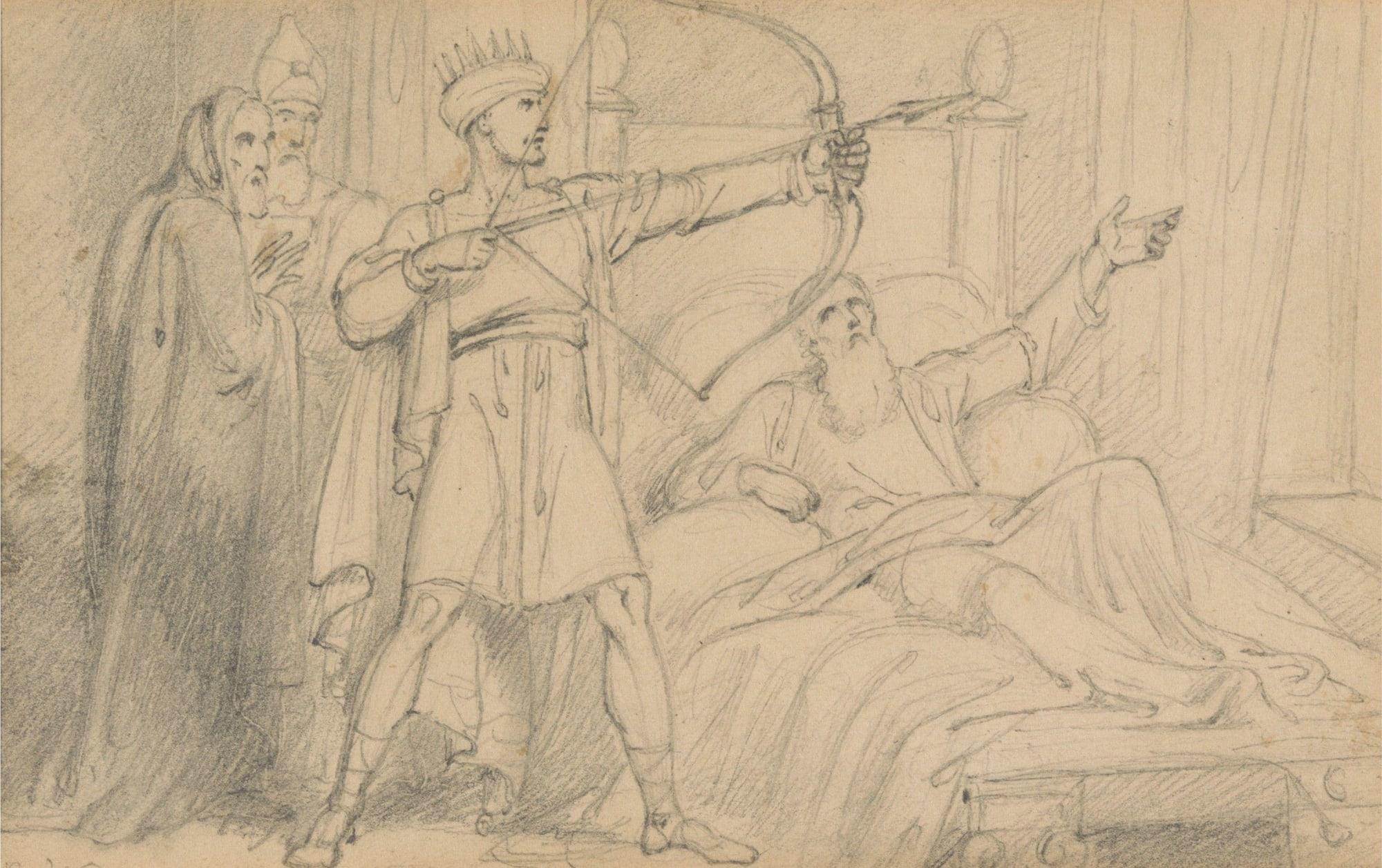
Richard Westall, Elisha on His Death-Bed, before 1835. Public domain.
2 Kings 13:14 to 25 · Story · Featured Study
Elisha's Last Act and the Arrows
Elisha's last recorded act took place at his own sickbed, beside a window facing east.
“Open the east window,” said Elisha. So he opened it and Elisha said, “Shoot!” So he shot. And Elisha declared: “This is the LORD’s arrow of victory, the arrow of victory over Aram, for you shall strike the Arameans in Aphek until you have put an end to them.”
- Where
- Samaria, Aphek, Gilead
- Who
- Elisha, Jehoash, Hazael, Ben Hadad
- When
- Elisha was dying in the reign of Jehoash king of Israel
A dying prophet asked a king for one arrow through an open window, and then for blows on the ground.
Summary
At Elisha's sickbed the prophet had Jehoash act out a sign with a bow and arrows. The king's part in it fixed how often Israel would beat the Arameans. Then Elisha's grave gave a sign of its own, when a corpse came alive on contact with his remains.
- Barnes links the window toward the sunrise with Israel's lost land beyond the Jordan.
- Three readings explain the prophet's anger at the king's part in the sign.
- Readers differ on what the miracle at the grave was for.
The Bow at the Window
Jehoash reigned in Samaria while Aram pressed Israel hard.
Jehoash son of Jehoahaz reigned over Israel in Samaria for sixteen years. Hazael king of Aram had oppressed Israel through all the reign of his father.
Elisha told him, “Take a bow and some arrows.” So Jehoash took a bow and some arrows.Elisha begins the sign with this command, before he explains anything.
The Last Acts in Order
The steps run from the first command to the cities Jehoash took back.
Elisha's commands at the bed, his burial and the victories over Aram close his story.
- Take a bow and some arrowsElisha commands2 Kings 13:15
- Put your hand on the bowElisha commands2 Kings 13:16
- Open the east window, and shootElisha commands2 Kings 13:17
- Strike the ground, and the king stops at threeElisha commands2 Kings 13:18
- Five or six blows would have finished AramElisha, angry2 Kings 13:19
- Elisha dies and is buriedthe narrator2 Kings 13:20
- A dead man touches his bones and stands upa burial party2 Kings 13:21
- Hazael dies, and Ben-hadad reigns in Aramthe narrator2 Kings 13:24
- Jehoash beats Ben-hadad three times and takes back the citiesJehoash2 Kings 13:25
The steps of 2 Kings 13:14 to 25 in order, each with the one who acts and its verse.
A dead man touches his bones and stands up, Hazael dies, and Ben-hadad reigns in Aram, Jehoash beats Ben-hadad three times and takes back the cities
Strike or Shoot?
Commentators differ on what the king did with the arrows after the first shot.
John Gill places the blows on the floor of the room in which the prophet lay.
Adam Clarke takes the blows to mean arrows shot into the earth, since the king had been told to take his arrows. Barnes reports that some render the command as “Shoot to the ground,” with the arrows sent from the window into the earth outside.
Josephus tells the scene in his Antiquities of the Jews. In his account the sign is a series of arrows shot from the bow, with no blows on the earth.
Why the Arrow Flew East
Albert Barnes ties the east window to the land Hazael had taken from Israel.
from the Jordan eastward through all the land of Gilead (the region of Gad, Reuben, and Manasseh), and from Aroer by the Arnon Valley through Gilead to Bashan.Gilead, named here, is the land Barnes sees the arrow aimed at.
Albert Barnes notes that Damascus lay partly east of the land and still more to the north. He holds that the arrow was aimed less at Aram itself than at Gilead. Gilead had seen Aram's recent victories, and Jehoash would win his own there.
Barnes places Aphek almost due east of Shunem, where he thinks Elisha may then have been.
The rest of them fled into the city of Aphek, where the wall fell on twenty-seven thousand of the remaining men. Ben-hadad also fled to the city and hid in an inner room.Aphek had seen an earlier Aramean defeat, in the days of Ahab.
What the Text Leaves Unsaid
The text gives no count of the arrows and no name for the man raised at the tomb.
The king says nothing after the blows.
Nothing more is told of the raised man after he stood up. Josephus gives a different scene, in which robbers threw a man they had killed into Elisha's grave.
The Man Raised at the Tomb
Readers have taken the miracle at the grave as a seal, as a double portion and as honour to the saints.
Once, as the Israelites were burying a man, suddenly they saw a band of raiders, so they threw the man’s body into Elisha’s tomb. And as soon as his body touched the bones of Elisha, the man was revived and stood up on his feet.Each reading of the miracle starts from this verse.
Albert Barnes notes that Jewish graves were caves cut in rock and closed with a heavy stone. The dead were wrapped in grave clothes without coffins. He calls this miracle more surprising than any Elisha worked in his lifetime.
A seal on his last prophecyC. F. Keil and F. Delitzsch, and Matthew Henry
Keil holds that the miracle set the seal of divine attestation on what the dying prophet had said about the victories over Aram. By it the Lord bore witness that he is the God of the living. Matthew Henry reads in it a sign that Israel's interests, which seemed sunk and lost, would revive by the promises Elisha had made. He adds that it may refer to Christ.
The objection: the text sets the raised man beside no word of Elisha and gives no reason for the miracle.
The double portion, shown even in deathEphrem the Syrian
Ephrem the Syrian notes that Elijah and Elisha each raised the dead in life, while no prophet before Elisha raised anyone after his own death. In this he saw the spirit of Elijah resting doubly on Elisha.
The objection: Keil rejects this reading by name and gives the miracle its design in the attestation of the prophecy.
Honour for the remains of the saintsJohn Chrysostom
John Chrysostom, in his Eulogy on Saint Ignatius, argued from Elisha's tomb that the very sepulchres of the saints are filled with spiritual grace. He urged his hearers to come to the martyr's tomb with faith.
The objection: the text records no visit to Elisha's tomb and no honour paid to it after that day.
Voices on the Arrows
Matthew Henry counted the victories against the blows.
Matthew Henry (1662 to 1714)
Commentary on the Whole Bible
How this text has been taught
“This was a great kindness to the cities themselves, which were hereby brought from under the yoke of oppression, and to the whole kingdom, which was much strengthened by the reduction of those cities. Thrice Joash beat the Syrians, just as often as he had struck the ground with the arrows, and then a full stop was put to the course of his victories.”
on 2 Kings 13:25Puritan
Why Was Elisha Angry at Three?
The text gives the count and the anger, and commentators read the king's part three ways.
He lacked zeal and faith in the promiseC. F. Keil and F. Delitzsch, Albert Barnes and John Gill
Keil holds that the king knew the first shot meant victory. Stopping at three, he says, showed a want of zeal for the promise, a want of true faith in God's power to keep it. Barnes writes that the unfaithfulness of man limits the goodness of God, and he sets the verse beside Mark 6:5 to 6. Gill thinks the king may have found the act trifling and done it only to please the prophet.
The objection: Elisha named no number before the king struck, and he had explained only the first arrow.
He probably did not know, and three was God's numberAdam Clarke
Clarke reads the act as a sign the prophet understood and the king probably did not. The king, he thinks, was probably not aware of what depended on the number. He adds that perhaps it was of the Lord, since God had determined to give Israel three victories.
The objection: the man of God was angry with the king, and the verse lays the loss on the king's stopping.
He feared the word would failClericus, as Keil quotes him
In a note Keil quotes Clericus, who held that the king had no implicit faith in Elisha. Weighing the power of the kings of Aram, he thought three blows enough. He feared the prophecy might not be fulfilled if he struck more.
The objection: the text records no thought of the king's at the bed, so the fear is supplied by the reader.
Books to Read Next
Both works are in the public domain, and each has a free copy to read.
Biblical Commentary on the Old Testament, on 2 Kings
C. F. Keil and F. Delitzsch · 1857 to 1878
Keil explains the anger at the three blows and the purpose of the miracle at the tomb.
Read at Bible HubCommentary on the Bible
Adam Clarke · 1832
Clarke's notes on 2 Kings 13 weigh what the king could have known.
Read at Bible HubThe Covenant Behind the Victories
The three victories went to a king the writer judged evil.
But the LORD was gracious to Israel and had compassion on them, and He turned toward them because of His covenant with Abraham, Isaac, and Jacob. And to this day, the LORD has been unwilling to destroy them or cast them from His presence.The verse gives the reason for that mercy.
Sources
Scripture is the Berean Standard Bible.
- C. F. Keil and F. Delitzsch, Biblical Commentary on the Old Testament (1857 to 1878), on 2 Kings 13:14 to 21, with the note quoting Clericus.
- Flavius Josephus, Antiquities of the Jews 9.8.6, translated by William Whiston.
- Albert Barnes, Notes, Explanatory and Practical, on the Old and New Testaments (1832 to 1869), on 2 Kings 13:14.
- Albert Barnes, Notes, Explanatory and Practical, on the Old and New Testaments (1832 to 1869), on 2 Kings 13:17.
- Albert Barnes, Notes, on 2 Kings 13:18.
- Albert Barnes, Notes, on 2 Kings 13:19.
- Albert Barnes, Notes, on 2 Kings 13:21.
- John Gill, Exposition of the Old Testament (1748 to 1763), on 2 Kings 13:18.
- Adam Clarke, Commentary on the Bible (1832), on 2 Kings 13:18.
- Ephrem the Syrian, On the Second Book of Kings 13:21.
- Matthew Henry, Commentary on the Whole Bible (1710), on 2 Kings 13:21.
- Matthew Henry, Commentary on the Whole Bible (1710), on 2 Kings 13:25.
- John Chrysostom, Eulogy on Saint Ignatius.
Keep Studying
Studies5
People and groups3