
1 Kings 19:8
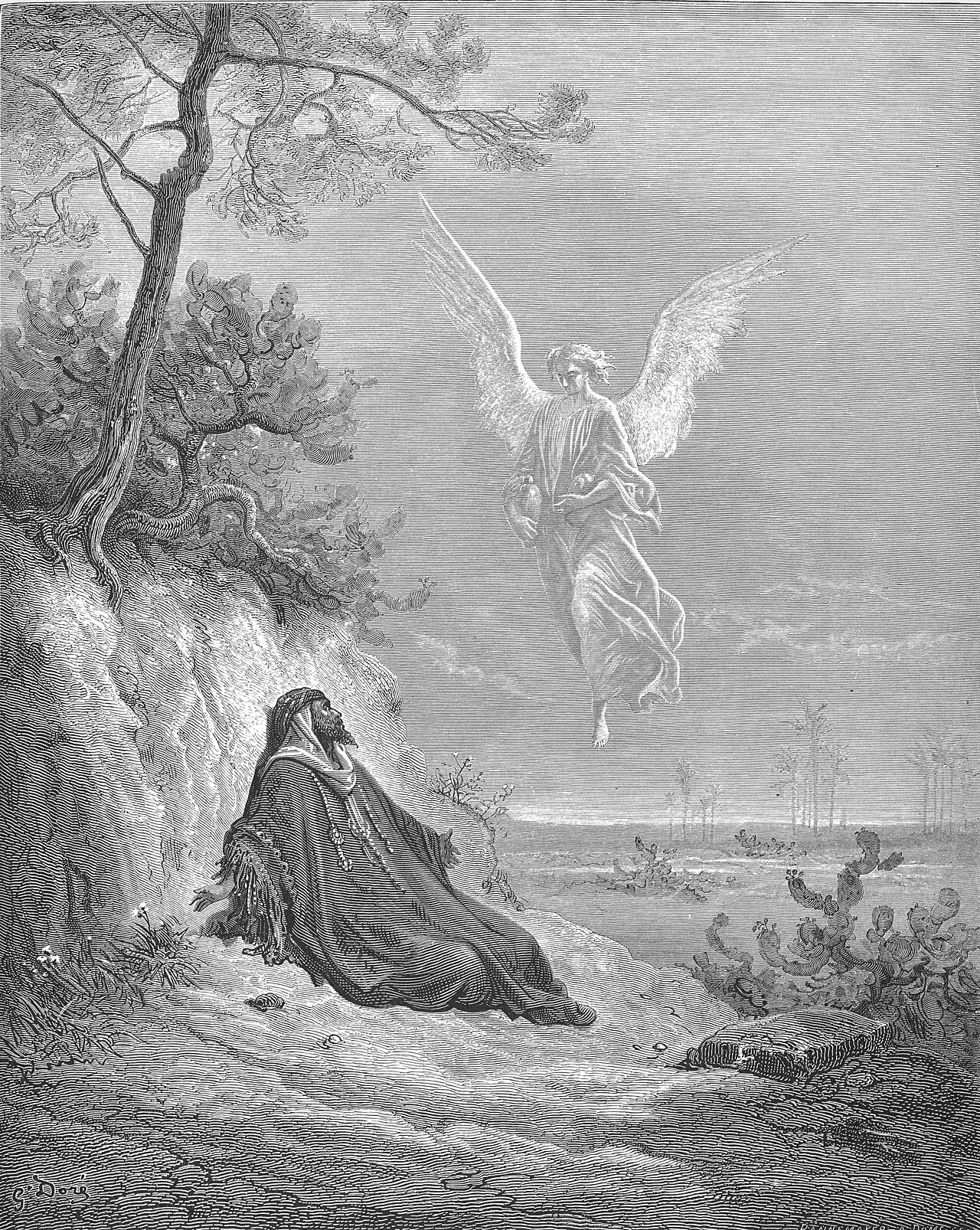
in 1 Kings 19So he got up and ate and drank. And strengthened by that food, he walked forty days and forty nights until he reached Horeb, the mountain of God.
BSB
The same verse in ASV and KJV ▾
ASV
And he arose, and did eat and drink, and went in the strength of that food forty days and forty nights unto Horeb the mount of God.
KJV
And he arose, and did eat and drink, and went in the strength of that meat forty days and forty nights unto Horeb the mount of God.
⋯
This verse in 1 Kings 19
Commentary
12 notes on this verseForty days and forty nights - So he fasted just the same time as Moses did at Horeb, and as Christ did in the wilderness.
This site's exposition
came again the second time
on 1 Kings 19:7-8
The angel returns and doubles the provision because what lies ahead is beyond what one meal could carry: forty days and forty nights in the strength of that meat to Horeb, the mount of God. Horeb is Sinai under its other name, and the forty days match the forty Moses spent on the same mountain without bread or water at Ex 34:28; Clarke and Henry both note the parallel and read Elijah as led, likely beyond his own planning, to meet God where the law was first given. The same number recurs at Christ's forty days in the wilderness, a likeness the commentators draw rather than a claim the text itself states.
This site's exposition
he walked forty days and forty nights
John Wesley notes that the direct road to Horeb took only three or four days, and he reads the forty days as wandering. Israel spent forty years in the wilderness by the sentence of Numbers 14:33. The food carried Elijah the whole way.
The record, by era
The Church Fathers2 voices
"The angel of the Lord came a second time, touched him and said, 'Get up and eat, otherwise the journey will be too much for you.' " Elijah was sleeping under a tree. Now an angel came to him and woke him up (sleep was …
A commentator
Philoxenus of Mabbug13 Ascetic Discourses, Discourse 11 -- On Abstinence · Written before 523.
proposed
And so also Elijah, after his fast of forty days and forty nights, received the sight of God in Mount Horeb, and he was alone in the wilderness, and in addition to the protracted fast he bore also the labour of the journey of the …
The Puritans and the Awakening3 voices
And went - He wandered hither and thither for forty days, 'till at last he came to Horeb, which in the direct road was not above three or four days journey.
Thither the Spirit of the Lord led him, probably beyond his own intention, that he might have communion with God in the same place where Moses had, the law that was given by Moses being revived by him. The angel bade him eat the second time, because of the greatness of the journey that was before him,
And he arose, and did eat and drink,....
4 more voices on this verse
The Nineteenth Century4 voices
A commentator
Jamieson, Fausset & Brown1802–1910
Commentary Critical and Explanatory on the Whole Bible (1871)
proposed
In the solitude of Sinai, God appeared to instruct him. "What doest thou here, Elijah?" was a searching question addressed to one who had been called to so arduous and urgent a mission as his.
A commentator
Charles Spurgeon1834–1892
The Metropolitan Tabernacle Pulpit, Sermon No. 3110: “Faintness and Refreshing” (lightly modernized text, CCEL edition) · Written before 1892.
proposed
[An Exposition of the greater part of the chapter from which the text is taken is given with Sermon #2828, Volume 49.] I. My first observation upon this passage is that THE GREATEST BELIEVERS ARE SOMETIMES SUBJECT TO FAINTING FITS. The Apostle James tells us that "Elijah was a man subject to like passions as we are." And this fact was very clearly manifest on the occasion to which our text refers. Otherwise he seemed, in most things, to be superior to the ordinary run of men, a sort of iron Prophet—what if I call him THE PROPHET OF FIRE—the man whose whole life seemed to be a flash of flame—a mighty, burning, ecstatic love and zeal towards the cause of God? But Elijah had his flaws, even as the sun has its spots. Strong man though he was, he was sometimes obliged to faint, even as the sun sometimes suffers an eclipse. His fainting, too, took a form which is very common among the saints of God. He cried, "O Lord, take away my life; for I am not better than my fathers." [See Sermon #2725, Volume 46—ELIJAH FAINTING] A desire to depart, when it arises from wisdom and knowledge, and from a general survey of things below, is very proper. But when a wish to die is merely the result of passion, a sort of quarreling with God as a child sometimes quarrels with its parents, it has more of folly in it than of wisdom and much more of petulance than of piety! It was a remarkable thing that the man who was never to die, for whom God had ordained an infinitely better lot, the man who was to be carried to Heaven by a whirlwind in a chariot of fire drawn by horses of fire—the man who, like Enoch, was "translated that he should not see death"—should thus pray to die! We have here a memorable proof that God does not always literally answer prayer, though He always does in effect. He gave Elijah something better than that for which he asked, so He really did hear and answer his prayer.
A commentator
Charles Spurgeon1834–1892
The Metropolitan Tabernacle Pulpit, Sermon No. 3110: “Faintness and Refreshing” (lightly modernized text, CCEL edition) · Written before 1892.
proposed
[An Exposition of the greater part of the chapter from which the text is taken is given with Sermon #2828, Volume 49.] I. My first observation upon this passage is that THE GREATEST BELIEVERS ARE SOMETIMES SUBJECT TO FAINTING FITS. The Apostle James tells us that "Elijah was a man subject to like passions as we are." And this fact was very clearly manifest on the occasion to which our text refers.
A commentator
Albert Barnes1798–1870
Notes, Explanatory and Practical, on the Old and New Testaments (1832-1869)
proposed
The old commentators generally understood this to mean that Elijah had no other food at all, and compared this long fast with that of Moses and that of our Lord (marginal references). But the words do not exclude the notion of the prophet’s having obtained such nourishment from roots and fruits as the desert offers to a wanderer, though these alone would not have sustained him.
The words behind it
15 Hebrew wordsEvery Hebrew word of this verse in the order it stands, with what it means and the door to its own study. The last column counts the times a word stands in the whole Bible: the rarer the word, the more the places it appears belong together.
| Hebrew | Sound | Meaning | Word study | In the Bible |
|---|---|---|---|---|
| וַיָּ֖קָם | vaiyakom | and he arose | H6965 → | 628 times |
| וַיֹּ֣אכַל | vaiyokhal | and he ate | H398 → | 810 times |
| וַיִּשְׁתֶּ֑ה | vaiyishteh | and he drank | H8354 → | 217 times |
| וַיֵּ֜לֶךְ | vaiyelekh | and he went | H1980 → | 1546 times |
| בְּכֹ֣חַ׀ | bekhoach | in [the] strength of | H3581 → | |
| הָאֲכִילָ֣ה | haakhilah | the food | H396 → | |
| הַהִ֗יא | hahi' | <the> that | H1931 → | 1879 times |
| אַרְבָּעִ֥ים | ʾarbaim | forty | H705 → | 136 times |
| יוֹם֙ | yom | day[s] | H3117 → | 2304 times |
| וְאַרְבָּעִ֣ים | vearbaim | and forty | H705 → | 136 times |
| לַ֔יְלָה | laylah | night[s] | H3915 → | 233 times |
| עַ֛ד | ʾad | to | H5704 → | 1261 times |
| הַ֥ר | har | [the] mountain of | H2022 → | 546 times |
| הָאֱלֹהִ֖ים | haelohim | <the> God | H430 → | 2601 times |
| חֹרֵֽב׃ | chorev | Horeb | H2722 → |
וַיָּ֖קָםand he arose
vaiyakomH6965 →628 times
וַיֹּ֣אכַלand he ate
vaiyokhalH398 →810 times
וַיִּשְׁתֶּ֑הand he drank
vaiyishtehH8354 →217 times
וַיֵּ֜לֶךְand he went
vaiyelekhH1980 →1546 times
בְּכֹ֣חַ׀in [the] strength of
bekhoachH3581 →
הָאֲכִילָ֣הthe food
haakhilahH396 →
הַהִ֗יא<the> that
hahi'H1931 →1879 times
אַרְבָּעִ֥יםforty
ʾarbaimH705 →136 times
יוֹם֙day[s]
yomH3117 →2304 times
וְאַרְבָּעִ֣יםand forty
vearbaimH705 →136 times
לַ֔יְלָהnight[s]
laylahH3915 →233 times
עַ֛דto
ʾadH5704 →1261 times
הַ֥ר[the] mountain of
harH2022 →546 times
הָאֱלֹהִ֖ים<the> God
haelohimH430 →2601 times
חֹרֵֽב׃Horeb
chorevH2722 →
A shaded row is a word that stands 400 times or fewer in the Bible.
The walk
8 stopsEach card is a verse this one points to, and under it the verses that one points to in turn. Where several paths arrive at the same place, that place is listed first: the text keeps returning to it.
Through
Matthew 4:2After fasting forty days and forty nights, He was hungry.
it leads to
- Deuteronomy 9:18
Then I fell down before the LORD for forty days and forty nights, as I had done the first time. I did not eat bread or drink water because of all the sin you…
Reached by 3 separate paths from here.
- Exodus 34:28
So Moses was there with the LORD forty days and forty nights without eating bread or drinking water. He wrote on the tablets the words of the covenant—the Ten Commandments.
Reached by 3 separate paths from here.
- Deuteronomy 9:9
When I went up on the mountain to receive the tablets of stone, the tablets of the covenant that the LORD made with you, I stayed on the mountain forty days and forty nights.…
Reached by 3 separate paths from here.
- Luke 4:2
where for forty days He was tempted by the devil. He ate nothing during those days, and when they had ended, He was hungry.
- Deuteronomy 9:18
Through
Exodus 34:28So Moses was there with the LORD forty days and forty nights without eating bread or drinking water. He wrote on the tablets the words of the covenant—the Ten Commandments.
it leads to
- Deuteronomy 9:25
So I fell down before the LORD for forty days and forty nights, because the LORD had said He would destroy you.
Reached by 3 separate paths from here.
- Exodus 34:1
Then the LORD said to Moses, “Chisel out two stone tablets like the originals, and I will write on them the words that were on the first tablets, which you broke.
- Deuteronomy 9:25
Through
Exodus 3:1Meanwhile, Moses was shepherding the flock of his father-in-law Jethro, the priest of Midian. He led the flock to the far side of the wilderness and came to Horeb, the mountain of God.
it leads to
- Exodus 17:6
Behold, I will stand there before you by the rock at Horeb. And when you strike the rock, water will come out of it for the people to drink.” So Moses did this in…
- Psalms 78:70–72
He chose David His servant and took him from the sheepfolds;
- Exodus 17:6
Where this verse is studied
On this page
Studies4
About 1 Kings
This page draws on 9 works. Open the list of works
This page draws on Adam Clarke, Commentary on the Bible; Albert Barnes, Notes, Explanatory and Practical, on the Old and New Testaments (1832-1869); Charles Spurgeon, The Metropolitan Tabernacle Pulpit, Sermon No. 3110: “Faintness and Refreshing” (lightly modernized text, CCEL edition); Ephrem the Syrian, ON THE FIRST BOOK OF KINGS 19:4; Jamieson, Fausset & Brown, Commentary Critical and Explanatory on the Whole Bible; John Gill, Exposition of the Old Testament (1748-1763); John Wesley, Explanatory Notes upon the Old Testament; Matthew Henry, Commentary on the Whole Bible and Philoxenus of Mabbug, 13 Ascetic Discourses, Discourse 11 -- On Abstinence.