
Nain
Summary
A Galilean town named in Scripture only here, where Jesus met the funeral procession of a widow's only son. Moved with compassion, he stopped the bier and raised the young man (Luke 7:11-17).
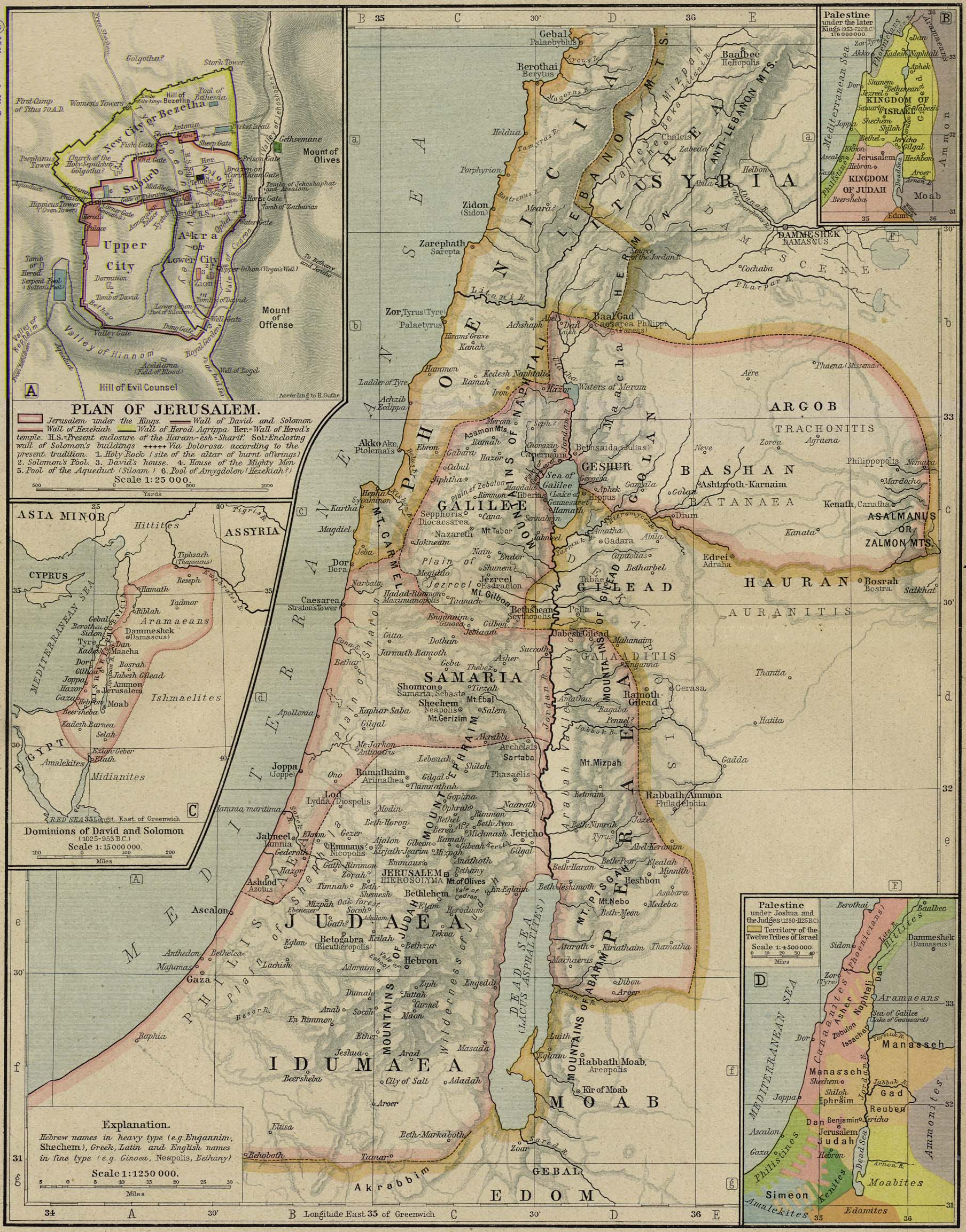
- Nain is named in Scripture only once, at Luke 7:11, a Galilean town on the slope of the hill of Moreh near Shunem.
- Jesus met a funeral procession at the town gate, a widow's only son being carried out to burial.
- Moved with compassion, Jesus touched the coffin and told the young man to get up, and he sat up and spoke.
- The crowd's cry, "A great prophet has appeared among us," recalls two earlier raisings of a widow's or a mother's only son, under Elijah at Zarephath and Elisha at Shunem.
- The news of this miracle reached John the Baptist, and Jesus later named the dead being raised as a sign of who He was.
On this page
In Scripture
- Verses
- 1
- Books
- 1
Near Nain
- Shunem3.1 km · 1.9 mi SW
- Mount Tabor7.4 km · 4.6 mi NE
- Jezreel8.5 km · 5.3 mi S
- Nazareth9.5 km · 5.9 mi NW
- Cana of Galilee13 km · 8.0 mi N
- Mount Gilboa15 km · 9.1 mi SE
Straight-line distances, computed from the gazetteer coordinates.
Where it is
the country around it
- Coordinates
- 32.6308° N, 35.3478° Efind it on the Atlas →
- Region
- Galilee
- Kind of place
- Town
- Located: the gazetteer fixes one site
Why Nain matters
What has been found
the evidence, and where it is disputed
The widow's son at Nain
Luke 7:11-17, in the order it happens
Read Luke 7:11-17, in the order it happens
- Jesus comes to NainLuke 7:11Soon afterward, Jesus went to a town called Nain. His disciples went with Him, accompanied by a large crowd.
- A widow's only son carried out to burialLuke 7:12As He approached the town gate, He saw a dead man being carried out, the only son of his mother, and she was a widow. And a large crowd from the town was with her.
- "Do not weep"Luke 7:13When the Lord saw her, He had compassion on her and said, “Do not weep.”
- "Young man, I tell you, get up!"Luke 7:14Then He went up and touched the coffin, and those carrying it stood still. “Young man,” He said, “I tell you, get up!”
- The dead man sits up and speaksLuke 7:15And the dead man sat up and began to speak! Then Jesus gave him back to his mother.
- "A great prophet has appeared among us"Luke 7:16A sense of awe swept over all of them, and they glorified God. “A great prophet has appeared among us!” they said. “God has visited His people!”
- The news spreads through the regionLuke 7:17And the news about Jesus spread throughout Judea and all the surrounding region.
The crowd's cry, "A great prophet has appeared among us," is not empty praise. It names Jesus inside a pattern their own Scripture already held: Elijah at Zarephath and Elisha at Shunem, a town close by Nain, had each raised an only son given back to his mother.
What happened here, in order
in the order the canon tells it
- The widow of Zarephath's son dies1 Kings 17:17Later, the son of the woman who owned the house became ill, and his sickness grew worse and worse, until no breath remained in him.
- Elijah stretches himself over the child and prays1 Kings 17:21Then he stretched himself out over the child three times and cried out to the LORD, “O LORD my God, please let this boy’s life return to him!”
- The child's life returns1 Kings 17:22And the LORD listened to the voice of Elijah, and the child’s life returned to him, and he lived.
- The Shunammite's son dies on her lap at noon2 Kings 4:20After the servant had picked him up and carried him to his mother, the boy sat on her lap until noon, and then he died.
- Elisha stretches himself out over the boy2 Kings 4:34Then Elisha got on the bed and lay on the boy, mouth to mouth, eye to eye, and hand to hand. As he stretched himself out over him, the boy’s body became warm.
- The boy sneezes seven times and opens his eyes2 Kings 4:35Elisha turned away and paced back and forth across the room. Then he got on the bed and stretched himself out over the boy again, and the boy sneezed seven times and opened his eyes.
- Jesus names the sign to John's disciples: the dead are raisedLuke 7:22So He replied, “Go back and report to John what you have seen and heard: The blind receive sight, the lame walk, the lepers are cleansed, the deaf hear, the dead are raised, and the good news is preached to the poor.
Nain in Scripture
1 verse names it, in 1 book
Open a book to read its mentions here. Text: Berean Standard Bible.
New Testament1 book · 1 mention
Common questions
Why does the crowd call Jesus "a great prophet," and which earlier prophetic raisings would that recall?
Two earlier prophets had raised an only son back to life for a grieving mother. Elijah raised the son of the widow who fed him at Zarephath, and Elisha raised the son of the woman of Shunem, a town close by Nain in the same valley. The crowd at Nain's gate saw Jesus do the same thing and named him inside that pattern before they had any other word for what they had just watched.
Why does the text specify that the dead man was the widow's only son?
An only son left a widow with no other child and, in that world, no other provider. Luke draws out the weight of her loss the same way the story of the widow of Zarephath does. Jesus is not shown responding to a general case of death; he is shown responding to this woman's grief in particular, which is why Luke records that he had compassion on her before he touched the coffin.
What is the relationship between Nain and Shunem, the town of the earlier raising under Elisha?
Nain sits on the slope of the hill of Moreh at the edge of the Jezreel Valley, close by Shunem, where Elisha raised the Shunammite woman's son centuries earlier. Scripture never says the crowd at Nain was thinking of that specific town, but the nearness of the two places is itself part of why the comparison would have come naturally to people who knew the region and its Scriptures.
Why does Jesus touch the coffin, and what would that have meant under the law?
Touching a corpse or its bier made a person ceremonially unclean under the law. Jesus touches the coffin anyway, and instead of being made unclean by death, he reverses it: the bearers stop, and the man he touches sits up alive. The same pattern appears elsewhere in his ministry, where his touch cleanses rather than being defiled.
What did this miracle lead to right after it, in Luke's own account?
Luke reports that news of what happened at Nain spread through Judea and the surrounding region, and it reached John the Baptist in prison. When John sent his own disciples to ask whether Jesus was the one to come, Jesus answered in part by naming the raising of the dead among the signs they could go back and report.
Sources cited
- OpenBible.info Bible Geocoding: Nainread 2026-08-20The coordinates on this page. Used under CC-BY with attribution to OpenBible.info.
- Berean Standard BiblePublic domain since 2023. All Scripture quoted on this page, from the site's own verse store.
- International Standard Bible Encyclopedia, "Nain"The identification with the modern village of Nein and the site's ancient remains, added in re-verification session 7.
Keep studying
On this page
Keep this page