
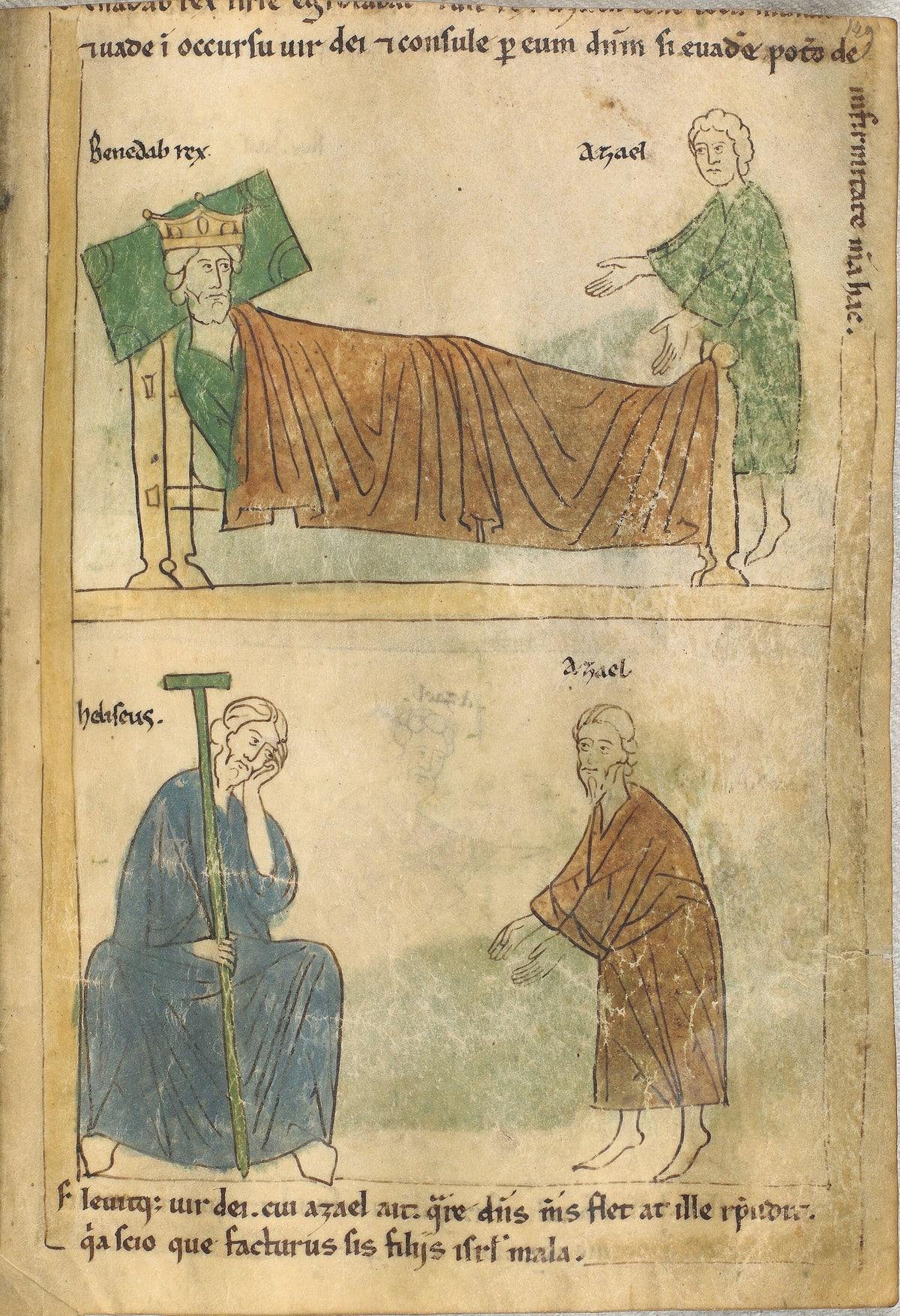
Pamplona Bible, folio 149r, about 1200. Public domain.
1 Kings 15:18 · Place · Featured Study
Aram-Damascus and the Ben-hadads
Aram-Damascus was the Aramean kingdom that pressed Israel from the reign of Asa to the reign of Jehoash.
Hazael told the dying Ben-hadad he would recover, and the next day he smothered him.
So Asa withdrew all the silver and gold that remained in the treasuries of the house of the LORD and the royal palace. He entrusted it to his servants and sent them with this message to Ben-hadad son of Tabrimmon, the son of Hezion king of Aram, who was ruling in Damascus:
So Asa withdrew all the silver and gold that remained in the treasuries of the house of the LORD and the royal palace. He entrusted it to his servants and sent them with this message to Ben-hadad son of Tabrimmon, the son of Hezion king of Aram, who was ruling in Damascus:
- Today
- Damascus
- Region
- The kingdom was ruled from Damascus, north-east of Israel.
- Site
- 33.511, 36.306
- First named
- 1 Kings 15:18 “So Asa withdrew all the silver and gold…”
- Last named
- Amos 1:4 “So I will send fire upon the house…”
Summary
Kings records two royal houses in Damascus, the line of Hezion and the line of Hazael.
- Ben-hadad let Ahab set up marketplaces in Damascus, as his own father had done in Samaria (1 Kings 20:34).
- Ben-hadad's servants went to Ahab in sackcloth to beg for his life (1 Kings 20:32).
- Hazael brought Elisha forty camel loads of the goods of Damascus (2 Kings 8:9).
The House of Hezion
Adam Clarke traces the first royal house of Damascus back to an exile from Zobah.
This study asks who the kings of Damascus were whom Scripture calls Ben-hadad, and how Hazael took their throne. It sets Hazael's reach on an atlas plate, follows the succession in order and weighs Elisha's answer to the dying king.
Adam Clarke, the Methodist commentator, takes Hezion, the grandfather of Asa's ally, to be Rezon, who founded the kingdom of Damascus.
The study of Zobah teaches the Aramean kingdom north of Damascus.
Hazael's Reach on the Map
Four places mark the reach of Damascus under Hazael.
From Damascus, Hazael's armies reached the Arnon in the east and Gath in the west, and Jerusalem bought him off.
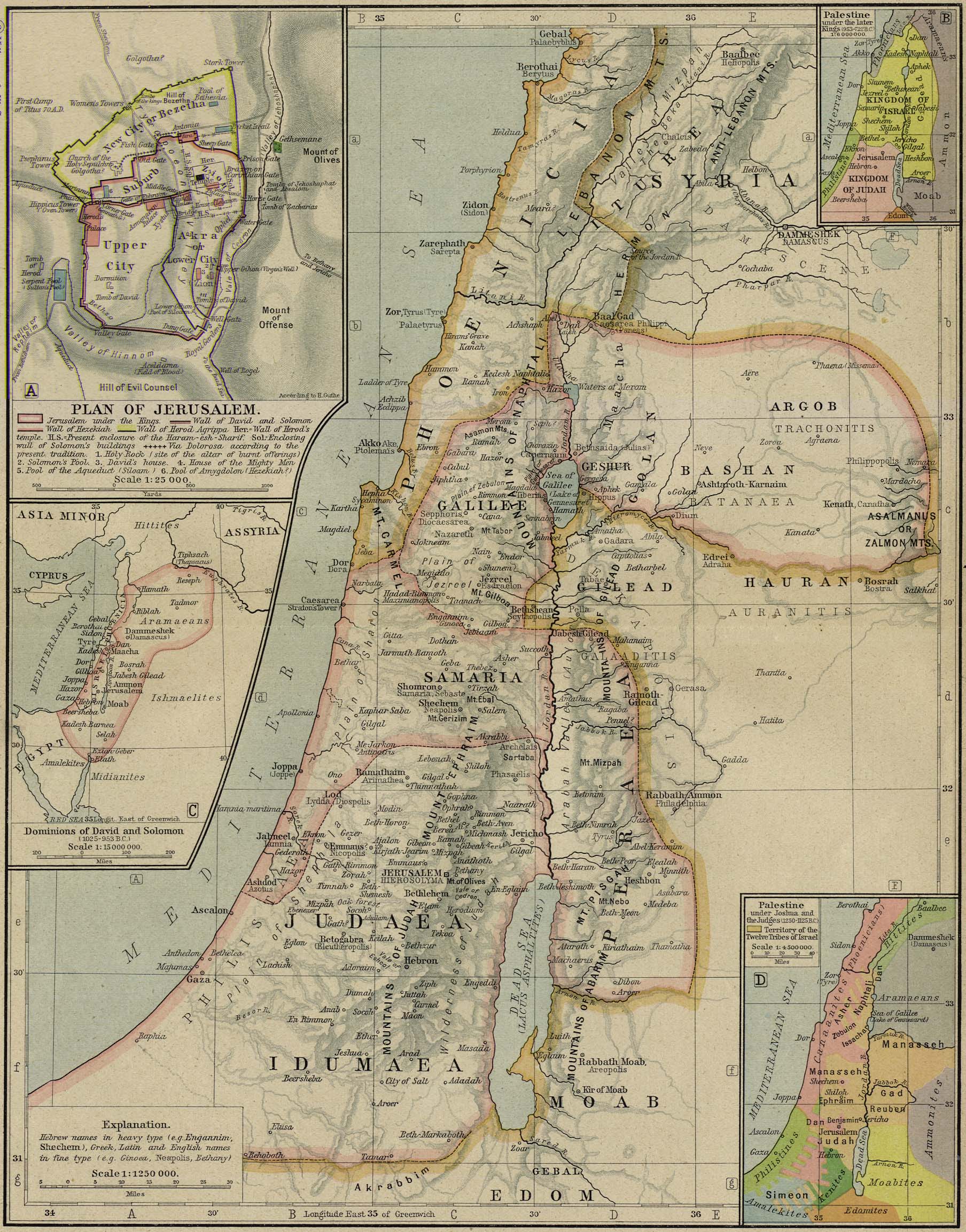
- 1Damascus, The LORD sent Elijah to the Desert of Damascus to anoint Hazael king over Aram. 1 Kings 19:15
- 2Aroer, Hazael took the land from the Jordan eastward, from Aroer by the Arnon through Gilead to Bashan. 2 Kings 10:33
- 3Gath, Hazael fought against Gath and captured it. 2 Kings 12:17
- 4Jerusalem, Joash sent Hazael the sacred gifts and the gold of the treasuries, and Hazael withdrew. 2 Kings 12:18
Base map: Reference map of ancient Palestine, Rand McNally reference map (1926), public domain. Places with a place page stand at its coordinates and the others at the point cited for each, set on the plate by Jerusalem and Damascus, as the plate prints them.
Four places, each with its verse. OpenBible scores Arair 872 and Tell es Safi 850 of 1,000 for Aroer and Gath.
The Kings of Damascus, in Order
Four verses carry the succession of Damascus through Kings.
The throne passed from the house of Hezion to Hazael, and Hazael's son took the old royal name.
- The reign of AsaBen-hadad son of Tabrimmon, son of Hezion, rules in Damascus1 Kings 15:18
- Elisha in DamascusElisha tells Hazael that the LORD has shown him he will be king over Aram2 Kings 8:13
- The reign of JehoahazThe LORD gives Israel into the hands of Hazael and his son Ben-hadad2 Kings 13:3
- The death of HazaelHazael dies, and his son Ben-hadad reigns in his place2 Kings 13:24
Four moments from 1 Kings to 2 Kings in the order of the canon, each with its verse.
The study of Syria tells the wars between Aram and Israel battle by battle, and the study of Elisha tells the prophet's whole ministry.
The Name Ben-hadad
More than one king of Damascus bore the name, and Damascus later honoured two of its kings as gods.
Easton's Bible Dictionary (1897) calls Ben-hadad the standing title of the Syrian kings, meaning the son of Hadad. It lists three kings of the name: Asa's ally, his son who fought Ahab, and Hazael's son.
Albert Barnes, the American commentator, also takes Ahab's foe in 1 Kings 20:1 to be probably the son of Asa's ally.
John Gill, the Baptist commentator, writes that the kingdom had passed to another family when Hazael died. His son still took the name Ben-hadad because the Syrians held it in honour.
Josephus, in Antiquities 9.4.6, says the people of Damascus honoured Ben-hadad and Hazael as gods in his own day. He gives the reason as their gifts to the city and the temples they built there.
What the Text Leaves Unsaid
Scripture gives Hazael no father and no rank before the throne.
Kings first shows Hazael as the man the king sent with a gift to Elisha (2 Kings 8:8). Easton's dictionary calls him an officer of Ben-hadad.
Fire on the House of Hazael
Amos and Jeremiah name the dynasty when they foretell the end of Damascus.
“I will set fire to the walls of Damascus; it will consume the fortresses of Ben-hadad.”The old royal name still stood for the strength of Damascus in Jeremiah's oracle.
So I will send fire upon the house of Hazael to consume the citadels of Ben-hadad.Amos makes the dynasty itself answer for its wars on Israel.
Voices on Aram-Damascus
Matthew Henry noted that some think the murder came to light only through the historian of Kings.
Matthew Henry (1662 to 1714)
“Hazael, who was Ben-hadad's confidant, was his murderer, and some think, was not suspected, nor did the truth ever come out but by the pen of this inspired historian.”
Matthew Henry · Commentary on the Whole Bible · on 2 Kings 8:15Puritan
Elisha's Answer in 2 Kings 8:10
Readers differ on how the prophet could say the king would recover and also that he would die.
Elisha answered, “Go and tell him, ‘You will surely recover.’ But the LORD has shown me that in fact he will die.”Each reading must hold the two halves of the prophet's answer together.
The sickness was not mortalAdam Clarke, John Wesley and Jamieson, Fausset and Brown
Clarke reads the first half as true of the disease, which would not kill the king. The second half foretold that Hazael would take his life. Wesley sees no contradiction and calls the disease not mortal. Jamieson, Fausset and Brown add that Hazael reported only the half that suited him (2 Kings 8:14).
The objection: the prophet sends the words of recovery to a king he knows will die within days.
The courtier's answer, then the truthAlbert Barnes
Barnes reads the first half as the answer Hazael had already planned to give, the kind a courtier always gives, and compares 1 Kings 22:15. The second half tells Hazael what will in fact happen.
The objection: the verse puts the words of recovery in the prophet's own command, Go and tell him.
The study of Aram teaches the people and the name of Aram.
The Prophet Wept
Elisha wept when he saw the harm Hazael would do to Israel (2 Kings 8:11 to 12).
As Jesus approached Jerusalem and saw the city, He wept over itThe Lord who foresaw the judgment of a city grieved over it, as His prophet had.
Sources
Scripture is the Berean Standard Bible.
- James Strong, Exhaustive Concordance of the Bible (1890), Hebrew dictionary, entries 1130, 1908 and 2371.
- M. G. Easton, Illustrated Bible Dictionary, third edition (1897), articles Ben-hadad and Hazael.
- Flavius Josephus, Antiquities of the Jews 9.4.6, translated by William Whiston (1737)
- OpenBible.info, Bible Geocoding Data, ancient.jsonl.
- Matthew Henry, Commentary on the Whole Bible (1710), on 2 Kings 8:15.
- Adam Clarke, Commentary on the Bible (1832), on 1 Kings 15:18.
- Albert Barnes, Notes, Explanatory and Practical, on the Old and New Testaments (1832 to 1869), on 1 Kings 20:1.
- John Gill, Exposition of the Old Testament (1748 to 1763), on 2 Kings 13:24.
- Adam Clarke, Commentary on the Bible (1832), on 2 Kings 8:10.
- John Wesley, Explanatory Notes upon the Old Testament (1765), on 2 Kings 8:10.
- Jamieson, Fausset and Brown, Commentary Critical and Explanatory (1871), on 2 Kings 8:10.
- Albert Barnes, Notes, on 2 Kings 8:10.
Keep Studying
People and groups2