
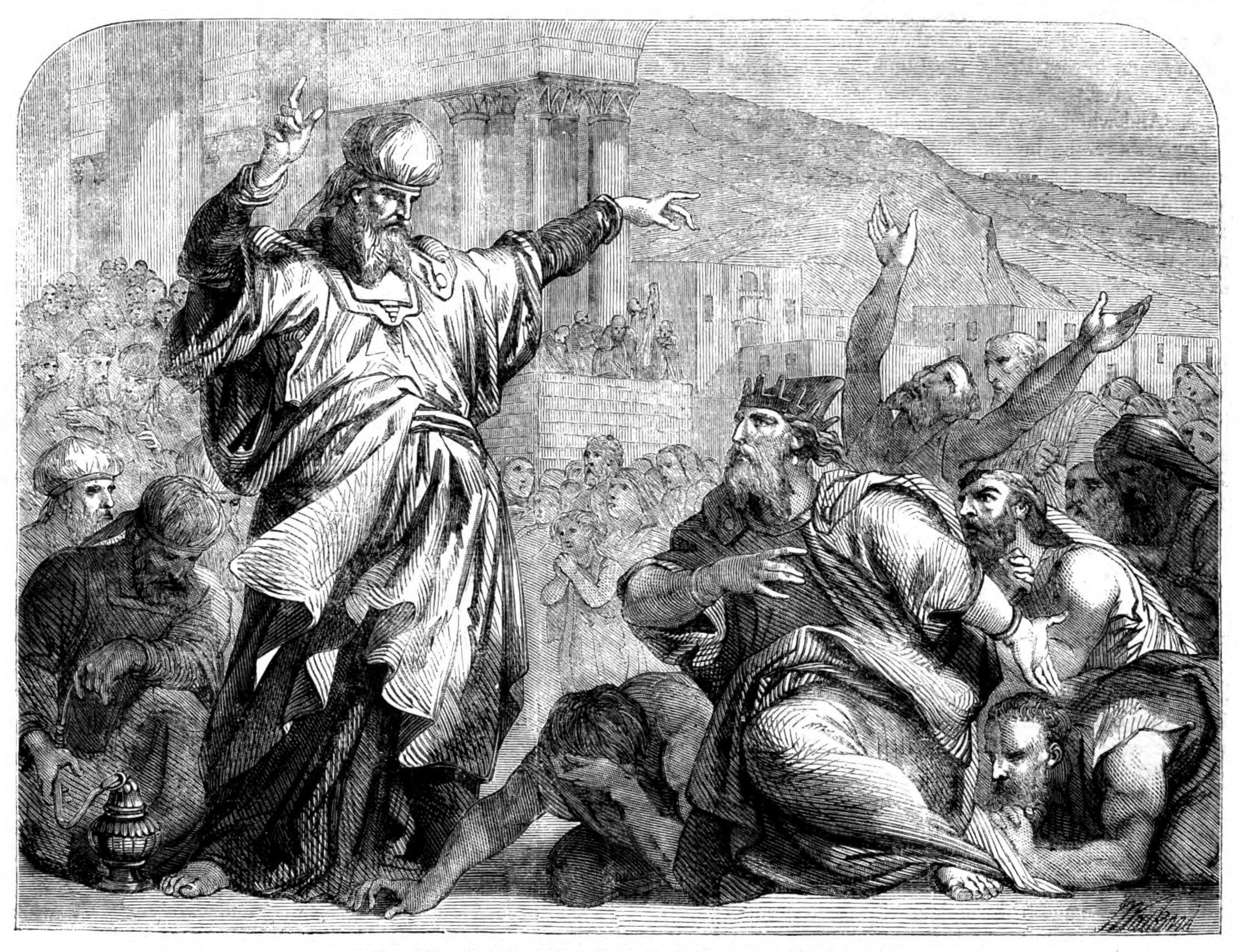
Jehoshaphat and the People Mourning, the Prophecy of Jahaziel, 1860s. Public domain.
1 Kings 22 and 2 Chronicles 17 to 20 · Person · Featured Study
Jehoshaphat
Jehoshaphat son of Asa was king of Judah in the days of Ahab and made peace with Israel.
Our God, will You not judge them? For we are powerless before this vast army that comes against us. We do not know what to do, but our eyes are upon You.”
- Family
- father: Asa; mother: Azubah daughter of Shilhi; son: Jehoram; grandson: Ahaziah
- Places
- Jerusalem, Tekoa, En-gedi
- First named
- 1 Kings 15:24 “…father David, and his son Jehoshaphat reigned in…”
- Last named
- Matthew 1:8 “Asa was the father of Jehoshaphat, Jehoshaphat the…”
He sent singers out ahead of his army, and the battle was over before Judah reached it.
Summary
Jehoshaphat became king at thirty-five and reigned twenty-five years in Jerusalem. He sent teachers of the Law through Judah and set judges in its cities. He married his son to a daughter of Ahab, and two prophets spoke against his alliances with Ahab's house.
- Jahaziel told Judah that the battle was God's.
- His ships for Ophir were wrecked at Ezion-geber.
- He marched with Jehoram of Israel against Moab.
Where Jehoshaphat Stands in Scripture
Kings gives the frame of his reign, and Chronicles tells it at length.
Matthew names him in the line of David.
Asa was the father of Jehoshaphat, Jehoshaphat the father of Joram, and Joram the father of Uzziah.And Jehoshaphat walked in all the ways of his father Asa; he did not turn away from them, but did what was right in the eyes of the LORD. The high places, however, were not removed; the people still sacrificed and burned incense on the high places.Kings praises him and names the one thing he left undone.
His Reign, Turn by Turn
His reign is drawn from Kings and Chronicles together.
His reign began in Ahab's fourth year and ran into the reign of Ahab's son Jehoram.
- Becomes king in Ahab's fourth yearJerusalem1 Kings 22:41 to 42
- Puts troops in the fortified citiesthe cities of Judah and Ephraim2 Chronicles 17:2
- Sends officials, Levites and priests out, in his third yearthe towns of Judah2 Chronicles 17:7 to 9
- Allies himself with Ahab by marriageJudah2 Chronicles 18:1
- Goes with Ahab to warRamoth-gilead2 Chronicles 18:2 to 3
- Rebuked by Jehu son of HananiJerusalem2 Chronicles 19:2
- Appoints judgesthe fortified cities and Jerusalem2 Chronicles 19:5 to 8
- Proclaims a fast as Moab and Ammon comeJerusalem2 Chronicles 20:3
- Blesses the LORD after the victorythe Valley of Beracah2 Chronicles 20:26
- His ships are wreckedEzion-geber2 Chronicles 20:36 to 37
- Marches against Moab with Jehoram and the king of Edomthe Desert of Edom2 Kings 3:7 to 9
Of these turns only the sending of the teachers is dated by a year of his own reign; the others stand in the order the text gives them.
Appoints judges, Proclaims a fast as Moab and Ammon come, Blesses the LORD after the victory, His ships are wrecked, Marches against Moab with Jehoram and the king of Edom
From the Teachers to the Ships
Five turns of his reign, told in the order of 2 Chronicles 17 to 20.
Chronicles sets his reforms beside his alliances, and a prophet speaks to him over each alliance.
The Law taught in the towns2 Chronicles 17:1 to 13
In his third year five officials went out with nine Levites and two priests.
They taught throughout Judah, taking with them the Book of the Law of the LORD. They went throughout the towns of Judah and taught the people.The seer's rebuke2 Chronicles 18:1 to 19:3
Jehu son of Hanani the seer went out to confront him and said to King Jehoshaphat, “Should you help the wicked and love those who hate the LORD? Because of this, the wrath of the LORD is upon you. However, some good is found in you, for you have removed the Asherah poles from the land and have set your heart on seeking God.”Judges in the land2 Chronicles 19:4 to 11
He went out again among the people from Beersheba to the hill country of Ephraim, and in Jerusalem he set Levites, priests and heads of families to judge.
Then he said to the judges, “Consider carefully what you do, for you are not judging for man, but for the LORD, who is with you when you render judgment. And now, may the fear of the LORD be upon you. Be careful what you do, for with the LORD our God there is no injustice or partiality or bribery.”The battle Judah did not fight2 Chronicles 20:1 to 30; Albert Barnes and Matthew Henry
Moab, Ammon and men from Mount Seir came against him as far as En-gedi. He proclaimed a fast throughout Judah, and Albert Barnes comments on the fast.
“General fasts had been previously observed by the Israelites (e. g. Jdg 20:26; 1Sa 7:6); but we do not hear of any fast having been ‘proclaimed’ by authority before this.”
Albert Barnes · Notes, Explanatory and Practical, on the Old and New Testaments (1832-1869) · on 2 Chronicles 20:3Evangelical
Matthew Henry explains the order of march.
“By this strange advance towards the field of battle, Jehoshaphat intended to express his firm reliance upon the word of God (which enabled him to triumph before the battle), to animate his own soldiers, to confound the enemy, and to engage God on their side; for praise pleases God better than all burnt offering and sacrifice.”
Matthew Henry · Commentary on the Whole Bible · on 2 Chronicles 20:21Puritan
The moment they began their shouts and praises, the LORD set ambushes against the men of Ammon, Moab, and Mount Seir who had come against Judah, and they were defeated. The Ammonites and Moabites rose up against the inhabitants of Mount Seir, devoting them to destruction. And when they had made an end to the inhabitants of Seir, they helped to destroy one another.The ships of Tarshish1 Kings 22:48 to 49; 2 Chronicles 20:35 to 37
He joined Ahaziah king of Israel in building them, and Eliezer of Mareshah prophesied against the alliance.
At that time Ahaziah son of Ahab said to Jehoshaphat, “Let my servants sail with your servants,” but Jehoshaphat refused.Peace Between the Two Kingdoms
Judah and Israel had been at war since the days of Rehoboam.
Jehoshaphat also made peace with the king of Israel.Albert Barnes, in his Notes on 1 Kings 22:44, places the peace early in the reign, about his eighth or ninth year. He holds that it closed a long series of wars, perhaps sealed by the marriage of Jehoram and Athaliah.
The Family of Jehoshaphat
The family runs across four generations, from Asa to his grandson Ahaziah.
The next two kings of Judah were his son and his grandson.
Generation 1
Generation 2
- JehoshaphatKing of Judah after Asa
Generation 3
Generation 4
- AhaziahHis grandson, king of Judah one year
Second Chronicles 21:2 names six more sons, and 2 Chronicles 21:4 says Jehoram put them all to the sword.
The Places of His Reign
Seven places mark his reign, from Ramoth-gilead in the north to Ezion-geber in the far south.
His ships lay far to the south of his capital.
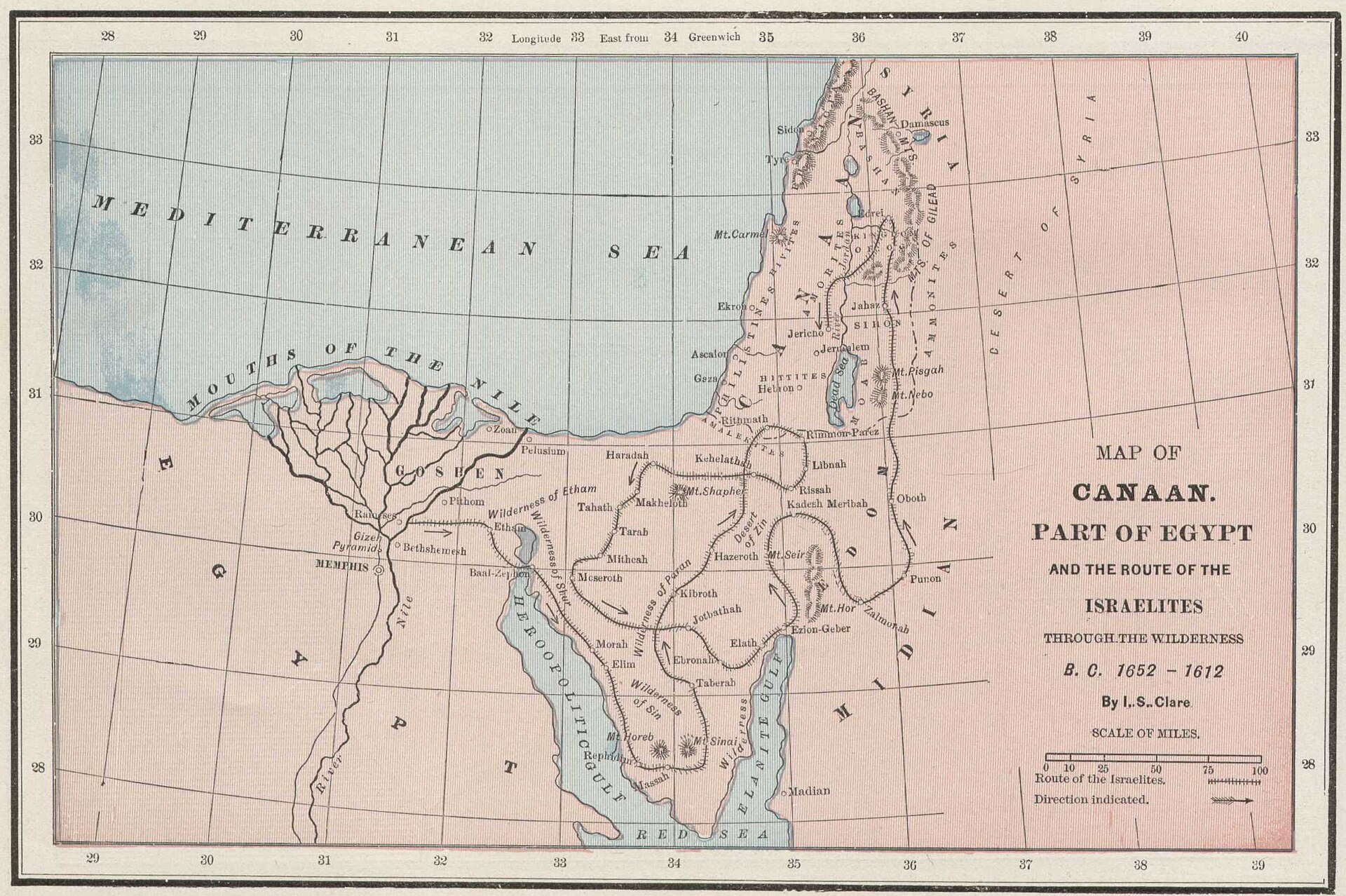
- Located: the site is known
- Identified: the point stands for an area, or is rounded
- Proposed: one candidate among several
- 1Jerusalem, His capital, where he stood in the assembly and prayed. 2 Chronicles 20:5
- 2Tekoa, The army went out to its wilderness singing. 2 Chronicles 20:20
- 3En-gedi, The armies of Moab and Ammon had reached it, called Hazazon-tamar. 2 Chronicles 20:2
- 4?Valley of Beracah, The valley took its name from that day. 2 Chronicles 20:26
- 5?Ezion-geber, His ships were wrecked there. 1 Kings 22:48
- 6Samaria, He went down there to visit Ahab. 2 Chronicles 18:2
- 7Ramoth-gilead, He went up there to war with Ahab. 2 Chronicles 18:3
Base map: The route of the Israelites through the wilderness, George F. Cram atlas plate, public domain. Places with a place page stand at its coordinates and the others at the point cited for each, set on the plate by Jerusalem and Mount Sinai, as the plate prints them.
Ramoth-gilead, Beracah and Ezion-geber are placed from the OpenBible.info identifications, Beracah at a score of 245 and Ezion-geber at 360, so both are proposed.
Questions His Reign Raises
Two questions are answered from the text.
Did he remove the high places?2 Chronicles 17:6 and 2 Chronicles 20:33
Second Chronicles 17:6 says he removed the high places and Asherah poles from Judah. Later in the same book the high places still stand, and the reason given lies with the people.
Why did Elisha answer the kings?2 Kings 3:11 to 14
Jehoshaphat asked for a prophet of the LORD when the three armies had no water, and Elisha answered for his sake and not for the king of Israel's.
What the Text Leaves Unsaid
The text leaves two things untold about him.
It does not say what the teachers of 2 Chronicles 17 taught beyond the Book of the Law.
It does not give the year of the marriage between his son and the house of Ahab.
How Scripture Reads Him
Chronicles gives his charge to the army, and Joel names a valley of judgment.
Early in the morning they got up and left for the Wilderness of Tekoa. As they set out, Jehoshaphat stood up and said, “Hear me, O people of Judah and Jerusalem. Believe in the LORD your God, and you will be upheld; believe in His prophets, and you will succeed.”Joel 3 gathers the nations to the Valley of Jehoshaphat. Jamieson, Fausset and Brown comment on the valley's name.
“As ‘Jehoshaphat’ means ‘the judgment of Jehovah,’ the valley of Jehoshaphat may be used as a general term for the theater of God's final judgments on Israel's foes, with an allusion to the judgment inflicted on them by Jehoshaphat.”
Jamieson, Fausset & Brown · Commentary Critical and Explanatory on the Whole Bible · on Joel 3:2Reformed
Voices on Jehoshaphat
Jerome and Matthew Henry wrote on his faith.
Jerome (died 420)
Against the Pelagians 2.21
Jerome, writing against the Pelagians, set Jehoshaphat beside David's first ways and not his later sins.
“Of Jehoshaphat, the king of Judah, it is written, ‘And the Lord was with Jehoshaphat, who walked in the first ways of David, his father.’ From this it is clear that Jehoshaphat possessed the justice that David first possessed and that he did not commit the sins that David later committed. ‘He trusted not in Baalim,’ he says, ‘but in the God of his father and walked in his commandments, and not according to the sins of Israel. And the Lord established the kingdom in his hand and all Judah brought presents to Jehoshaphat.”
on 2 Chronicles 17:3 to 6Patristic
Matthew Henry (1662 to 1714)
Commentary on the Whole Bible
Matthew Henry drew a lesson from his charge to the army.
“That is true courage which faith inspires a man with; nor will any thing contribute more to the establishing of the heart in shaking times than a firm belief of the power, and mercy, and promise of God. The heart is fixed that thus trusteth in the Lord, and is kept in perfect peace. In our spiritual conflicts, this is the victory, this is the prosperity, even our faith.”
on 2 Chronicles 20:20Puritan
The Alliance With the House of Ahab
A seer rebuked the alliance, and commentators weigh what it cost and what it gained.
Now Jehoshaphat had riches and honor in abundance, and he allied himself with Ahab by marriage.The alliance was his great faultMatthew Henry and John Wesley
Matthew Henry, on 2 Chronicles 20:37, reads the storm that broke the ships in port as a warning to end the alliance with Ahaziah.
John Wesley, on 2 Chronicles 19:2, traces the wrath to the invasion of Moab, to Jehoram's killing of his brothers and to Jehu's slaughter of the king's grandchildren.
The objection is that the same seer also found good in him.
The alliance served the peaceAlbert Barnes
Albert Barnes, on 2 Kings 3:7, suggests that Jehoram's removal of the worship of Baal weighed with Jehoshaphat when he joined him.
The objection is that two prophets, Jehu son of Hanani and Eliezer of Mareshah, spoke against his alliances by name.
Books to Read Next
Both works are in the public domain, and Keil's is free to read at the Internet Archive.
The Books of the Kings
C. F. Keil · 1872
Keil's commentary in the series of Keil and Delitzsch explains the Hebrew of 1 Kings 22.
Read at the Internet ArchiveCommentary Critical and Explanatory on the Whole Bible
Jamieson, Fausset and Brown · 1871
Its notes on 2 Chronicles 17 to 20 follow the teachers, the prayer in the temple court and the Valley of Beracah.
Stand Firm and See
Judah stood still and saw the salvation of the LORD.
But thanks be to God, who gives us the victory through our Lord Jesus Christ!Sources
Scripture is the Berean Standard Bible.
- Albert Barnes, Notes, Explanatory and Practical, on the Old Testament, on 1 Kings 22:44, 2 Kings 3:7 and 2 Chronicles 20:3.
- Matthew Henry, Commentary on the Whole Bible, 1710, on 2 Chronicles 20:20, 20:21 and 20:37.
- John Wesley, Explanatory Notes upon the Old Testament, 1765, on 2 Chronicles 19:2.
- Jamieson, Fausset and Brown, Commentary Critical and Explanatory on the Whole Bible, 1871, on Joel 3:2.
- Jerome, Against the Pelagians 2.21.
- C. F. Keil, The Books of the Kings, tr. James Martin, T. and T. Clark, 1872.
- OpenBible.info, Bible Geocoding Data, ancient.jsonl.
Keep Studying
Read it5
Subjects1
People and groups4