
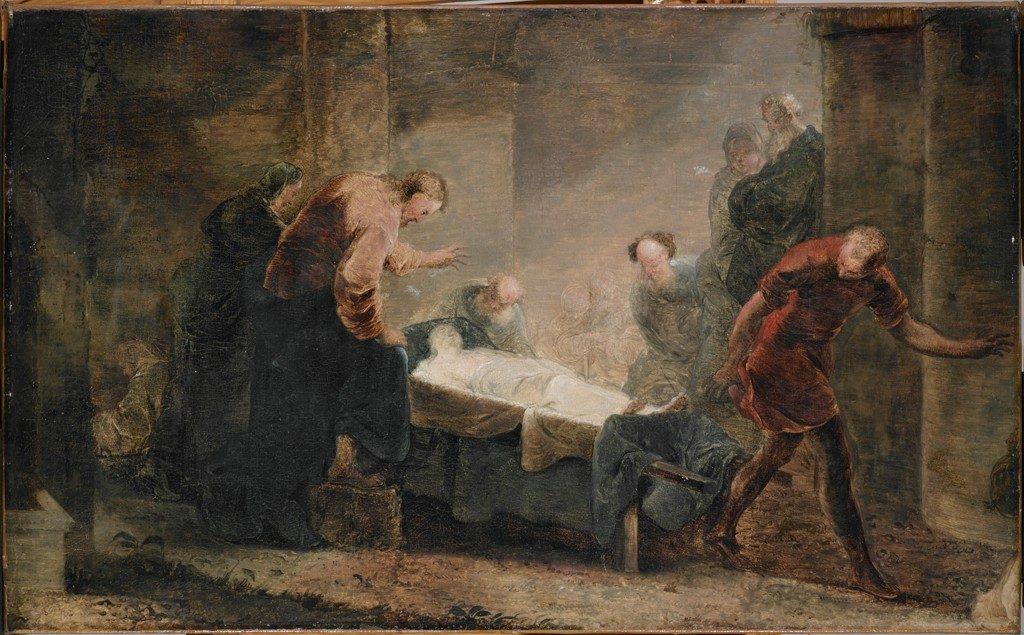
Johannes Zick, Jesus Raises the Widow's Son at Nain, 1752. Public domain.
Luke 7:11 to 17 · Story · Featured Study
The Widow of Nain
Luke sets the story in Galilee, soon after Jesus healed a centurion's servant.
When the Lord saw her, He had compassion on her and said, “Do not weep.”
- Where
- Nain
- Who
- Jesus of Nazareth
- When
- Luke 7:11 to 17
No one asked Jesus for help, and He stopped the funeral Himself.
Summary
Jesus came to the town of Nain as a funeral came out of its gate. The dead man was the only son of a widow. Jesus felt compassion for her and told her not to weep. He touched the coffin, told the young man to get up, and gave him back to his mother.
- Luke alone tells this story, the first raising of the dead in his Gospel.
- Jesus gave the son back to his mother, as Elijah had done for the widow at Zarephath.
- Gregory of Nyssa wrote that the widow had lost her last hope of children.
The Funeral at the Gate
Two crowds met at the town gate, one following Jesus and one following the dead man.
Jesus went to a town called Nain with His disciples and a large crowd (Luke 7:11).
As He approached the town gate, He saw a dead man being carried out, the only son of his mother, and she was a widow. And a large crowd from the town was with her.Luke names the three facts that made this death so heavy: an only son, a mother, and a widow.
Jamieson, Fausset and Brown explain that the dead were buried outside the towns, usually on the same day they died. Matthew Henry noted that the two crowds made the miracle as well witnessed as it could be.
Nain and the Prophets' Towns
Bede placed Nain two miles south of Mount Tabor, near Endor.
Jesus raised the widow's son at Nain, a short way from Shunem, where Elisha raised a boy.
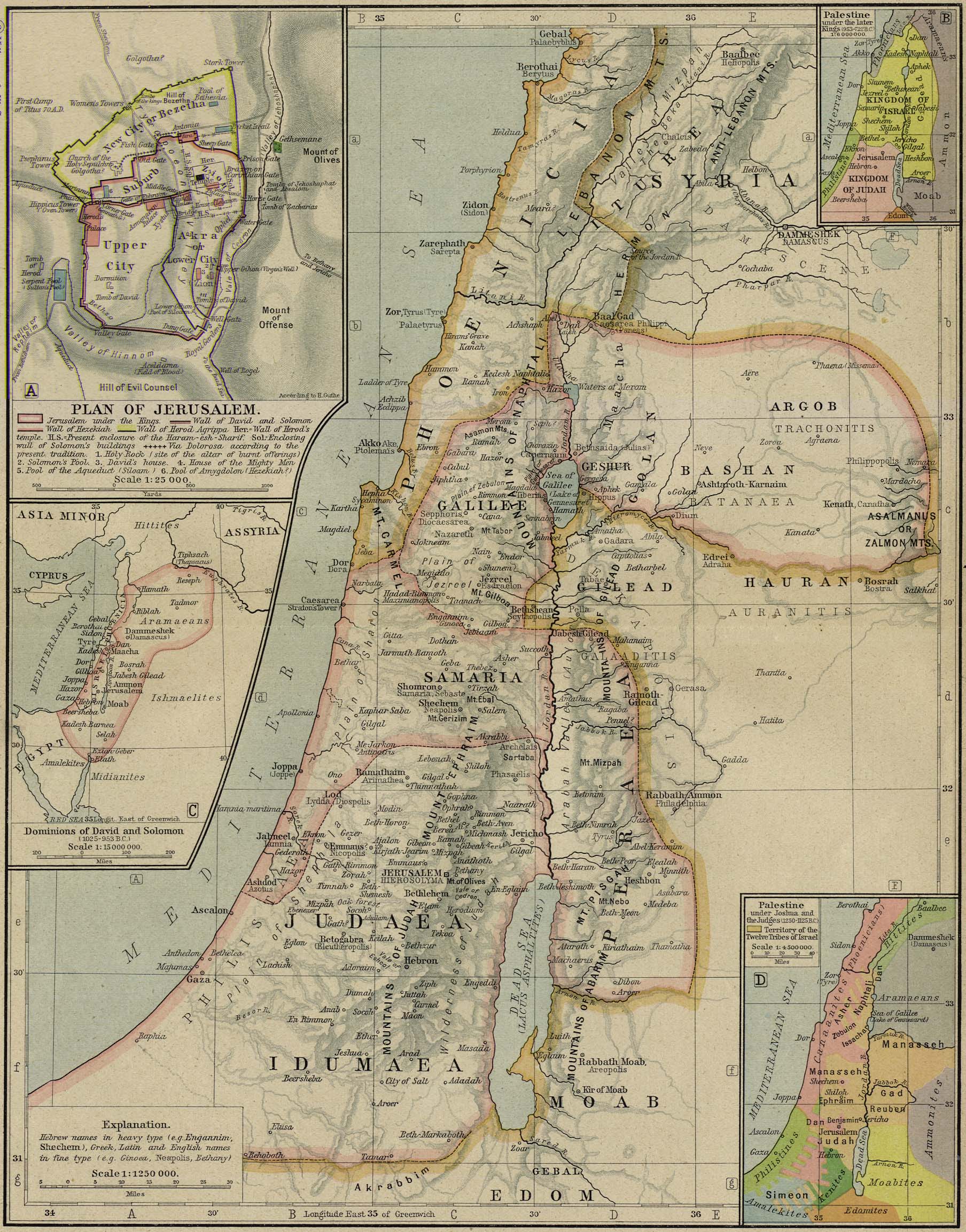
- Located: the site is known
- Identified: the point stands for an area, or is rounded
- 1Nain, The raising by Jesus, Luke 7:11
- 2Shunem, The raising by Elisha, in the woman's house, 2 Kings 4:8
- 3Zarephath, The raising by Elijah, in the widow's house, 1 Kings 17:9
- 4Mount Tabor, Bede's first landmark for Nain, Bede on Luke 7:11
- 5Endor, Bede's second landmark for Nain, Bede on Luke 7:11
Base map: Reference map of ancient Palestine, Rand McNally reference map (1926), public domain. Places with a place page stand at its coordinates and the others at the point cited for each, set on the plate by Jerusalem and Damascus, as the plate prints them.
Endor stands at Khirbet es Safsafa, the site OpenBible.info identifies with a score of 757 of 1,000.
The Touch and the Word
Titus of Bostra explained what the two signs of life prove.
Then He went up and touched the coffin, and those carrying it stood still. “Young man,” He said, “I tell you, get up!” And the dead man sat up and began to speak! Then Jesus gave him back to his mother.These verses hold the raising and the two signs of life.
Titus of Bostra noted that the young man rose at once, with no delay and no prayer. He took the speaking and the return home as the signs of a true resurrection.
Elijah at Zarephath and Elisha at Shunem
Two prophets of Israel had raised a dead son and given him back to his mother.
Elijah laid the dead boy on his own bed and cried to the LORD for his life (1 Kings 17:19 to 21).
Then Elijah took the child, brought him down from the upper room into the house, and gave him to his mother. “Look, your son is alive,” Elijah declared.Luke's words for the son's return, "gave him back to his mother", follow this verse.
A Great Prophet Has Appeared
The crowd's answer put Jesus beside the prophets of Israel.
A sense of awe swept over all of them, and they glorified God. “A great prophet has appeared among us!” they said. “God has visited His people!”The verse gives the crowd's verdict, which the story builds to.
Matthew Henry took the crowd to mean the great prophet they had long looked for. Tertullian noted that they gave the glory to the God whose people they were. Their prophets had come from Him.
An Only Son and a Widowed Mother
The son's death left his mother a widow with no other child.
Matthew Henry called her loss breach upon breach, because she was already a widow.
Three Ways the Raising Has Been Read
Since the second century, teachers have read the raising as a proof, a picture and a sign.
A proof of the resurrection of the bodyIrenaeus, Against Heresies, Book 5, chapter 13; Gregory of Nyssa, in Thomas Aquinas, Catena Aurea
Irenaeus asked in what bodies the widow's son and Lazarus rose, and answered that they rose in the same bodies in which they died. Gregory of Nyssa read the raisings as works that lead faith from the less wonderful to the greater, the resurrection of all.
The objection: the young man rose to die again, so his raising shows a return to this life more than the resurrection body Paul describes (1 Corinthians 15:42 to 44).
A picture of the sinner raised by repentanceAmbrose of Milan, Commentary on Luke (397); Bede, in Thomas Aquinas, Catena Aurea
Ambrose turned the scene into a call to the sinner. Bede read the coffin as the troubled conscience of a sinner, and those who carry it as the desires and companions who lead him to death.
“And if it is a grave sin that you cannot wash away with the tears of your repentance, let the mother Church weep for you, who intervenes as a widowed mother for each one as if for a single son; she sympathizes with a spiritual sorrow of nature when she sees her children urged towards death by deadly vices. We are her own flesh and blood; for there are also spiritual organs, which Paul says he has, saying: So, brother, let me have joy of you in the Lord: refresh my bowels in the Lord (Philem. 20).”
Ambrose of Milan · Commentary on Luke · on Luke 7:13 to 15Patristic
The objection: Luke tells of a real funeral and a real mother, and nothing in the telling marks the widow or the coffin as figures.
A sign that Christ's flesh gives lifeCyril of Alexandria, Commentary on Luke, Homily 36 (444)
Cyril asked why Jesus touched the coffin when one word was enough.
“He performs the miracle not only in word, but also touches the bier, to the end that you might know that the sacred body of Christ is powerful to the saving of man. For it is the body of Life and the flesh of the Omnipotent Word, whose power it possesses. For as iron applied to fire does the work of fire, so the flesh, when it is united to the Word, which quickens all things, becomes itself also quickening, and the banisher of death.”
Cyril of Alexandria · Catena Aurea by Aquinas · on Luke 7:14Patristic
The objection: Luke gives the touch no comment, and the young man rises at the word "get up" (Luke 7:14).
The Dead Are Raised
John the Baptist heard of these things and sent two disciples with a question.
Luke places the question right after the raising at Nain (Luke 7:18 to 20).
So He replied, “Go back and report to John what you have seen and heard: The blind receive sight, the lame walk, the lepers are cleansed, the deaf hear, the dead are raised, and the good news is preached to the poor.The answer points John to the works Jesus had done, the raising of the dead among them.
Sources
Scripture is the Berean Standard Bible.
- Robert Jamieson, A. R. Fausset and David Brown, Commentary Critical and Explanatory on the Whole Bible (1871), on Luke 7:12.
- Matthew Henry, Commentary on the Whole Bible (1710), on Luke 7:11, Luke 7:12 and Luke 7:16.
- Bede, On the Gospel of Luke (735), on Luke 7:11, and in Thomas Aquinas, Catena Aurea (1264), on Luke 7:14.
- Gregory of Nyssa (395), on Luke 7:12, in Thomas Aquinas, Catena Aurea (1264)
- Titus of Bostra (378), on Luke 7:14 and Luke 7:15, in Thomas Aquinas, Catena Aurea (1264)
- Tertullian, Against Marcion, Book 4 (220), on Luke 7:16.
- Irenaeus, Against Heresies, Book 5, chapter 13 (202), on Luke 7:12.
- Ambrose of Milan, Commentary on Luke (397), on Luke 7:13 to 15.
- Cyril of Alexandria, Commentary on Luke, Homily 36 (444), on Luke 7:14, and in Thomas Aquinas, Catena Aurea (1264)
Keep Studying
Studies4
People and groups4
Doctrines1
Go further9