
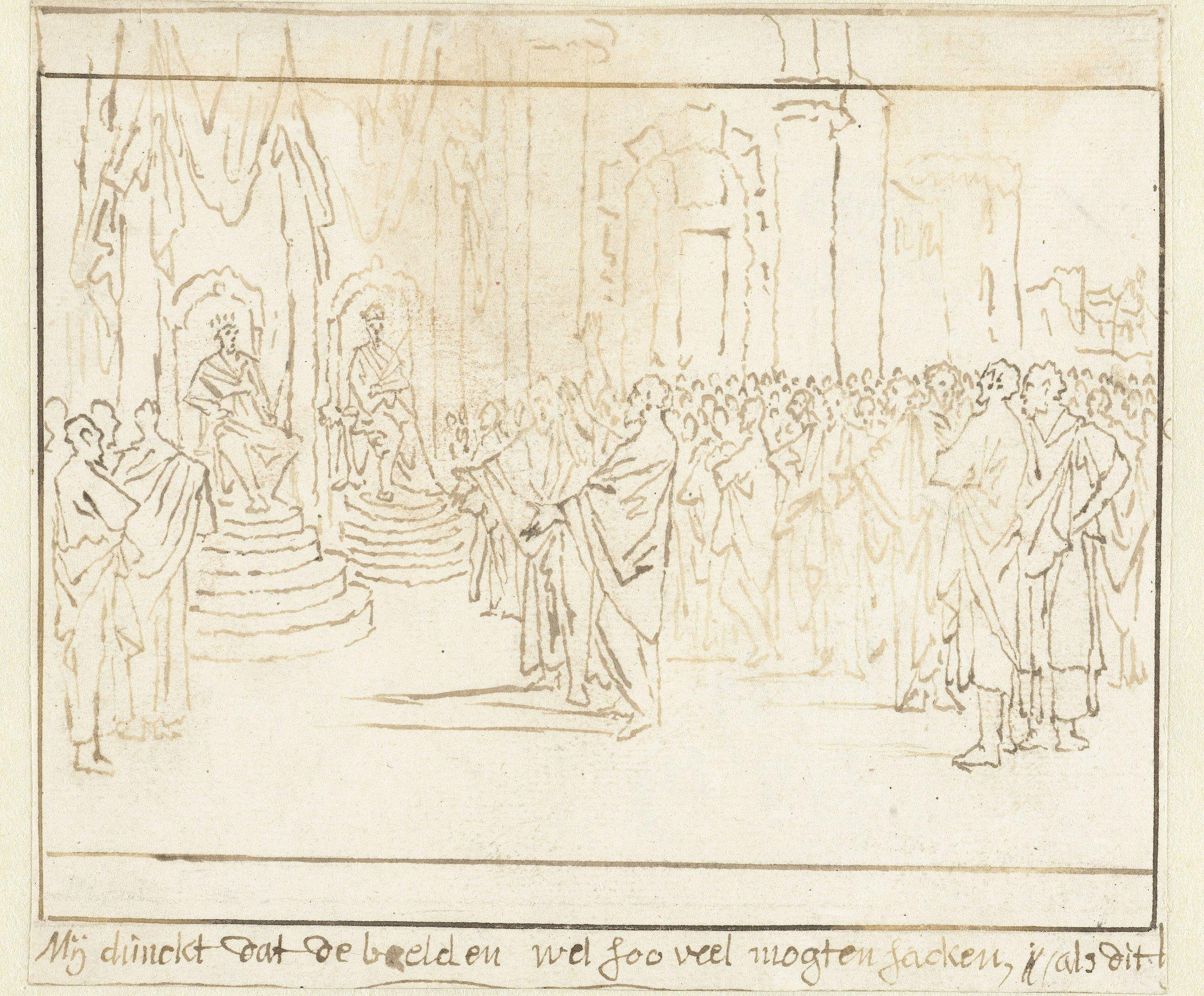
Caspar Luyken, Micaiah before Ahab and Jehoshaphat, 1710 to 1712. Public domain.
1 Kings 22 · Person · Featured Study
Micaiah son of Imlah
He was the prophet of the LORD whom Ahab hated, in the last year of Ahab's reign.
But Micaiah said, “As surely as the LORD lives, I will speak whatever the LORD tells me.”
- Family
- father: Imlah
- Places
- Samaria
- First named
- 1 Kings 22:8 “…but only bad. He is Micaiah son of…”
- Last named
- 2 Chronicles 18:27 “But Micaiah replied, “If…”
Ahab ordered him held on bread and water until the king returned safely, and the king never returned alive.
Summary
Micaiah son of Imlah spoke against the war for Ramoth-gilead when every other prophet at the gate spoke for it. Jehoshaphat of Judah asked for a prophet of the LORD, and the king of Israel named Micaiah though he hated him.
- He swore to speak only what the LORD told him, though a messenger urged him to agree with the others.
- He saw Israel scattered like sheep without a shepherd.
- He told of the LORD's council and the spirit sent to Ahab's prophets.
Where Micaiah Stands in Scripture
His father Imlah is named four times, twice in each book, and nowhere else.
Micaiah appears in 1 Kings 22 and again in 2 Chronicles 18, which tells the same day with Jehoshaphat at its centre.
He is the one prophet Jehoshaphat would accept, and the other prophets in the chapter all speak in the king's favour.
The king of Israel answered, “There is still one man who can ask the LORD, but I hate him because he never prophesies anything good for me, but only bad. He is Micaiah son of Imlah.” “The king should not say that!” Jehoshaphat replied.Jehoshaphat had asked in 1 Kings 22:7 whether a prophet of the LORD was still left to ask.
His Day, Turn by Turn
The account runs from the summons to the washing of the chariot.
Micaiah was in prison when Ahab fell at Ramoth-gilead.
- Named by Ahab as the prophet he hatesSamaria1 Kings 22:8
- Urged by the messenger to agree with the otherson the way to the gate1 Kings 22:13
- Swears to speak only the LORD's wordon the way to the gate1 Kings 22:14
- Answers in the four hundred's own wordsthe gate of Samaria1 Kings 22:15
- Tells the vision of the scattered sheepthe gate of Samaria1 Kings 22:17
- Tells the vision of the LORD's councilthe gate of Samaria1 Kings 22:19 to 23
- Struck by Zedekiah son of Chenaanahthe gate of Samaria1 Kings 22:24
- Sent to prison on bread and waterSamaria1 Kings 22:27
- Ahab is struck by an arrow and diesRamoth-gilead1 Kings 22:34 to 35
- Ahab's chariot is washedSamaria1 Kings 22:38
The last two turns took place after he was taken to prison.
Struck by Zedekiah son of Chenaanah, Sent to prison on bread and water, Ahab is struck by an arrow and dies, Ahab's chariot is washed
From the Gate to the Prison
The story runs through 1 Kings 22:1 to 38.
After three years without war, Jehoshaphat king of Judah came down to Ahab, and Ahab asked him to join in taking Ramoth-gilead back from Aram.
The four hundred1 Kings 22:5 to 12, with Albert Barnes
So the king of Israel assembled the prophets, about four hundred men, and asked them, “Should I go to war against Ramoth-gilead, or should I refrain?” “Go up,” they replied, “and the Lord will deliver it into the hand of the king.”Jehoshaphat had first asked Ahab to seek the word of the LORD.
Zedekiah son of Chenaanah made iron horns and promised that Ahab would gore the Arameans with them.
Albert Barnes, in his Notes on 1 Kings 22:7, holds that the four hundred had promised victory but not in the name of Yahweh, so Jehoshaphat asked for a true prophet.
The oath and the first answer1 Kings 22:13 to 16, with Albert Barnes
When Micaiah arrived, the king asked him, “Micaiah, should we go to war against Ramoth-gilead, or should we refrain?” “Go up and triumph,” Micaiah replied, “for the LORD will give it into the hand of the king.” But the king said to him, “How many times must I make you swear not to tell me anything but the truth in the name of the LORD?”Albert Barnes hears mockery in the first answer, a manner the king's rejoinder shows he had met before.
Two visions1 Kings 22:17 to 23
So Micaiah declared: “I saw all Israel scattered on the hills like sheep without a shepherd. And the LORD said, ‘These people have no master; let each one return home in peace.’”Moses used the same picture when he asked for a leader after him, in Numbers 27:17.
Micaiah continued, “Therefore hear the word of the LORD: I saw the LORD sitting on His throne, and all the host of heaven standing by Him on His right and on His left. And the LORD said, ‘Who will entice Ahab to march up and fall at Ramoth-gilead?’ And one suggested this, and another that. Then a spirit came forward, stood before the LORD, and said, ‘I will entice him.’ ‘By what means?’ asked the LORD. And he replied, ‘I will go out and be a lying spirit in the mouths of all his prophets.’ ‘You will surely entice him and prevail,’ said the LORD. ‘Go and do it.’Isaiah saw the Lord seated on a throne in Isaiah 6:1.
The blow and the prison1 Kings 22:24 to 28
Zedekiah struck Micaiah in the face and mocked him. Micaiah answered that Zedekiah would one day hide in an inner room.
and tell them that this is what the king says: ‘Put this man in prison and feed him only bread and water until I return safely.’” But Micaiah replied, “If you ever return safely, the LORD has not spoken through me.” Then he added, “Take heed, all you people!”Ahab gave the order of 1 Kings 22:27, and Micaiah answered it in the hearing of the people.
A Prophet in Ahab's Court
Jehoshaphat had tied his house to Ahab's by marriage.
And some years later he went down to visit Ahab in Samaria, where Ahab sacrificed many sheep and cattle for him and the people with him, and urged him to march up to Ramoth-gilead.Jehoshaphat's son Jehoram married Ahab's daughter, as 2 Kings 8:18 records.
C. F. Keil, in The Books of the Kings, holds that Ahab hated Micaiah for a belief drawn from heathen ideas of prophecy, that a god must fulfil what his prophet says. Albert Barnes, in his Notes on 1 Kings 22:13, reads the messenger's request in the same way.
Jehu son of Hanani the seer went out to confront him and said to King Jehoshaphat, “Should you help the wicked and love those who hate the LORD? Because of this, the wrath of the LORD is upon you.The marriage alliance of 2 Chronicles 18:1 had brought Jehoshaphat to Ahab's side.
The Men Around Micaiah
His father and six men of that day stand around him.
Imlah is his only kin the text names.
Generation 1
- ImlahHis father
Generation 2
- AhabKing of Israel, who hated him and sent him to prison
- JehoshaphatWanted a prophet besides the four hundred
- Zedekiah son of ChenaanahThe prophet who struck him
- AmonGovernor of the city, who received him as a prisoner
- JoashThe king's son, who received him with Amon
- The messengerThe officer who fetched him and urged him to agree
Generation 2 is Micaiah's own, and the kings and officers stand there beside him.
The Places of His Day
Two places mark his story, Samaria and Ramoth-gilead.
Micaiah spoke at Samaria, and Ahab died at Ramoth-gilead across the Jordan.
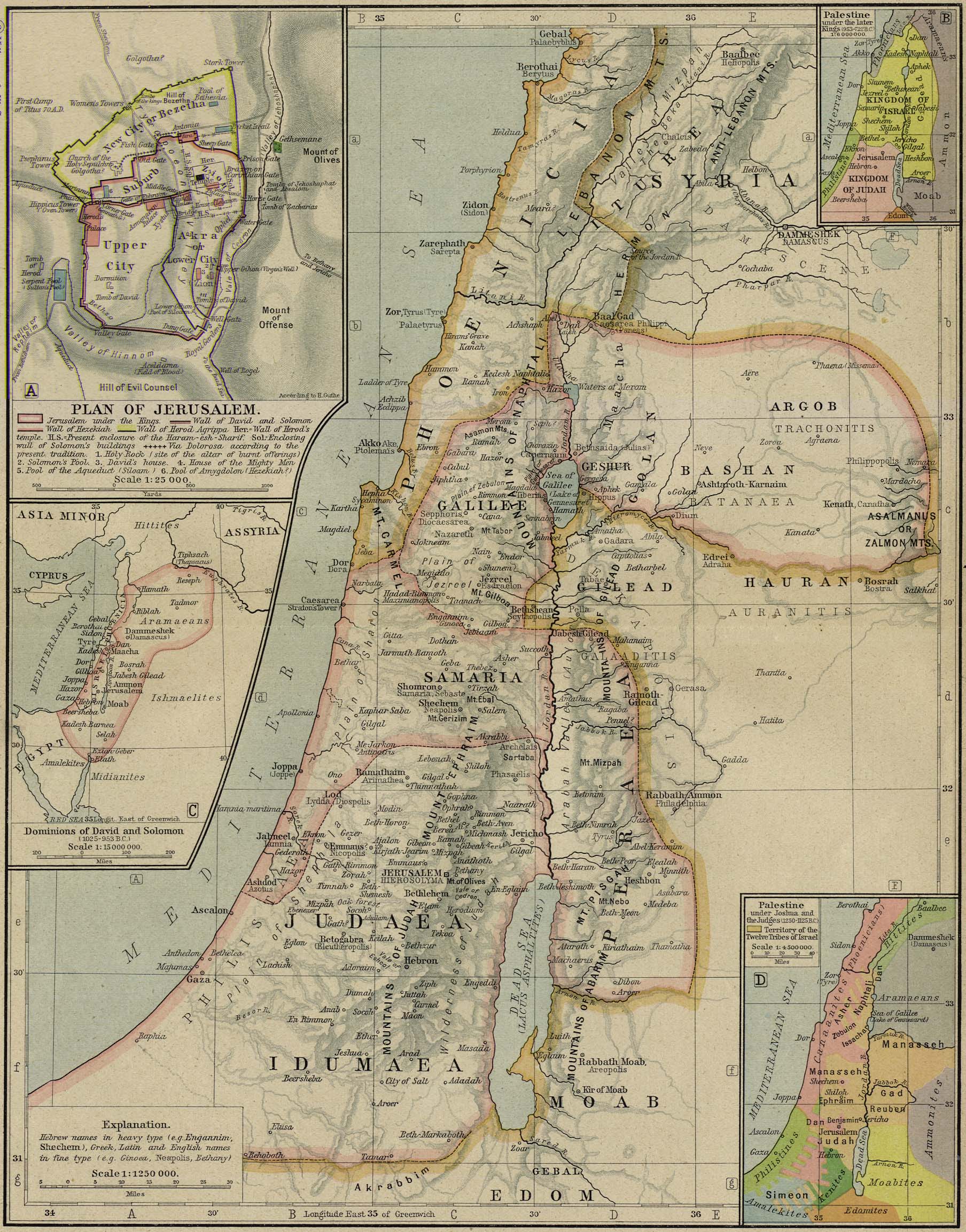
- 1Samaria, The kings sat on their thrones at the threshing floor by its gate. 1 Kings 22:10
- 2Ramoth-gilead, Ahab was struck there and died that evening. 1 Kings 22:35
Base map: Reference map of ancient Palestine, Rand McNally reference map (1926), public domain. Places with a place page stand at its coordinates and the others at the point cited for each, set on the plate by Jerusalem and Damascus, as the plate prints them.
Ramoth-gilead is marked probable at Tall er Rumeith, OpenBible.info's identification, scored 808 of 1,000.
Questions His Day Raises
An unnamed prophet and Elijah's word raise two questions.
Was Micaiah the prophet of 1 Kings 20?1 Kings 20:35 to 43, with Adam Clarke and C. F. Keil
After Ahab let Ben-hadad go, an unnamed prophet told him that his life would go for Ben-hadad's life.
Adam Clarke, in his Commentary on 1 Kings 22:8, reports that the Jews take that prophet to be Micaiah, and that Ahab hated him for that judgment. Keil names Josephus and the rabbis for the same view and calls it mere conjecture.
Where was Elijah's word fulfilled?1 Kings 21:19 and 1 Kings 22:38, with Adam Clarke
Tell him that this is what the LORD says: ‘Have you not murdered a man and seized his land?’ Then tell him that this is also what the LORD says: ‘In the place where the dogs licked up the blood of Naboth, there also the dogs will lick up your blood—yes, yours!’”Elijah spoke this to Ahab in Naboth's vineyard, by 1 Kings 21:18.
First Kings 22:38 places it at the pool of Samaria, where the chariot was washed, and calls it the word the LORD had spoken. Adam Clarke, in his Commentary on that verse, reports that some of the rabbis place it at the spot where Naboth was stoned, and Naboth's vineyard lay in Jezreel by 1 Kings 21:1.
What the Text Leaves Unsaid
Four things the text does not tell about him
The text does not say where Micaiah lived or how he was called. It does not tell what Ahab had heard from him before that day.
It does not say whether he was set free after Ahab died.
How Scripture Reads Him
Micaiah's word was judged by the law of Moses.
Before he was led away, Micaiah pointed the people to the law's test of a prophet.
When a prophet speaks in the name of the LORD and the message does not come to pass or come true, that is a message the LORD has not spoken. The prophet has spoken presumptuously. Do not be afraid of him.Moses gave this test with the promise of a prophet like himself in Deuteronomy 18:15.
Voices on Micaiah
Origen wrote on the spirit of 1 Kings 22:21 to 22.
Origen of Alexandria (died 253)
COMMENTARY ON THE GOSPEL OF JOHN 20.257-62
Origen of Alexandria, in his Commentary on the Gospel of John, used the lying spirit to teach where falsehood comes from.
“I think every evil and deceitful spirit is a lie, and whenever anyone of these speaks, it speaks from its own resources and by no means from the resources of God. And the father of these [spirits] is the liar, the devil. We will now present what moved us to say that every inferior spirit is false.”
on 1 Kings 22:21 to 22Patristic
Who Was the Lying Spirit?
Commentators read the spirit of 1 Kings 22:21 three ways.
So you see, the LORD has put a lying spirit in the mouths of all these prophets of yours, and the LORD has pronounced disaster against you.”Micaiah speaks this to Ahab before all four hundred.
An evil spirit the LORD permittedAdam Clarke
Adam Clarke holds that the LORD permitted a lying spirit to work on Ahab's prophets, and that Scripture often says God does what He only allows.
The objection is that Keil reads the LORD as sending the spirit in judgment, as 1 Kings 22:22 says.
The spirit of prophecy, sent in judgmentC. F. Keil
Keil holds that the spirit is neither Satan nor an evil spirit but the spirit of prophecy, personified. The LORD sends it to deceive Ahab as a judgment for his unbelief.
The objection is that the Speaker's Commentary, citing Job 1:6, allows that Satan may have presented himself among the host on that occasion.
A picture for human understandingJohn Wesley
Wesley holds that the scene brings divine things down to human capacity and shows the many means God has to carry out His purposes.
The objection is that Keil takes the scene as the real inward vision by which the matter was revealed to Micaiah.
Books to Read Next
Both works are in the public domain, and each has a free copy to read.
The Books of the Kings
C. F. Keil, translated by James Martin · 1872
Keil comments on 1 Kings 22 from page 273 and argues his reading of the spirit on pages 276 to 277.
Read at the Internet ArchiveThe Holy Bible with an Explanatory and Critical Commentary, volume 2
F. C. Cook, editor; Kings by George Rawlinson · 1872
Its note on 1 Kings 22:22 weighs whether the lying spirit was Satan or one of the holy angels.
Read at the Internet ArchiveThe Word That Came to Pass
Micaiah kept his oath before four hundred prophets and two kings. Paul's last letter gives Timothy the same duty.
Preach the word; be prepared in season and out of season; reprove, rebuke, and encourage with every form of patient instruction. For the time will come when men will not tolerate sound doctrine, but with itching ears they will gather around themselves teachers to suit their own desires.Paul wrote this charge from prison near the end of his life.
Sources
Scripture is the Berean Standard Bible.
- James Strong, Exhaustive Concordance of the Bible, 1890, entries H3229 and H4321.
- C. F. Keil, The Books of the Kings, translated by James Martin, T. and T. Clark, 1872, pp. 273 to 277.
- OpenBible.info, Bible-Geocoding-Data, ancient.jsonl, Ramoth-gilead.
- Albert Barnes, Notes, Explanatory and Practical, on the Old Testament, on 1 Kings 22:7, 13 and 15.
- The Holy Bible with an Explanatory and Critical Commentary (the Speaker's Commentary), volume 2, ed. F. C. Cook, John Murray, 1872, on 1 Kings 20:13 and 22:22.
- Adam Clarke, Commentary on the Bible, 1832, on 1 Kings 22:8, 23 and 38.
- John Wesley, Explanatory Notes upon the Old Testament, 1765, on 1 Kings 22:20.
- Origen of Alexandria, Commentary on the Gospel of John, 20.257 to 262.
Keep Studying
Studies1
People and groups7
Places1
Doctrines1