
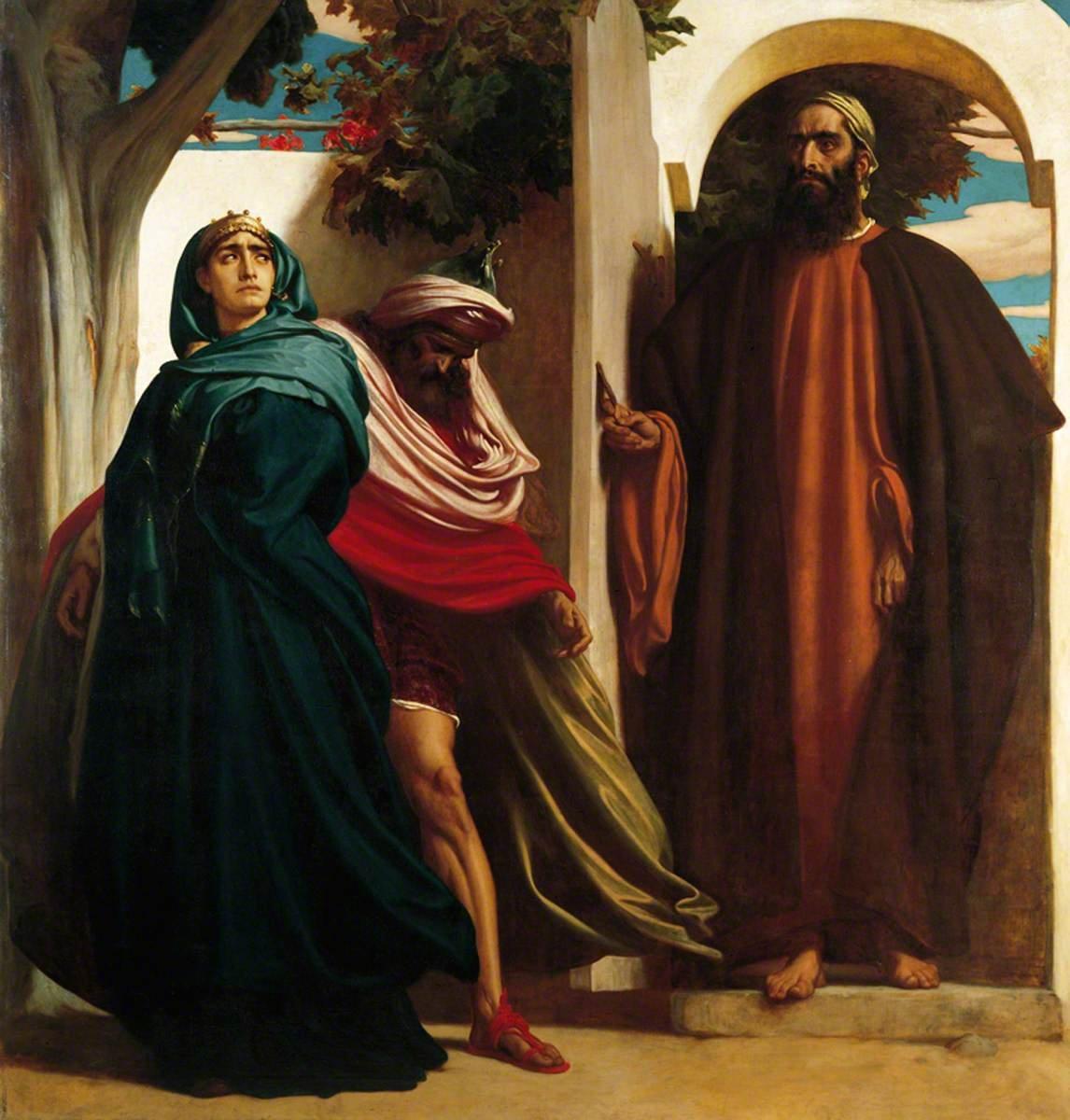
Frederic Leighton, Jezebel and Ahab, 1863. Public domain.
1 Kings 16 to 22 and 2 Kings 9 · Person · Featured Study
Ahab and Jezebel
Ahab ruled Israel from Samaria, and his queen Jezebel was a king's daughter from Sidon.
She wrote the letters in his name and sealed them with his seal.
(Surely there was never one like Ahab, who sold himself to do evil in the sight of the LORD, incited by his wife Jezebel.
- Family
- his father: Omri; her father: Ethbaal king of the Sidonians; son: Ahaziah; son: Jehoram
- Places
- Samaria, Jezreel, Mount Carmel
- First named
- 1 Kings 16:28 “…in Samaria, and his son Ahab reigned in…”
- Last named
- Revelation 2:20 “But I have this against you: You tolerate…”
Summary
Ahab became king in the thirty-eighth year of Asa of Judah and reigned twenty-two years. He brought the worship of Baal into Israel's capital. Jezebel killed the prophets of the LORD and had Naboth stoned for his vineyard. Ahab died of a wound taken in battle, and Jezebel lived on into the reign of their son Jehoram.
- Four hundred prophets of Asherah ate at Jezebel's table.
- Ahab twice defeated Ben-hadad of Aram.
- An Assyrian king counted 2,000 of Ahab's chariots.
Where Ahab and Jezebel Stand in Scripture
Ahab's reign is told in the last chapters of 1 Kings.
However, Ahab son of Omri did evil in the sight of the LORD, more than all who were before him.Their Reign, Turn by Turn
Their reign begins in Samaria, and their story ends at a window in Jezreel.
Most of the turns fall in Ahab's reign, and the last falls after it.
- Ahab becomes king in Asa's thirty-eighth yearSamaria1 Kings 16:29
- He marries Jezebel and builds Baal a templeSamaria1 Kings 16:31 to 32
- Jezebel kills the prophets of the LORDthe land of Israel1 Kings 18:4
- Elijah calls Israel and Baal's prophets to the mountainMount Carmel1 Kings 18:19
- Jezebel swears to take Elijah's lifethe royal court1 Kings 19:2
- Ben-hadad besieges the citySamaria1 Kings 20:1
- Ahab defeats Aram and makes a treaty with Ben-hadadAphek1 Kings 20:29 to 34
- Naboth is stoned and Ahab takes his vineyardJezreel1 Kings 21:13 to 16
- Ahab is brought back and buriedSamaria1 Kings 22:37
- Jezebel is thrown from a windowJezreel2 Kings 9:33
Jezebel dies after Jehu kills her son Jehoram, who reigned twelve years.
Ahab defeats Aram and makes a treaty with Ben-hadad, Naboth is stoned and Ahab takes his vineyard, Ahab is brought back and buried, Jezebel is thrown from a window
From the Marriage to the Window
Five turns of their story, from the temple of Baal to the gate of Jezreel.
Elijah stands against them in two of the five folds, and an unnamed prophet in a third.
The marriage and Baal1 Kings 16:29 to 33
After the marriage, Baal had a temple in Israel's own capital.
First, Ahab set up an altar for Baal in the temple of Baal that he had built in Samaria. Then he set up an Asherah pole. Thus Ahab did more to provoke the LORD, the God of Israel, to anger than all the kings of Israel before him.Jezebel against the prophets1 Kings 18:4 to 19:3
Obadiah, who was over Ahab's palace, hid a hundred of the LORD's prophets from Jezebel, fifty in each cave.
So Jezebel sent a messenger to Elijah, saying, “May the gods deal with me, and ever so severely, if by this time tomorrow I do not make your life like the lives of those you killed!”Elijah fled south to Beersheba when the message came.
The page Elijah on Mount Carmel tells the contest itself.
The wars with Ben-hadad1 Kings 20:1 to 43; Jamieson, Fausset and Brown
Ben-hadad of Aram came up with thirty-two kings, and a prophet promised Ahab the victory.
And the prophet said to the king, “This is what the LORD says: ‘Because you have let slip from your hand the man I had devoted to destruction, your life will be exchanged for his life, and your people for his people.’”The prophet spoke after Ahab let the beaten king go.
Jamieson, Fausset and Brown comment on the treaty at Aphek.
“Their voluntary attitude and language of submission flattered the pride of Ahab, who, little concerned about the dishonor done to the God of Israel by the Syrian king, and thinking of nothing but victory, paraded his clemency, called the vanquished king ‘his brother,’ invited him to sit in the royal chariot, and dismissed him with a covenant of peace.”
Jamieson, Fausset & Brown · Commentary Critical and Explanatory on the Whole Bible · on 1 Kings 20:32 to 34Reformed
Naboth's vineyard1 Kings 21:1 to 16; Albert Barnes
Naboth would not sell the inheritance of his fathers, and Ahab lay on his bed and would not eat. Albert Barnes gives the sense of Jezebel's answer.
“The meaning is, ‘Art thou king, and yet sufferest thyself to be thwarted in this way by a mere subject? I, the queen, the weak woman, will give thee the vineyard, if thou, the king, the strong man, wilt do nothing.’”
Albert Barnes · Notes, Explanatory and Practical, on the Old and New Testaments (1832-1869) · on 1 Kings 21:7Evangelical
The page Naboth's Vineyard tells the trial and the sentence Elijah spoke.
The end of the house2 Kings 9:30 to 37; Matthew Henry
Now when Jehu arrived in Jezreel, Jezebel heard of it. So she painted her eyes, adorned her head, and looked down from a window. And as Jehu entered the gate, she asked, “Have you come in peace, O Zimri, murderer of your master?”She called Jehu Zimri, the name of the man who killed King Elah and reigned seven days before Omri.
Matthew Henry reads the manner of her death as a judgment.
“However it was, thus she was most shamefully put to death, dashed against the wall and the pavement, and then trodden on by the horses, which were all besmeared with her blood and brains. See the end of pride and cruelty, and say, The Lord is righteous. The very dogs completing her shame and ruin, according to the prophecy.”
Matthew Henry · Commentary on the Whole Bible · on 2 Kings 9:33Puritan
The Assyrian Record
Assyria named Ahab among the kings who fought it at Karkar.
Shalmaneser III of Assyria set up a stone that tells his wars up to the battle of Karkar, in his sixth year. Its list of the kings against him, in D. D. Luckenbill's translation of 1926, names Ahab the Israelite with his chariots and soldiers.
The page Archaeology and the Bible weighs what such records prove.
The House of Ahab
The family runs across three generations, from Omri and Ethbaal to Athaliah.
Two of their sons reigned over Israel, and a daughter of Ahab married into the house of David.
Generation 1
Generation 2
Generation 3
Second Kings 8:26 names Athaliah as the mother of Ahaziah king of Judah.
The Places of Their Reign
Five places mark their story, from Sidon on the coast to Aphek in the east.
Their reign ran from two palaces, Samaria and Jezreel.
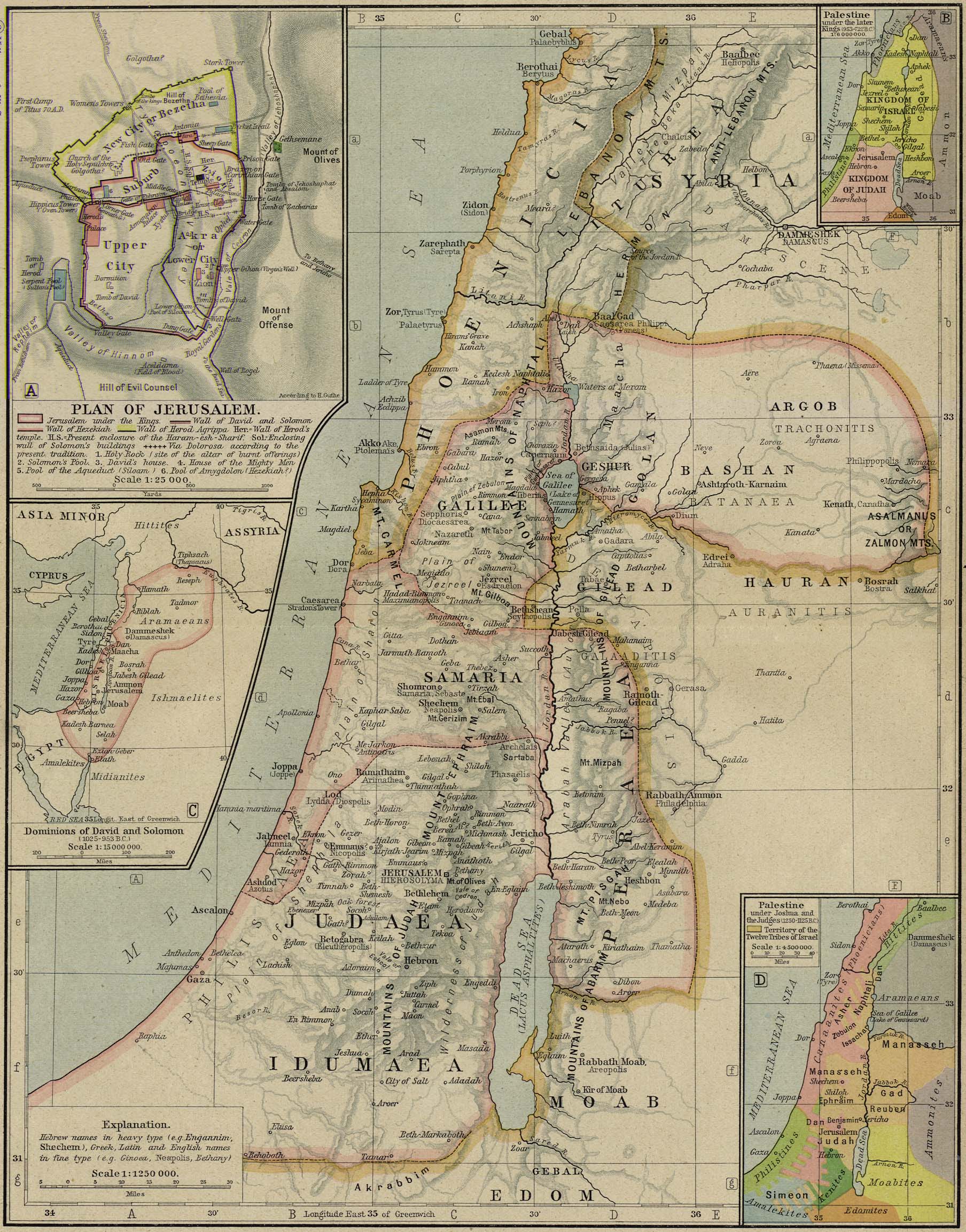
- Located: the site is known
- Identified: the point stands for an area, or is rounded
- Proposed: one candidate among several
- 1Sidon, The city of Jezebel's father, Ethbaal. 1 Kings 16:31
- 2Mount Carmel, The contest of 1 Kings 18 was held there. 1 Kings 18:19
- 3Jezreel, Naboth's vineyard lay beside Ahab's palace there, and Jezebel died there. 1 Kings 21:1
- 4Samaria, Ahab's capital and the place of his burial. 1 Kings 22:37
- 5?Aphek, The Arameans fled into the city, and its wall fell on them. 1 Kings 20:26
Base map: Reference map of ancient Palestine, Rand McNally reference map (1926), public domain. Places with a place page stand at its coordinates and the others at the point cited for each, set on the plate by Jerusalem and Damascus, as the plate prints them.
Sidon and Aphek stand at points from the OpenBible.info identifications, Aphek at a score of 435 and so proposed.
Questions Their Reign Raises
Two questions are answered here, one from a commentary and one from the text.
Who was Jezebel's father?1 Kings 16:31; Jamieson, Fausset and Brown
Jamieson, Fausset and Brown tell how her father came to rule.
“This was done through the influence of Jezebel, Ahab's queen. She was ‘the daughter of Eth-baal, king of the Zidonians.’ He was priest of Ashtaroth or Astarte, who, having murdered Philetes, king of Tyre, ascended the throne of that kingdom, being the eighth king since Hiram.”
Jamieson, Fausset & Brown · Commentary Critical and Explanatory on the Whole Bible · on 1 Kings 16:31Reformed
Why did Jezebel paint her eyes?2 Kings 9:30
Second Kings 9:30 tells what she did when she heard that Jehu had come, and it gives no reason for it.
What the Text Leaves Unsaid
The text leaves two things untold about them.
It gives no year for the marriage and no age for either of them.
It does not say whether Ahab knew of the letters before Naboth died.
How Scripture Reads Them
Revelation takes up Jezebel's name for a false prophetess at Thyatira.
In Revelation the Son of God speaks to the church at Thyatira.
But I have this against you: You tolerate that woman Jezebel, who calls herself a prophetess. By her teaching she misleads My servants to be sexually immoral and to eat food sacrificed to idols.Voices on Ahab and Jezebel
Two commentators wrote on her persecution of the prophets and on her name.
Matthew Henry (1662 to 1714)
Commentary on the Whole Bible
Matthew Henry noted what the word to Jehu charges the house of Ahab with.
“That they were idolaters was bad enough, and merited all that was brought upon them; yet that is not mentioned here, but the controversy God has with them is for their being persecutors, not so much their throwing down God's altars as their slaying his prophets with the sword.”
on 2 Kings 9:7Puritan
Jamieson, Fausset & Brown (1802 to 1910)
Commentary Critical and Explanatory on the Whole Bible
Jamieson, Fausset and Brown read the Thyatira passage through the life of the queen.
“Like her father, she was swift to shed blood. Wholly given to Baal worship, like Eth-baal, whose name expresses his idolatry, she, with her strong will, seduced the weak Ahab and Israel beyond the calf-worship (which was a worship of the true God under the cherub-ox form, that is, a violation of the second commandment) to that of Baal (a violation of the first commandment also).”
on Revelation 2:20Reformed
Was Ahab's Humbling Real?
The LORD delayed the calamity because Ahab humbled himself, and commentators part over what the humbling was.
When Ahab heard these words, he tore his clothes, put on sackcloth, and fasted. He lay down in sackcloth and walked around meekly. Then the word of the LORD came to Elijah the Tishbite, saying: “Have you seen how Ahab has humbled himself before Me? Because he has humbled himself before Me, I will not bring the calamity during his days, but I will bring it upon his house in the days of his son.”A sincere repentanceEphrem the Syrian
Ephrem the Syrian, in his commentary on 1 Kings 21:28, held that the LORD would not have praised Ahab's repentance if it had not been sincere.
The objection is that the LORD delayed the calamity and did not revoke it, so the sentence on Ahab's house stood.
An outward sorrowJohn Gill and Ambrose of Milan
John Gill, in his Exposition on 1 Kings 21:29, called it an external humiliation seen only with bodily eyes. Ambrose of Milan wrote on the same chapter in his work on Naboth.
“The rich become angry and slander in order to harm, if they do not obtain what they desire. However, when they have harmed through slander, they pretend to be sorry: yet they go forth sad and mournful, not in their hearts but in their appearance, and they seize the place of the property they have seized by their unfairness.”
Ambrose of Milan · On Naboth the Jezreelite 11.47 · on 1 Kings 21:27Patristic
The objection is that the LORD Himself says twice that Ahab humbled himself before Him.
Books to Read Next
Both works are free to read at the Internet Archive.
The Books of the Kings
C. F. Keil · 1872
Keil's commentary in the series of Keil and Delitzsch explains the Hebrew of 1 Kings 16 to 22.
Read at the Internet ArchiveAncient Records of Assyria and Babylonia, Volume 1
Daniel David Luckenbill · 1926
Luckenbill's first volume holds the records of the Assyrian kings from the earliest times to Sargon.
Read at the Internet ArchiveThe King Who Gives His Own
Ahab took a man's inheritance and his life. Jesus gave His own.
For even the Son of Man did not come to be served, but to serve, and to give His life as a ransom for many.”Sources
Scripture is the Berean Standard Bible.
- Jamieson, Fausset and Brown, Commentary Critical and Explanatory on the Whole Bible, 1871, on 1 Kings 16:31, 20:32 to 34 and Revelation 2:20.
- Albert Barnes, Notes, Explanatory and Practical, on the Old Testament, on 1 Kings 21:7.
- Matthew Henry, Commentary on the Whole Bible, 1710, on 2 Kings 9:7 and 9:33.
- Ambrose of Milan, On Naboth the Jezreelite 11.47.
- Ephrem the Syrian, On the First Book of Kings 21:28.
- John Gill, Exposition of the Old Testament, on 1 Kings 21:29.
- D. D. Luckenbill, Ancient Records of Assyria and Babylonia, vol. 1, University of Chicago Press, 1926, sections 594 and 611.
- C. F. Keil, The Books of the Kings, tr. James Martin, T. and T. Clark, 1872.
- OpenBible.info, Bible Geocoding Data, ancient.jsonl.
Keep Studying
Read it4
Studies5
People and groups9
Subjects1