
1 Kings 19:4
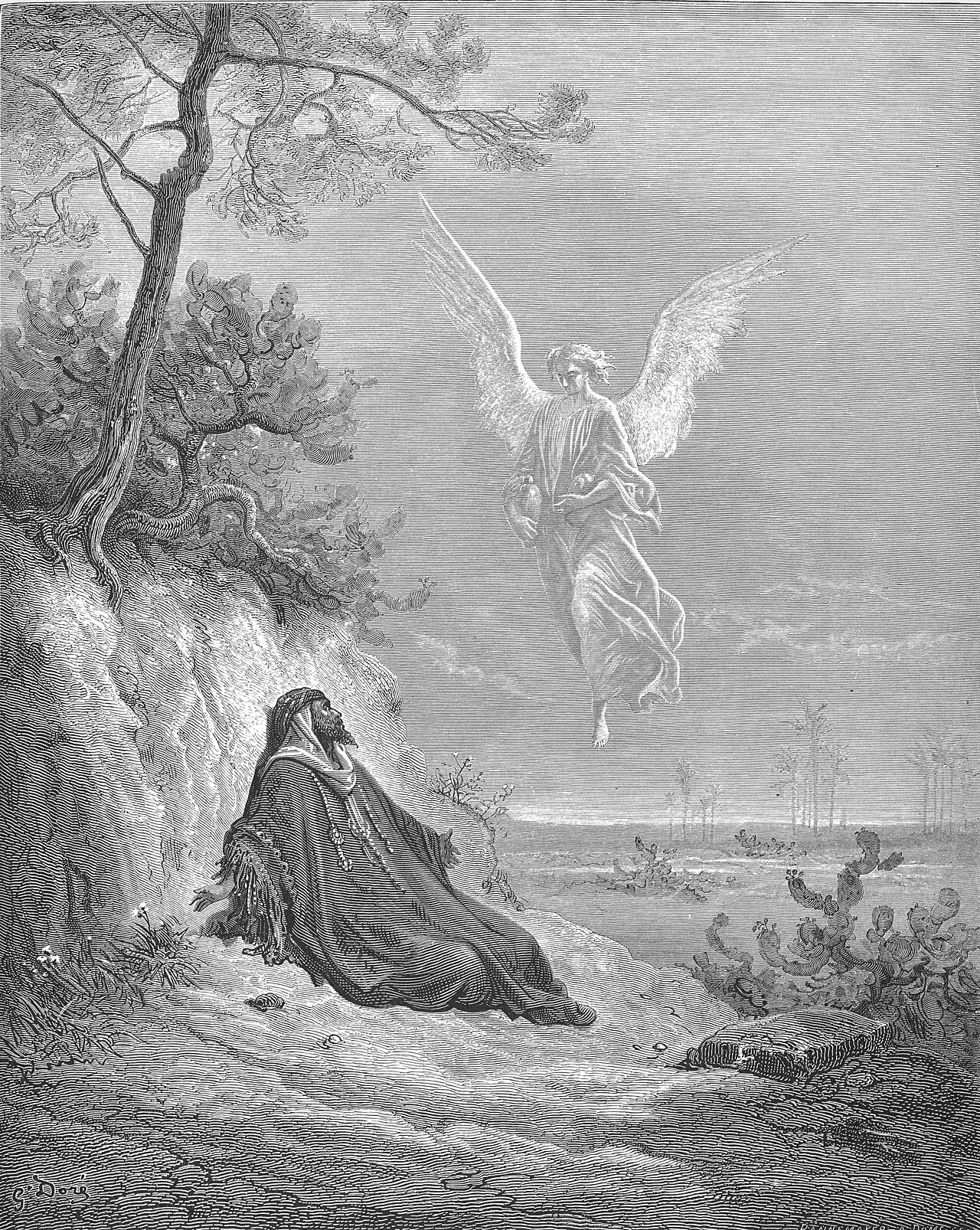
in 1 Kings 19while he himself traveled on a day’s journey into the wilderness. He sat down under a broom tree and prayed that he might die. “I have had enough, LORD,” he said. “Take my life, for I am no better than my fathers.”
BSB
The same verse in ASV and KJV ▾
ASV
But he himself went a day’s journey into the wilderness, and came and sat down under a juniper-tree: and he requested for himself that he might die, and said, It is enough; now, O Jehovah, take away my life; for I am not better than my fathers.
KJV
But he himself went a day’s journey into the wilderness, and came and sat down under a juniper tree: and he requested for himself that he might die; and said, It is enough; now, O Lord, take away my life; for I am not better than my fathers.
⋯
This verse in 1 Kings 19
Commentary
14 notes on this verseElijah, whom John the Baptist followed in spirit and virtue and who caused fire to fall from heaven and the waters of the Jordan to part by his prayers, was afraid of Jezebel and fled, and exhausted, he sat down in the wilderness under a tree, and, wearied from walking, he prayed for death, saying, "It is enough for me, Lord, take away my soul, for I am no better than my ancestors." Who can deny that he was a just man?
This site's exposition
he arose, and went for his life
on 1 Kings 19:3-4
The man who faced four hundred and fifty prophets alone on Carmel now travels a day into the wilderness at one woman's threat and sits under a juniper tree asking to die. Great faith is not always equally strong, as Henry notes of this very collapse. Elijah's plea, it is enough, and his reason, I am not better than my fathers, set him beside Moses and Jonah among the prophets who asked the Lord to end their lives rather than carry on the calling.
This site's exposition
sat down under a broom tree
John Wesley reads the flight beyond Beersheba as distrust of Judah, whose king was allied with Ahab. Jerome held up Elijah here as a righteous man who still gave way to fear and weariness. Matthew Henry sets the prayer beside Job's wish to die.
The record, by era
The Church Fathers2 voices
To be sure, it was not a woman that such a great prophet was fleeing, but it was this world. And it was not death that he feared, for he offered himself to the one that searched for him and said to the Lord, "Take my soul." He endured a weariness of this life, not a desire for it, but he was fleeing worldly enticement and the contagion of filthy conduct and the impious acts of an unholy and sinful generation.
"He came and sat down under a solitary broom tree. He asked that he might die." He hopes for death, but not for the one with which Jezebel had threatened him, that is, the one that would have given the prophets of Baal the pretext …
The Puritans and the Awakening3 voices
Into the wilderness - The vast wilderness of Arabia. He durst not stay in Judah, tho' good Jehosaphat reigned there, because he was allied to Ahab, and was a man of an easy temper, whom Ahab might circumvent, and either by force or art seize upon Elijah.
He requested for his life (so it is in the margin), that he might die; for death is life to a good man; the death of the body is the life of the soul. Yet that was not the reason why he wished to die; it was not the deliberate desire of grace, as Paul's, to depart and be with Christ, but the passionate wish of his corruption, as Job's.
) God answered him not according to his folly, but was so far from letting him die that he not only kept him alive then but provided that he should never die, but be translated.
quarantine:debris (2026-07-29) — leading-punctuation+unbalanced-parens
6 more voices on this verse
The Puritans and the Awakening1 voice
But he himself went a day's journey into the wilderness,....
The Nineteenth Century5 voices
A commentator
Jamieson, Fausset & Brown1802–1910
Commentary Critical and Explanatory on the Whole Bible (1871)
proposed
In the solitude of Sinai, God appeared to instruct him. "What doest thou here, Elijah?" was a searching question addressed to one who had been called to so arduous and urgent a mission as his.
A commentator
Charles Spurgeon1834–1892
The Metropolitan Tabernacle Pulpit, Sermon No. 2725: “Elijah Fainting” (lightly modernized text, CCEL edition) · Written before 1892.
proposed
WHEN we read the Scriptures in our youth, we are often astonished at the peculiar conditions in which we find even good men. It is difficult for us to understand why David could be in such sore distress and why such a man as Elijah could be so dreadfully downcast.
A commentator
Charles Spurgeon1834–1892
The Metropolitan Tabernacle Pulpit, Sermon No. 2725: “Elijah Fainting” (lightly modernized text, CCEL edition) · Written before 1892.
proposed
WHEN we read the Scriptures in our youth, we are often astonished at the peculiar conditions in which we find even good men. It is difficult for us to understand why David could be in such sore distress and why such a man as Elijah could be so dreadfully downcast. As we get older and become more experienced, as trials multiply around us and our inner life enters upon a sterner conflict—as the babe grows to manhood and, therefore, is entrusted with heavier tasks, we can better understand why God allowed His ancient servants to be put into such peculiar positions, for we find ourselves in similar places—and we are relieved by discovering that we are walking along a path which others have traversed before us. It might puzzle us to tell why Elijah should get under a juniper bush. We can understand his attitude on Mount Carmel and comprehend his hewing the Prophets of Baal in pieces, but we ask, in perplexity, "What are you doing here, Elijah, under a juniper, or away there in a cave on the hillside?" But when we get under the juniper, ourselves, we are glad to recall the fact that Elijah once sat there—and when we are hiding away in the cave, it is a source of comfort to us to remember that such a man as this great Prophet of Israel was there before us. The experience of one saint is instructive to others. Many of those Psalms which are headed, "Maschil," or instructive Psalms, record the experience of the writer and, therefore, become the lesson book for others. I may be, at this time, addressing some of the Lord's children who have prayed Elijah's prayer. I know one who, in the bitterness of his soul, has often prayed it and, if God the Comforter shall guide me, I may be able to say something that shall help such an one in this, his time of trial.
A day’s journey into the wilderness - Probably in his way to Mount Horeb. See 1Ki 19:8. Juniper tree - A tree that afforded him a shade from the scorching sun. It is enough - I have lived long enough! I can do no more good among this people; let me now end my days.
A commentator
Albert Barnes1798–1870
Notes, Explanatory and Practical, on the Old and New Testaments (1832-1869)
proposed
Elijah did not feel himself safe until he was beyond the territory of Judah, for Ahab might demand him of Jehoshaphat 1Ki 18:10, with whom he was on terms of close alliance 1Ki 22:4. He, therefore, proceeds southward into the desert, simply to be out of the reach of his enemies. A juniper-tree - The tree here mentioned רתם rethem is not the juniper but a species of broom (Genista monosperma), called “rethem” by the Arabs, which abounds in the Sinaitic peninsula. It grows to such a size as to afford shade and protection, both in heat and storm, to travelers. Requested for himself that he might die - Like Moses and Jonah (marginal references). The prophet’s depression here reached its lowest point. He was still suffering from the reaction of overstrained feeling; he was weary with nights and days of travel; he was faint with the sun’s heat; he was exhausted for want of food; he was for the first time alone - alone in the awful solitude and silence of the great white desert. Such solitude might brace the soul in certain moods; but in others it must utterly overwhelm and crush. Thus the prophet at length gave way completely - made his prayer that he might die - and, exhausted sank, to sleep. I am not better than my fathers - i. e., “I am a mere weak man, no better nor stronger than they who have gone before me, no more able to revolutionize the world than they.”
The words behind it
25 Hebrew wordsEvery Hebrew word of this verse in the order it stands, with what it means and the door to its own study. The last column counts the times a word stands in the whole Bible: the rarer the word, the more the places it appears belong together.
| Hebrew | Sound | Meaning | Word study | In the Bible |
|---|---|---|---|---|
| וְהֽוּא־ | vehu'- | and he | H1931 → | 1879 times |
| הָלַ֤ךְ | halakh | he went | H1980 → | 1546 times |
| בַּמִּדְבָּר֙ | bamidbar | in the wilderness | H4057 → | 270 times |
| דֶּ֣רֶךְ | derekh | a journey of | H1870 → | 707 times |
| י֔וֹם | yom | a day | H3117 → | 2304 times |
| וַיָּבֹ֕א | vaiyavo' | and he came | H935 → | 2568 times |
| וַיֵּ֕שֶׁב | vaiyeshev | and he sat | H3427 → | 1079 times |
| תַּ֖חַת | tachat | under | H8478 → | 505 times |
| רֹ֣תֶם | rotem | a broom plant | H7574 → | |
| אֶחָ֑ד | ʾechat | one | H259 → | 971 times |
| וַיִּשְׁאַ֤ל | vaiyishal | and he asked | H7592 → | 171 times |
| אֶת־ | ʾet- | <obj.> | H853 → | 10935 times |
| נַפְשׁוֹ֙ | nafsho | self his | H5315 → | 754 times |
| לָמ֔וּת | lamut | to die | H4191 → | 839 times |
| וַיֹּ֣אמֶר׀ | vaiyomer | and he said | H559 → | 5305 times |
| רַ֗ב | rav | enough | H7227 → | 454 times |
| עַתָּ֤ה | ʾatah | now | H6258 → | 433 times |
| יְהוָה֙ | yahweh | O Yahweh | H3068 → | 6520 times |
| קַ֣ח | kach | take | H3947 → | 966 times |
| נַפְשִׁ֔י | nafshi | life my | H5315 → | 754 times |
| כִּֽי־ | ki- | for | H3588 → | 4482 times |
| לֹא־ | lo'- | not | H3808 → | 5168 times |
| ט֥וֹב | tov | [am] good | H2896 → | 538 times |
| אָנֹכִ֖י | ʾanokhi | I | H595 → | 359 times |
| מֵאֲבֹתָֽי׃ | meavotai | more than ancestors my | H1 → | 1212 times |
וְהֽוּא־and he
vehu'-H1931 →1879 times
הָלַ֤ךְhe went
halakhH1980 →1546 times
בַּמִּדְבָּר֙in the wilderness
bamidbarH4057 →270 times
דֶּ֣רֶךְa journey of
derekhH1870 →707 times
י֔וֹםa day
yomH3117 →2304 times
וַיָּבֹ֕אand he came
vaiyavo'H935 →2568 times
וַיֵּ֕שֶׁבand he sat
vaiyeshevH3427 →1079 times
תַּ֖חַתunder
tachatH8478 →505 times
רֹ֣תֶםa broom plant
rotemH7574 →
אֶחָ֑דone
ʾechatH259 →971 times
וַיִּשְׁאַ֤לand he asked
vaiyishalH7592 →171 times
אֶת־<obj.>
ʾet-H853 →10935 times
נַפְשׁוֹ֙self his
nafshoH5315 →754 times
לָמ֔וּתto die
lamutH4191 →839 times
וַיֹּ֣אמֶר׀and he said
vaiyomerH559 →5305 times
רַ֗בenough
ravH7227 →454 times
עַתָּ֤הnow
ʾatahH6258 →433 times
יְהוָה֙O Yahweh
yahwehH3068 →6520 times
קַ֣חtake
kachH3947 →966 times
נַפְשִׁ֔יlife my
nafshiH5315 →754 times
כִּֽי־for
ki-H3588 →4482 times
לֹא־not
lo'-H3808 →5168 times
ט֥וֹב[am] good
tovH2896 →538 times
אָנֹכִ֖יI
ʾanokhiH595 →359 times
מֵאֲבֹתָֽי׃more than ancestors my
meavotaiH1 →1212 times
A shaded row is a word that stands 400 times or fewer in the Bible.
The walk
8 stopsEach card is a verse this one points to, and under it the verses that one points to in turn. Where several paths arrive at the same place, that place is listed first: the text keeps returning to it.
Through
Numbers 11:15If this is how You are going to treat me, please kill me right now—if I have found favor in Your eyes—and let me not see my own wretchedness.”
it leads to
- Jonah 4:3
And now, O LORD, please take my life from me, for it is better for me to die than to live.”
Reached by 2 separate paths from here.
- Jonah 4:8–9
As the sun was rising, God appointed a scorching east wind, and the sun beat down on Jonah’s head so that he grew faint and wished to die, saying, “It is better for me…
- Jonah 4:3
Through
Jonah 4:3And now, O LORD, please take my life from me, for it is better for me to die than to live.”
it leads to
- Ecclesiastes 7:1
A good name is better than fine perfume, and one’s day of death is better than his day of birth.
- Numbers 11:15
If this is how You are going to treat me, please kill me right now—if I have found favor in Your eyes—and let me not see my own wretchedness.”
- Jeremiah 20:14–18
Cursed be the day I was born! May the day my mother bore me never be blessed.
- Numbers 20:3
The people quarreled with Moses and said, “If only we had perished with our brothers before the LORD!
- Jonah 4:8
As the sun was rising, God appointed a scorching east wind, and the sun beat down on Jonah’s head so that he grew faint and wished to die, saying, “It is better for me…
- Ecclesiastes 7:1
Through
Jonah 4:8As the sun was rising, God appointed a scorching east wind, and the sun beat down on Jonah’s head so that he grew faint and wished to die, saying, “It is better for me…
it leads to
- Psalms 121:6
The sun will not strike you by day, nor the moon by night.
- Psalms 121:6
Where this verse is studied
On this page
Studies4
About 1 Kings
This page draws on 11 works. Open the list of works
This page draws on Adam Clarke, Commentary on the Bible; Albert Barnes, Notes, Explanatory and Practical, on the Old and New Testaments (1832-1869); Ambrose of Milan, FLIGHT FROM THE WORLD 6.34; Charles Spurgeon, The Metropolitan Tabernacle Pulpit, Sermon No. 2725: “Elijah Fainting” (lightly modernized text, CCEL edition); Ephrem the Syrian, ON THE FIRST BOOK OF KINGS 19:4; Jamieson Fausset and Brown, Commentary Critical and Explanatory on the Whole Bible; Jamieson, Fausset & Brown, Commentary Critical and Explanatory on the Whole Bible; Jerome, Against the Pelagians 2.21; John Gill, Exposition of the Old Testament (1748-1763); John Wesley, Explanatory Notes upon the Old Testament and Matthew Henry, Commentary on the Whole Bible.