
Matthew 17:8
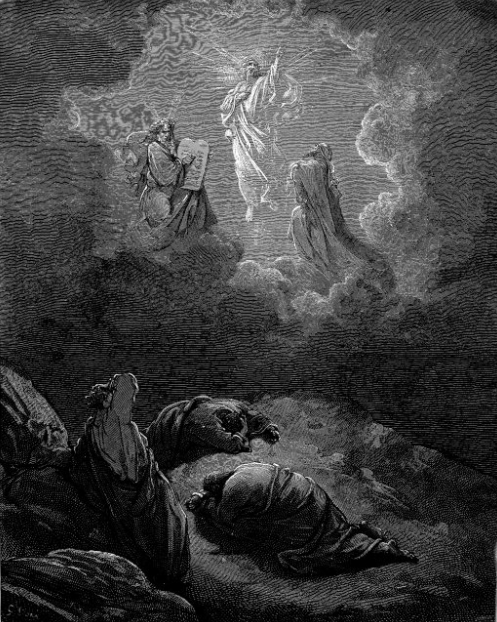
in Matthew 17And when they looked up, they saw no one except Jesus.
BSB
The same verse in ASV and KJV ▾
ASV
And lifting up their eyes, they saw no one, save Jesus only.
KJV
And when they had lifted up their eyes, they saw no man, save Jesus only.
⋯
This verse in Matthew 17
Commentary
14 notes on this verseAnd when they lifted up their eyes, they saw no man, save Jesus only; which was done with good reason; for had Moses and Elias continued with the Lord, it might have seemed uncertain to which in particular the witness of the Father was borne. Also they see Jesus standing after the cloud has been removed, and Moses and Elias disappeared, because after the shadow of the Law and Prophets has departed, both are found in the Gospel.
This site's exposition
they fell facedown in terror
on Matthew 17:6-8
The disciples fall facedown in terror at the voice, and Jesus comes over and touches them, as He touched the leper in chapter 8, saying, Get up, and, Do not be afraid. When they look up they see no one except Jesus, for Moses and Elijah have gone and He stands alone, the center of the whole vision.
This site's exposition
they saw no one except Jesus
Jerome and Theophylact both explain why the two visitors are gone when the disciples look up. With Jesus standing alone, no one could take the Father's voice of verse 5 as testimony to Moses or Elijah. John Gill sees the law and the prophets completing their work.
The record, by era
The Church Fathers3 voices
Consider the details of this passage. See if you can also say this: The disciples understood that the Son of God had been speaking with Moses. It was Moses who had said of God, "No one shall see my face and live." The disciples understood the testimony of Moses about God. They were not able to endure the radiance of the Word. They humbled themselves under the mighty hand of God.But after the touch of the Word, they lifted up their eyes. They saw Jesus only and no other. Moses, the law and Elijah the prophet had become one with the gospel of Jesus. They did not abide as they formerly were as three, but they became one. Think of these things in a spiritual sense.
(Verse 8.) But lifting up their eyes, they saw no one except Jesus alone. Reasonably, after they had risen, they saw no one except Jesus alone: lest if Moses and Elijah had continued with the Lord, the uncertain voice of the Father would be seen, to whom he would give the testimony. Therefore, they see Jesus standing, the cloud having been taken away, and Moses and Elijah had vanished: because after the shadow of the Law and the Prophets had departed, which had covered the apostles with its veil, both lights are found in the Gospel.
A commentator
John ChrysostomHomily on the Gospel of Matthew 56 · Written in the 5th century.
proposed
"And Jesus came and touched them, and said, Arise, and be not afraid. And when they lifted up their eyes, they saw no man, save Jesus only." But that the fear abiding so long might not drive out their recollection, presently He puts an end to their alarm, and is seen Himself alone, and commands them to tell no man this, until He is risen from the dead.
The Medieval Church2 voices
Then follows the effect of the strengthening: and they lifting up their eyes saw no one but only Jesus. And this is the effect of divine strengthening, because those strengthened by Christ see no one but Jesus, nor do they rejoice or find strength in …
And when they had lifted up their eyes, they saw no man, save Jesus only. He is seen to be alone, so that you will not imagine that the voice was for Moses or Elijah; indeed, the voice was for Christ, as He is the …
6 more voices on this verse
The Puritans and the Awakening2 voices
And when they had lift up their eyes,.... And "looked round about", as Mark says, to see whether the same objects still continued, as Moses and Elias; and the bright cloud: they saw no man; neither Moses nor Elias, who were both gone: signifying, that though the law and the prophets were till this time, they were now finished and completed, and the Mosaic economy was to be no more; as these men appeared no more after, nor will they till the second coming of Christ.
If sometimes we are favoured with special manifestations of divine grace, glimpses and pledges of future glory, yet they are withdrawn presently; two heavens are too much for those to expect that never deserve one. Now they saw no man, save Jesus only. Note, Christ will tarry with us when Moses and Elias are gone.
The Nineteenth Century4 voices
These verses contain one of the most remarkable events in our Lord’s earthly ministry, the event commonly called the transfiguration. The order in which it is recorded is beautiful and instructive. The latter part of the last chapter showed us the cross; here we are graciously allowed to see something of the coming reward. The hearts which have just been saddened by a plain statement of Christ’s sufferings are at once gladdened by a vision of Christ’s glory. Let us mark this. We often lose much by not tracing the connection between chapter and chapter in the Word of God.
The last words will suffice us for a text, “Jesus only.” When Peter saw our Lord with Moses and Elias, he exclaimed, “Master, it is good to be here,” as if he implied that it was better to be with Jesus, and Moses, and Elias, than to be with Jesus only.
These verses contain one of the most remarkable events in our Lord’s earthly ministry, the event commonly called the transfiguration. The order in which it is recorded is beautiful and instructive. The latter part of the last chapter showed us the cross; here we are graciously allowed to see something of the coming reward. The hearts which have just been saddened by a plain statement of Christ’s sufferings are at once gladdened by a vision of Christ’s glory. Let us mark this. We often lose much by not tracing the connection between chapter and chapter in the Word of God. There are some mysterious things, no doubt, in the vision here described. It must needs be so. We are yet in the body. Our senses are conversant with gross and material things; our ideas and perceptions about glorified bodies and dead saints must necessarily be vague and imperfect. Let us content ourselves with endeavoring to mark out the practical lessons which the transfiguration is meant to teach us. In the first place we have in these verses a striking pattern of the glory in which Christ and his people will appear when he comes the second time. There can be little question that this was one main object of this wonderful vision. It was meant to encourage the disciples by giving them a glimpse of good things yet to come. That face “shining as the sun” and that raiment “white as the light” were intended to give the disciples some idea of the majesty in which Jesus will appear to the world when he comes the second time, and all his saints with him. The corner of the veil was lifted up to show them their Master’s true dignity. They were taught that if he did not yet appear to the world in the guise of a King, it was only because the time for putting on his royal apparel was not yet come. It is impossible to draw any other conclusion from St. Peter’s language when writing on the subject.
The last words will suffice us for a text, “Jesus only.” When Peter saw our Lord with Moses and Elias, he exclaimed, “Master, it is good to be here,” as if he implied that it was better to be with Jesus, and Moses, and Elias, than to be with Jesus only. Now it was certainly good that for once in his life he should see Christ transfigured with the representatives of the law and the prophets; it might be for that particular occasion the best sight that he could see, but as an ordinary thing an ecstasy so sublime would not have been good for the disciples; and Peter himself very soon found this out, for when the luminous cloud overshadowed him, and the voice was heard out of heaven, we find that he with the rest became sore afraid. The best thing after all for Peter, was not the excessive strain of the transfiguration, nor the delectable company of the two great spirits who appeared with Jesus, but the equally glorious, but less exciting society of “Jesus only.” Depend on it, brethren, that ravishing and exciting experiences and transporting enjoyments, though they may be useful as occasional refreshments, would not be so good for every day as that quiet but delightful ordinary fellowship with “Jesus only,” which ought to be the distinguishing mark of all Christian life. As the disciples ascended the mountain side with Jesus only, and as they went back again to the multitude with Jesus only, they were in as good company as when they were on the mountain summit, Moses and Elias being there also; and although Jesus Christ in his common habiliments and in his ordinary attire might not so dazzle their eyes as when they saw his raiment bright as the light, and his face shining as the sun, yet he really was quite as glorious, and his company quite as beneficial.
The words behind it
12 Greek wordsEvery Greek word of this verse in the order it stands, with what it means and the door to its own study. The last column counts the times a word stands in the whole Bible: the rarer the word, the more the places it appears belong together.
| Greek | Sound | Meaning | Word study | In the Bible |
|---|---|---|---|---|
| ἐπάραντες | eparantes | Having lifted up | G1869 → | |
| δὲ | de | and | G1161 → | 2765 times |
| τοὺς | tous | the | G3588 → | 19766 times |
| ὀφθαλμοὺς | ophthalmous | eyes | G3788 → | 100 times |
| αὐτῶν | auton | of them | G846 → | 5565 times |
| οὐδένα | oudena | no [one] | G3762 → | 232 times |
| εἶδον | eidon | they saw | G1492 → | 374 times |
| εἰ | ei | only | G1487 → | 508 times |
| μὴ | me | except | G3361 → | 1066 times |
| αὐτὸν | auton | Himself | G846 → | 5565 times |
| Ἰησοῦν | iesoun | Jesus | G2424 → | 908 times |
| μόνον.¶ | monon | alone. | G3441 → | 110 times |
ἐπάραντεςHaving lifted up
eparantesG1869 →
δὲand
deG1161 →2765 times
τοὺςthe
tousG3588 →19766 times
ὀφθαλμοὺςeyes
ophthalmousG3788 →100 times
αὐτῶνof them
autonG846 →5565 times
οὐδέναno [one]
oudenaG3762 →232 times
εἶδονthey saw
eidonG1492 →374 times
εἰonly
eiG1487 →508 times
μὴexcept
meG3361 →1066 times
αὐτὸνHimself
autonG846 →5565 times
ἸησοῦνJesus
iesounG2424 →908 times
μόνον.¶alone.
mononG3441 →110 times
A shaded row is a word that stands 400 times or fewer in the Bible.
The walk
8 stopsEach card is a verse this one points to, and under it the verses that one points to in turn. Where several paths arrive at the same place, that place is listed first: the text keeps returning to it.
Through
Luke 9:36After the voice had spoken, only Jesus was present with them. The disciples kept this to themselves, and in those days they did not tell anyone what they had seen.
it leads to
- Matthew 17:9
As they were coming down the mountain, Jesus commanded them, “Do not tell anyone about this vision until the Son of Man has been raised from the dead.”
- Mark 9:9–10
As they were coming down the mountain, Jesus admonished them not to tell anyone what they had seen until the Son of Man had risen from the dead.
- Ecclesiastes 3:7
a time to tear and a time to mend, a time to be silent and a time to speak,
- Mark 9:6
For they were all so terrified that Peter did not know what else to say.
- Matthew 17:9
Through
Mark 9:8Suddenly, when they looked around, they saw no one with them except Jesus.
it leads to
- Acts 10:16
This happened three times, and all at once the sheet was taken back up into heaven.
- Acts 8:39–40
When they came up out of the water, the Spirit of the Lord carried Philip away, and the eunuch saw him no more, but went on his way rejoicing.
- Luke 24:31
Then their eyes were opened and they recognized Jesus—and He disappeared from their sight.
- Luke 9:36
After the voice had spoken, only Jesus was present with them. The disciples kept this to themselves, and in those days they did not tell anyone what they had seen.
- Acts 10:16
Where this verse is studied
About Matthew
This page draws on 11 works. Open the list of works
This page draws on Charles Spurgeon, The Metropolitan Tabernacle Pulpit, Sermon No. 924: “Jesus Only” (lightly modernized text, CCEL edition); J.C. Ryle, Expository Thoughts on the Gospels: Matthew; Jerome, Catena Aurea by Aquinas; Jerome, Commentary on Matthew; John Chrysostom, Homilies on the Gospel of Matthew; John Chrysostom, Homily on the Gospel of Matthew 56; John Gill, Exposition of the New Testament (1746-1748); Matthew Henry, Commentary on the Whole Bible; Origen of Alexandria, COMMENTARY ON MATTHEW 12.43; Theophylact of Ohrid, Commentary on Matthew and Thomas Aquinas, Commentary on Matthew.