
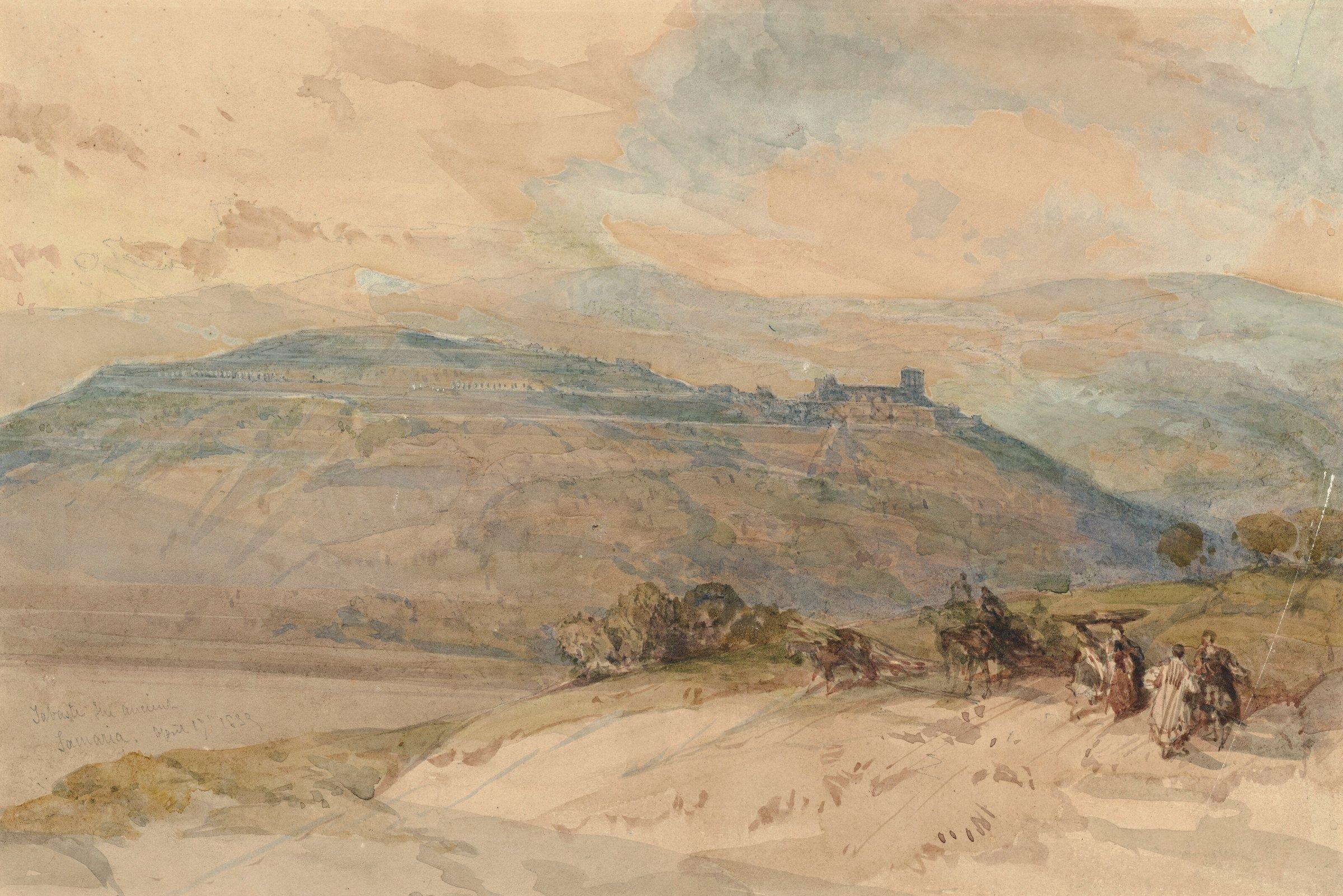
David Roberts, Distant View of Sebaste, Ancient Samaria, 1839. Public domain.
1 Kings 16 · Person · Featured Study
Omri and the Founding of Samaria
He reigned over Israel and founded a line of four kings.
He bought the hill of Samaria from Shemer for two talents of silver and built a city there, calling it Samaria after the name of Shemer, who had owned the hill.
- Family
- son: Ahab; grandson: Ahaziah of Israel; grandson: Joram of Israel; granddaughter: Athaliah
- Places
- Samaria
- First named
- 1 Kings 16:16 “…very day, all Israel proclaimed Omri, the commander…”
- Last named
- Micah 6:16 “…have kept the statutes of Omri and all…”
Omri bought a bare hill for two talents of silver and built Israel's capital on it.
Summary
Omri was the commander of Israel's army when Zimri killed King Elah. The troops proclaimed him king in their camp, and after a civil war he became king of all Israel.
- Half of Israel followed Tibni son of Ginath until Tibni died.
- He founded Samaria and was buried there.
- Scripture judges him more wicked than every king before him.
- A Moabite stele and Assyrian records name him.
Where Omri Stands in Scripture
Thirteen verses name the king, in four books.
Ten of the thirteen verses stand in 1 Kings 16, where his rise and his reign are told in fourteen verses. The other three name him beside Athaliah in 2 Kings and 2 Chronicles, and beside Ahab's house in Micah.
Omri is also named outside Scripture, on a stone of Moab and in the records of Assyria.
and the people in the camp heard that Zimri had not only conspired but had also struck down the king. So there in the camp that very day, all Israel proclaimed Omri, the commander of the army, king over Israel.Israel's army had besieged the same town in 1 Kings 15:27, when Baasha killed Nadab there.
His Life, Turn by Turn
First Kings dates his rise by the years of Asa king of Judah.
First Kings dates his proclamation to Asa's twenty-seventh year and his reign to the thirty-first.
- Proclaimed king by the troops at Gibbethon27th year1 Kings 16:15 to 16
- Marches up and besieges Tirzah27th year1 Kings 16:17
- Zimri burns the citadel over himself27th year1 Kings 16:18
- Israel divides between Omri and Tibniafter the 27th year1 Kings 16:21
- Becomes king of all Israel31st year1 Kings 16:22 to 23
- Buys the hill from Shemer and builds SamariaSamaria1 Kings 16:24
- Dies and is buried in SamariaSamaria1 Kings 16:28
- Ahab his son becomes king38th year1 Kings 16:29
Asa reigned forty-one years in Jerusalem, by 1 Kings 15:10.
Dies and is buried in Samaria, Ahab his son becomes king
From Gibbethon to Samaria
His rise runs through 1 Kings 16:15 to 24.
Zimri, commander of half the chariots, killed King Elah in Tirzah and reigned there seven days.
The army's king1 Kings 16:15 to 18, with Albert Barnes
Then Omri and all the Israelites marched up from Gibbethon and besieged Tirzah. When Zimri saw that the city was captured, he entered the citadel of the royal palace and burned it down upon himself. So he diedZimri had killed every male of Baasha's house in 1 Kings 16:11.
Albert Barnes, in his Notes on 1 Kings 16:17, reads the words marched up as the climb from the Shephelah, where Gibbethon stood, to the hill country, where Tirzah stood.
Omri and Tibni1 Kings 16:21 to 22, with Adam Clarke
At that time the people of Israel were divided: Half of the people supported Tibni son of Ginath as king, and half supported Omri. But the followers of Omri proved stronger than those of Tibni son of Ginath. So Tibni died and Omri became king.Tibni son of Ginath is named nowhere else in Scripture.
Adam Clarke, in his Commentary on 1 Kings 16:21, says the people seem to have been for Tibni and the army for Omri.
The hill of Shemer1 Kings 16:23 to 24, with Adam Clarke
Tirzah had been the seat of Israel's kings since Baasha, by 1 Kings 15:33.
Adam Clarke, in his Commentary on 1 Kings 16:24, holds that Omri founded a new city because Tirzah had suffered in the civil wars and its palace had been burned by Zimri.
Omri in the Records of Moab and Assyria
A king of Moab and three kings of Assyria name Omri.
The stele of Mesha king of Moab is a basalt stone 125 cm high, now in the Louvre (AO 5066). Klein of the Church Missionary Society found it at Dibon in 1868. The Louvre dates it to the time of Mesha, about 830 to 805 BC.
In H. F. B. Compston's edition of 1919, lines 4 to 8 read: "'Omri was king of Yisra'el, and he afflicted Mo'ab days many, for Kemos was angry with his land. And his son succeeded him ... And 'Omri possessed the land of Mehedeba."
Now Mesha king of Moab was a sheep breeder, and he would render to the king of Israel a hundred thousand lambs and the wool of a hundred thousand rams. But after the death of Ahab, the king of Moab rebelled against the king of Israel.Kings gives the tribute, and the stele gives Omri's hold on Moab.
In D. D. Luckenbill's Ancient Records of Assyria and Babylonia (1926), the Black Obelisk of Shalmaneser III reads "Tribute of Iaua (Jehu), son of Omri" (section 590). Adad-nirari III lists "Humri (Omriland, Israel)" among the lands he names (section 739). Tiglath-pileser III names "the land of Bit-Humria", the house of Omri, when he set Hoshea over it (section 816).
Jehu was not of Omri's line, for he killed Omri's grandson Joram in 2 Kings 9:24. The Assyrian title names the kingdom by the house that had ruled it.
The House of Omri
Seven people are named, across four generations.
His son, two grandsons and a great-grandson became kings.
Generation 1
- OmriKing of Israel
Generation 2
Generation 3
- Ahaziah of IsraelReigned after Ahab
- Joram of IsraelReigned after his brother Ahaziah
- AthaliahGranddaughter of Omri, mother of Ahaziah of Judah
Generation 4
- Ahaziah of JudahSon of Jehoram and Athaliah, king of Judah
Athaliah joined his line to the royal house of Judah.
The Places of His Life
Five places, from Gibbethon in the west to Dibon in Moab
His rise ran from the Philistine border to the hill country, and his rule reached Moab.
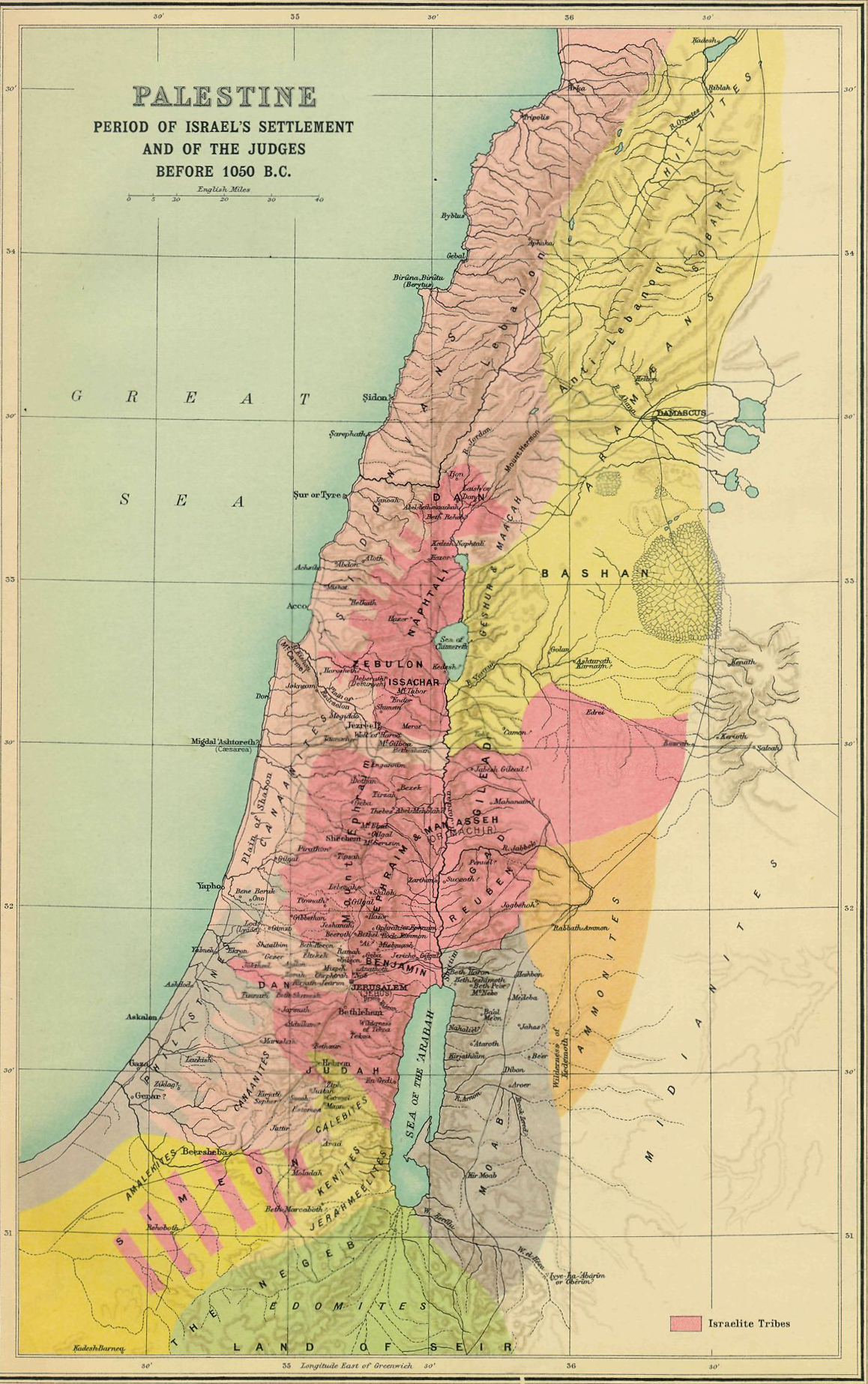
- Located: the site is known
- Identified: the point stands for an area, or is rounded
- 1Gibbethon, The army besieging the town proclaimed him king. 1 Kings 16:16
- 2Tirzah, He besieged it and took it from Zimri. 1 Kings 16:17
- 3Samaria, His capital, and the place of his burial. 1 Kings 16:28
- 4Medeba, Omri took possession of its land, by lines 7 to 8 of the stele.
- 5Dibon, The city of Mesha's stele.
Base map: Israel's settlement and the period of the Judges, George Adam Smith, Atlas of the Historical Geography of the Holy Land (1915), public domain. Places with a place page stand at its coordinates and the others at the point cited for each, set on the plate by Jerusalem and Damascus, as the plate prints them.
The points are OpenBible.info identifications with their scores out of 1,000.
Questions His Life Raises
His rival's death and his granddaughter's line raise two questions.
How did Tibni die?1 Kings 16:22, with Jamieson, Fausset and Brown, Albert Barnes and Rashi
Jamieson, Fausset and Brown say the Hebrew does not show whether his death was violent or natural. Albert Barnes, in his Notes, thinks it can scarcely have been natural and that Tibni fell in battle or was put to death.
Rashi, following Seder Olam, says Tibni was killed when Asa took a daughter of Omri as a wife for his son Jehoshaphat and the people saw how strong Omri had become.
Was Athaliah his daughter or his granddaughter?2 Kings 8:18 and 26
The Hebrew of 2 Kings 8:26 calls Athaliah a daughter of Omri, and the Berean text renders granddaughter. Second Kings 8:18 says Jehoram married a daughter of Ahab.
Ahaziah was twenty-two years old when he became king, and he reigned in Jerusalem one year. His mother’s name was Athaliah, the granddaughter of Omri king of Israel.Strong's lexicon gives the Hebrew word for daughter the same wide sense as other words of kinship.
What the Text Leaves Unsaid
The text leaves five things about him unsaid.
Scripture names no father, tribe or home for Omri, and does not tell how he rose to command the army.
It refers his might to the lost Book of the Chronicles of the Kings of Israel without telling what it was.
How Scripture Reads Him
Micah's charge against Judah reached back to Omri.
But Omri did evil in the sight of the LORD and acted more wickedly than all who were before him. For he walked in all the ways of Jeroboam son of Nebat and in his sins, which he caused Israel to commit, provoking the LORD, the God of Israel, to anger with their worthless idols.Ahab is judged in nearly the same words in 1 Kings 16:30.
You have kept the statutes of Omri and all the practices of Ahab’s house; you have followed their counsel. Therefore I will make you a desolation, and your inhabitants an object of contempt; you will bear the scorn of the nations.”Micah prophesied in the days of Jotham, Ahaz and Hezekiah, by Micah 1:1.
Voices on Omri
Matthew Henry and Albert Barnes wrote on his rise and his reign.
Matthew Henry (1662 to 1714)
Commentary on the Whole Bible
Matthew Henry, in his Commentary on the Whole Bible, set the army's choice of Omri against the war it left behind at Gibbethon.
“They did not attempt to avenge the death of Nadab upon Baasha, perhaps because the house of Baasha had ruled with more gentleness than the house of Jeroboam; but Zimri shall feel the resentments of the provoked army. The siege of Gibbethon is quitted (Philistines are sure to gain when Israelites quarrel) and Zimri is prosecuted.”
on 1 Kings 16:16Puritan
Albert Barnes (1798 to 1870)
Notes, Explanatory and Practical, on the Old and New Testaments (1832-1869)
Albert Barnes, in his Notes, gave the charge of 1 Kings 16:25 a cause.
“Omri outwent his idolatrous predecessors in his zeal, reducing the calf-worship to a regular formal system, which went down to posterity (compare the marginal reference).”
on 1 Kings 16:25Evangelical
When Did His Twelve Years Begin?
Commentators reconcile the twenty-seventh year and the thirty-first in two ways.
In the thirty-first year of Asa’s reign over Judah, Omri became king of Israel, and he reigned twelve years, six of them in Tirzah.Ahab began to reign in Asa's thirty-eighth year, by 1 Kings 16:29.
Twelve years from the camp, alone from the thirty-first yearJamieson, Fausset and Brown, Albert Barnes and Rashi
Jamieson, Fausset and Brown count the twelve years from Asa's twenty-seventh year, when the army proclaimed him. Albert Barnes reads the four years to the thirty-first as the contest with Tibni, and verse 23 as the date Omri began to reign alone. Rashi calls the thirty-first year the start of an undisputed reign, after five years of conflict counted from the twenty-seventh.
The objection is that the plain order of 1 Kings 16:23 dates the start of the reign itself, as Adam Clarke takes it.
A copyist's error for twenty-sevenAdam Clarke
Adam Clarke holds that thirty-one must be a mistake for twenty-seven, since Zimri's seven days fell in the twenty-seventh year and Omri followed him at once.
The objection is that Rashi, after Seder Olam, keeps the number as the start of the undisputed reign.
Books to Read Next
All three works are in the public domain, and each has a free copy to read.
The Inscription on the Stele of Mesa', commonly called The Moabite Stone
H. F. B. Compston · 1919
Compston gives a translation line by line, and tells how the stone was found at Dibon and its fragments recovered.
Read at the Internet ArchiveAncient Records of Assyria and Babylonia, volume 1
D. D. Luckenbill · 1926
Luckenbill translates the Assyrian inscriptions that name Omri, Jehu and the land of Bit-Humria.
Read at the Internet ArchiveThe Books of the Kings
C. F. Keil, translated by James Martin · 1872
Keil comments on the kings from Nadab to Omri, 1 Kings 15:25 to 16:28, from page 222.
Read at the Internet ArchiveA City With Foundations
Samaria stood until the king of Assyria took it in the ninth year of Hoshea. Abraham lived in tents in the land of promise, by Hebrews 11:9, and Hebrews gives his hope as the pattern of faith.
For he was looking forward to the city with foundations, whose architect and builder is God.Hebrews 11:16 adds that God has prepared a city for them.
Sources
Scripture is the Berean Standard Bible.
- James Strong, Exhaustive Concordance of the Bible, 1890, entries H6018, H8402 and H1323.
- Musée du Louvre, Stèle de Mesha, AO 5066, basalt, found at Diban, IXe s. av. J.-C. (époque de Mesha vers 830-805)
- H. F. B. Compston, The Inscription on the Stele of Mesa' commonly called The Moabite Stone, SPCK, 1919, pp. 6 and 14, lines 4 to 8 (the words the edition divides at the line ends are joined)
- D. D. Luckenbill, Ancient Records of Assyria and Babylonia, volume 1, University of Chicago Press, 1926, sections 590 (p. 211), 739 (p. 262) and 816 (p. 293)
- C. F. Keil, The Books of the Kings, translated by James Martin, T. and T. Clark, 1872.
- Rashi on 1 Kings 16:22 to 23, The Metsudah Tanach series, Lakewood, N.J. (CC-BY)
- OpenBible.info, Bible-Geocoding-Data, ancient.jsonl: Gibbethon, Tirzah, Medeba, Dibon 1.
- Matthew Henry, Commentary on the Whole Bible, 1710, on 1 Kings 16:16.
- Albert Barnes, Notes, Explanatory and Practical, on the Old and New Testaments, on 1 Kings 16:17, 22 and 25.
- Adam Clarke, Commentary on the Bible, 1832, on 1 Kings 16:21, 23 and 24.
- Jamieson, Fausset and Brown, Commentary Critical and Explanatory on the Whole Bible, 1871, on 1 Kings 16:22 to 23.
Keep Studying
Studies4
People and groups6
Places1
Doctrines1