
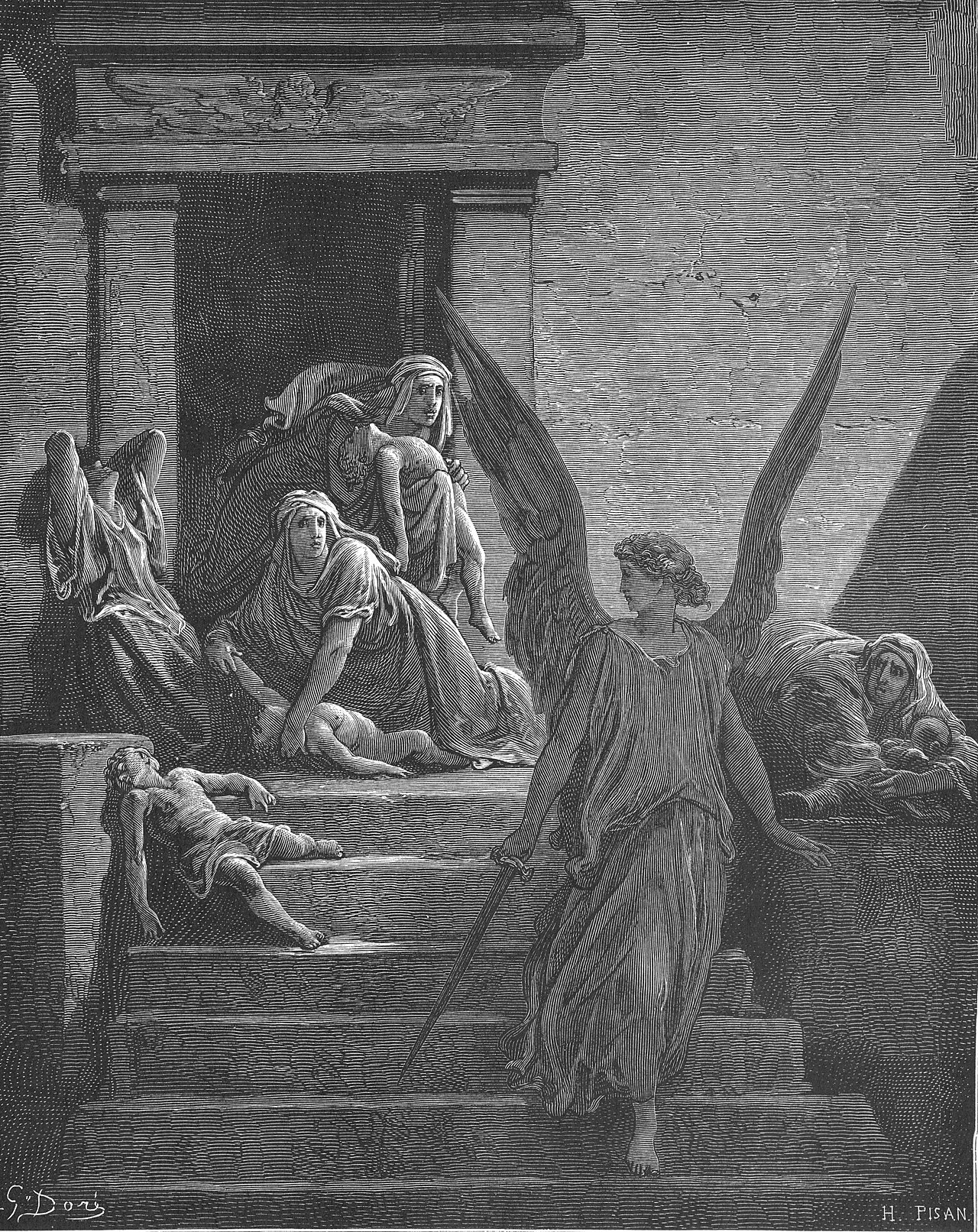
Exoduschapter 12
51 verses · Moses, by tradition · 15th or 13th century BC · The Law
The blood on the houses where you are staying will distinguish them; when I see the blood, I will pass over you. No plague will fall on you to destroy you when I strike the land of Egypt.
Introduction
Moses, by tradition, The Law, Exodus Overview.
The book names Moses as the one who wrote down the words of the LORD, and this chapter comes from the man who led a nation of slaves out of Egypt in one night. Its first hearers kept this meal every spring and knew its order by heart. The chapter sets the law of the feast beside the night the feast remembers. It is where Israel's calendar begins and where the book turns from Egypt to the road. Listen for the places where the account moves between command and event, and for the question a child is expected to ask.
Context
- Who
- Israel in the wilderness, and every generation after them that kept this meal each spring
- What
- Exodus 12 is the law of the Passover and the Feast of Unleavened Bread, given together with the account of the night the firstborn of Egypt died and Israel left.
- Where
- It takes place in Egypt and ends on the march from Rameses in the eastern Nile delta to Succoth, whose exact site is uncertain.
- When
- It falls at the exodus itself, in the spring month of Abib, which the two main datings place in the fifteenth or the thirteenth century BC, with Exodus 12:40 and 41 and 1 Kings 6:1 bearing on the date, and both datings are held.
- Why
- It founds the meal Israel kept every year to remember its rescue, and it ties that rescue to the blood of a lamb.
Historical context
The chapter is given as the LORD's own speech to Moses and Aaron in the land of Egypt, and the instructions reach the whole congregation through the elders.
Show the rest of the historical context, 5 more paragraphs
The night falls on the fourteenth day of a month the chapter makes the first of the year. The early dating puts it about 1446 BC from the four hundred and eighty years of 1 Kings 6:1 read literally, while Kenneth Kitchen and James Hoffmeier date the exodus to the thirteenth century from the store cities of Exodus 1:11, and the chapter names no Pharaoh and no year.
The place is the Israelite quarter of the eastern Delta, and by the end of the chapter the road from Rameses to Succoth.
The occasion is the last plague and the meal eaten while it passes.
A first hearer knew that the year had just been moved, so that the nation counted from the month of its deliverance, later called Abib and then Nisan. He knew what unleavened bread was for, since dough without leaven needs no rising time and a household leaving in haste carried its kneading bowls bound up in its cloaks. He knew hyssop as a common bushy herb used for sprinkling, and he knew that marking a doorway to guard a household was an idea already at home in that world, which here is God's own instruction and God's own sign. He also knew what an unblemished year-old male cost a poor family, which is why the rule that a small household joins the nearest neighbour is written into the command.
The numbers are the chapter's own, about six hundred thousand men on foot besides women and children and four hundred and thirty years of stay to the very day, and how the six hundred thousand is to be read is contested, with Colin Humphreys proposing that the Hebrew eleph stands for a clan or a military unit.
Significance
Every house that came through that night came through because a lamb had died and its blood stood on the doorframe.
Show the rest of the significance, 1 more paragraph
The command includes the children's question and the answer their fathers were to give them. Israel's central act of worship was built from the first night to be explained to the next generation.
This chapter in Jewish lifeWhat this chapter is in Jewish life and reading.
What is done
Passover, in Hebrew Pesach, is kept from this chapter, and this site's own note on it describes the evening as Jewish families keep it now. The meal is called the seder, which is the Hebrew word for order. It carries unleavened bread, bitter herbs, cups of wine and the retelling of this chapter's story, with the children asking the questions. The lamb stood at the centre of the feast while the Temple stood. The seder as it is now practised took its shape after the Temple fell in AD 70, and its oldest written outline is the Mishnah at Pesachim 10. The month this chapter sets first is the month the festival year is counted from. Rashi reads verse 2 as a lesson given by sight. God showed Moses the moon in its renewal and said that this is how the beginning of a month is known (Rashi on Exodus 12:2:1). From Passover the counting runs on toward Weeks, and this site's own note on the firstfruits describes the sheaf brought during the festival week.
How it is read
Rashi reads this chapter through the Mekhilta and the tractate Pesachim, so the law and the story come together in almost every line. At verse 6 he holds that the four days between taking the lamb and killing it were for examining it against blemish. He carries Rabbi Mathia ben Cheresh on why those days were given (Rashi on Exodus 12:6:1). At verse 13 he reads the blood as a private mark. It is "a sign, and not to others for a sign", and from that he concludes that the blood was placed inside the houses (Rashi on Exodus 12:13:1). At verse 17 he carries Rabbi Josiah's reading of the unleavened bread as a rule about time. Just as dough must not be left to rise, "so we may not let the commandment become leavened by waiting too long before we perform it" (Rashi on Exodus 12:17:1). At verse 23 he gives two senses for the verb the feast is named from, holding that it signifies sparing, and also that it can be read as leaping over (Rashi on Exodus 12:23:1). The text is the Rosenbaum and Silbermann Rashi of 1929 to 1934, in the public domain.
What the rabbis say
The rabbis take up the lamb of verse 3 at Bekhorot 12a:2 and the company that eats it at Chagigah 7b:10. On the lamb without blemish they taught at Arakhin 31b:10, and on its keeping until the fourteenth day at Arakhin 13b:2. On the eating of it they taught at Berakhot 38b:13 and Bava Metzia 115b:2, and on what is left until morning at Berakhot 9a:18. The Jerusalem Talmud carries the child's question of verses 26 and 27 at Pesachim 10:4:2 and 10:7:5.
Sources: Rashi, Rashi on Exodus 12:2:1, 12:6:1, 12:13:1, 12:17:1 and 12:23:1, Pentateuch with Rashi's commentary by M. Rosenbaum and A. M. Silbermann, 1929 to 1934 (public domain); This site's Hebraic note on Exodus 12, src/lib/hebraic/feasts.ts, the entry titled The night Israel still keeps, and the firstfruits entry in the same file; The Babylonian Talmud, Bekhorot 12a:2, Chagigah 7b:10, Arakhin 31b:10 and 13b:2, Berakhot 38b:13 and 9a:18, and Bava Metzia 115b:2, cited by ref; The Jerusalem Talmud, Jerusalem Talmud Pesachim 10:4:2 and 10:7:5, cited by ref.
The heads below are this chapter's scenes. The numbered points under each are its verses.
A Lamb for Each Household
Exodus 12:1-2
in the land of Egypt: The instruction for the passover is given while the people are still slaves and the last plague has not yet fallen. God resets the calendar before he changes their circumstances, so the year itself begins from a redemption rather than from a harvest or a king's reign. Israel's whole reckoning of time is moved to this month.
Exodus 12:1
“This chapter was written some time after the Exodus, probably when Moses put together the portions of the book toward the end of his life. The statements that these instructions were given in the land of Egypt, and that they were given to Moses and Aaron, are important: the one marks the special dignity of this ordinance, which was established before the Sinaitic code; the other marks the distinction between Moses and Aaron and all other prophets. They alone were prophets of the law, i. e. no law was promulgated by any other prophets.”
Adam Clarke reports that the Jewish year had begun in the autumn month Tishri, and this word to Moses and Aaron in Egypt moved the year's beginning to spring, the month of the Passover. Later books call this month Nisan, as at Nehemiah 2:1 and Esther 3:7. Pseudo-Macarius calls it the month of flowers.
Exodus 12:2
“This month shall be unto you the beginning of months - It is supposed that God now changed the commencement of the Jewish year. The month to which this verse refers, the month Abib, answers to a part of our March and April; whereas it is supposed that previously to this the year began with Tisri, which answers to a part of our September; for in this month the Jews suppose God created the world, when the earth appeared at once with all its fruits in perfection.”
Adam Clarke · Commentary on the Bible (1810-1826)evangelical
Exodus 12:3-5
The lamb is chosen four days before it is killed and it is reckoned by households rather than by heads, with a small household joining its neighbour so that nothing is wasted. It must be without blemish and a male of the first year, and it may come from the sheep or from the goats. The word congregation occurs here for the first time in Scripture, so Israel is named an assembly on the night it becomes a nation.
Exodus 12:3
“A lamb - The Hebrew word is general, meaning either a sheep or a goat - male or female - and of any age; the age and sex are therefore epecially defined in the following verse. The direction to select the lamb on the tenth day, the fourth day before it was offered, was intended to secure due care in the preparation for the great national festival. The custom certainly fell into desuetude at a later period, but probably not before the destruction of the temple.”
1 more voice on this verse
Exodus 12:3
“It is observable that, amid all the hurry and bustle of such a departure, their serious attention was to be given to a solemn act of religion. a lamb for an house--a kid might be taken (Ex 12:5). The service was to be a domestic one, for the deliverance was to be from an evil threatened to every house in Egypt.”
Jamieson, Fausset & Brown · Commentary Critical and Explanatory on the Whole Bible (1871)reformed
If the household is too small for a whole lamb: Albert Barnes reports ten people as the least number tradition set for one lamb, and he thinks each household was left to judge its own number. He reads the last clause as apportioning the lamb by what each person would eat. Verse 10 depends on that count.
Exodus 12:4
“If the household be too little - That is, if there be not persons enough in one family to eat a whole lamb, then two families must join together. The rabbins allow that there should be at least ten persons to one paschal lamb, and not more than twenty. Take it, according to the number of the souls - The persons who were to eat of it were to be first ascertained, and then the lamb was to be slain and dressed for that number.”
Adam Clarke · Commentary on the Bible (1810-1826)evangelical
Your lamb must be an unblemished: Albert Barnes finds a special reason for the rule here, for the lamb stood in place of each household's firstborn male, and he calls the limit to a year-old animal unique in the law. John Gill cites Maimonides, who counted fifty blemishes that barred a lamb from sacrifice. Peter calls Christ a lamb without blemish or spot at 1 Peter 1:19.
Exodus 12:5
“Without blemish - This is in accordance with the general rule (margin reference): although in this case there is a special reason, since the lamb was in place of the firstborn male in each household. The restriction to the first year is unique, and refers apparently to the condition of perfect innocence in the antitype, the Lamb of God.”
Connections1 Peter 1:19
Exodus 12:6-7
The lamb lives with the family for four days before it dies, which makes the killing personal rather than procedural. The whole assembly of the congregation kills it, so the act belongs to the nation and not to a priesthood, and there is no priesthood yet. The blood goes on the two side posts and the upper door post, which puts it where the household passes in and out.
Exodus 12:6
“Why is this lamb offered up in the evening and not during the day? The reason is plain enough, for our Lord and Savior suffered his passion at the close of the ages. So John says in his letter: "Dear children, it is the last hour." Since, moreover, it is the last hour, it is the beginning of night, for day has come to an end. It must be understood, however, that as long as we are in this world, as long as we abide in Egypt, we are not in a clear light but in a dark mist.”
Jerome · written before 420 · HOMILY 91patristic
Connections1 Corinthians 5:7
put it on the sides and tops of the doorframes: Albert Barnes records that Israel read the rule of the doorframe as belonging to the first Passover alone, and the feast kept later in the land dropped it. Barnes reads the blood as a life given for the firstborn. John Wesley marks that the blood had to be applied to the house as well as shed.
Exodus 12:7
“Moses caused the doorposts of the Israelites to be signed with the blood of a lamb; but you have given us a sign, the blood itself of a Lamb without blemish, slain for the sin of the world. Ezekiel says that a sign was given on the foreheads of the persons.”
Basil of Caesarea · written before 379 · EXEGETIC HOMILIES 20.3patristic
1 more voice on this verse
Exodus 12:7
“The upper door post - Or lintel, Exo 12:23. This direction was understood by the Hebrews to apply only to the first Passover: it was certainly not adopted in Palestine. The meaning of the sprinkling of blood is hardly open to question. It was a representation of the offering of the life, substituted for that of the firstborn in each house, as an expiatory and vicarious sacrifice.”
ConnectionsExodus 12:13
Exodus 12:8-10
Blood on the door saves the house and the flesh inside feeds the people, and the chapter requires both. Roasting with fire rather than boiling keeps the animal whole, and the bitter herbs put the taste of the bondage on the table on the night it ends. Nothing may be left until morning, so the meal cannot become a store of food and belongs to that night alone.
Exodus 12:8
“They shall eat the flesh - roast with fire - As it was the ordinary custom of the Jews to boil their flesh, some think that the command given here was in opposition to the custom of the Egyptians, who ate raw flesh in honor of Osiris. The Ethiopians are to this day remarkable for eating raw flesh, as is the case with most savage nations. Unleavened bread - מצות matstsoth, from מצה matsah, to squeeze or compress, because the bread prepared without leaven or yeast was generally compressed, sad or heavy, as we term it.”
Adam Clarke · Commentary on the Bible (1810-1826)evangelical
1 more voice on this verse
Exodus 12:8
“And they shall eat the flesh in that night, roast with fire,.... The night of the fourteenth of Nisan; and as the Jews reckoned their days from the evening preceding, this must be the beginning of the fifteenth day, which being observed, will serve to reconcile some passages relating to this ordinance.”
Albert Barnes takes the word rendered raw to mean half-cooked, and he notes that boiling was the usual way to cook meat, the pots Israel missed at 16:3. Barnes adds that the inner parts were washed and replaced before roasting. Jamieson, Fausset and Brown see a guard against idolatrous custom.
Exodus 12:9
“Eat not of it raw,.... Not roasted enough; and so Jarchi says, that what is not sufficiently roasted, or is not thoroughly and down roasted, is in the Arabic language called נא (u), the word here used; and so Maimonides (w) says it signifies flesh, on which the fire begins to operate, and is roasted a little, but not enough for eating.”
1 more voice on this verse
Exodus 12:9
“Eat not of it raw--that is, with any blood remaining; a caveat against conformity to idolatrous practices. It was to be roasted whole, not a bone to be broken, and this pointed to Christ (Joh 19:36).”
Jamieson, Fausset & Brown · Commentary Critical and Explanatory on the Whole Bible (1871)reformed
you must burn up any part that is left over: Albert Barnes notes that the rule became a general law of sacrifice, and the fire offered to the LORD whatever part was left over. Adam Clarke sets it beside Psalm 16:10, where the Holy One is kept from seeing decay. Acts 2:27 applies that psalm to Jesus.
Exodus 12:10
“Ye shall let nothing of it remain until the morning - Merely to prevent putrefaction; for it was not meet that a thing offered to God should be subjected to corruption, which in such hot countries it must speedily undergo. Thus the body of our blessed Lord saw no corruption, Psa 16:10; Act 2:27, because, like the paschal lamb, it was a sacrifice offered to God. It appears that from the Jewish passover the heathens borrowed their sacrifice termed Propter Viam.”
Adam Clarke · Commentary on the Bible (1810-1826)evangelical
They eat dressed to leave, with shoes on and staff in hand, which nobody does at a meal in his own house. The posture is itself the instruction, since the food is for a road they have not yet been told they are taking. The word passover occurs here for the first time in Scripture, at the close of the verse that describes how to eat in haste.
Exodus 12:11
“These instructions are understood by the Jews to apply only to the first Passover, when they belonged to the occasion. There is no trace of their observance at any later time. Each of the directions marks preparation for a journey; the long flowing robes are girded round the loins; shoes or sandals, not worn in the house or at meals, were fastened on the feet; and the traveler’s staff was taken in hand. The Lord’s passover - The great and most significant name for the whole ordinance.”
Exodus 12:12-13
God names two targets and the second is easy to read past, the firstborn of Egypt and the gods of Egypt. Numbers 33:4 looks back and says the same, that upon their gods the LORD executed judgments, so the plagues were a contest and not only a punishment. The sign is the blood and nothing else, since the promise reads when I see the blood, I will pass over you, and says nothing about who is inside.
Exodus 12:12
“Against all the gods of Egypt, etc. - As different animals were sacred among the Egyptians, the slaying of the first-born of all the beasts might be called executing judgment upon the gods of Egypt. As this however does not appear very clear and satisfactory, some have imagined that the word אלהי elohey should be translated princes, which is the rendering in our margin; for as these princes, who were rulers of the kingdom under Pharaoh, were equally hostile to the Hebrews with Pharaoh himself, therefore these judgments fell equally heavy on them also.”
Adam Clarke · Commentary on the Bible (1810-1826)evangelical
1 more voice on this verse
Exodus 12:12
“Moses does not mention the fulfillment, in this chapter, yet he speaks of it Num. xxxiii. It is very probable that the idols which the Egyptians worshipped were destroyed, those of metal melted, those of wood consumed, and those of stone broken to pieces, whence Jethro infers ( ch. xviii. 11 ), The Lord is greater than all gods.”
Matthew Henry · Commentary on the Whole Bible (1707-1721)puritan
The blood on the houses where you are staying will distinguish them: Behind will distinguish them stands the Hebrew word for a sign, the word used of the signs of 4:8 and 7:3. Adam Clarke reads the blood as a sign that the house stood under God's protection. Earlier signs struck Egypt, and this one guarded Israel.
Exodus 12:13
“The blood shall be to you for a token - It shall be the sign to the destroying angel, that the house on which he sees this blood sprinkled is under the protection of God, and that no person in it is to be injured. See Clarke on Exo 12:11 (note).”
Adam Clarke · Commentary on the Bible (1810-1826)evangelical
Seven Days of Unleavened Bread
The night is turned into a permanent institution before it has happened. The word ordinance occurs here for the first time in Scripture, and the first thing Israel is ordered to keep for ever is a meal that explains itself to children. Memory is being built into the calendar rather than left to the people who were there.
Exodus 12:14
“As also the Word of God, when desirous [to establish the paschal feast] said to his disciples, "With desire I have desired to eat this Passover with you." Now that is a wonderful account, for a man might have seen them at that time girded as for a procession or a dance and going out with staves and sandals and unleavened bread. These things, which took place before in shadows, were typical anticipatory symbols. But now the truth has drawn near to us, "the image of the invisible God," our Lord Jesus Christ, the true Light.”
Athanasius of Alexandria · written before 373 · FESTAL LETTERS 14.3patristic
1 more voice on this verse
Exodus 12:14
“Now, without doubt, there was much of the gospel in this ordinance; it is often referred to in the New Testament, and, in it, to us is the gospel preached, and not to them only, who could not stedfastly look to the end of these things, Heb. iv. The paschal lamb was typical. Christ is our Passover, 1 Cor. v. 7 .”
Matthew Henry · Commentary on the Whole Bible (1707-1721)puritan
Exodus 12:15-16
Leaven occurs here for the first time in Scripture and it arrives as something to be put out rather than something to be avoided. Seven days of unleavened bread follow one night of the lamb, so the deliverance is a night and the consequence is a week. Paul reads the two together at 1 Corinthians 5:7, telling a church to purge out the old leaven because Christ our passover is sacrificed for us.
Exodus 12:15
“A figurative allusion to this is made (1Co 5:7). The exclusion of leaven for seven days would not be attended with inconvenience in the East, where the usual leaven is dough kept till it becomes sour, and it is kept from one day to another for the purpose of preserving leaven in readiness.”
Jamieson, Fausset & Brown · Commentary Critical and Explanatory on the Whole Bible (1871)reformed
1 more voice on this verse
Exodus 12:15
“Cut off - The penalty inflicted on those who transgressed the command may be accounted for on the ground that it was an act of rebellion; but additional light is thrown upon it by the typical meaning assigned to leaven by our Lord, Mat 16:6.”
you are to hold a sacred assembly: Adam Clarke finds here the first sacred assembly for worship alone. He sets its Hebrew name, mikra, beside the Greek ekklesia, an assembly called together by public summons. Albert Barnes marks the one exception to the rest from work on the first and seventh days, the freedom to prepare the meals, which the Sabbath forbade.
Exodus 12:16
“In the first day and in the seventh day there shall be a holy convocation - This is the first place where we meet with the account of an assembly collected for the mere purpose of religious worship. Such assemblies are called holy convocations, which is a very appropriate appellation for a religious assembly; they were called together by the express command of God, and were to be employed in a work of holiness.”
Adam Clarke · Commentary on the Bible (1810-1826)evangelical
Exodus 12:17-20
The feast is grounded on a date rather than on a season, since in this selfsame day have I brought your armies out of the land of Egypt. The word armies for a body of unarmed slaves is the text's own and it returns at verse 51. The rule already reaches the stranger as well as the man born in the land, which is the first sign of what verses 48 and 49 will say outright.
Exodus 12:17
“Self-same day - בעצם beetsem, in the body of this day, or in the strength of this day; probably they began their march about day-break, called here the body or strength of the day, and in Deu 16:1, by night - sometime before the sun rose.”
Adam Clarke · Commentary on the Bible (1810-1826)evangelical
from the evening of the fourteenth day: The dates run evening to evening, seven full days. John Gill uses that reckoning to place the meal of verse 8 at the start of the fifteenth day. Leviticus 23:5 and 6 later name the fourteenth for the Passover and the fifteenth for the feast.
whether a foreigner or native of the land: Albert Barnes reads native of the land as a man belonging to the country by descent from Abraham, to whom Canaan had been promised. The law speaks from Canaan while Israel still stands in Egypt.
Exodus 12:19
“Born in the land - A stranger or foreigner might be born in the land, but the word here used means “a native of the land,” belonging to the country by virtue of descent, that descent being reckoned from Abraham, to whom Canaan was promised as a perpetual inheritance.”
Deuteronomy 16:5 and 6 later limit the Passover sacrifice to the place the LORD would choose. The unleavened bread stayed in every home. Albert Barnes notes that the dress for travel and the blood on the door belonged to the first Passover alone, and the bread rule outlasted both.
Exodus 12:20
“30 And Pharaoh rose up in the night, he, and all his servants, and all the Egyptians; and there was a great cry in Egypt; for there was not a house where there was not one dead.”
Matthew Henry · Commentary on the Whole Bible (1707-1721)puritan
Blood on the Doorposts
Exodus 12:21-22
Moses turns the instruction into an order and supplies a detail the reader has not been given before, that the blood is applied with a bunch of hyssop. Hyssop returns for the cleansing of the leper and the house in Leviticus 14, in David's prayer at Psalm 51:7, and at the cross in John 19:29. The families are also shut in until morning, so the night is spent inside a house marked with blood.
Exodus 12:21
“Draw out - i. e. draw the lamb from the fold and then take it to the house. The passover - The word is here applied to the lamb; an important fact, marking the lamb as the sign and pledge of the exemption of the Israelites.”
None of you shall go out the door of his house until morning: Matthew Henry notes that the destroyer could have told an Israelite from an Egyptian in the street. Staying inside kept them under the blood. Adam Clarke lists musk, rosemary, mint and marjoram among the plants proposed for the hyssop, and he judges hyssop the fittest rendering.
Exodus 12:22
“A bunch of hyssop - The original word אזוב ezob has been variously translated musk, rosemary, polypody of the wall, mint, origanum, marjoram, and Hyssop: the latter seems to be the most proper. Parkhurst says it is named from its detersive and cleansing qualities, whence it was used in sprinkling the blood of the paschal lamb, in cleansing the leprosy, Lev 14:4, Lev 14:6, Lev 14:51, Lev 14:52; in composing the water of purification, Num 19:6, and sprinkling it, Num 19:18. It was a type of the purifying virtue of the bitter sufferings of Christ.”
Adam Clarke · Commentary on the Bible (1810-1826)evangelical
1 more voice on this verse
Exodus 12:22
“Not but that the destroying angel could have known an Israelite from an Egyptian in the street; but God would intimate to them that their safety was owing to the blood of sprinkling; if they put themselves from under the protection of that, it was at their peril.”
Matthew Henry · Commentary on the Whole Bible (1707-1721)puritan
ConnectionsHebrews 11:28, Hebrews 9:19, John 19:29
The verse names two actors, the LORD who passes through and the destroyer who is not suffered to come in, and commentators have long divided over whether these are one or two. The text does not settle it. What it does settle is the mechanism, since the blood is seen from outside the house, so a family is kept safe by something none of them can see while they eat.
Exodus 12:23
I cull these few flowers in passing from the fair field of the Holy Scriptures. They will suffice to warn you that you must shut the door of your breast and fortify your brow by often making the sign of the cross. Thus alone will the destroyer of Egypt find no place to attack you. Thus alone will the firstborn of your soul escape the fate of the firstborn of the Egyptians. Thus alone will you be able with the prophet to say, "My heart is fixed, O God, my heart is fixed; I will sing and give praise."
Jerome · written before 420 · LETTER 130.9patristic
2 more voices on this verse
Exodus 12:23
“This [cross] we have been given as a sign on our forehead, just as Israel was given the circumcision. For by it we faithful are set apart from the infidels and recognized. It is a shield and armor and a trophy against the devil. It is a seal that the destroyer may not strike us, as Scripture says.”
John Damascene · written before 749 · ORTHODOX FAITH 4.11patristic
Exodus 12:23
“And who else could be the destroyer in Exodus, which Moses wrote, except the one who is the cause of destruction to those who obey him and who do not resist and struggle against his wickedness?”
Origen of Alexandria · written before 253 · AGAINST CELSUS 6.43patristic
Exodus 12:24-25
The command reaches forward to a land they have not seen and to a generation not yet born. It is called a service, and the Hebrew root behind that word is the one Exodus 1:14 used five times over for the bondage they are leaving that night. Israel does not stop serving; the master changes.
Exodus 12:24
“And ye shall observe this thing for an ordinance to thee and thy sons for ever. Not this last thing of sprinkling the blood, which was peculiar to the passover in Egypt; but the whole before observed relating to the feast of the passover, and the feast of unleavened bread, and all the rites appertaining to them, which were to be observed until the coming of Christ.”
When you enter the land that the LORD will give you: Numbers 9:5 records one Passover kept in the wilderness. The next stands at Joshua 5:10, kept at Gilgal on the plains of Jericho once Israel could enter the land. Jamieson, Fausset and Brown read this service as a command for the land the LORD had promised.
Exodus 12:25
“And it shall come to pass, when ye be come to the land,.... To the land of Canaan, towards which they were just about to set forward on their journey, and in a few years would be in the possession of: which the Lord will give you according as he hath promised; to their fathers, Abraham, Isaac, and Jacob, and to them: that ye shall keep this service; enjoined them, respecting the passover lamb, and leavened bread, with all the rites and ceremonies relative thereunto, excepting such as were peculiar to the first passover in Egypt.”
Exodus 12:26-27
The rite is built to provoke a question from a child, and the answer given back is a piece of history rather than a doctrine. Israel's children are to learn who God is by being told what he did on one night to particular houses. The people bow and worship at the end of verse 27, before the plague has fallen and before anything has been delivered.
Exodus 12:26
IN a spiritual religion everything must be understood. That which is not spiritual, but ritualistic, contents itself with the outward form. Under the Jewish dispensation there was a very strong tendency in that direction, but it was kept in check to some extent. Under the Christian faith this tendency must not be tolerated at all. We must know the meaning of what we do, otherwise we are not profited. We do not believe in the faith of the man who was asked what he believed and replied that he believed what the church believed. "But what does the church believe?"
Charles Spurgeon · written before 1892 · The Metropolitan Tabernacle Pulpit, Sermon No. 2268: “A Question for Communicants” (lightly modernized text, CCEL edition)Particular Baptist
1 more voice on this verse
Exodus 12:26
“What mean ye by this service? - The establishment of this service annually was a very wise provision to keep up in remembrance this wonderful deliverance. From the remotest antiquity the institution of feasts, games, etc., has been used to keep up the memory of past grand events. Hence God instituted the Sabbath, to keep up the remembrance of the creation; and the passover to keep up the remembrance of the deliverance from Egypt. All the other feasts were instituted on similar reasons.”
Adam Clarke · Commentary on the Bible (1810-1826)evangelical
Albert Barnes calls this the feast's most formal name. He takes Passover here as the lamb itself, as at verse 21, which makes the meal a sacrifice offered to the LORD by his own ordinance.
Exodus 12:27
“It is the sacrifice of the Lord’s passover - or This is the sacrifice of the Passover to Yahweh. The most formal and exact designation of the festival is thus given: but “the Passover” may mean either the act of God’s mercy in sparing the Israelites, or the lamb which is offered in sacrifice: more probably the latter, as in Exo 12:21. This gives a clear sense to the expression “to Yahweh;” the Passover lamb was a sacrifice offered to Yahweh by His ordinance.”
1 more voice on this verse
Exodus 12:27
“We were obnoxious to the sword of the destroying angel, but Christ our passover was sacrificed for us, his death was our life, and thus he was the Lamb slain from the foundation of the world, from the foundation of the Jewish church: Moses kept the passover by faith in Christ, for Christ was the end of the law for righteousness.”
Matthew Henry · Commentary on the Whole Bible (1707-1721)puritan
One verse of obedience stands between the instruction and the midnight, and verse 50 repeats it after the event. The report that the people did as they were told is the shape Exodus uses at its close, where the phrase as the LORD commanded Moses falls thirteen times in chapters 39 and 40. Between those two ends stands chapter 32, where they do the opposite.
Exodus 12:28
“And the children of Israel went away,.... The elders of the people, Exo 12:21 they departed to their several tribes and families at Goshen and elsewhere: and did as the Lord commanded Moses and Aaron, so did they; they took a lamb on the tenth day, and kept it till the fourteenth, on which day they slew it, and roasted it with fire, and ate it with unleavened bread and bitter herbs.”
At Midnight, a Great Cry
Exodus 12:29-30
The stroke reaches from the throne to the dungeon, so it falls on the household of the man who ordered Hebrew boys drowned and on the household of a prisoner who ordered nothing. It answers the words of Exodus 4:22 and 4:23, where God called Israel his firstborn son and told Pharaoh what refusal would cost. There was not a house where there was not one dead, and Israel's houses are the exception the blood made.
Exodus 12:29
"He that has opened a pit and dug it." We do not find the name of "pit" (lakkos) ever assigned in the divine Scriptures in the case of something good, nor a "well" of water (phrear) in the case of something bad. That into which Joseph was thrown by his brothers is a pit (lakkos). And there is a slaughter "from the firstborn of Pharaoh unto the firstborn of the captive woman that was in the prison (lakkos)."
Basil of Caesarea · written before 379 · EXEGETIC HOMILIES 11.8patristic
1 more voice on this verse
Exodus 12:29
“This plague is distinctly attributed here and in Exo 12:23 to the personal intervention of the Lord; but it is to be observed that although the Lord Himself passed through to smite the Egyptians, He employed the agency of “the destroyer” Exo 12:23, in whom, in accordance with Heb 11:28, all the ancient versions, and most critics, recognize an Angel (compare 2Ki 19:35; 2Sa 24:16).”
there was loud wailing in Egypt: Egyptian mourning was loud and public. Adam Clarke cites Herodotus and Diodorus on households that ran into the street when a relative died, beating themselves and crying aloud. On this night that custom broke out in every house at once.
Exodus 12:30
“There was a great cry - No people in the universe were more remarkable for their mournings than the Egyptians, especially in matters of religion; they whipped, beat, tore themselves, and howled in all the excess of grief. When a relative died, the people left the house, ran into the streets, and howled in the most lamentable and frantic manner. See Diod. Sicul., lib. i., and Herod., lib. ii., c. 85, 86. And this latter author happening to be in Egypt on one of their solemnities, saw myriads of people whipping and beating themselves in this manner, lib. ii., c.”
Adam Clarke · Commentary on the Bible (1810-1826)evangelical
Exodus 12:31-32
Pharaoh finally uses the words Moses had been given at the start, go, serve the LORD, and drops every condition he had tried to attach in chapters 8 and 10. Then he asks for something for himself, bless me also, and the text records no answer. The man who said at 5:2 who is the LORD, that I should obey his voice ends the contest asking for a blessing.
Exodus 12:31
“Called for Moses and Aaron - That is, he sent the message here mentioned to them; for it does not appear that he had any farther interview with Moses and Aaron, after what is mentioned Exo 10:28, Exo 10:29, and Exo 11:8. See Clarke’s notes Exo 10:28, Exo 10:29 (note), and Exo 11:8 (note).”
Adam Clarke · Commentary on the Bible (1810-1826)evangelical
Take your flocks and herds as well, just as you have said: At 10:26 Moses said not a hoof would stay behind. Pharaoh now grants the flocks and herds on the terms Moses set, and Jamieson, Fausset and Brown trace the change to the death in his own family. They read his request for a blessing as a plea for prayer.
Exodus 12:32
“Appalling judgments in such rapid succession showed plainly that the hand of God was against him. His own family bereavement had so crushed him to the earth that he not only showed impatience to rid his kingdom of such formidable neighbors, but even begged an interest in their prayers.”
Jamieson, Fausset & Brown · Commentary Critical and Explanatory on the Whole Bible (1871)reformed
Exodus 12:33-34
Egypt drives out the people it had refused to release, saying we be all dead men. The dough goes onto their shoulders unleavened because there is no time, which means the seven-day feast commanded at verse 15 rests on a practical fact of that same morning. The reason for the ordinance and the reason of the moment turn out to be one reason.
Exodus 12:33
“The Egyptians were urgent upon the people - They felt much, they feared more; and therefore wished to get immediately rid of a people on whose account they found they were smitten with so many and such dreadful plagues.”
Adam Clarke · Commentary on the Bible (1810-1826)evangelical
1 more voice on this verse
Exodus 12:33
“Note, When death comes into our houses, it is seasonable for us to think of our own mortality. It is easy to infer thence that we are dying, and, in effect, already dead men.”
Matthew Henry · Commentary on the Whole Bible (1707-1721)puritan
carrying it on their shoulders in kneading bowls wrapped in clothing: Adam Clarke describes the kneading bowls of the Arabs as small wooden dishes that serve for kneading and then for eating. Albert Barnes adds that the Hebrews used the outer cloak as a bag, the way Ruth holds out her shawl for barley at Ruth 3:15. The whole kitchen went on the shoulder.
Exodus 12:34
“The people took their dough before it was leavened, etc. - There was no time now to make any regular preparation for their departure, such was the universal hurry and confusion. The Israelites could carry but little of their household utensils with them; but some, such as they kneaded their bread and kept their meal in, they were obliged to carry with them. The kneading troughs of the Arabs are comparatively small wooden bowls, which, after kneading their bread in, serve them as dishes out of which they eat their victuals.”
Adam Clarke · Commentary on the Bible (1810-1826)evangelical
Exodus 12:35-36
This is the discharge of a promise made to Abram four hundred years earlier, that afterward shall they come out with great substance, at Genesis 15:14. The words borrowed and lent have troubled readers of the English, and the Hebrew verb is the ordinary word for asking, with the transfer described from Egypt's own side as a thing given. The gold carried out here will build the tabernacle in chapter 35 and the calf in chapter 32.
Exodus 12:35
“The Israelites themselves thought they were only going three days' journey to hold a feast unto the Lord, and in these circumstances it would be easy for them to borrow what was necessary for a sacred festival. But borrow conveys a wrong meaning. The word rendered borrow signifies properly to ask, demand, require.”
Jamieson, Fausset & Brown · Commentary Critical and Explanatory on the Whole Bible (1871)reformed
1 more voice on this verse
Exodus 12:35
“It was by God's special order and appointment that the Israelites did what they did, which was sufficient to justify them, and bear them out; but what they did will by no means authorize others (who cannot pretend to any such warrant) to do the same.”
Matthew Henry · Commentary on the Whole Bible (1707-1721)puritan
In this way they plundered the Egyptians: Albert Barnes takes the word plundered as settling that the goods were a gift. He counts them as wages for long service and payment for cruel wrongs. Matthew Henry limits the warrant to God's own order.
Exodus 12:36
“Lent - Or gave. The word in the Hebrew means simply “granted their request.” Whether the grant is made as a loan, or as a gift, depends in every instance upon the context. Here the word “spoiled” ought to be regarded as conclusive that the grant was a gift, a moderate remuneration for long service, and a compensation for cruel wrongs.”
Out of Egypt by Night
Exodus 12:37-38
from Rameses to Succoth: Six hundred thousand men on foot beside children is the figure the text gives, and the size of the total it implies has been argued over for centuries without agreement. A mixed multitude goes up with them, named here without comment, and Numbers 11:4 will say the trouble began among them. What leaves Egypt is larger and less uniform than the family that came down in Genesis 46.
Exodus 12:37
“And the children of Israel journeyed from Rameses to Succoth,.... Rameses was a place in Goshen, or rather the land of Goshen, from whence the country was so called; See Gill on Gen 47:11. The Targum of Jonathan takes it to be Pelusium, or Sin, now called Tinah, formerly the strength of Egypt, and which lay at the entrance of it, and says it was one hundred and thirty miles to Succoth; and Jarchi says one hundred and twenty.”
3 more voices on this verse
Exodus 12:37
“Rameses - See Exo 1:11 note. Rameses was evidently the place of general rendezvous, well adapted for that purpose as the principal city of Goshen. The Israelites were probably settled in considerable numbers in and about it. Pharaoh with his army and court were at that time near the frontier, and Rameses, where a large garrison was kept, was probably the place where the last interview with Moses occurred. The first part of the journey appears to have followed the course of the ancient canal.”
Exodus 12:37
“About six hundred thousand men - The word means strong and able men fit for wars, beside women and children, which we cannot suppose to make less than twelve hundred thousand more. What a vast increase was this to arise from seventy souls, in little more than two hundred years.”
John Wesley · Explanatory Notes upon the Old Testament (1765)evangelical
Exodus 12:37
“In journeying from Rameses to Palestine, there was a choice of two routes--the one along the shores of the Mediterranean to El-Arish, the other more circuitous round the head of the Red Sea and the desert of Sinai. The latter Moses was directed to take (Ex 13:17). to Succoth--that is, booths, probably nothing more than a place of temporary encampment.”
Jamieson, Fausset & Brown · Commentary Critical and Explanatory on the Whole Bible (1871)reformed
along with great droves of livestock, both flocks and herds: Albert Barnes takes the mixed multitude as remnants of an older Semitic people in the delta, with their own reasons to leave after the plagues. Matthew Henry says the herds are mentioned because Pharaoh had long refused to release them. Barnes adds that Israel kept its property through the bondage.
Exodus 12:38
“A mixed multitude - Probably remains of the old Semitic population, whether first brought into the district by the Hyksos or not is uncertain. As natural objects of suspicion and dislike to the Egyptians who had lately become masters of the country, they would be anxious to escape, the more especially after the calamities which preceded the Exodus. Very much cattle - This is an important fact, both as showing that the oppression of the Israelites had not extended to confiscation of their property, and as bearing upon the question of their maintenance in the Wilderness.”
The bread of the feast is the bread of the hurry, baked from dough that had no time to rise. They were thrust out of Egypt and could not tarry, which is the narrator's own account of an ordinance he had already recorded God commanding. Both explanations stand in the same chapter and the text sets no tension between them.
Exodus 12:40-41
Four hundred and thirty years is stated twice and the going out is dated to the selfsame day. Genesis 15:13 had said four hundred years of affliction, which is a different quantity from a sojourning, and the Samaritan Pentateuch and the Septuagint read the four hundred and thirty as covering Canaan and Egypt together, which is the reading Paul appears to follow at Galatians 3:17. The Masoretic Hebrew reads it as Egypt alone, and both readings have long been held.
Exodus 12:40
“Now the sojourning of the children of Israel, etc. - The statement in this verse is allowed on all hands to be extremely difficult, and therefore the passage stands in especial need of illustration. “That the descendants of Israel did not dwell 430 years in Egypt,” says Dr. Kennicott, “may be easily proved, and has often been demonstrated. Some therefore imagine that by Egypt here both it and Canaan are to be understood.”
Adam Clarke · Commentary on the Bible (1810-1826)evangelical
2 more voices on this verse
Exodus 12:40
“Now the sojourning of the children of Israel, who dwelt in Egypt,.... The Septuagint version adds, "and in the land of Canaan"; and the Samaritan version is,"the sojourning of the children of Israel, and of their fathers, in the land of Canaan, and in the land of Egypt.''Agreeably to which are both the Talmuds: in one (o) of them the words are,"in Egypt and in all lands,''and in the other (p),"in Egypt, and in the rest of the lands;''and in the same way Aben Ezra interprets the words.”
Exodus 12:40
“So long the promise God made to Abraham lay dormant and unfulfilled, but now, it revived, and things began to work towards the accomplishment of it. The first day of the march of Abraham's seed towards Canaan was four hundred and thirty years (it should seem, to a day) from the promise made to Abraham, Gen. xii, 2.”
John Wesley · Explanatory Notes upon the Old Testament (1765)evangelical
At the end of the 430 years, to the very day: Adam Clarke reads the Hebrew behind to the very day as the body or strength of the day, and he places the start of the march before sunrise. Deuteronomy 16:1 says the LORD brought them out by night. The divisions are named here as the LORD's own.
Exodus 12:41
“IT IS our firm conviction and increasing belief, that the historical books of Scripture were intended to teach us by types and figures spiritual things. We believe that every portion of Scripture history is not only a faithful transcript of what did actually happen, but also a shadow of what happens spiritually in the dealings of God with his people, or in the dispensations of his grace towards the world at large.”
The verse calls it a night of observance twice over, once unto the LORD and once to be observed of all the children of Israel in their generations. A date is being fixed in the memory of a people who have not yet walked out of the country. The observance has run from that generation to this one.
Exodus 12:42
“This first passover night was a night of the Lord, much to be observed; but the last passover night, in which Christ was betrayed, was a night of the Lord, much more to be observed, when a yoke heavier than that of Egypt was broke from off our necks, and a land better than that of Canaan set before us.”
John Wesley · Explanatory Notes upon the Old Testament (1765)evangelical
Who May Eat the Passover
Exodus 12:43-45
The meal is closed to outsiders and the closure has one door in it, which is circumcision. A bought servant who is circumcised eats, a hired servant who is not does not, and money is not what decides it. The line runs between covenant and no covenant rather than between Israelite and foreigner, which verses 48 and 49 then say outright.
Exodus 12:43
“And the Lord said - From this verse to Exo 13:16 are instructions regarding the Passover. Such instructions were needed when the Israelites were joined by the “mixed multitude:” of strangers; and they were probably given at Succoth, on the morning following the departure from Rameses. No stranger - Literally, “son of a stranger.” The term is general; it includes all who were aliens from Israel, until they were incorporated into the nation by circumcision.”
any slave who has been purchased may eat of it: The rule follows Genesis 17:12 and 13, where Abraham was told to circumcise every male purchased from a foreigner. Albert Barnes reads the rite as adoption into the family. Leviticus 22:11 later lets a slave bought by a priest eat the priest's holy food.
Exodus 12:44
“Servant - The circumcision of the slave, thus enjoined formally on the first day that Israel became a nation, in accordance with the law given to Abraham, (see the margin reference) made him a true member of the family, equally entitled to all religious privileges. In the household of a priest the slave was even permitted to eat the consecrated food: Lev 22:11.”
A temporary resident or hired hand shall not eat the Passover: Albert Barnes describes the temporary resident as a man living in the country for a time, outside any Israelite household. John Gill takes the hired hand as a man engaged by the day, the week or the year. Neither had been circumcised into the house.
Exodus 12:45
“A foreigner and an hired servant shall not eat thereof. One of another nation, and one that was only hired by the day, week, or year; as they were not obliged to circumcision, so without it they had no right to eat of the passover, none but such as became proselytes of righteousness.”
The lamb is eaten in one house and no bone of it is broken. John 19:36 quotes this rule at the crucifixion and says the scripture was fulfilled when the soldiers found Jesus already dead and did not break his legs. This is one of the places where the New Testament makes the connection itself rather than leaving it to a reader.
Exodus 12:46
“In one house - i. e. “in one company.” Each lamb was to be entirely consumed by the members of one company, whether they belonged to the same household or not. Break a bone - The typical significance of this injunction is recognized by John, (see the margin reference.) It is not easy to assign any other satisfactory reason for it. This victim alone was exempt from the general law by which the limbs were ordered to be separated from the body.”
1 more voice on this verse
Exodus 12:46
And that prophecy also is fulfilled, "A bone of Him shall not be broken." (Ex. xii. 46; Num. ix. 12.) For even if this was said with reference to the lamb of the Jews, still it was for the sake of the reality that the type preceded, and in Him the prophecy was more fully accomplished. On this account the Evangelist brought forward the Prophet.
John Chrysostom · written before 407 · HOMILIES ON THE GOSPEL OF JOHN 85patristic
Cross references
Exodus 12:46
- Quoted inJohn 19:36Now these things happened so that the Scripture would be fulfilled: “Not one of His bones will be broken.”
'A bone of him shall not be broken' (Passover-lamb law; w/ Num 9:12, Ps 34:20)
ConnectionsJohn 19:36
Exodus 12:47-49
One law shall be to him that is homeborn, and unto the stranger that sojourneth among you. On the night Israel becomes a nation it is given a rule that refuses to make its own birth a privilege. The stranger who joins the covenant is to be as one that is born in the land, which is the same phrase the chapter uses of the native.
Exodus 12:47
“All that share in God's mercies should join in thankful praises for them. Though it was observed in families apart, yet it is looked upon as the act of the whole congregation; for the smaller communities constituted the greater. The New-Testament passover, the Lord's supper, ought not to be neglected by any who are capable of celebrating it.”
Matthew Henry · Commentary on the Whole Bible (1707-1721)puritan
all the males in the household must be circumcised: The foreigner brings his whole household into the covenant with him, and then he comes to the table like any head of an Israelite house. Matthew Henry sees early favour here toward the Gentiles. John Wesley applies the rule to baptism before the Lord's Supper.
Exodus 12:48
“If in sincerity, and with that zeal which the thing required and deserves, we give up ourselves to God, we shall, with ourselves, give up all we have to him, and do our utmost that all ours may be his too. Here is an early indication of favour to the poor Gentiles, that the stranger, if circumcised, stands upon the same level with the home-born Israelite.”
Matthew Henry · Commentary on the Whole Bible (1707-1721)puritan
The same law shall apply to both the native and the foreigner: Matthew Henry reads the rule as a humbling one for Israel, teaching that dedication to God gave the right to the feast, and he sets it beside Isaiah 56. Numbers 15:15 and 16 extend the same law to the offerings.
Exodus 12:49
“One law shall be to him that is homeborn, and unto the stranger--This regulation displays the liberal spirit of the Hebrew institutions. Any foreigner might obtain admission to the privileges of the nation on complying with their sacred ordinances. In the Mosaic equally as in the Christian dispensation, privilege and duty were inseparably conjoined.”
Jamieson, Fausset & Brown · Commentary Critical and Explanatory on the Whole Bible (1871)reformed
Exodus 12:50-51
The chapter closes on obedience and on the date, the selfsame day. The word armies is used again of the people who left, as at verse 17, and it is a word for a body drawn up in order rather than a crowd running. Four hundred and thirty years of service to Egypt end in one line, and the rest of the book is about what they are now to serve.
Exodus 12:50
“13 And the blood shall be to you for a token upon the houses where ye are: and when I see the blood, I will pass over you, and the plague shall not be upon you to destroy you, when I smite the land of Egypt.”
Matthew Henry · Commentary on the Whole Bible (1707-1721)puritan
the LORD brought the Israelites out of the land of Egypt by their divisions: Adam Clarke traces the title LORD of Hosts to the word behind divisions, the LORD having brought the Israelites out of Egypt by his own ordering. That title first appears at 1 Samuel 1:3. Cosmas Indicopleustes names Egyptian writers, Manetho among them, who recorded Moses and the day Israel left Egypt.
Exodus 12:51
“By their armies - צבאתם tsibotham, from צבא tsaba, to assemble, meet together, in an orderly or regulated manner, and hence to war, to act together as troops in battle; whence צבאות tsebaoth, troops, armies, hosts. It is from this that the Divine Being calls himself יהוה צבאות Yehovah tsebaoth, the Lord Of Hosts or armies, because the Israelites were brought out of Egypt under his direction, marshalled and ordered by himself, guided by his wisdom, supported by his providence, and protected by his might.”
Adam Clarke · Commentary on the Bible (1810-1826)evangelical
How this psalm is built
The form: Law and narrative set in one chapter, the ordinance given first and the night it covers told after, as Barnes classes it.
The patterns in this chapter
| Device | What it does | Where to see it |
|---|---|---|
| The rules counted one at a time before anything happens | Verses 3 to 11 give the day the lamb is chosen, its age and condition, the household that shares it, the hour it is killed, the blood on the doorframe, the roasting, the bitter herbs, the burning of what is left, and the posture of the people eating. Nine separate rules are laid down before a single event of the night is reported. | Exodus 12:3, Exodus 12:11 |
| The permanent statute, said four times over | The phrase for a lasting ordinance returns at verses 14, 17 and 24, and the vigil of verse 42 is given the same standing. Each return attaches the command to the generations that had not been in Egypt, which is the chapter's way of reaching past the people it was first spoken to. | Exodus 12:14, Exodus 12:17, Exodus 12:24, Exodus 12:42 |
| The child's question and the answer written out for the father | Verses 26 and 27 set the question a child will ask, what this service means, and the sentence the father is to say back. Matthew Henry reads it beside the boy Jesus hearing and asking questions in the temple at Luke 2:46. The same device returns in the next chapter at 13:14.Matthew Henry, Commentary on the Whole Bible, 1710, on Exodus 12:26. | Exodus 12:26, Exodus 12:27 |
| Passing over and passing through, one sound and two acts | Albert Barnes shows that the word behind I will pass through in verse 12 is wholly distinct from the word behind I will pass over in verse 13, and that the passing through is the judgment while the passing over is the sparing. The chapter then names the feast itself after the second word at verses 11, 27 and 43.Albert Barnes, Notes, Explanatory and Practical, on the Old and New Testaments, on Exodus 12:12. | Exodus 12:12, Exodus 12:13, Exodus 12:27 |
| That very day, at the opening of the ordinance and at the close of the chapter | Verse 17 grounds the feast on the day the LORD brought the divisions out. Verse 41 says the four hundred and thirty years ended to the very day, and verse 51 closes the chapter with the same phrase. The law given in advance and the event that fulfils it are tied together by one expression. | Exodus 12:17, Exodus 12:41, Exodus 12:51 |
Exodus 12 is the end of the plague narrative and the start of the going out. The chapter before it announced the night and this one delivers it, and by verse 51 Israel is out of Egypt and the rest of the book is about a people on the move.
10 more paragraphs on the patterns
The pattern the chapter works by is substitution. A lamb without blemish is chosen by a household, kept four days, killed at twilight and eaten, and the blood put where the household can be seen from outside. What follows for that house is a plague that passes over it. Charles Spurgeon takes verse 13 as the security of the people of God resting on a sign God himself gave and God himself reads.
The chapter also reaches outward. Verses 43 to 49 admit the foreigner who is circumcised on the same terms as the native and shut out the uncircumcised, and Adam Clarke notes that verse 49 is the first place in Scripture where the word torah, law, appears. Jamieson, Fausset and Brown read the same passage as evidence of the liberal spirit of the Hebrew constitution toward outsiders.
The New Testament's use
This chapter is used more than any other in Exodus. Paul calls Christ our Passover, sacrificed for us, at 1 Corinthians 5:7, and argues from the seven days of unleavened bread to the clearing out of the old leaven. John 19:36 reports that no bone of Jesus was broken and cites the rule of verse 46, and Augustine takes up exactly that pairing when he asks why the legs of the two beside him were broken and his were not. Hebrews 11:28 credits Moses with keeping the Passover and the sprinkling of blood by faith. 1 Peter 1:19 speaks of a lamb without blemish or defect. The meal Jesus kept on the night he was betrayed is this meal.
The debated points
Two questions in this chapter are old and unsettled, and the site names the positions without stamping a verdict.
The first is the number at verse 37, about six hundred thousand men on foot besides women and children. The traditional reading, held by most conservative commentators, takes the figure at face value, and John Wesley reads the word as strong and able men fit for war, with women and children besides. Colin Humphreys and others propose that the Hebrew eleph behind the thousand can mean a clan or a military unit, which would give a far smaller company. The dossier carries both positions with their holders (src/components/book/dossier-content/exodus.ts).
The second is the four hundred and thirty years of verse 40. Adam Clarke writes that the statement is allowed on all hands to be extremely difficult, and the difficulty is that the Samaritan Pentateuch and the Septuagint read the period as covering the stay in Canaan and in Egypt together, while the received Hebrew reads it of Egypt. Matthew Henry takes the term from the promise to Abraham to the day of the exodus.
Where to go deeper
The lamb itself is set out at the lamb and the sign on the door at the blood. The seven days are set out at unleavened bread, and the claim on the eldest son at the firstborn. The reset calendar is set out at the Hebrew calendar, the songs sung at the feast at the Hallel, and the going out at the exodus. The ordinance itself has no page of its own yet, and this lane has added a row for it to docs/lanes/FEATURE-PAGES-OWED.md.
Keep studying
Studies12
Places1
Words12
Trails1
Subjects3
Sources for this chapter
The summary
Jamieson, Fausset & Brown, Commentary Critical and Explanatory; John Calvin, Commentaries; John Wesley, Notes on the Old Testament and Matthew Henry, Complete Commentary.
The context
Chuck Missler, Learn the Bible in 24 Hours; Keil and Delitzsch, Biblical Commentary on the Old Testament and Matthew Henry, Commentary on the Whole Bible.
The form and classifications
Albert Barnes, Notes, Explanatory and Practical, on the Old and New Testaments, on Exodus 12:14; Jerome, Homily 91, 420 and Matthew Henry, Commentary on the Whole Bible, 1710, on Exodus 12:14.
The exposition
Adam Clarke, Commentary on the Bible; Albert Barnes, Notes, Explanatory and Practical, on the Old and New Testaments; Alfred Edersheim; Chuck Missler, Learn the Bible in 24 Hours; Cosmas Indicopleustes, The Christian Topography, Book 12; Jamieson, Fausset & Brown, Commentary Critical and Explanatory on the Whole Bible; John Gill, Exposition of the Old Testament; John Wesley, Explanatory Notes upon the Old Testament; Keil and Delitzsch, Biblical Commentary on the Old Testament: The Pentateuch; Matthew Henry, Commentary on the Whole Bible; Pseudo-Macarius, Homily 47 and Sir Robert Anderson, Types in Hebrews.