
Exodus 12:46
in Exodus 12It must be eaten inside one house. You are not to take any of the meat outside the house, and you may not break any of the bones.
BSB
The same verse in ASV and KJV ▾
ASV
In one house shall it be eaten; thou shalt not carry forth aught of the flesh abroad out of the house; neither shall ye break a bone thereof.
KJV
In one house shall it be eaten; thou shalt not carry forth ought of the flesh abroad out of the house; neither shall ye break a bone thereof.
⋯
This verse in Exodus 12
Commentary
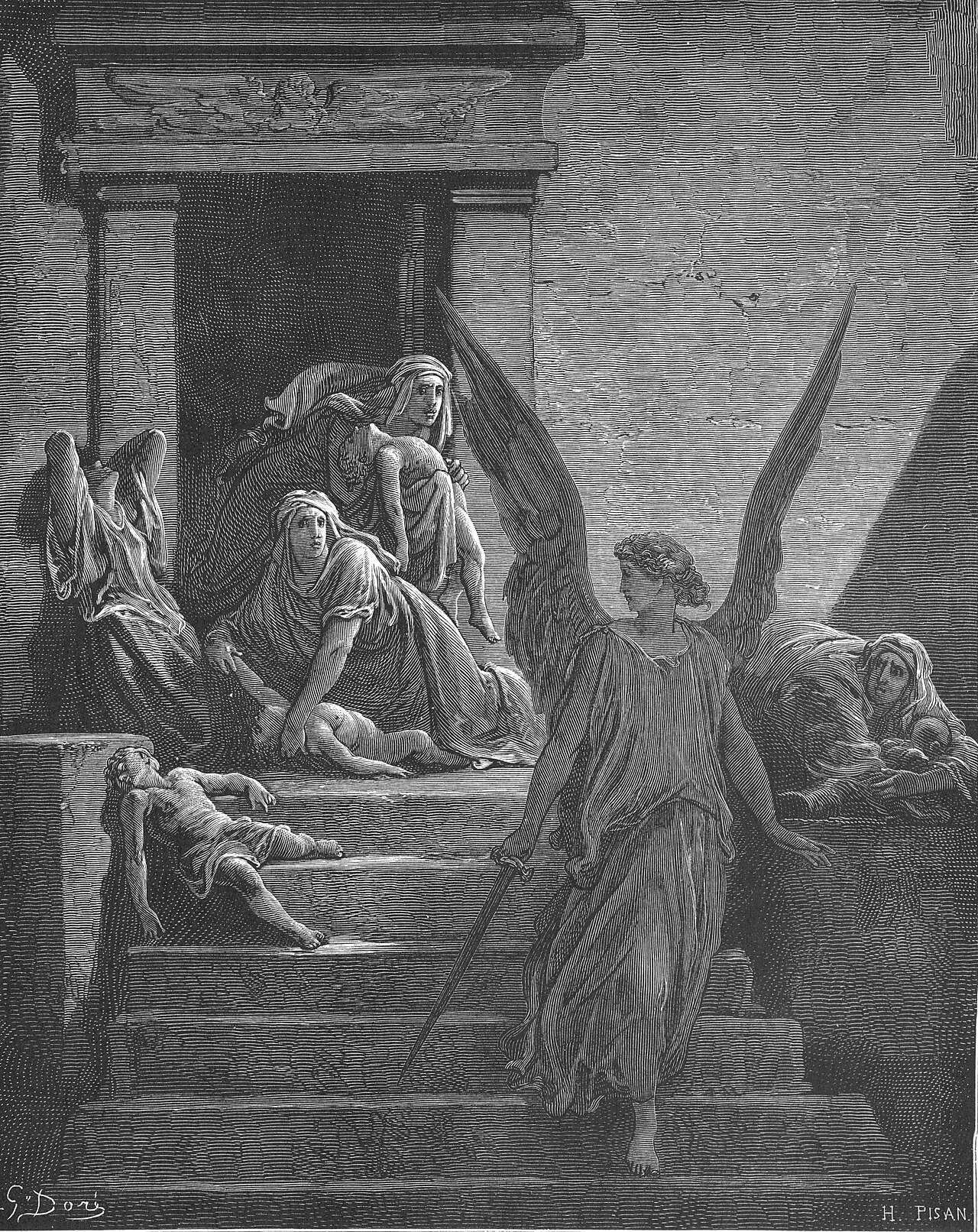
12 notes on this verseIn one house shall it be eaten - In one family, if that be large enough; if not, a neighboring family might be invited, Exo 12:4. Thou shalt not carry forth aught of the flesh - Every family must abide within doors because of the destroying angel, none being permitted to go out of his house till the next day, Exo 12:
The record, by era
The Church Fathers5 voices
And that prophecy also is fulfilled, "A bone of Him shall not be broken." (Ex. xii. 46; Num. ix. 12.) For even if this was said with reference to the lamb of the Jews, still it was for the sake of the reality that the type preceded, and in Him the prophecy was more fully accomplished. On this account the Evangelist brought forward the Prophet. For since by continually producing himself as witness he would have seemed unworthy of credit, he brings Moses to help him, and saith, that neither did this come to pass without a purpose, but was written before of old. And this is the meaning of the words, "A bone of Him shall not be broken."
Now next, that the legs of those two were broken, while his [Christ's] were not. He was already dead. Why this happened was stated in the Gospel itself. It was fitting, you see, to demonstrate by this sign as well that the true point and purpose of the Jewish Passover, which contained this instruction, not to break the lamb's bones, was to be a prophetic preenactment of his death.
God says, "In one house shall it be eaten; you shall not cast the flesh abroad out of the house." The flesh of Christ and the holy thing of the Lord cannot be cast out. The faithful have no home but the one church. This home, this house of unanimity, the Holy Spirit announces unmistakably in the Psalms: "God who makes men to dwell together of one mind as in a house."
For the faith of the sacred Scripture sets forth that the Church is not without, nor can be separated nor divided against itself, but maintains the unity of an inseparable and undivided house; since it is written of the sacrament of the passover, and of the lamb, which Lamb designated Christ: "In one house shall it be eaten: ye shall not carry forth the flesh abroad out of the house." Which also we see expressed concerning Rahab, who herself also bore a type of the Church, who received the command which said, "Thou shalt bring thy father, and thy mother, and thy brethren, and all thy father's household unto thee into thine house; and whosoever shall go out of the doors of thine house into the street, his blood shall be upon him." In which mystery is declared, that they who will live, and escape from the destruction of the world, must be gathered together into one house alone, that is, into the Church; but whosoever of those thus collected together shall go out abroad, that is, if any one, although he may have obtained grace in the Church, shall depart and go out of the Church, that his blood shall be upon him; that is, that he himself must charge it upon himself that he perishes; which the Apostle Paul explains, teaching and enjoining that a heretic must be avoided, as perverse, and a sinner, and as condemned of himself. For that man will be guilty of his own ruin, who, not being cast out by the bishop, but of his own accord deserting from the Church is by heretical presumption condemned of himself.
All such efforts are only of use when they are made within the church's pale. We must celebrate the Passover in the one house. We must enter the ark with Noah. We must take refuge from the fall of Jericho with the justified harlot, Rahab.
6 more voices on this verse
The Church Fathers1 voice
Now next, that the legs of those two were broken, while his [Christ's] were not. He was already dead. Why this happened was stated in the Gospel itself. It was fitting, you see, to demonstrate by this sign as well that the true point and purpose of the Jewish Passover, which contained this instruction, not to break the lamb's bones, was to be a prophetic preenactment of his death.
The Puritans and the Awakening3 voices
33, 36 ), denoting the unbroken strength of the Lord Jesus. The sprinkling of the blood was typical. (1.) It was not enough that the blood of the lamb was shed, but it must be sprinkled, denoting the application of the merits of Christ's death to our souls; we must receive the atonement, Rom. v. 11 .
quarantine:debris (2026-07-29) — leading-citation-number+unbalanced-parens
The papists' carrying their consecrated host from house to house is not only superstitious in itself, but contrary to this typical law of the passover, which directed that no part of the lamb should be carried abroad. The chapter concludes with a repetition of the whole matter, that the children of Israel did as they were bidden, and God did for them as he promised (
quarantine:debris (2026-07-29) — unbalanced-parens
In one house shall it be eaten,....
The Nineteenth Century1 voice
A commentator
Albert Barnes1798–1870
Notes, Explanatory and Practical, on the Old and New Testaments (1832-1869)
In one house - i. e. “in one company.” Each lamb was to be entirely consumed by the members of one company, whether they belonged to the same household or not. Break a bone - The typical significance of this injunction is recognized by John, (see the margin reference.) It is not easy to assign any other satisfactory reason for it. This victim alone was exempt from the general law by which the limbs were ordered to be separated from the body.
Modern Voices1 voice
Exodus 12 is a key chapter on the Lamb and in Exodus 12:46, the Scripture states that not a bone was to be broken.
How the passage was read
On Exodus 12:1-51On Exodus 12:1-51
The night Israel still keeps
This chapter founds Passover, in Hebrew Pesach, the spring feast that remembers the night God struck Egypt's firstborn and passed over the blood-marked houses. Jewish families keep it to this day with a ceremonial meal called the seder (Hebrew for “order”): unleavened flatbread (matzah), bitter herbs, cups of wine, and the retelling of this chapter's story, with the children asking the questions.
Honesty about the timeline helps the reader: in the Bible's own period the center of the feast was the lamb, slain and eaten as this chapter commands. The seder as now practiced took its shape after the Temple fell in AD 70 and the lamb could no longer be offered; its oldest written outline is in the Mishnah, the first code of Jewish oral law (about AD 200), which already includes the four cups and the rule that “in every generation a person must see himself as if he personally came out of Egypt.”
This section is reception history: how the passage was read and kept in the Jewish tradition. Where a reading parts from an essential of the Christian faith, the section says so at that point.
Sources: Mishnah Pesachim 10 (the seder's oldest outline) · Mishnah Pesachim 10:5 (“in every generation”) · The Feasts of the LORD (this site's study)
The words behind it
14 Hebrew wordsEvery Hebrew word of this verse in the order it stands, with what it means and the door to its own study. The last column counts the times a word stands in the whole Bible: the rarer the word, the more the places it appears belong together.
| Hebrew | Sound | Meaning | Word study | In the Bible |
|---|---|---|---|---|
| בְּבַ֤יִת | bevayit | in a house | H1004 → | 2046 times |
| אֶחָד֙ | ʾechad | one | H259 → | 971 times |
| יֵאָכֵ֔ל | yeakhel | it will be eaten | H398 → | 810 times |
| לֹא־ | lo'- | not | H3808 → | 5168 times |
| תוֹצִ֧יא | totzi' | you will bring out | H3318 → | 1067 times |
| מִן־ | min- | from | H4480 → | 1188 times |
| הַבַּ֛יִת | habayit | the house | H1004 → | 2046 times |
| מִן־ | min- | any of | H4480 → | 1188 times |
| הַבָּשָׂ֖ר | habasar | the meat | H1320 → | 270 times |
| ח֑וּצָה | chutzah | [the] outside towards | H2351 → | 164 times |
| וְעֶ֖צֶם | veetzem | and a bone | H6106 → | 126 times |
| לֹ֥א | lo' | not | H3808 → | 5168 times |
| תִשְׁבְּרוּ־ | tishberu- | you will break | H7665 → | 147 times |
| בֽוֹ׃ | vo | in <the> it |
בְּבַ֤יִתin a house
bevayitH1004 →2046 times
אֶחָד֙one
ʾechadH259 →971 times
יֵאָכֵ֔לit will be eaten
yeakhelH398 →810 times
לֹא־not
lo'-H3808 →5168 times
תוֹצִ֧יאyou will bring out
totzi'H3318 →1067 times
מִן־from
min-H4480 →1188 times
הַבַּ֛יִתthe house
habayitH1004 →2046 times
מִן־any of
min-H4480 →1188 times
הַבָּשָׂ֖רthe meat
habasarH1320 →270 times
ח֑וּצָה[the] outside towards
chutzahH2351 →164 times
וְעֶ֖צֶםand a bone
veetzemH6106 →126 times
לֹ֥אnot
lo'H3808 →5168 times
תִשְׁבְּרוּ־you will break
tishberu-H7665 →147 times
בֽוֹ׃in <the> it
vo
A shaded row is a word that stands 400 times or fewer in the Bible.
The walk
8 stopsEach card is a verse this one points to, and under it the verses that one points to in turn. Where several paths arrive at the same place, that place is listed first: the text keeps returning to it.
Through
John 19:36Now these things happened so that the Scripture would be fulfilled: “Not one of His bones will be broken.”
it leads to
- Psalms 34:20
He protects all his bones; not one of them will be broken.
- Numbers 9:12
they may not leave any of it until morning or break any of its bones. They must observe the Passover according to all its statutes.
- Psalms 34:20
Through
1 Corinthians 12:12The body is a unit, though it is composed of many parts. And although its parts are many, they all form one body. So it is with Christ.
it leads to
- Romans 12:4–5
Just as each of us has one body with many members, and not all members have the same function,
- Colossians 3:15
Let the peace of Christ rule in your hearts, for to this you were called as members of one body. And be thankful.
- 1 Corinthians 12:27
Now you are the body of Christ, and each of you is a member of it.
- Ephesians 4:15–16
Instead, speaking the truth in love, we will in all things grow up into Christ Himself, who is the head.
- Colossians 2:19
He has lost connection to the head, from whom the whole body, supported and knit together by its joints and ligaments, grows as God causes it to grow.
- Romans 12:4–5
Through
Numbers 9:12they may not leave any of it until morning or break any of its bones. They must observe the Passover according to all its statutes.
it leads to
- John 19:36
Now these things happened so that the Scripture would be fulfilled: “Not one of His bones will be broken.”
- John 19:36
Where this verse is studied
On this page
Studies30
On this verse
On this chapter
- The Words Philoxenia and Ger
- The Words Tom and Tamim
- Jesus: Titles & Roles
- Pharaoh
- Rahab and the Scarlet Cord
- The Scarlet Thread
Show the next 6 titles
About Exodus
This page draws on 10 works. Open the list of works
This page draws on Adam Clarke, Commentary on the Bible; Albert Barnes, Notes, Explanatory and Practical, on the Old and New Testaments (1832-1869); Augustine of Hippo, SERMON 218.13; Chuck Missler, Passover (article); Cyprian, Treatise I. On the Unity of the Church 8; Cyprian, Epistle LXXV.4; Jerome, LETTER 22.38; John Chrysostom, HOMILIES ON THE GOSPEL OF JOHN 85; John Gill, Exposition of the Old Testament (1748-1763) and Matthew Henry, Commentary on the Whole Bible.