
Exodus 12:5
in Exodus 12Your lamb must be an unblemished year-old male, and you may take it from the sheep or the goats.
BSB
The same verse in ASV and KJV ▾
ASV
Your lamb shall be without blemish, a male a year old: ye shall take it from the sheep, or from the goats:
KJV
Your lamb shall be without blemish, a male of the first year: ye shall take it out from the sheep, or from the goats:
⋯
This verse in Exodus 12
Commentary
3 notes on this verseYour lamb shall be without blemish,.... Without any spot or defect in it. Maimonides (h) reckons no less than fifty blemishes in a creature, anyone of which makes it unfit for sacrifice, see Lev 21:
This site's exposition
In the tenth day of this month
on Exodus 12:3-5
The lamb is chosen four days before it is killed and it is reckoned by households rather than by heads, with a small household joining its neighbour so that nothing is wasted. It must be without blemish and a male of the first year, and it may come from the sheep or from the goats. The word congregation occurs here for the first time in Scripture, so Israel is named an assembly on the night it becomes a nation.
The record, by era
The Nineteenth Century1 voice
A commentator
Albert Barnes1798–1870
Notes, Explanatory and Practical, on the Old and New Testaments (1832-1869)
Without blemish - This is in accordance with the general rule (margin reference): although in this case there is a special reason, since the lamb was in place of the firstborn male in each household. The restriction to the first year is unique, and refers apparently to the condition of perfect innocence in the antitype, the Lamb of God.
How the passage was read
On Exodus 12:1-51On Exodus 12:1-51
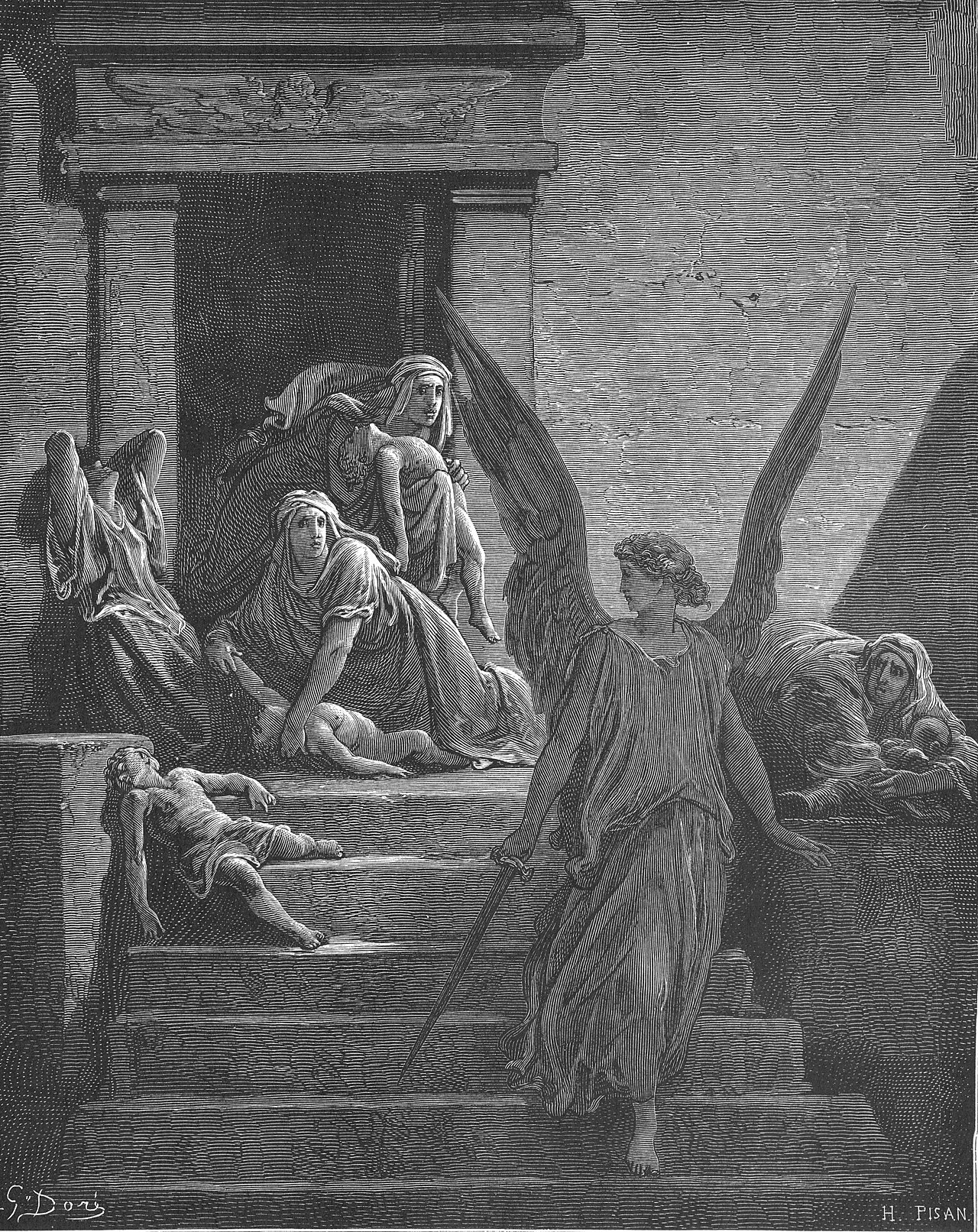
The night Israel still keeps
This chapter founds Passover, in Hebrew Pesach, the spring feast that remembers the night God struck Egypt's firstborn and passed over the blood-marked houses. Jewish families keep it to this day with a ceremonial meal called the seder (Hebrew for “order”): unleavened flatbread (matzah), bitter herbs, cups of wine, and the retelling of this chapter's story, with the children asking the questions.
Honesty about the timeline helps the reader: in the Bible's own period the center of the feast was the lamb, slain and eaten as this chapter commands. The seder as now practiced took its shape after the Temple fell in AD 70 and the lamb could no longer be offered; its oldest written outline is in the Mishnah, the first code of Jewish oral law (about AD 200), which already includes the four cups and the rule that “in every generation a person must see himself as if he personally came out of Egypt.”
This section is reception history: how the passage was read and kept in the Jewish tradition. Where a reading parts from an essential of the Christian faith, the section says so at that point.
Sources: Mishnah Pesachim 10 (the seder's oldest outline) · Mishnah Pesachim 10:5 (“in every generation”) · The Feasts of the LORD (this site's study)
The words behind it
12 Hebrew wordsEvery Hebrew word of this verse in the order it stands, with what it means and the door to its own study. The last column counts the times a word stands in the whole Bible: the rarer the word, the more the places it appears belong together.
| Hebrew | Sound | Meaning | Word study | In the Bible |
|---|---|---|---|---|
| שֶׂ֥ה | seh | a lamb | H7716 → | 47 times |
| תָמִ֛ים | tamim | unblemished | H8549 → | |
| זָכָ֥ר | zakhar | male | H2145 → | 82 times |
| בֶּן־ | ben- | a son of | H1121 → | 4930 times |
| שָׁנָ֖ה | shanah | a year | H8141 → | 877 times |
| יִהְיֶ֣ה | yihyeh | it will be | H1961 → | 3559 times |
| לָכֶ֑ם | lakhem | for <the> you | ||
| מִן־ | min- | one of | H4480 → | 1188 times |
| הַכְּבָשִׂ֥ים | hakevasim | the lambs | H3532 → | 107 times |
| וּמִן־ | umin- | and one of | H4480 → | 1188 times |
| הָעִזִּ֖ים | haizim | the goats | H5795 → | 74 times |
| תִּקָּֽחוּ׃ | tikachu | you will take | H3947 → | 966 times |
שֶׂ֥הa lamb
sehH7716 →47 times
תָמִ֛יםunblemished
tamimH8549 →
זָכָ֥רmale
zakharH2145 →82 times
בֶּן־a son of
ben-H1121 →4930 times
שָׁנָ֖הa year
shanahH8141 →877 times
יִהְיֶ֣הit will be
yihyehH1961 →3559 times
לָכֶ֑םfor <the> you
lakhem
מִן־one of
min-H4480 →1188 times
הַכְּבָשִׂ֥יםthe lambs
hakevasimH3532 →107 times
וּמִן־and one of
umin-H4480 →1188 times
הָעִזִּ֖יםthe goats
haizimH5795 →74 times
תִּקָּֽחוּ׃you will take
tikachuH3947 →966 times
A shaded row is a word that stands 400 times or fewer in the Bible.
The walk
8 stopsEach card is a verse this one points to, and under it the verses that one points to in turn. Where several paths arrive at the same place, that place is listed first: the text keeps returning to it.
Through
Malachi 1:14“But cursed is the deceiver who has an acceptable male in his flock and vows to give it, but sacrifices a defective animal to the Lord. For I am a great King,” says the…
it leads to
- Malachi 1:8
When you offer blind animals for sacrifice, is it not wrong? And when you present the lame and sick ones, is it not wrong? Try offering them to your governor! Would he be pleased…
Reached by 2 separate paths from here.
- Acts 5:1–10
Now a man named Ananias, together with his wife Sapphira, also sold a piece of property.
- Ecclesiastes 5:4–5
When you make a vow to God, do not delay in fulfilling it, because He takes no pleasure in fools. Fulfill your vow.
- 2 Corinthians 8:12
For if the eagerness is there, the gift is acceptable according to what one has, not according to what he does not have.
- Luke 12:46
The master of that servant will come on a day he does not expect and at an hour he does not anticipate. Then he will cut him to pieces and assign him a place…
- Malachi 1:8
Through
Deuteronomy 17:1You shall not sacrifice to the LORD your God an ox or a sheep with any defect or serious flaw, for that is detestable to the LORD your God.
it leads to
- Deuteronomy 15:21
But if an animal has a defect, is lame or blind, or has any serious flaw, you must not sacrifice it to the LORD your God.
- Deuteronomy 23:18
You must not bring the wages of a prostitute, whether female or male, into the house of the LORD your God to fulfill any vow, because both are detestable to the LORD your God.
- Leviticus 22:20–25
You must not present anything with a defect, because it will not be accepted on your behalf.
- Deuteronomy 15:21
Where this verse is studied
About Exodus
This page draws on Albert Barnes, Notes, Explanatory and Practical, on the Old and New Testaments (1832-1869); John Gill, Exposition of the Old Testament (1748-1763); John Gill, Exposition of the Old Testament and Matthew Henry, Commentary on the Whole Bible.