
Exodus 12:13
in Exodus 12The blood on the houses where you are staying will distinguish them; when I see the blood, I will pass over you. No plague will fall on you to destroy you when I strike the land of Egypt.
BSB
The same verse in ASV and KJV ▾
ASV
And the blood shall be to you for a token upon the houses where ye are: and when I see the blood, I will pass over you, and there shall no plague be upon you to destroy you, when I smite the land of Egypt.
KJV
And the blood shall be to you for a token upon the houses where ye are: and when I see the blood, I will pass over you, and the plague shall not be upon you to destroy you, when I smite the land of Egypt.
⋯
This verse in Exodus 12
Commentary
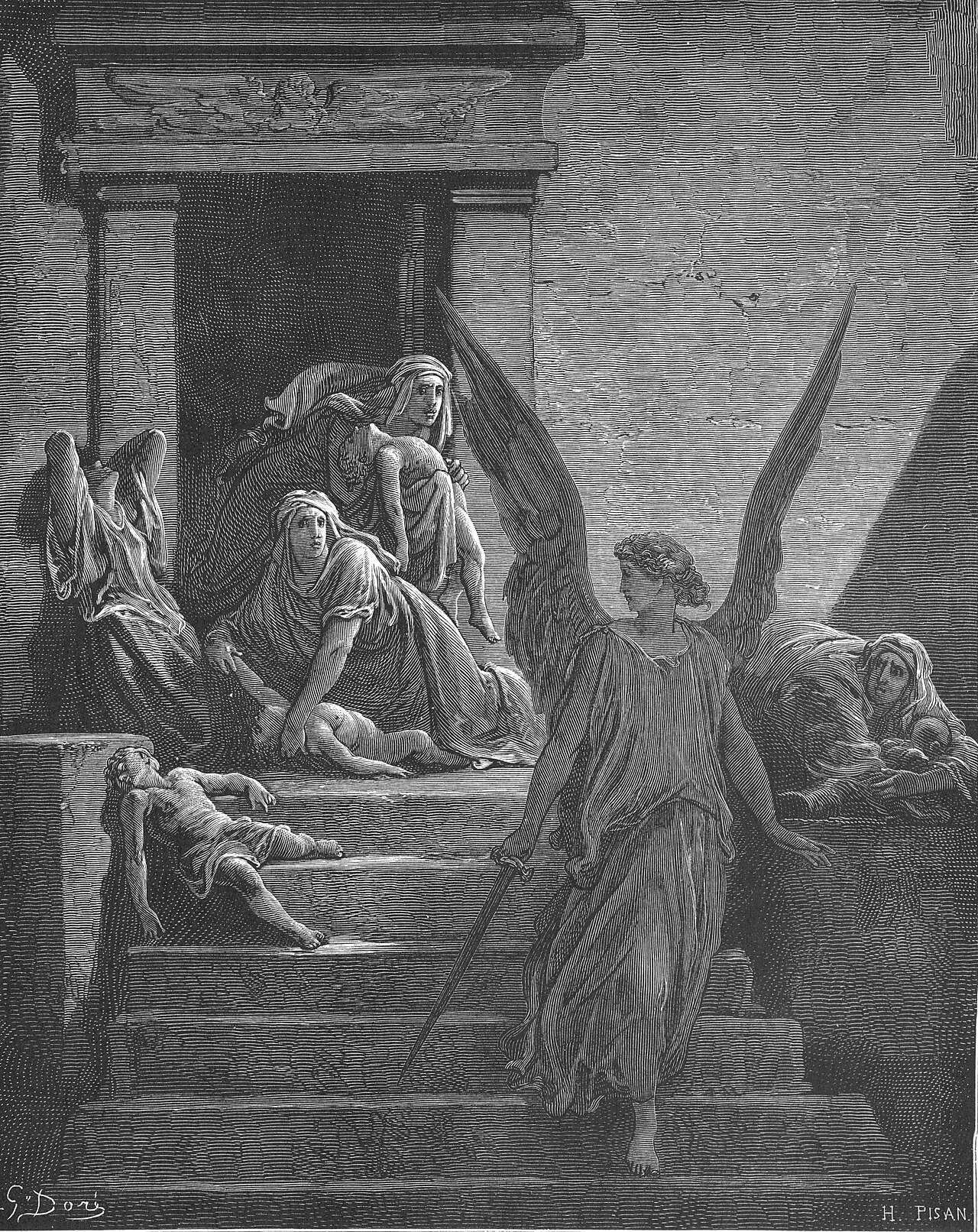
10 notes on this verseThe blood shall be to you for a token - It shall be the sign to the destroying angel, that the house on which he sees this blood sprinkled is under the protection of God, and that no person in it is to be injured. See Clarke on Exo 12:11 (note).
This site's exposition
I will pass through the land of Egypt
on Exodus 12:12-13
God names two targets, the firstborn of Egypt and all the gods of Egypt. Numbers 33:4 says the same, so the plagues were a contest as well as a punishment.
This site's exposition
The blood on the houses where you are staying will distinguish them
Behind will distinguish them stands the Hebrew word for a sign, the word used of the signs of 4:8 and 7:3. Adam Clarke reads the blood as a sign that the house stood under God's protection. Earlier signs struck Egypt, and this one guarded Israel.
The record, by era
The Church Fathers1 voice
Original sin could not have easily been forgiven, if a victim had not been offered for it, if that sacred blood of propitiation had not been shed. Even then the words in Exodus were not vainly said of our Lord: "I shall see the blood …
The Puritans and the Awakening2 voices
Moses does not mention the fulfillment, in this chapter, yet he speaks of it Num. xxxiii. It is very probable that the idols which the Egyptians worshipped were destroyed, those of metal melted, those of wood consumed, and those of stone broken to pieces, whence Jethro infers ( ch. xviii. 11 ), The Lord is greater than all gods.
And the blood shall be to you for a token upon the houses where you are,....
The Nineteenth Century2 voices
A commentator
Charles Spurgeon1834–1892
The New Park Street Pulpit, Sermon No. 228: “The Blood” (lightly modernized text, CCEL edition) (1858)
proposed
GOD’S PEOPLE ARE ALWAYS SAFE. “All the saints are in his hand;” and the hand of God is a place for safety, as well as a place of honour. Nothing can hurt the man who has made his refuge God. “Thou hast given commandment to save me,” said David; and every believing child of God may say the same. Plague, famine, war, tempest,—all these have received commandment of God to save his people.
A commentator
Charles Spurgeon1834–1892
The New Park Street Pulpit, Sermon No. 228: “The Blood” (lightly modernized text, CCEL edition) (1858)
proposed
GOD’S PEOPLE ARE ALWAYS SAFE. “All the saints are in his hand;” and the hand of God is a place for safety, as well as a place of honour. Nothing can hurt the man who has made his refuge God. “Thou hast given commandment to save me,” said David; and every believing child of God may say the same. Plague, famine, war, tempest,—all these have received commandment of God to save his people. Though the earth should rock beneath the feet of man, yet the Christian, may stand fast, and though the heavens should be rolled up, and the firmament should pass away like a scroll that is burned by fervent heat, yet need not a Christian fear; God’s people shall be saved: if they cannot be saved under the heavens, they shall be saved in the heavens; if there be no safety for them in the time of trouble upon this solid earth, they shall be “caught up together with the Lord in the air, and so shall they be ever with the Lord,” and ever safe. Now, at the time of which this Book of Exodus speaks, Egypt was exposed to a terrible peril. Jehovah himself was about to march through the streets of all the cities of Egypt. It was not merely a destroying angel, but Jehovah himself; for thus it is written, “I will pass through the land of Egypt this night, and will smite all the first-born in the land of Egypt, both man and beast.” No one less than I AM, the great God, had vowed to “cut Rahab” with the sword of vengeance. Tremble, ye inhabitants of the earth, for God has come down among you, provoked, incensed, and at last awakened from his seeming sleep of patience. He has girded on his terrible sword, and he has come to smite you. Quake for fear, all ye that have sin within you, for when God walks through the streets, sword in hand, will he not smite you all? But hark! the voice of covenant mercy speaks, God’s children are safe, even though an angry God be in the streets.
2 more voices on this verse
The Nineteenth Century2 voices
You remember that last Lord's-Day morning we spoke upon the witness within the child of God. We tried to show that Believers did not need any man to assure them that they are forgiven, that they could get on exceedingly well without absolution from a priest and could know their salvation altogether apart from the ghostly father, seeing that they have the evidence of it in their own souls by believing in the Lord Jesus Christ. We shall not think or speak much of that miserable impostor, the priest, this morning, for he really is not worth thinking of.
You remember that last Lord's-Day morning we spoke upon the witness within the child of God. We tried to show that Believers did not need any man to assure them that they are forgiven, that they could get on exceedingly well without absolution from a priest and could know their salvation altogether apart from the ghostly father, seeing that they have the evidence of it in their own souls by believing in the Lord Jesus Christ. We shall not think or speak much of that miserable impostor, the priest, this morning, for he really is not worth thinking of. But we shall continue our consideration of the witness which the Lord has given to His believing people concerning their safety in Jesus Christ. May the Holy Spirit help us while we meditate upon the most vital of all subjects, which lies at the very heart of true religion. There are some, as we have said, who desire a token of their safety from man—a poor thing when they get it and not worth asking for! And there are others who desire it from God in the form of a sign or a wonder, or else they will not believe. "Show me a token for good" is a prayer which is often used in a very mistaken sense. They desire some special transaction of Providence, or remarkable dream, or singular feeling. But God says to all those who desire a token for good, "The blood shall be to you for a token." What more can we desire? All the squadrons of the angelic host could not better assure us if each one brought a message from Heaven. The best of all evidences of Divine Love is the Cross! The strongest of all assurances of safety, the surest of all pledges of favor, the best token of Grace that a man can possibly behold is the sprinkled blood by which he is cleansed from sin.
How the passage was read
On Exodus 12:1-51On Exodus 12:1-51
The night Israel still keeps
This chapter founds Passover, in Hebrew Pesach, the spring feast that remembers the night God struck Egypt's firstborn and passed over the blood-marked houses. Jewish families keep it to this day with a ceremonial meal called the seder (Hebrew for “order”): unleavened flatbread (matzah), bitter herbs, cups of wine, and the retelling of this chapter's story, with the children asking the questions.
Honesty about the timeline helps the reader: in the Bible's own period the center of the feast was the lamb, slain and eaten as this chapter commands. The seder as now practiced took its shape after the Temple fell in AD 70 and the lamb could no longer be offered; its oldest written outline is in the Mishnah, the first code of Jewish oral law (about AD 200), which already includes the four cups and the rule that “in every generation a person must see himself as if he personally came out of Egypt.”
What the Jewish commentators add
On the verses either side of this one
The idol of wood rotted, and the one of metal melted. 183 This is the language of Rashi. The Mechilta here has it: “the metal idols corroded.” Now Scripture did not elucidate the nature of these judgments because the vanities by which they are instructed are but timber.
This section is reception history: how the passage was read and kept in the Jewish tradition. Where a reading parts from an essential of the Christian faith, the section says so at that point.
Sources: Mishnah Pesachim 10 (the seder's oldest outline) · Mishnah Pesachim 10:5 (“in every generation”) · The Feasts of the LORD (this site's study)
Texts and citation data: Sefaria; each excerpt follows its version’s licence. 3 further sources are cited on this chapter that carry no English text this site may quote or only restate the verse.
The words behind it
22 Hebrew wordsEvery Hebrew word of this verse in the order it stands, with what it means and the door to its own study. The last column counts the times a word stands in the whole Bible: the rarer the word, the more the places it appears belong together.
| Hebrew | Sound | Meaning | Word study | In the Bible |
|---|---|---|---|---|
| וְהָיָה֩ | vehayah | and it will become | H1961 → | 3559 times |
| הַדָּ֨ם | hadam | the blood | H1818 → | 360 times |
| לָכֶ֜ם | lakhem | for <the> you | ||
| לְאֹ֗ת | leot | <into> a sign | H226 → | 80 times |
| עַ֤ל | ʾal | on | H5921 → | 5755 times |
| הַבָּתִּים֙ | habatim | the houses | H1004 → | 2046 times |
| אֲשֶׁ֣ר | ʾasher | where | H834 → | 5497 times |
| אַתֶּ֣ם | ʾatem | you | H859 → | 1094 times |
| שָׁ֔ם | sham | [are] there | H8033 → | 834 times |
| וְרָאִ֙יתִי֙ | veraiti | and I will see | H7200 → | 1300 times |
| אֶת־ | ʾet- | <obj.> | H853 → | 10935 times |
| הַדָּ֔ם | hadam | the blood | H1818 → | 360 times |
| וּפָסַחְתִּ֖י | ufasachti | and I will pass over | H6452 → | 7 times |
| עֲלֵכֶ֑ם | ʾalekhem | over you | H5921 → | 5755 times |
| וְלֹֽא־ | velo'- | and not | H3808 → | 5168 times |
| יִֽהְיֶ֨ה | yihyeh | it will be | H1961 → | 3559 times |
| בָכֶ֥ם | vakhem | among <the> you | ||
| נֶ֙גֶף֙ | negef | a plague | H5063 → | |
| לְמַשְׁחִ֔ית | lemashchit | for destruction | H4889 → | |
| בְּהַכֹּתִ֖י | behakoti | when strike I | H5221 → | 499 times |
| בְּאֶ֥רֶץ | beeretz | in [the] land of | H776 → | 2504 times |
| מִצְרָֽיִם׃ | mitzrayim | Egypt | H4714 → | 641 times |
וְהָיָה֩and it will become
vehayahH1961 →3559 times
הַדָּ֨םthe blood
hadamH1818 →360 times
לָכֶ֜םfor <the> you
lakhem
לְאֹ֗ת<into> a sign
leotH226 →80 times
עַ֤לon
ʾalH5921 →5755 times
הַבָּתִּים֙the houses
habatimH1004 →2046 times
אֲשֶׁ֣רwhere
ʾasherH834 →5497 times
אַתֶּ֣םyou
ʾatemH859 →1094 times
שָׁ֔ם[are] there
shamH8033 →834 times
וְרָאִ֙יתִי֙and I will see
veraitiH7200 →1300 times
אֶת־<obj.>
ʾet-H853 →10935 times
הַדָּ֔םthe blood
hadamH1818 →360 times
וּפָסַחְתִּ֖יand I will pass over
ufasachtiH6452 →7 times
עֲלֵכֶ֑םover you
ʾalekhemH5921 →5755 times
וְלֹֽא־and not
velo'-H3808 →5168 times
יִֽהְיֶ֨הit will be
yihyehH1961 →3559 times
בָכֶ֥םamong <the> you
vakhem
נֶ֙גֶף֙a plague
negefH5063 →
לְמַשְׁחִ֔יתfor destruction
lemashchitH4889 →
בְּהַכֹּתִ֖יwhen strike I
behakotiH5221 →499 times
בְּאֶ֥רֶץin [the] land of
beeretzH776 →2504 times
מִצְרָֽיִם׃Egypt
mitzrayimH4714 →641 times
A shaded row is a word that stands 400 times or fewer in the Bible.
The walk
8 stopsEach card is a verse this one points to, and under it the verses that one points to in turn. Where several paths arrive at the same place, that place is listed first: the text keeps returning to it.
Through
1 John 1:7But if we walk in the light as He is in the light, we have fellowship with one another, and the blood of Jesus His Son cleanses us from all sin.
it leads to
- Ephesians 5:8
For you were once darkness, but now you are light in the Lord. Walk as children of light,
- Romans 13:12
The night is nearly over; the day has drawn near. So let us lay aside the deeds of darkness and put on the armor of light.
- Revelation 1:5
and from Jesus Christ, the faithful witness, the firstborn from the dead, and the ruler of the kings of the earth. To Him who loves us and has released us from our sins by…
- Ephesians 1:7
In Him we have redemption through His blood, the forgiveness of our trespasses, according to the riches of His grace
- Revelation 7:14
“Sir,” I answered, “you know.” So he replied, “These are the ones who have come out of the great tribulation; they have washed their robes and made them white in the blood of the…
- Ephesians 5:8
Through
Exodus 12:23When the LORD passes through to strike down the Egyptians, He will see the blood on the top and sides of the doorframe and will pass over that doorway; so He will not allow…
it leads to
- Revelation 7:3
“Do not harm the land or sea or trees until we have sealed the foreheads of the servants of our God.”
- Revelation 9:4
They were told not to harm the grass of the earth or any plant or tree, but only those who did not have the seal of God on their foreheads.
- Hebrews 11:28
By faith he kept the Passover and the sprinkling of blood, so that the destroyer of the firstborn would not touch Israel’s own firstborn.
- Revelation 7:3
Where this verse is studied
By subject
Redemption35 verses
Salvation35 verses
On this page
Studies30
On this verse
On this chapter
- The Words Philoxenia and Ger
- The Words Tom and Tamim
- Pharaoh
- The Ark and Dagon: 1 Samuel 4-6
- The Brickfields of Egypt
- The Calendar of the Flood
Show the next 6 titles
About Exodus
Who and where
1 name in this verse with a page on the site.
This page draws on Adam Clarke, Commentary on the Bible; Caesarius of Arles, SERMON 11.5; Charles Spurgeon, The New Park Street Pulpit, Sermon No. 228: “The Blood” (lightly modernized text, CCEL edition); Charles Spurgeon, The Metropolitan Tabernacle Pulpit, Sermon No. 1251: “The Sacred Love-Token” (lightly modernized text, CCEL edition); Chuck Missler, Learn the Bible in 24 Hours; John Gill, Exposition of the Old Testament (1748-1763); Keil and Delitzsch, Biblical Commentary on the Old Testament: The Pentateuch and Matthew Henry, Commentary on the Whole Bible.