
Exodus 12:48
in Exodus 12If a foreigner resides with you and wants to celebrate the LORD’s Passover, all the males in the household must be circumcised; then he may come near to celebrate it, and he shall be like a native of the land. But no uncircumcised man may eat of it.
BSB
The same verse in ASV and KJV ▾
ASV
And when a stranger shall sojourn with thee, and will keep the passover to Jehovah, let all his males be circumcised, and then let him come near and keep it; and he shall be as one that is born in the land: but no uncircumcised person shall eat thereof.
KJV
And when a stranger shall sojourn with thee, and will keep the passover to the Lord, let all his males be circumcised, and then let him come near and keep it; and he shall be as one that is born in the land: for no uncircumcised person shall eat thereof.
⋯
This verse in Exodus 12
Commentary
4 notes on this verseIf in sincerity, and with that zeal which the thing required and deserves, we give up ourselves to God, we shall, with ourselves, give up all we have to him, and do our utmost that all ours may be his too. Here is an early indication of favour to the poor Gentiles, that the stranger, if circumcised, stands upon the same level with the home-born Israelite.
The record, by era
The Puritans and the Awakening2 voices
No stranger that was uncircumcised might eat of it. Neither may any now approach the Lord's supper who have not first submitted to baptism; nor shall any partake of the benefit of Christ's sacrifice, who are not first circumcised in heart. Any stranger that was circumcised might eat of the passover, even servants.
And when a stranger shall sojourn with thee, Who by so doing became a proselyte of the gate, he observing the commands of the sons of Noah: and will keep the passover of the Lord; is desirous of being admitted to that ordinance: let all his males be circumcised, and then let him come near, and keep it: first himself, and then all his male children and male servants, and then, and not till then, he might approach to this ordinance, and observe it; for by this means he would become a proselyte of righteousness, and in all respects as an Israelite, or son of Abraham, as it follows: and he shall be as one that is born in the land; a native and proper inhabitant of Canaan, enjoying all the privileges and immunities of such: for no uncircumcised person shall eat thereof; these laws and rules concerning those persons that were to eat of the passover are such as were to be observed in all successive generations, to the coming of Christ; and were the rather necessary to be given now, because of the mixed multitude who now came up with the children of Israel out of Egypt.
The Nineteenth Century1 voice
And when a stranger - will keep the passover, etc. - Let all who sojourn among you, and who desire to partake of this sacred ordinance, not only be circumcised themselves, but all the males of their families likewise, that they may all have an equal right to the blessings of the covenant.
How the passage was read
On Exodus 12:1-51On Exodus 12:1-51
The night Israel still keeps
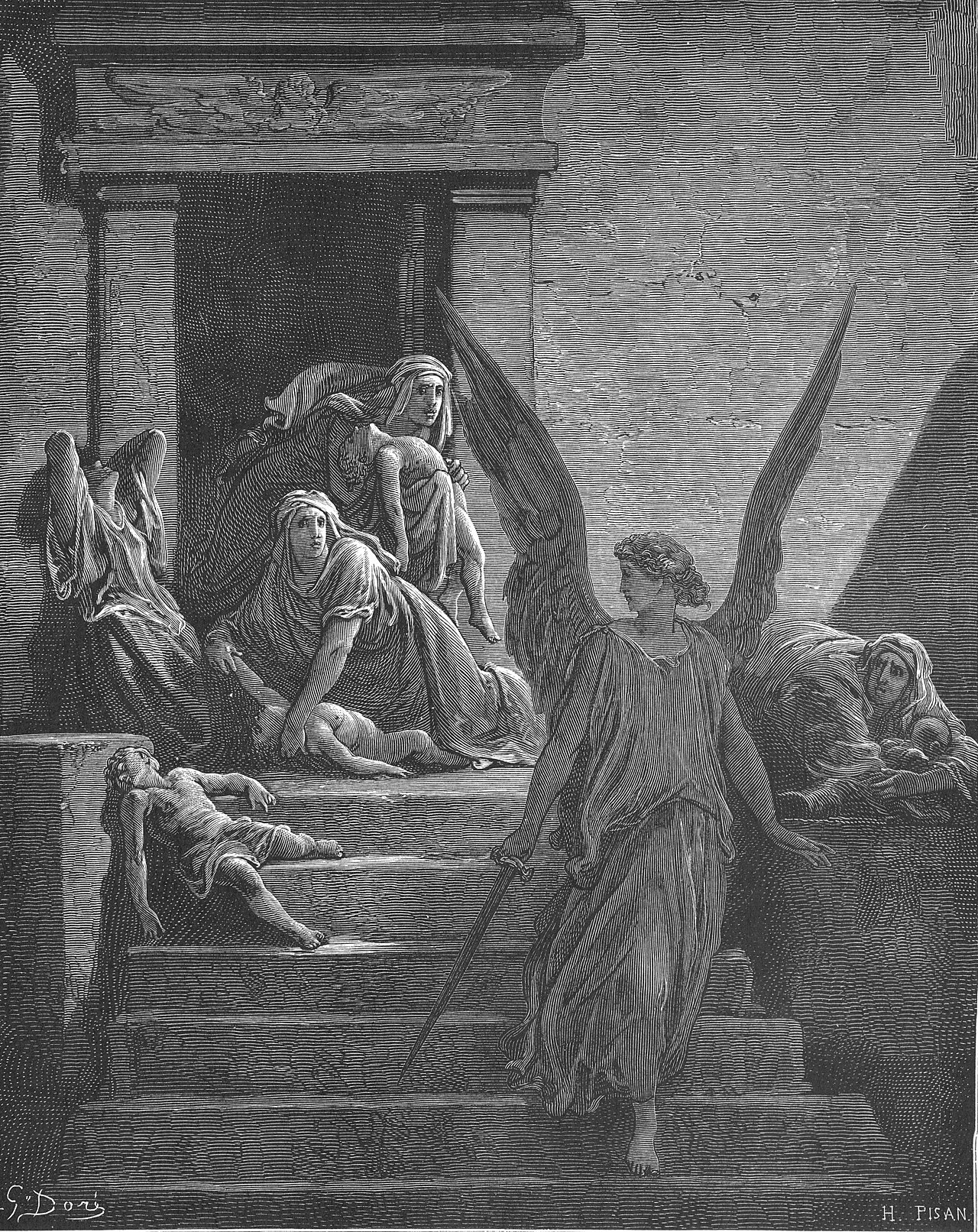
This chapter founds Passover, in Hebrew Pesach, the spring feast that remembers the night God struck Egypt's firstborn and passed over the blood-marked houses. Jewish families keep it to this day with a ceremonial meal called the seder (Hebrew for “order”): unleavened flatbread (matzah), bitter herbs, cups of wine, and the retelling of this chapter's story, with the children asking the questions.
Honesty about the timeline helps the reader: in the Bible's own period the center of the feast was the lamb, slain and eaten as this chapter commands. The seder as now practiced took its shape after the Temple fell in AD 70 and the lamb could no longer be offered; its oldest written outline is in the Mishnah, the first code of Jewish oral law (about AD 200), which already includes the four cups and the rule that “in every generation a person must see himself as if he personally came out of Egypt.”
This section is reception history: how the passage was read and kept in the Jewish tradition. Where a reading parts from an essential of the Christian faith, the section says so at that point.
Sources: Mishnah Pesachim 10 (the seder's oldest outline) · Mishnah Pesachim 10:5 (“in every generation”) · The Feasts of the LORD (this site's study)
The words behind it
22 Hebrew wordsEvery Hebrew word of this verse in the order it stands, with what it means and the door to its own study. The last column counts the times a word stands in the whole Bible: the rarer the word, the more the places it appears belong together.
| Hebrew | Sound | Meaning | Word study | In the Bible |
|---|---|---|---|---|
| וְכִֽי־ | vekhi- | and if | H3588 → | 4482 times |
| יָג֨וּר | yagur | he will sojourn | H1481 → | 97 times |
| אִתְּךָ֜ | ʾitekha | with you | H854 → | 929 times |
| גֵּ֗ר | ger | a sojourner | H1616 → | 92 times |
| וְעָ֣שָׂה | veasah | and he will observe | H6213 → | 2628 times |
| פֶסַח֮ | fesach | a passover | H6453 → | 49 times |
| לַיהוָה֒ | layahweh | to Yahweh | H3068 → | 6520 times |
| הִמּ֧וֹל | himol | he will be circumcised | H4135 → | |
| ל֣וֹ | lo | of him | ||
| כָל־ | khol- | every | H3605 → | 5413 times |
| זָכָ֗ר | zakhar | male | H2145 → | 82 times |
| וְאָז֙ | veaz | and then | H227 → | 141 times |
| יִקְרַ֣ב | yikrav | he will draw near | H7126 → | 280 times |
| לַעֲשֹׂת֔וֹ | laasoto | to observe it | H6213 → | 2628 times |
| וְהָיָ֖ה | vehayah | and he will be | H1961 → | 3559 times |
| כְּאֶזְרַ֣ח | keezrach | like [the] native-born of | H249 → | 17 times |
| הָאָ֑רֶץ | haaretz | the land | H776 → | 2504 times |
| וְכָל־ | vekhol | and any | H3605 → | 5413 times |
| עָרֵ֖ל | ʾarel | uncircumcised [man] | H6189 → | 35 times |
| לֹֽא־ | lo'- | not | H3808 → | 5168 times |
| יֹ֥אכַל | yokhal | he will eat | H398 → | 810 times |
| בּֽוֹ׃ | bo | in <the> it |
וְכִֽי־and if
vekhi-H3588 →4482 times
יָג֨וּרhe will sojourn
yagurH1481 →97 times
אִתְּךָ֜with you
ʾitekhaH854 →929 times
גֵּ֗רa sojourner
gerH1616 →92 times
וְעָ֣שָׂהand he will observe
veasahH6213 →2628 times
פֶסַח֮a passover
fesachH6453 →49 times
לַיהוָה֒to Yahweh
layahwehH3068 →6520 times
הִמּ֧וֹלhe will be circumcised
himolH4135 →
ל֣וֹof him
lo
כָל־every
khol-H3605 →5413 times
זָכָ֗רmale
zakharH2145 →82 times
וְאָז֙and then
veazH227 →141 times
יִקְרַ֣בhe will draw near
yikravH7126 →280 times
לַעֲשֹׂת֔וֹto observe it
laasotoH6213 →2628 times
וְהָיָ֖הand he will be
vehayahH1961 →3559 times
כְּאֶזְרַ֣חlike [the] native-born of
keezrachH249 →17 times
הָאָ֑רֶץthe land
haaretzH776 →2504 times
וְכָל־and any
vekholH3605 →5413 times
עָרֵ֖לuncircumcised [man]
ʾarelH6189 →35 times
לֹֽא־not
lo'-H3808 →5168 times
יֹ֥אכַלhe will eat
yokhalH398 →810 times
בּֽוֹ׃in <the> it
bo
A shaded row is a word that stands 400 times or fewer in the Bible.
The walk
8 stopsEach card is a verse this one points to, and under it the verses that one points to in turn. Where several paths arrive at the same place, that place is listed first: the text keeps returning to it.
Through
Galatians 3:28There is neither Jew nor Greek, slave nor free, male nor female, for you are all one in Christ Jesus.
it leads to
- Colossians 3:11
Here there is no Greek or Jew, circumcised or uncircumcised, barbarian, Scythian, slave, or free, but Christ is all and is in all.
Reached by 2 separate paths from here.
- 1 Corinthians 12:12–13
The body is a unit, though it is composed of many parts. And although its parts are many, they all form one body. So it is with Christ.
- Romans 3:29–30
Is God the God of Jews only? Is He not the God of Gentiles too? Yes, of Gentiles too,
- Galatians 5:6
For in Christ Jesus neither circumcision nor uncircumcision has any value. All that matters is faith, expressed through love.
- Romans 10:12–15
For there is no difference between Jew and Greek: The same Lord is Lord of all, and gives richly to all who call on Him,
- Colossians 3:11
Through
Colossians 3:11Here there is no Greek or Jew, circumcised or uncircumcised, barbarian, Scythian, slave, or free, but Christ is all and is in all.
it leads to
- Romans 10:12
For there is no difference between Jew and Greek: The same Lord is Lord of all, and gives richly to all who call on Him,
Reached by 2 separate paths from here.
- Ephesians 3:6
This mystery is that through the gospel the Gentiles are fellow heirs, fellow members of the body, and fellow partakers of the promise in Christ Jesus.
Reached by 2 separate paths from here.
- Galatians 3:28–29
There is neither Jew nor Greek, slave nor free, male nor female, for you are all one in Christ Jesus.
- Romans 10:12
Where this verse is studied
About Exodus
This page draws on Adam Clarke, Commentary on the Bible; John Gill, Exposition of the Old Testament (1748-1763); John Wesley, Explanatory Notes upon the Old Testament and Matthew Henry, Commentary on the Whole Bible.