
Exodus 12:14
in Exodus 12And this day will be a memorial for you, and you are to celebrate it as a feast to the LORD, as a permanent statute for the generations to come.
BSB
The same verse in ASV and KJV ▾
ASV
And this day shall be unto you for a memorial, and ye shall keep it a feast to Jehovah: throughout your generations ye shall keep it a feast by an ordinance for ever.
KJV
And this day shall be unto you for a memorial; and ye shall keep it a feast to the Lord throughout your generations; ye shall keep it a feast by an ordinance for ever.
⋯
This verse in Exodus 12
Commentary
7 notes on this verseAs also the Word of God, when desirous [to establish the paschal feast] said to his disciples, "With desire I have desired to eat this Passover with you." Now that is a wonderful account, for a man might have seen them at that time girded as for a procession or a dance and going out with staves and sandals and unleavened bread. These things, which took place before in shadows, were typical anticipatory symbols. But now the truth has drawn near to us, "the image of the invisible God," our Lord Jesus Christ, the true Light.
This site's exposition
this day shall be unto you for a memorial
The night is turned into a permanent institution before it has happened. The word ordinance occurs here for the first time in Scripture, and the first thing Israel is ordered to keep for ever is a meal that explains itself to children. Memory is being built into the calendar rather than left to the people who were there.
The record, by era
The Puritans and the Awakening2 voices
Now, without doubt, there was much of the gospel in this ordinance; it is often referred to in the New Testament, and, in it, to us is the gospel preached, and not to them only, who could not stedfastly look to the end of these things, Heb. iv. The paschal lamb was typical. Christ is our Passover, 1 Cor. v. 7 .
And this shall be unto you for a memorial,....
The Nineteenth Century3 voices
A commentator
Jamieson, Fausset & Brown1802–1910
Commentary Critical and Explanatory on the Whole Bible (1871)
proposed
for a memorial, &c.--The close analogy traceable in all points between the Jewish and Christian passovers is seen also in the circumstance that both festivals were instituted before the events they were to commemorate had transpired.
quarantine:debris (2026-07-29) — starts-lowercase
A memorial - To keep up a remembrance of the severity and goodness, or justice and mercy, of God. Ye shall keep it a feast - it shall be annually observed, and shall be celebrated with solemn religious joy, throughout your generations - as long as ye continue to be a distinct people; an ordinance - a Divine appointment, an institution of God himself, neither to be altered nor set aside by any human authority.
A commentator
Albert Barnes1798–1870
Notes, Explanatory and Practical, on the Old and New Testaments (1832-1869)
proposed
A memorial - A commemorative and sacramental ordinance of perpetual obligation. As such, it has ever been observed by the Hebrews. By the Christian it is spiritually observed; its full significance is recognized, and all that it foreshadowed is realized, in the sacrament of holy communion.
How the passage was read
On Exodus 12:1-51On Exodus 12:1-51
The night Israel still keeps
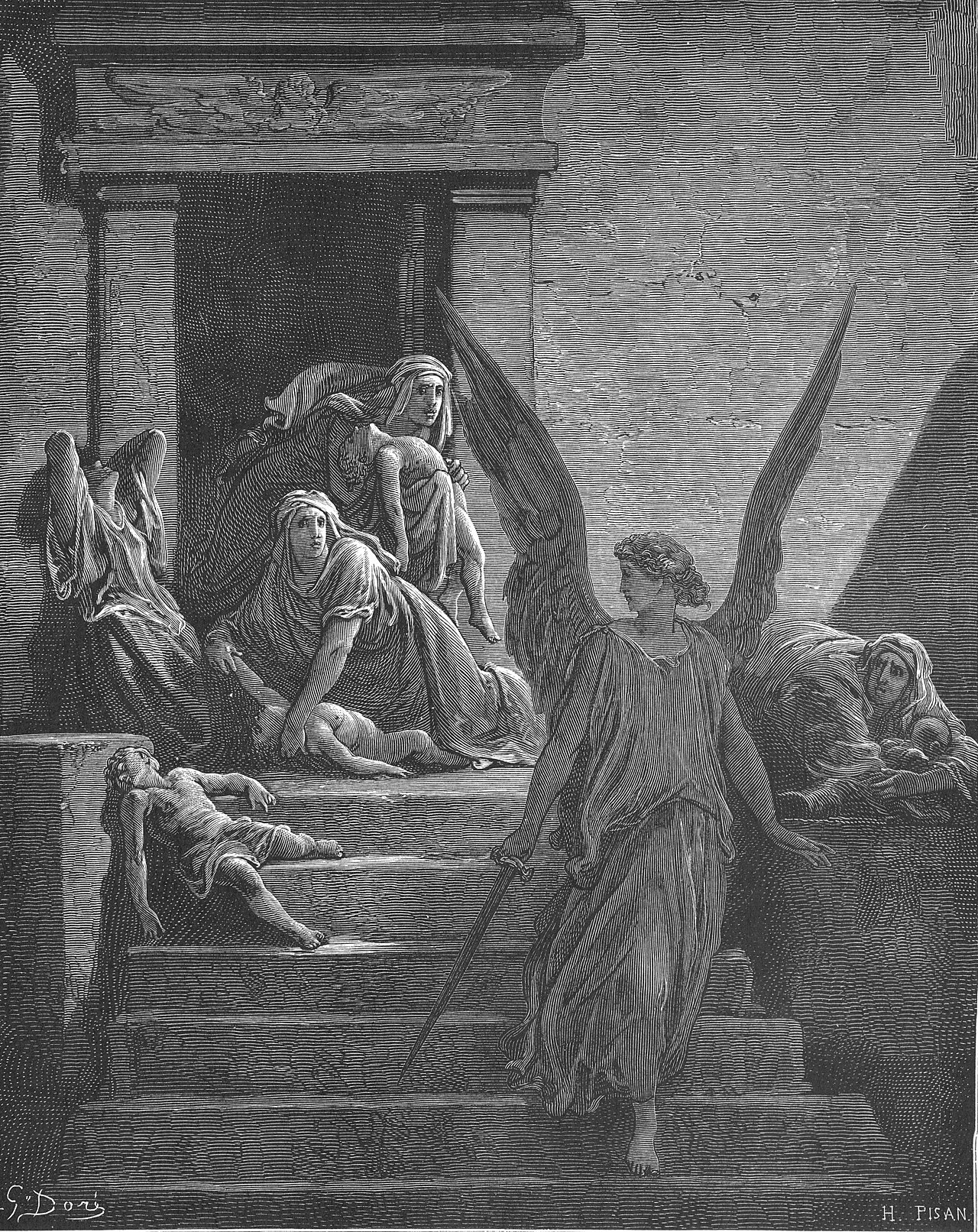
This chapter founds Passover, in Hebrew Pesach, the spring feast that remembers the night God struck Egypt's firstborn and passed over the blood-marked houses. Jewish families keep it to this day with a ceremonial meal called the seder (Hebrew for “order”): unleavened flatbread (matzah), bitter herbs, cups of wine, and the retelling of this chapter's story, with the children asking the questions.
Honesty about the timeline helps the reader: in the Bible's own period the center of the feast was the lamb, slain and eaten as this chapter commands. The seder as now practiced took its shape after the Temple fell in AD 70 and the lamb could no longer be offered; its oldest written outline is in the Mishnah, the first code of Jewish oral law (about AD 200), which already includes the four cups and the rule that “in every generation a person must see himself as if he personally came out of Egypt.”
This section is reception history: how the passage was read and kept in the Jewish tradition. Where a reading parts from an essential of the Christian faith, the section says so at that point.
Sources: Mishnah Pesachim 10 (the seder's oldest outline) · Mishnah Pesachim 10:5 (“in every generation”) · The Feasts of the LORD (this site's study)
The words behind it
13 Hebrew wordsEvery Hebrew word of this verse in the order it stands, with what it means and the door to its own study. The last column counts the times a word stands in the whole Bible: the rarer the word, the more the places it appears belong together.
| Hebrew | Sound | Meaning | Word study | In the Bible |
|---|---|---|---|---|
| וְהָיָה֩ | vehayah | and it will become | H1961 → | 3559 times |
| הַיּ֨וֹם | haiyom | the day | H3117 → | 2304 times |
| הַזֶּ֤ה | hazeh | <the> this | H2088 → | 1180 times |
| לָכֶם֙ | lakhem | for <the> you | ||
| לְזִכָּר֔וֹן | lezikaron | <into> a memorial | H2146 → | 24 times |
| וְחַגֹּתֶ֥ם | vechagotem | and you will celebrate a festival | H2287 → | 16 times |
| אֹת֖וֹ | ʾoto | <obj.> it | H853 → | 10935 times |
| חַ֣ג | chag | a festival | H2282 → | 62 times |
| לַֽיהוָ֑ה | layahweh | of Yahweh | H3068 → | 6520 times |
| לְדֹרֹ֣תֵיכֶ֔ם | ledoroteikhem | to generations your | H1755 → | 167 times |
| חֻקַּ֥ת | chukat | a statute of | H2708 → | 104 times |
| עוֹלָ֖ם | olam | perpetuity | H5769 → | 438 times |
| תְּחָגֻּֽהוּ׃ | techaguhu | you will celebrate as a festival it | H2287 → | 16 times |
וְהָיָה֩and it will become
vehayahH1961 →3559 times
הַיּ֨וֹםthe day
haiyomH3117 →2304 times
הַזֶּ֤ה<the> this
hazehH2088 →1180 times
לָכֶם֙for <the> you
lakhem
לְזִכָּר֔וֹן<into> a memorial
lezikaronH2146 →24 times
וְחַגֹּתֶ֥םand you will celebrate a festival
vechagotemH2287 →16 times
אֹת֖וֹ<obj.> it
ʾotoH853 →10935 times
חַ֣גa festival
chagH2282 →62 times
לַֽיהוָ֑הof Yahweh
layahwehH3068 →6520 times
לְדֹרֹ֣תֵיכֶ֔םto generations your
ledoroteikhemH1755 →167 times
חֻקַּ֥תa statute of
chukatH2708 →104 times
עוֹלָ֖םperpetuity
olamH5769 →438 times
תְּחָגֻּֽהוּ׃you will celebrate as a festival it
techaguhuH2287 →16 times
A shaded row is a word that stands 400 times or fewer in the Bible.
The walk
8 stopsEach card is a verse this one points to, and under it the verses that one points to in turn. Where several paths arrive at the same place, that place is listed first: the text keeps returning to it.
Through
2 Kings 23:21The king commanded all the people, “Keep the Passover of the LORD your God, as it is written in this Book of the Covenant.”
it leads to
- Deuteronomy 16:1–8
Observe the month of Abib and celebrate the Passover to the LORD your God, because in the month of Abib the LORD your God brought you out of Egypt by night.
- Numbers 9:2–5
“The Israelites are to observe the Passover at its appointed time.
- Numbers 28:16–25
The fourteenth day of the first month is the LORD’s Passover.
- 2 Chronicles 35:1–19
Then Josiah celebrated the Passover to the LORD in Jerusalem, and the Passover lamb was slaughtered on the fourteenth day of the first month.
- Leviticus 23:5–8
The Passover to the LORD begins at twilight on the fourteenth day of the first month.
- Deuteronomy 16:1–8
Through
Exodus 12:17So you are to keep the Feast of Unleavened Bread, for on this very day I brought your divisions out of the land of Egypt. You must keep this day as a permanent statute…
it leads to
- Exodus 12:41
At the end of the 430 years, to the very day, all the LORD’s divisions went out of the land of Egypt.
- Exodus 13:3
So Moses told the people, “Remember this day, the day you came out of Egypt, out of the house of slavery; for the LORD brought you out of it by the strength of His…
- Exodus 13:8
And on that day you are to explain to your son, ‘This is because of what the LORD did for me when I came out of Egypt.’
- Exodus 12:41
Where this verse is studied
About Exodus
This page draws on Adam Clarke, Commentary on the Bible; Albert Barnes, Notes, Explanatory and Practical, on the Old and New Testaments (1832-1869); Athanasius of Alexandria, FESTAL LETTERS 14.3; Jamieson, Fausset & Brown, Commentary Critical and Explanatory on the Whole Bible; John Gill, Exposition of the Old Testament; John Gill, Exposition of the Old Testament (1748-1763) and Matthew Henry, Commentary on the Whole Bible.