
Exodus 12:29
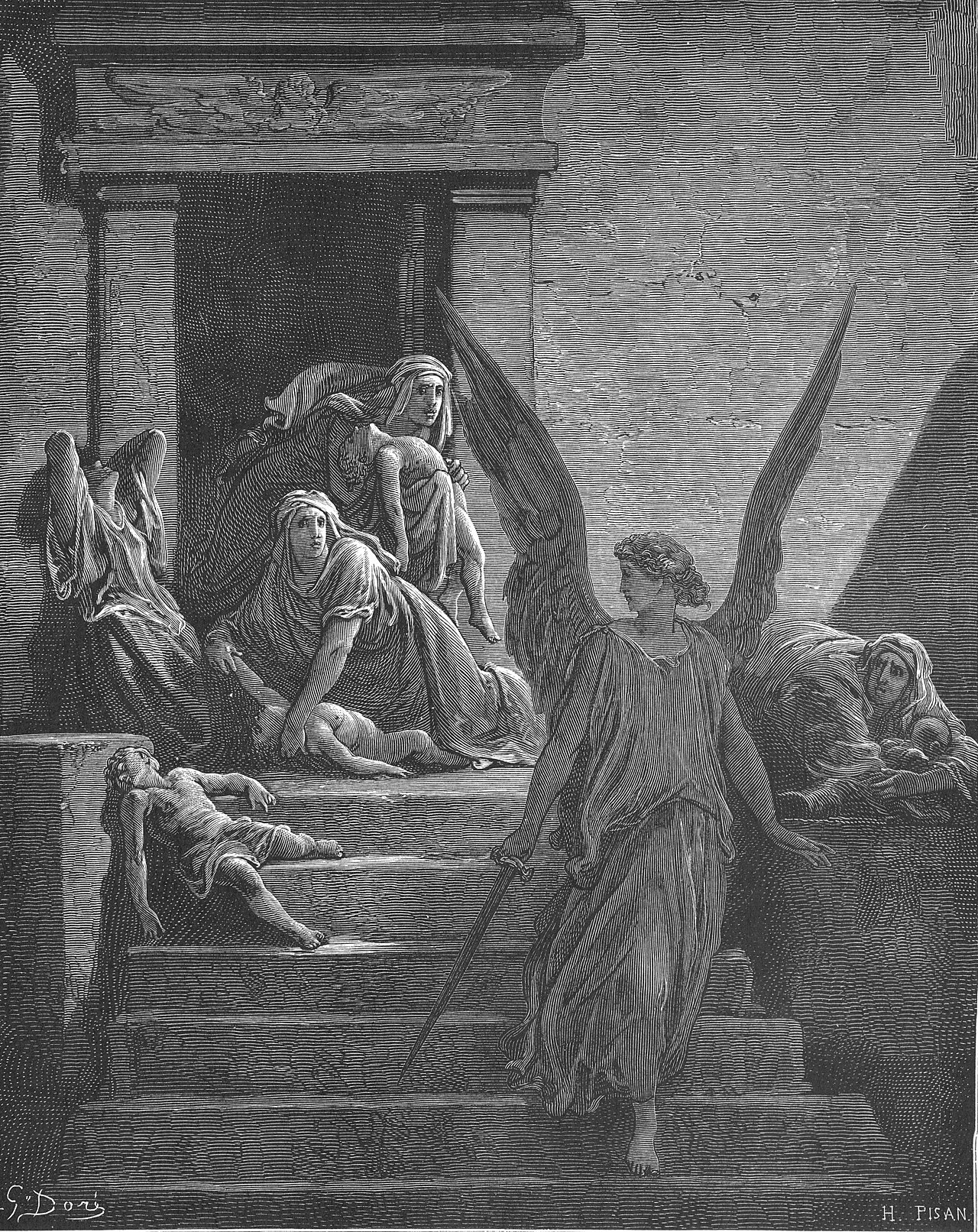
in Exodus 12Now at midnight the LORD struck down every firstborn male in the land of Egypt, from the firstborn of Pharaoh, who sat on his throne, to the firstborn of the prisoner in the dungeon, as well as all the firstborn among the livestock.
BSB
The same verse in ASV and KJV ▾
ASV
And it came to pass at midnight, that Jehovah smote all the first-born in the land of Egypt, from the first-born of Pharaoh that sat on his throne unto the first-born of the captive that was in the dungeon; and all the first-born of cattle.
KJV
And it came to pass, that at midnight the Lord smote all the firstborn in the land of Egypt, from the firstborn of Pharaoh that sat on his throne unto the firstborn of the captive that was in the dungeon; and all the firstborn of cattle.
⋯
This verse in Exodus 12
Commentary
7 notes on this verse"He that has opened a pit and dug it." We do not find the name of "pit" (lakkos) ever assigned in the divine Scriptures in the case of something good, nor a "well" of water (phrear) in the case of something bad. That into which Joseph was thrown by his brothers is a pit (lakkos). And there is a slaughter "from the firstborn of Pharaoh unto the firstborn of the captive woman that was in the prison (lakkos)."
This site's exposition
at midnight the LORD smote all the firstborn
on Exodus 12:29-30
The stroke reaches from the throne to the dungeon, so it falls on the household of the man who ordered Hebrew boys drowned and on the household of a prisoner who ordered nothing. It answers the words of Exodus 4:22 and 4:23, where God called Israel his firstborn son and told Pharaoh what refusal would cost. There was not a house where there was not one dead, and Israel's houses are the exception the blood made.
The record, by era
The Puritans and the Awakening2 voices
And it came to pass, that at midnight the Lord smote all the firstborn in the land of Egypt,....
Let us learn hence, (1.) To tremble before God, and to be afraid of his judgments, Ps. cxix. Who is able to stand before him, or dares resist him? (2.) To be thankful to God for the daily preservation of ourselves and our families: lying so much exposed, we have reason to say, "It is of the Lord's mercies that we are not consumed." II.
The Nineteenth Century3 voices
A commentator
Albert Barnes1798–1870
Notes, Explanatory and Practical, on the Old and New Testaments (1832-1869)
This plague is distinctly attributed here and in Exo 12:23 to the personal intervention of the Lord; but it is to be observed that although the Lord Himself passed through to smite the Egyptians, He employed the agency of “the destroyer” Exo 12:23, in whom, in accordance with Heb 11:28, all the ancient versions, and most critics, recognize an Angel (compare 2Ki 19:35; 2Sa 24:16).
A commentator
Jamieson, Fausset & Brown1802–1910
Commentary Critical and Explanatory on the Whole Bible (1871)
proposed
They were made, in the justice of God, to feel something of what they had made His people feel. Many a time have the hands of sinners made the snares in which they have themselves been entangled, and fallen into the pit which they have dug for the righteous [Pr 28:10]. "Verily there is a God that judgeth in the earth" [Ps 58:11].
Smote all the first born - If we take the term first-born in its literal sense only, we shall be led to conclude that in a vast number of the houses of the Egyptians there could have been no death, as it is not at all likely that every first-born child of every Egyptian family was still alive, and that all the first-born of their cattle still remained. And yet it is said, Exo 12:30, that there was not a house where there was not one dead. The word therefore must not be taken in its literal sense only. From its use in a great variety of places in the Scriptures it is evident that it means the chief, most excellent, best beloved, most distinguished, etc. In this sense our blessed Lord is called the First-Born of every creature, Col 1:15, and the First-Born among many brethren, Rom 8:29; that is, he is more excellent than all creatures, and greater than all the children of men. In the same sense we may understand Rev 1:5, where Christ is called the First-Begotten from the dead, i.e., the chief of all that have ever visited the empire of death, and on whom death has had any power; and the only one who by his own might quickened himself. In the same sense wisdom is represented as being brought forth before all the creatures, and being possessed by the Lord in the beginning of his ways, Pro 8:22-30; that is, the wisdom of God is peculiarly conspicuous in the production, arrangement, and government of every part of the creation. So Ephraim is called the Lord’s First-Born, Jer 31:9. And the people of Israel are often called by the same name, see Exo 4:22: Israel is my son, my First-Born; that is, the people in whom I particularly delight, and whom I will especially support and defend. […]
How the passage was read
On Exodus 12:1-51On Exodus 12:1-51
The night Israel still keeps
This chapter founds Passover, in Hebrew Pesach, the spring feast that remembers the night God struck Egypt's firstborn and passed over the blood-marked houses. Jewish families keep it to this day with a ceremonial meal called the seder (Hebrew for “order”): unleavened flatbread (matzah), bitter herbs, cups of wine, and the retelling of this chapter's story, with the children asking the questions.
Honesty about the timeline helps the reader: in the Bible's own period the center of the feast was the lamb, slain and eaten as this chapter commands. The seder as now practiced took its shape after the Temple fell in AD 70 and the lamb could no longer be offered; its oldest written outline is in the Mishnah, the first code of Jewish oral law (about AD 200), which already includes the four cups and the rule that “in every generation a person must see himself as if he personally came out of Egypt.”
This section is reception history: how the passage was read and kept in the Jewish tradition. Where a reading parts from an essential of the Christian faith, the section says so at that point.
Sources: Mishnah Pesachim 10 (the seder's oldest outline) · Mishnah Pesachim 10:5 (“in every generation”) · The Feasts of the LORD (this site's study)
The words behind it
23 Hebrew wordsEvery Hebrew word of this verse in the order it stands, with what it means and the door to its own study. The last column counts the times a word stands in the whole Bible: the rarer the word, the more the places it appears belong together.
| Hebrew | Sound | Meaning | Word study | In the Bible |
|---|---|---|---|---|
| וַיְהִ֣י׀ | vayhi | and it was | H1961 → | 3559 times |
| בַּחֲצִ֣י | bachatzi | in [the] middle of | H2677 → | 125 times |
| הַלַּ֗יְלָה | halaylah | the night | H3915 → | 233 times |
| וַֽיהוָה֮ | vayahweh | and Yahweh | H3068 → | 6520 times |
| הִכָּ֣ה | hikah | he struck | H5221 → | 499 times |
| כָל־ | khol- | every | H3605 → | 5413 times |
| בְּכוֹר֮ | bekhor | firstborn | H1060 → | 122 times |
| בְּאֶ֣רֶץ | beeretz | in [the] land of | H776 → | 2504 times |
| מִצְרַיִם֒ | mitzrayim | Egypt | H4714 → | 641 times |
| מִבְּכֹ֤ר | mibekhor | from [the] firstborn of | H1060 → | 122 times |
| פַּרְעֹה֙ | paroh | Pharaoh | H6547 → | 274 times |
| הַיֹּשֵׁ֣ב | haiyoshev | who sat | H3427 → | 1079 times |
| עַל־ | ʾal- | on | H5921 → | 5755 times |
| כִּסְא֔וֹ | kiso | throne his | H3678 → | |
| עַ֚ד | ʾad | unto | H5704 → | 1261 times |
| בְּכ֣וֹר | bekhor | [the] firstborn of | H1060 → | 122 times |
| הַשְּׁבִ֔י | hashevi | the prisoner | H7628 → | |
| אֲשֶׁ֖ר | ʾasher | who | H834 → | 5497 times |
| בְּבֵ֣ית | beveit | [was] in [the] house of | H1004 → | 2046 times |
| הַבּ֑וֹר | habor | the cistern | H953 → | 66 times |
| וְכֹ֖ל | vekhol | and every | H3605 → | 5413 times |
| בְּכ֥וֹר | bekhor | firstborn of | H1060 → | 122 times |
| בְּהֵמָֽה׃ | behemah | livestock | H929 → | 190 times |
וַיְהִ֣י׀and it was
vayhiH1961 →3559 times
בַּחֲצִ֣יin [the] middle of
bachatziH2677 →125 times
הַלַּ֗יְלָהthe night
halaylahH3915 →233 times
וַֽיהוָה֮and Yahweh
vayahwehH3068 →6520 times
הִכָּ֣הhe struck
hikahH5221 →499 times
כָל־every
khol-H3605 →5413 times
בְּכוֹר֮firstborn
bekhorH1060 →122 times
בְּאֶ֣רֶץin [the] land of
beeretzH776 →2504 times
מִצְרַיִם֒Egypt
mitzrayimH4714 →641 times
מִבְּכֹ֤רfrom [the] firstborn of
mibekhorH1060 →122 times
פַּרְעֹה֙Pharaoh
parohH6547 →274 times
הַיֹּשֵׁ֣בwho sat
haiyoshevH3427 →1079 times
עַל־on
ʾal-H5921 →5755 times
כִּסְא֔וֹthrone his
kisoH3678 →
עַ֚דunto
ʾadH5704 →1261 times
בְּכ֣וֹר[the] firstborn of
bekhorH1060 →122 times
הַשְּׁבִ֔יthe prisoner
hasheviH7628 →
אֲשֶׁ֖רwho
ʾasherH834 →5497 times
בְּבֵ֣ית[was] in [the] house of
beveitH1004 →2046 times
הַבּ֑וֹרthe cistern
haborH953 →66 times
וְכֹ֖לand every
vekholH3605 →5413 times
בְּכ֥וֹרfirstborn of
bekhorH1060 →122 times
בְּהֵמָֽה׃livestock
behemahH929 →190 times
A shaded row is a word that stands 400 times or fewer in the Bible.
The walk
8 stopsEach card is a verse this one points to, and under it the verses that one points to in turn. Where several paths arrive at the same place, that place is listed first: the text keeps returning to it.
Through
Psalms 78:51He struck all the firstborn of Egypt, the virility in the tents of Ham.
it leads to
- Psalms 105:36
Then He struck all the firstborn in their land, the firstfruits of all their vigor.
Reached by 4 separate paths from here.
- Psalms 135:8
He struck down the firstborn of Egypt, of both man and beast.
Reached by 3 separate paths from here.
- Psalms 136:10
He struck down the firstborn of Egypt His loving devotion endures forever.
Reached by 3 separate paths from here.
- Psalms 105:23
Then Israel entered Egypt; Jacob dwelt in the land of Ham.
- Psalms 106:22
wondrous works in the land of Ham, and awesome deeds by the Red Sea.
- Psalms 105:36
Through
Psalms 135:8He struck down the firstborn of Egypt, of both man and beast.
it leads to
- Psalms 78:51
He struck all the firstborn of Egypt, the virility in the tents of Ham.
Reached by 3 separate paths from here.
- Exodus 12:12
On that night I will pass through the land of Egypt and strike down every firstborn male, both man and beast, and I will execute judgment against all the gods of Egypt. I am…
Reached by 3 separate paths from here.
- Psalms 78:51
Through
Exodus 4:23and I told you to let My son go so that he may worship Me. But since you have refused to let him go, behold, I will kill your firstborn son!’”
it leads to
- Exodus 11:5
and every firstborn son in the land of Egypt will die, from the firstborn of Pharaoh who sits on his throne, to the firstborn of the servant girl behind the hand mill, as well…
- Exodus 11:5
Where this verse is studied
On this page
Studies10
About Exodus
Who and where
1 name in this verse with a page on the site.
This page draws on Adam Clarke, Commentary on the Bible; Albert Barnes, Notes, Explanatory and Practical, on the Old and New Testaments (1832-1869); Basil of Caesarea, EXEGETIC HOMILIES 11.8; Jamieson, Fausset & Brown, Commentary Critical and Explanatory on the Whole Bible; John Gill, Exposition of the Old Testament; John Gill, Exposition of the Old Testament (1748-1763) and Matthew Henry, Commentary on the Whole Bible.