
Exodus 12:26
in Exodus 12When your children ask you, ‘What does this service mean to you?’
BSB
The same verse in ASV and KJV ▾
ASV
And it shall come to pass, when your children shall say unto you, What mean ye by this service?
KJV
And it shall come to pass, when your children shall say unto you, What mean ye by this service?
⋯
This verse in Exodus 12
Commentary
10 notes on this verseWhat mean ye by this service? - The establishment of this service annually was a very wise provision to keep up in remembrance this wonderful deliverance. From the remotest antiquity the institution of feasts, games, etc., has been used to keep up the memory of past grand events. Hence God instituted the Sabbath, to keep up the remembrance of the creation; and the passover to keep up the remembrance of the deliverance from Egypt. All the other feasts were instituted on similar reasons.
This site's exposition
What does this service mean
on Exodus 12:26-27
The rite is built to provoke a question from a child, and the answer given back is a piece of history. Israel's children learn who God is by being told what he did on one night to particular houses.
The record, by era
The Puritans and the Awakening3 voices
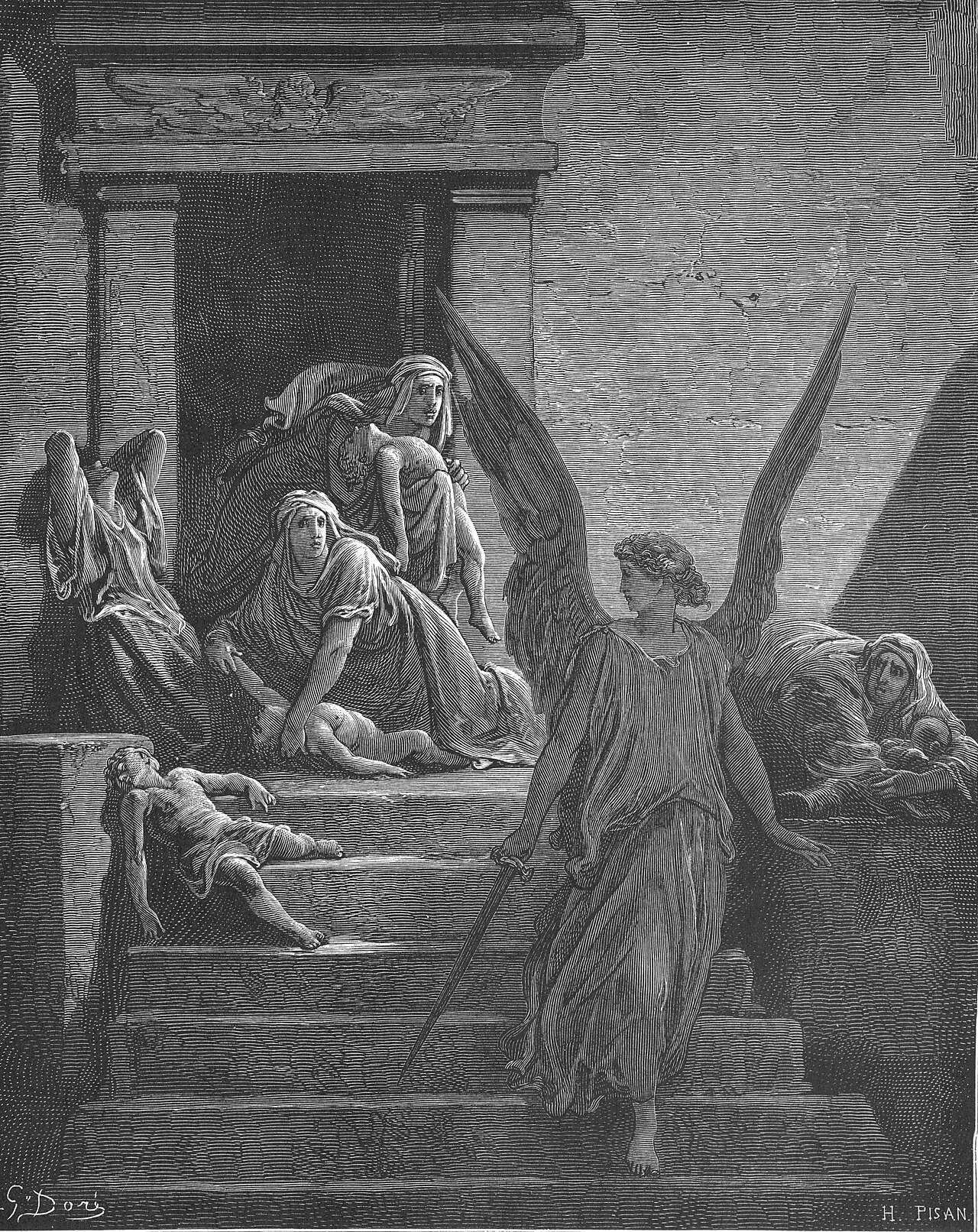
None of all the providences of God concerning the Jewish church was more illustrious, than the deliverance of the children of Israel out of Egypt. The first-born of the Egyptians are slain, ver. 29, 30. Orders are given immediately for their discharge, ver. 31-33.
quarantine:anchor (2026-07-29) — cites-ver-31-anchored-24-27
And it shall come to pass, when your children shall say unto you, what mean ye by this service? Of killing and roasting a lamb, and eating it with bitter herbs, and of abstaining from leavened bread.
Christ himself, when a child, heard and asked questions, Luke ii. 46 . [2.] It concerns us all rightly to understand the meaning of those holy ordinances wherein we worship God, what is the nature and what the end of them, what is signified and what intended, what is the duty expected from us in them and what are the advantages to be expected by us.
The Nineteenth Century2 voices
A commentator
Charles Spurgeon1834–1892
The Metropolitan Tabernacle Pulpit, Sermon No. 2268: “A Question for Communicants” (lightly modernized text, CCEL edition) · Written before 1892.
IN a spiritual religion everything must be understood. That which is not spiritual, but ritualistic, contents itself with the outward form. Under the Jewish dispensation there was a very strong tendency in that direction, but it was kept in check to some extent. Under the Christian faith this tendency must not be tolerated at all. We must know the meaning of what we do, otherwise we are not profited. We do not believe in the faith of the man who was asked what he believed and replied that he believed what the church believed. "But what does the church believe?"
A commentator
Jamieson, Fausset & Brown1802–1910
Commentary Critical and Explanatory on the Whole Bible (1871)
proposed
27, 28. the people bowed the head, and worshipped--All the preceding directions were communicated through the elders, and the Israelites, being deeply solemnized by the influence of past and prospective events, gave prompt and faithful obedience.
3 more voices on this verse
The Nineteenth Century3 voices
I WANTED, dear Friends, earnestly wanted, to continue the subject of last Lord's-Day morning, for I felt it important that we should bear again and again our witness to the doctrine of the vicarious Sacrifice of Jesus Christ our Lord. But, at the same time, I promised that I would endeavor to keep "the feast of the children" and have a sermon which should be specially addressed to Sunday school teachers.
I WANTED, dear Friends, earnestly wanted, to continue the subject of last Lord's-Day morning, for I felt it important that we should bear again and again our witness to the doctrine of the vicarious Sacrifice of Jesus Christ our Lord. But, at the same time, I promised that I would endeavor to keep "the feast of the children" and have a sermon which should be specially addressed to Sunday school teachers. I could not preach a school sermon at the appointed time, so as to open your children's week, but thought a discourse might come in, none the less suitably, if I brought up the rear by closing your meetings. How am I to fulfill both my purposes? I think the subject before us will enable me to do so. We shall preach of the sprinkled blood and of Jesus, the great Sacrifice for sin—and then we shall press upon all who know the value of the great Redemption that they teach the young in their earliest days what is meant by the death of Jesus and salvation through His blood. The Paschal lamb was a special type of our Lord Jesus Christ. We are not left to gather this from the general fact that all the ancient sacrifices were shadows of the one true and real Substance—we are assured in the New Testament that "Christ our Passover is sacrificed for us" (1 Cor 5:7). As the Paschal lamb must be without blemish, so was our Lord, and its killing and roasting with fire were typical of His death and sufferings. Even as to time our Lord fulfilled the type, for the time of His Crucifixion was the Passover. As the impression answers to the seal, so does the Sacrifice of our Lord correspond with all the items of the ceremonial Passover. We see Him "drawn out" from among men and led as a lamb to the slaughter. We see His blood shed and sprinkled. We see Him roasted in the fire of anguish. By faith we eat of Him and flavor the feast with the bitter herbs of penitence.
A commentator
Charles Spurgeon1834–1892
The Metropolitan Tabernacle Pulpit, Sermon No. 2268: “A Question for Communicants” (lightly modernized text, CCEL edition) · Written before 1892.
proposed
IN a spiritual religion everything must be understood. That which is not spiritual, but ritualistic, contents itself with the outward form. Under the Jewish dispensation there was a very strong tendency in that direction, but it was kept in check to some extent. Under the Christian faith this tendency must not be tolerated at all. We must know the meaning of what we do, otherwise we are not profited. We do not believe in the faith of the man who was asked what he believed and replied that he believed what the church believed. "But what does the church believe?" "The church believes what I believe." "Well, but what do you and the church believe?" "We both believe the same thing." He would not explain himself any further. We look upon such expressions as the talk of ignorance and not the language offaith. Faith knows what she believes and can give a reason for the hope that is in her meekness and fear. Concerning the Passover, the young people among the Jews were encouraged to ask their parents this question, "What do you mean by this service?" Children should be encouraged to ask such gracious questions now. I am afraid they are not prompted to do so as they used to be in Puritan times. After the sermon always came the catechizing of the children when they were at home—and every father was bound to be attentive to the sermon—because he had to ask the boys and girls in the evening what they had heard. The children were more attentive, then, than now, because they had to be prepared to answer any questions of their parents. Cultivate in your children a desire to understand everything connected with our holy faith! In this chapter, from which I culled my text, the parents are taught how to answer their children. If the parent is ignorant, a question from his child is inconvenient.
How the passage was read
On Exodus 12:1-51On Exodus 12:1-51
The night Israel still keeps
This chapter founds Passover, in Hebrew Pesach, the spring feast that remembers the night God struck Egypt's firstborn and passed over the blood-marked houses. Jewish families keep it to this day with a ceremonial meal called the seder (Hebrew for “order”): unleavened flatbread (matzah), bitter herbs, cups of wine, and the retelling of this chapter's story, with the children asking the questions.
Honesty about the timeline helps the reader: in the Bible's own period the center of the feast was the lamb, slain and eaten as this chapter commands. The seder as now practiced took its shape after the Temple fell in AD 70 and the lamb could no longer be offered; its oldest written outline is in the Mishnah, the first code of Jewish oral law (about AD 200), which already includes the four cups and the rule that “in every generation a person must see himself as if he personally came out of Egypt.”
This section is reception history: how the passage was read and kept in the Jewish tradition. Where a reading parts from an essential of the Christian faith, the section says so at that point.
Sources: Mishnah Pesachim 10 (the seder's oldest outline) · Mishnah Pesachim 10:5 (“in every generation”) · The Feasts of the LORD (this site's study)
The words behind it
9 Hebrew wordsEvery Hebrew word of this verse in the order it stands, with what it means and the door to its own study. The last column counts the times a word stands in the whole Bible: the rarer the word, the more the places it appears belong together.
| Hebrew | Sound | Meaning | Word study | In the Bible |
|---|---|---|---|---|
| וְהָיָ֕ה | vehayah | and it will be | H1961 → | 3559 times |
| כִּֽי־ | ki- | that | H3588 → | 4482 times |
| יֹאמְר֥וּ | yomeru | they will say | H559 → | 5305 times |
| אֲלֵיכֶ֖ם | ʾaleikhem | to you | H413 → | 5510 times |
| בְּנֵיכֶ֑ם | beneikhem | children your | H1121 → | 4930 times |
| מָ֛ה | mah | what? | H4100 → | 752 times |
| הָעֲבֹדָ֥ה | haavodah | [is] the service | H5656 → | 145 times |
| הַזֹּ֖את | hazot | <the> this | H2063 → | 603 times |
| לָכֶֽם׃ | lakhem | to <the> you |
וְהָיָ֕הand it will be
vehayahH1961 →3559 times
כִּֽי־that
ki-H3588 →4482 times
יֹאמְר֥וּthey will say
yomeruH559 →5305 times
אֲלֵיכֶ֖םto you
ʾaleikhemH413 →5510 times
בְּנֵיכֶ֑םchildren your
beneikhemH1121 →4930 times
מָ֛הwhat?
mahH4100 →752 times
הָעֲבֹדָ֥ה[is] the service
haavodahH5656 →145 times
הַזֹּ֖את<the> this
hazotH2063 →603 times
לָכֶֽם׃to <the> you
lakhem
A shaded row is a word that stands 400 times or fewer in the Bible.
The walk
8 stopsEach card is a verse this one points to, and under it the verses that one points to in turn. Where several paths arrive at the same place, that place is listed first: the text keeps returning to it.
Through
Psalms 145:4One generation will commend Your works to the next, and will proclaim Your mighty acts—
it leads to
- Psalms 71:18
Even when I am old and gray, do not forsake me, O God, until I proclaim Your power to the next generation, Your might to all who are to come.
- Psalms 78:3–7
that we have heard and known and our fathers have relayed to us.
- Deuteronomy 6:7
And you shall teach them diligently to your children and speak of them when you sit at home and when you walk along the road, when you lie down and when you get up.
- Isaiah 38:19
The living, only the living, can thank You, as I do today; fathers will tell their children about Your faithfulness.
- Psalms 71:18
Through
Deuteronomy 32:7Remember the days of old; consider the years long past. Ask your father, and he will tell you, your elders, and they will inform you.
it leads to
- Psalms 78:3–4
that we have heard and known and our fathers have relayed to us.
- Psalms 44:1
We have heard with our ears, O God; our fathers have told us the work You did in their days, in the days of old.
- Job 8:8–10
Please inquire of past generations and consider the discoveries of their fathers.
- Psalms 77:5–6
I considered the days of old, the years long in the past.
- Psalms 78:3–4
Where this verse is studied
On this page
Studies30
On this verse
On this chapter
- The Words Philoxenia and Ger
- The Words Tom and Tamim
- Jesus: Titles & Roles
- Pharaoh
- Rahab and the Scarlet Cord
- The Scarlet Thread
Show the next 6 titles
About Exodus
This page draws on Adam Clarke, Commentary on the Bible; Charles Spurgeon, The Metropolitan Tabernacle Pulpit, Sermon No. 2268: “A Question for Communicants” (lightly modernized text, CCEL edition); Charles Spurgeon, The Metropolitan Tabernacle Pulpit, Sermon No. 1988: “The Blood of Sprinkling and the Children” (lightly modernized text, CCEL edition); Jamieson, Fausset & Brown, Commentary Critical and Explanatory on the Whole Bible; John Gill, Exposition of the Old Testament (1748-1763); John Wesley, Explanatory Notes upon the Old Testament and Matthew Henry, Commentary on the Whole Bible.