
Exodus 12:25
in Exodus 12When you enter the land that the LORD will give you as He promised, you are to keep this service.
BSB
The same verse in ASV and KJV ▾
ASV
And it shall come to pass, when ye are come to the land which Jehovah will give you, according as he hath promised, that ye shall keep this service.
KJV
And it shall come to pass, when ye be come to the land which the Lord will give you, according as he hath promised, that ye shall keep this service.
⋯
This verse in Exodus 12
Commentary
6 notes on this verseThis site's exposition
you are to keep this command
on Exodus 12:24-25
The command reaches forward to a land they have not seen and a generation not yet born. It is called a service, and the Hebrew root behind that word is the one Exodus 1:14 used five times for the bondage. Israel keeps serving, and the master changes.
This site's exposition
When you enter the land that the LORD will give you
Numbers 9:5 records one Passover kept in the wilderness. The next stands at Joshua 5:10, kept at Gilgal on the plains of Jericho once Israel could enter the land. Jamieson, Fausset and Brown read this service as a command for the land the LORD had promised.
The record, by era
The Puritans and the Awakening2 voices
None of all the providences of God concerning the Jewish church was more illustrious, than the deliverance of the children of Israel out of Egypt. The first-born of the Egyptians are slain, ver. 29, 30. Orders are given immediately for their discharge, ver. 31-33.
quarantine:anchor (2026-07-29) — cites-ver-31-anchored-24-27
And it shall come to pass, when ye be come to the land,.... To the land of Canaan, towards which they were just about to set forward on their journey, and in a few years would be in the possession of: which the Lord will give you according as he hath promised; to their fathers, Abraham, Isaac, and Jacob, and to them: that ye shall keep this service; enjoined them, respecting the passover lamb, and leavened bread, with all the rites and ceremonies relative thereunto, excepting such as were peculiar to the first passover in Egypt.
The Nineteenth Century2 voices
I WANTED, dear Friends, earnestly wanted, to continue the subject of last Lord's-Day morning, for I felt it important that we should bear again and again our witness to the doctrine of the vicarious Sacrifice of Jesus Christ our Lord. But, at the same time, I promised that I would endeavor to keep "the feast of the children" and have a sermon which should be specially addressed to Sunday school teachers.
I WANTED, dear Friends, earnestly wanted, to continue the subject of last Lord's-Day morning, for I felt it important that we should bear again and again our witness to the doctrine of the vicarious Sacrifice of Jesus Christ our Lord. But, at the same time, I promised that I would endeavor to keep "the feast of the children" and have a sermon which should be specially addressed to Sunday school teachers. I could not preach a school sermon at the appointed time, so as to open your children's week, but thought a discourse might come in, none the less suitably, if I brought up the rear by closing your meetings. How am I to fulfill both my purposes? I think the subject before us will enable me to do so. We shall preach of the sprinkled blood and of Jesus, the great Sacrifice for sin—and then we shall press upon all who know the value of the great Redemption that they teach the young in their earliest days what is meant by the death of Jesus and salvation through His blood. The Paschal lamb was a special type of our Lord Jesus Christ. We are not left to gather this from the general fact that all the ancient sacrifices were shadows of the one true and real Substance—we are assured in the New Testament that "Christ our Passover is sacrificed for us" (1 Cor 5:7). As the Paschal lamb must be without blemish, so was our Lord, and its killing and roasting with fire were typical of His death and sufferings. Even as to time our Lord fulfilled the type, for the time of His Crucifixion was the Passover. As the impression answers to the seal, so does the Sacrifice of our Lord correspond with all the items of the ceremonial Passover. We see Him "drawn out" from among men and led as a lamb to the slaughter. We see His blood shed and sprinkled. We see Him roasted in the fire of anguish. By faith we eat of Him and flavor the feast with the bitter herbs of penitence.
How the passage was read
On Exodus 12:1-51On Exodus 12:1-51
The night Israel still keeps
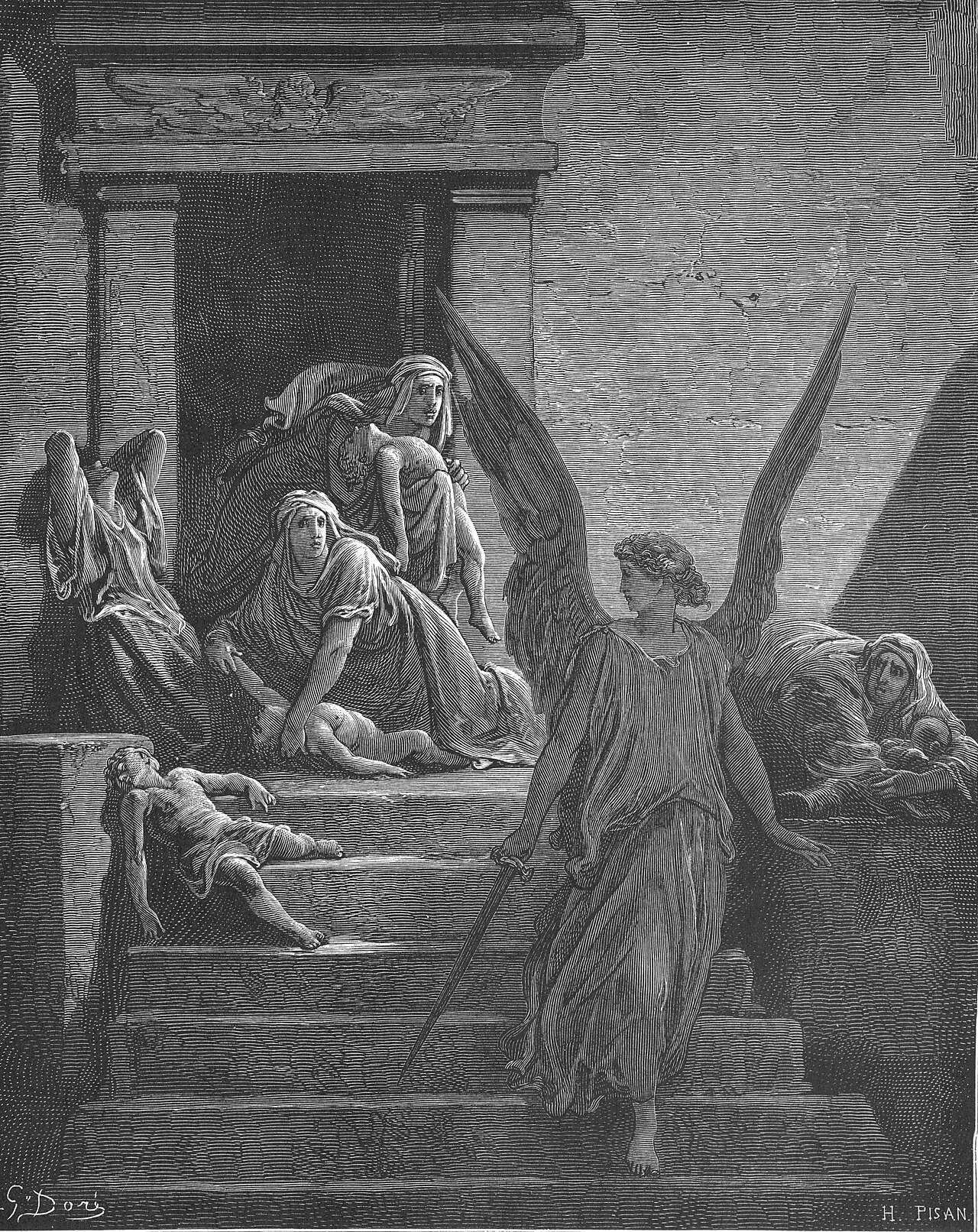
This chapter founds Passover, in Hebrew Pesach, the spring feast that remembers the night God struck Egypt's firstborn and passed over the blood-marked houses. Jewish families keep it to this day with a ceremonial meal called the seder (Hebrew for “order”): unleavened flatbread (matzah), bitter herbs, cups of wine, and the retelling of this chapter's story, with the children asking the questions.
Honesty about the timeline helps the reader: in the Bible's own period the center of the feast was the lamb, slain and eaten as this chapter commands. The seder as now practiced took its shape after the Temple fell in AD 70 and the lamb could no longer be offered; its oldest written outline is in the Mishnah, the first code of Jewish oral law (about AD 200), which already includes the four cups and the rule that “in every generation a person must see himself as if he personally came out of Egypt.”
This section is reception history: how the passage was read and kept in the Jewish tradition. Where a reading parts from an essential of the Christian faith, the section says so at that point.
Sources: Mishnah Pesachim 10 (the seder's oldest outline) · Mishnah Pesachim 10:5 (“in every generation”) · The Feasts of the LORD (this site's study)
The words behind it
15 Hebrew wordsEvery Hebrew word of this verse in the order it stands, with what it means and the door to its own study. The last column counts the times a word stands in the whole Bible: the rarer the word, the more the places it appears belong together.
| Hebrew | Sound | Meaning | Word study | In the Bible |
|---|---|---|---|---|
| וְהָיָ֞ה | vehayah | and it will be | H1961 → | 3559 times |
| כִּֽי־ | ki- | that | H3588 → | 4482 times |
| תָבֹ֣אוּ | tavou | you will come | H935 → | 2568 times |
| אֶל־ | ʾel- | into | H413 → | 5510 times |
| הָאָ֗רֶץ | haaretz | the land | H776 → | 2504 times |
| אֲשֶׁ֨ר | ʾasher | which | H834 → | 5497 times |
| יִתֵּ֧ן | yiten | he will give | H5414 → | 2011 times |
| יְהוָ֛ה | yahweh | Yahweh | H3068 → | 6520 times |
| לָכֶ֖ם | lakhem | to <the> you | ||
| כַּאֲשֶׁ֣ר | kaasher | just as | H834 → | 5497 times |
| דִּבֵּ֑ר | diber | he said | H1696 → | 1141 times |
| וּשְׁמַרְתֶּ֖ם | ushemartem | and you will keep | H8104 → | 468 times |
| אֶת־ | ʾet- | <obj.> | H853 → | 10935 times |
| הָעֲבֹדָ֥ה | haavodah | the service | H5656 → | 145 times |
| הַזֹּֽאת׃ | hazot | <the> this | H2063 → | 603 times |
וְהָיָ֞הand it will be
vehayahH1961 →3559 times
כִּֽי־that
ki-H3588 →4482 times
תָבֹ֣אוּyou will come
tavouH935 →2568 times
אֶל־into
ʾel-H413 →5510 times
הָאָ֗רֶץthe land
haaretzH776 →2504 times
אֲשֶׁ֨רwhich
ʾasherH834 →5497 times
יִתֵּ֧ןhe will give
yitenH5414 →2011 times
יְהוָ֛הYahweh
yahwehH3068 →6520 times
לָכֶ֖םto <the> you
lakhem
כַּאֲשֶׁ֣רjust as
kaasherH834 →5497 times
דִּבֵּ֑רhe said
diberH1696 →1141 times
וּשְׁמַרְתֶּ֖םand you will keep
ushemartemH8104 →468 times
אֶת־<obj.>
ʾet-H853 →10935 times
הָעֲבֹדָ֥הthe service
haavodahH5656 →145 times
הַזֹּֽאת׃<the> this
hazotH2063 →603 times
A shaded row is a word that stands 400 times or fewer in the Bible.
The walk
8 stopsEach card is a verse this one points to, and under it the verses that one points to in turn. Where several paths arrive at the same place, that place is listed first: the text keeps returning to it.
Through
Exodus 3:8I have come down to rescue them from the hand of the Egyptians and to bring them up out of that land to a good and spacious land, a land flowing with milk and…
it leads to
- Genesis 50:24
Then Joseph said to his brothers, “I am about to die, but God will surely visit you and bring you up from this land to the land He promised on oath to Abraham, Isaac,…
Reached by 2 separate paths from here.
- Exodus 3:17
And I have promised to bring you up out of your affliction in Egypt, into the land of the Canaanites, Hittites, Amorites, Perizzites, Hivites, and Jebusites—a land flowing with milk and honey.’
- Genesis 15:18–21
On that day the LORD made a covenant with Abram, saying, “To your descendants I have given this land—from the river of Egypt to the great River Euphrates—
- Exodus 13:5
And when the LORD brings you into the land of the Canaanites, Hittites, Amorites, Hivites, and Jebusites—the land He swore to your fathers that He would give you, a land flowing with milk and…
- Deuteronomy 1:25
They took some of the fruit of the land in their hands, carried it down to us, and brought us word: “It is a good land that the LORD our God is giving us.”
- Genesis 50:24
Through
Deuteronomy 4:5See, I have taught you statutes and ordinances just as the LORD my God has commanded me, so that you may follow them in the land that you are about to enter and possess.
it leads to
- Matthew 28:20
and teaching them to obey all that I have commanded you. And surely I am with you always, even to the end of the age.”
- 1 Thessalonians 4:1–2
Finally, brothers, we ask and encourage you in the Lord Jesus to live in a way that is pleasing to God, just as you have received from us. This is how you already live,…
- Deuteronomy 4:1
Hear now, O Israel, the statutes and ordinances I am teaching you to follow, so that you may live and may enter and take possession of the land that the LORD, the God of…
- Matthew 28:20
Where this verse is studied
On this page
Studies30
On this verse
On this chapter
- The Words Philoxenia and Ger
- The Words Tom and Tamim
- Jesus: Titles & Roles
- Pharaoh
- Rahab and the Scarlet Cord
- The Scarlet Thread
Show the next 6 titles
- Taw: The Mark of God
- The Ark and Dagon: 1 Samuel 4-6
- The Brickfields of Egypt
- The Calendar of the Flood
- The Crossing of the Jordan
- The Date of the Exodus
Show the next 6 titles
About Exodus
This page draws on Charles Spurgeon, The Metropolitan Tabernacle Pulpit, Sermon No. 1988: “The Blood of Sprinkling and the Children” (lightly modernized text, CCEL edition); Jamieson, Fausset & Brown, Commentary Critical and Explanatory on the Whole Bible; John Gill, Exposition of the Old Testament (1748-1763); John Wesley, Explanatory Notes upon the Old Testament; Keil and Delitzsch, Biblical Commentary on the Old Testament: The Pentateuch and Matthew Henry, Commentary on the Whole Bible.