
Exodus 12:47
in Exodus 12The whole congregation of Israel must celebrate it.
BSB
The same verse in ASV and KJV ▾
ASV
All the congregation of Israel shall keep it.
KJV
All the congregation of Israel shall keep it.
⋯
This verse in Exodus 12
Commentary
3 notes on this verseAll that share in God's mercies should join in thankful praises for them. Though it was observed in families apart, yet it is looked upon as the act of the whole congregation; for the smaller communities constituted the greater. The New-Testament passover, the Lord's supper, ought not to be neglected by any who are capable of celebrating it.
This site's exposition
All the congregation of Israel shall keep it
on Exodus 12:47-49
One law shall be to him that is homeborn, and unto the stranger that sojourneth among you. On the night Israel becomes a nation it is given a rule that refuses to make its own birth a privilege. The stranger who joins the covenant is to be as one that is born in the land, which is the same phrase the chapter uses of the native.
The record, by era
The Puritans and the Awakening1 voice
All the congregation of Israel shall keep it. The passover, and the feast of unleavened bread only; for a Gentile was first to be circumcised, and be joined to the congregation, and then partake of it, and not before.
How the passage was read
On Exodus 12:1-51On Exodus 12:1-51
The night Israel still keeps
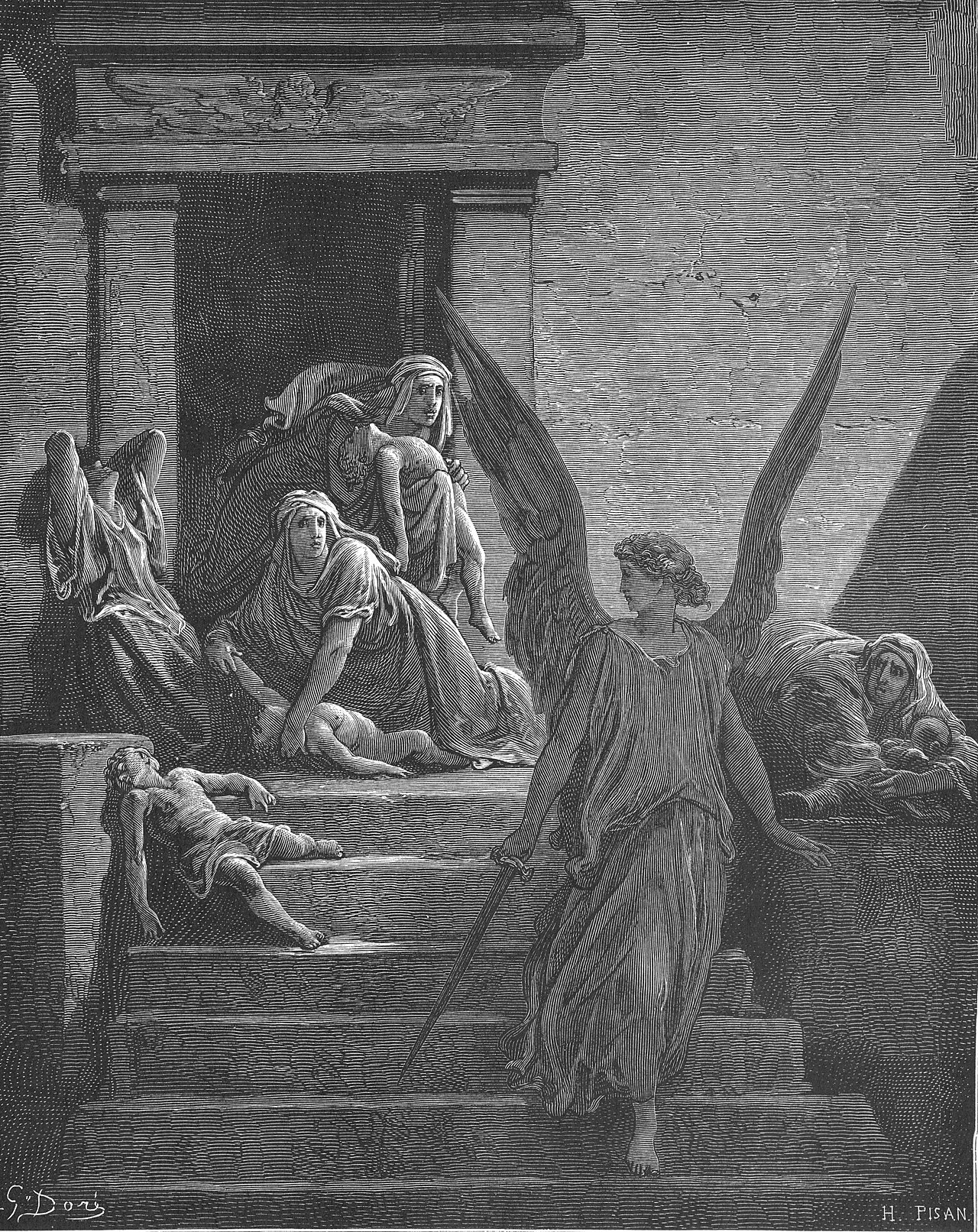
This chapter founds Passover, in Hebrew Pesach, the spring feast that remembers the night God struck Egypt's firstborn and passed over the blood-marked houses. Jewish families keep it to this day with a ceremonial meal called the seder (Hebrew for “order”): unleavened flatbread (matzah), bitter herbs, cups of wine, and the retelling of this chapter's story, with the children asking the questions.
Honesty about the timeline helps the reader: in the Bible's own period the center of the feast was the lamb, slain and eaten as this chapter commands. The seder as now practiced took its shape after the Temple fell in AD 70 and the lamb could no longer be offered; its oldest written outline is in the Mishnah, the first code of Jewish oral law (about AD 200), which already includes the four cups and the rule that “in every generation a person must see himself as if he personally came out of Egypt.”
This section is reception history: how the passage was read and kept in the Jewish tradition. Where a reading parts from an essential of the Christian faith, the section says so at that point.
Sources: Mishnah Pesachim 10 (the seder's oldest outline) · Mishnah Pesachim 10:5 (“in every generation”) · The Feasts of the LORD (this site's study)
The words behind it
5 Hebrew wordsEvery Hebrew word of this verse in the order it stands, with what it means and the door to its own study. The last column counts the times a word stands in the whole Bible: the rarer the word, the more the places it appears belong together.
| Hebrew | Sound | Meaning | Word study | In the Bible |
|---|---|---|---|---|
| כָּל־ | kol- | all | H3605 → | 5413 times |
| עֲדַ֥ת | ʾadat | [the] congregation of | H5712 → | 149 times |
| יִשְׂרָאֵ֖ל | yisrael | Israel | H3478 → | 2507 times |
| יַעֲשׂ֥וּ | yaasu | they will do | H6213 → | 2628 times |
| אֹתֽוֹ׃ | ʾoto | <obj.> it | H853 → | 10935 times |
כָּל־all
kol-H3605 →5413 times
עֲדַ֥ת[the] congregation of
ʾadatH5712 →149 times
יִשְׂרָאֵ֖לIsrael
yisraelH3478 →2507 times
יַעֲשׂ֥וּthey will do
yaasuH6213 →2628 times
אֹתֽוֹ׃<obj.> it
ʾotoH853 →10935 times
A shaded row is a word that stands 400 times or fewer in the Bible.
The walk
8 stopsEach card is a verse this one points to, and under it the verses that one points to in turn. Where several paths arrive at the same place, that place is listed first: the text keeps returning to it.
Through
Exodus 12:6You must keep it until the fourteenth day of the month, when the whole assembly of the congregation of Israel will slaughter the animals at twilight.
it leads to
- Leviticus 23:5
The Passover to the LORD begins at twilight on the fourteenth day of the first month.
- 2 Chronicles 30:15–18
And on the fourteenth day of the second month they slaughtered the Passover lamb. The priests and Levites were ashamed, and they consecrated themselves and brought burnt offerings to the house of the LORD.
- Numbers 28:16
The fourteenth day of the first month is the LORD’s Passover.
- Numbers 9:1–3
In the first month of the second year after Israel had come out of the land of Egypt, the LORD spoke to Moses in the Wilderness of Sinai:
- Exodus 12:18
In the first month you are to eat unleavened bread, from the evening of the fourteenth day until the evening of the twenty-first day.
- Leviticus 23:5
Through
Numbers 9:13But if a man who is ceremonially clean and is not on a journey still fails to observe the Passover, he must be cut off from his people, because he did not present the…
it leads to
- Genesis 17:14
But if any male is not circumcised, he will be cut off from his people; he has broken My covenant.”
- Exodus 12:15
For seven days you must eat unleavened bread. On the first day you are to remove the leaven from your houses. Whoever eats anything leavened from the first day through the seventh must be…
- Numbers 9:7
and said to Moses, “We are unclean because of a dead body, but why should we be excluded from presenting the LORD’s offering with the other Israelites at the appointed time?”
- Genesis 17:14
Where this verse is studied
About Exodus
This page draws on John Gill, Exposition of the Old Testament (1748-1763); Keil and Delitzsch, Biblical Commentary on the Old Testament: The Pentateuch and Matthew Henry, Commentary on the Whole Bible.