
Priest
Aaron
First High Priest of Israel · Exodus/Wilderness · c. 1529-1407 BC
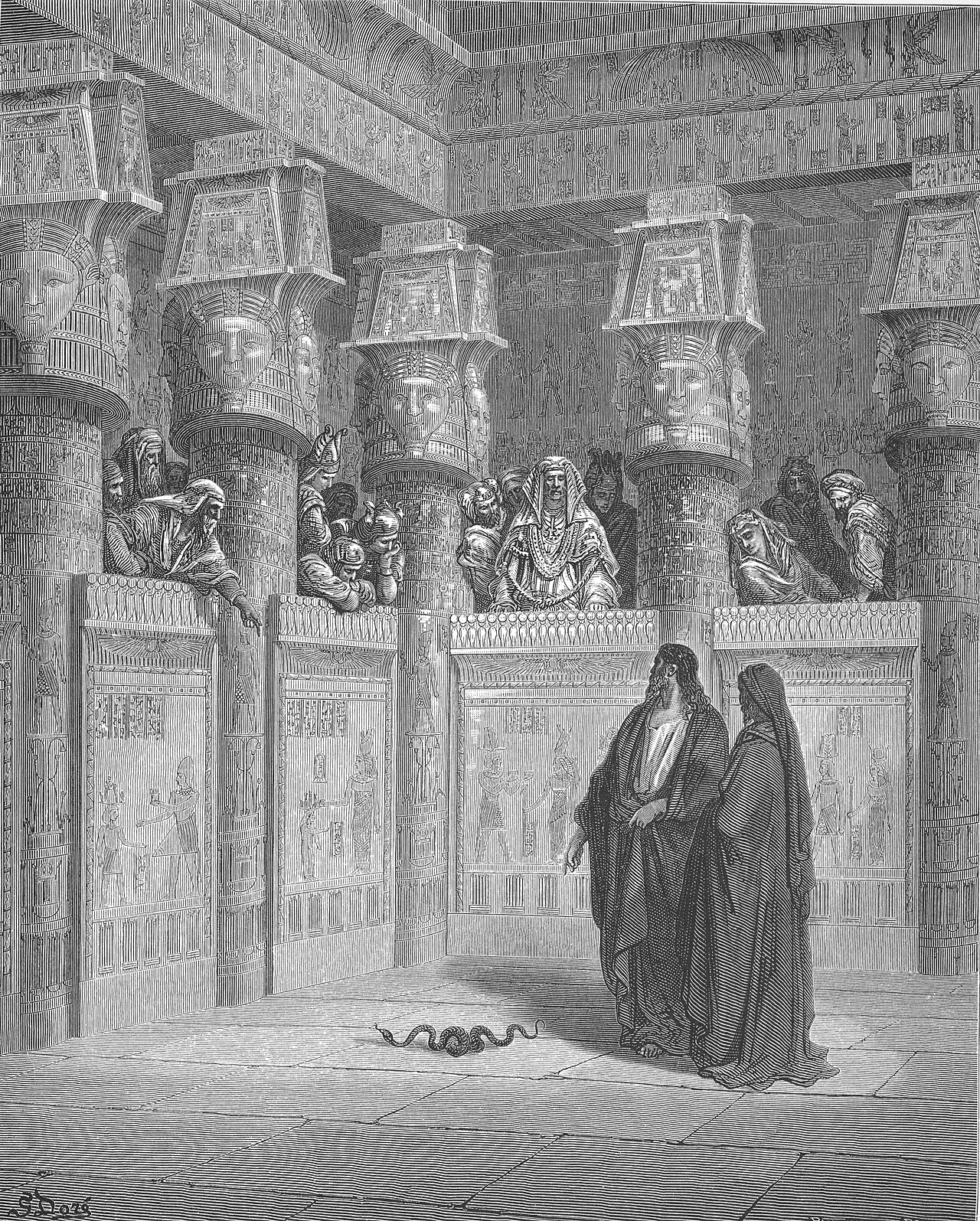
Moses and Aaron Appear before Pharaoh — Gustave Doré, The Holy Bible (1866), public domain
Summary
Aaron was Moses' older brother and spokesman before Pharaoh, later consecrated as Israel's first high priest. His mediating role at the altar prefigured Christ's priesthood, though his failure at the golden calf shows even God's chosen leaders can fall to pressure.
- Among the passages here, Aaron is first named in Exodus 4:14: “Then the anger of the LORD burned against Moses, and He said, “Is not…”
- The record places Aaron in Exodus/Wilderness.
- 343 verses name Aaron, in 16 books.
- 6 moments stand in order on this page, each with its verse.
On this page
Start here
Then the anger of the LORD burned against Moses, and He said, “Is not Aaron the Levite your brother? I know that he can speak well, and he is now on his way to meet you. When he sees you, he will be glad in his heart.
Exodus 4:14→- 6 key events in order
- 343 verses name Aaron, across 16 books
In Scripture
- Verses
- 343
- Books
- 16
Aaron
- Role
- First High Priest of Israel
- Era
- Exodus/Wilderness
- Dates
- c. 1529-1407 BC
- Tribe
- Levi (Israel)
- Father
- Amram
- Mother
- Jochebed
- Spouse
- Elisheba
- Children
- Nadab, Abihu, Eleazar, Ithamar
The life in order
from the events the row records, with the first and last verse that names the person among the passages this page stands on
1Where the passages this page records open
2What the record holds, in its own order
- Appointed Moses' spokesmanExodus 4:14-16Then the anger of the LORD burned against Moses, and He said, “Is not Aaron the Levite your brother? I know that he can speak well, and he is now on his way to meet you. When he sees you, he will be glad in his heart.
- Consecrated as high priestExodus 28:1“Next, have your brother Aaron brought to you from among the Israelites, along with his sons Nadab, Abihu, Eleazar, and Ithamar, to serve Me as priests.
- Made the golden calfExodus 32:1-6Now when the people saw that Moses was delayed in coming down from the mountain, they gathered around Aaron and said, “Come, make us gods who will go before us. As for this Moses who brought us up out of the land of Egypt, we do not know what has happened to him!”
- Nadab and Abihu's deathLeviticus 10:1-2Now Aaron’s sons Nadab and Abihu took their censers, put fire in them and added incense, and offered unauthorized fire before the LORD, contrary to His command.
- Aaron's staff buddedNumbers 17:1-11And the LORD said to Moses,
- Died on Mount HorNumbers 20:22-29After they had set out from Kadesh, the whole congregation of Israel came to Mount Hor.
3Where the passages this page records close
Biography
Aaron, three years older than Moses, was appointed by God to be his brother's mouthpiece when Moses protested his own inadequacy as a speaker. Together the brothers confronted Pharaoh, and Aaron's staff performed several of the plague signs, including turning to a serpent before Pharaoh's magicians. At Sinai, Aaron was set apart with his sons as Israel's priesthood, clothed in garments of glory and beauty, and given the sacred duty of mediating between God and the people through sacrifice. Yet it was Aaron who, under pressure from the people while Moses was on the mountain, fashioned the golden calf that Israel worshiped in flagrant idolatry, nearly bringing God's judgment on the whole nation. Aaron's priesthood was confirmed when his staff alone budded among the tribal staffs, silencing further challenges to his authority such as Korah's rebellion. His sons Nadab and Abihu were struck dead for offering unauthorized fire before the LORD, a sobering reminder that priestly service demands reverence, not innovation. Aaron died on Mount Hor at 123 years old, his priestly garments transferred to his son Eleazar in full view of the people, marking the succession of Israel's high priesthood that would continue for centuries.
Then the anger of the LORD burned against Moses, and He said, “Is not Aaron the Levite your brother? I know that he can speak well, and he is now on his way to meet you. When he sees you, he will be glad in his heart.
God's provision of Aaron as Moses' spokesman
More key verses
Text: Berean Standard Bible.
“Next, have your brother Aaron brought to you from among the Israelites, along with his sons Nadab, Abihu, Eleazar, and Ithamar, to serve Me as priests.
“Now Aaron’s sons Nadab and Abihu took their censers, put fire in them and added incense, and offered unauthorized fire before the LORD, contrary to His command.”
What they got right, and what they got wrong
Strengths
Gifted communicator, faithful support of Moses' leadership, eventual restoration after the golden calf, endured decades of wilderness service
Weaknesses
Yielded to the people's demand for an idol, made excuses for his failure rather than confessing plainly, joined Miriam in challenging Moses' authority
Lessons
Spiritual gifting does not exempt leaders from moral failure. Worship must follow God's terms, not human invention or popular demand. God confirms true authority in His own time and way.
Spiritual significance
Aaron establishes the Levitical priesthood as mediator between God and Israel through sacrifice, while his failure at the golden calf warns that even ordained leaders can be swept into sin by popular pressure.
How Aaron points to Jesus
Aaron's priesthood, offering sacrifices for the people, prefigures Christ's superior priesthood, who offered Himself once for all (Hebrews 7:26-27).
Aaron in Scripture
Open a book to read its mentions here. Text: Berean Standard Bible. Names repeat in Scripture, so some of these verses may speak of another person called Aaron. The two marks are drawn from the chapters this page's own references stand in.
Old TestamentNew Testamentsegment width = share of mentions
Old Testament13 books · 338 mentions
Exodus114 mentions
- Exodus 4:14Then the anger of the LORD burned against Moses, and He said, “Is not Aaron the Levite your brother? I know that he can speak well, and he is now on his way to meet you. When he sees you, he will be glad in his heart.
- Exodus 4:27Meanwhile, the LORD had said to Aaron, “Go and meet Moses in the wilderness.” So he went and met Moses at the mountain of God and kissed him.
- Exodus 4:28And Moses told Aaron everything the LORD had sent him to say, and all the signs He had commanded him to perform.
- Exodus 4:29Then Moses and Aaron went and assembled all the elders of the Israelites,
- Exodus 4:30and Aaron relayed everything the LORD had said to Moses. And Moses performed the signs before the people,
109 further mentions in Exodus, read them in the book.
Leviticus81 mentions
- Leviticus 1:5And he shall slaughter the young bull before the LORD, and Aaron’s sons the priests are to present the blood and sprinkle it on all sides of the altar at the entrance to the Tent of Meeting.
- Leviticus 1:7The sons of Aaron the priest shall put a fire on the altar and arrange wood on the fire.
- Leviticus 1:8Then Aaron’s sons the priests are to arrange the pieces, including the head and the fat, atop the burning wood on the altar.
- Leviticus 1:11He shall slaughter it on the north side of the altar before the LORD, and Aaron’s sons the priests are to sprinkle its blood against the altar on all sides.
- Leviticus 2:2and bring it to Aaron’s sons the priests. The priest shall take a handful of the flour and oil, together with all the frankincense, and burn this as a memorial portion on the altar, an offering made by fire, a pleasing aroma to the LORD.
76 further mentions in Leviticus, read them in the book.
Numbers98 mentions
- Numbers 1:3You and Aaron are to number those who are twenty years of age or older by their divisions—everyone who can serve in Israel’s army.
- Numbers 1:17So Moses and Aaron took these men who had been designated by name,
- Numbers 1:44These were the men numbered by Moses and Aaron, with the assistance of the twelve leaders of Israel, each one representing his family.
- Numbers 2:1Then the LORD said to Moses and Aaron:
- Numbers 3:1This is the account of Aaron and Moses at the time the LORD spoke with Moses on Mount Sinai.
93 further mentions in Numbers, read them in the book.
Deuteronomy3 mentions
- Deuteronomy 9:20The LORD was angry enough with Aaron to destroy him, but at that time I also prayed for Aaron.
- Deuteronomy 10:6The Israelites traveled from Beeroth Bene-jaakan to Moserah, where Aaron died and was buried, and Eleazar his son succeeded him as priest.
- Deuteronomy 32:50And there on the mountain that you climb, you will die and be gathered to your people, just as your brother Aaron died on Mount Hor and was gathered to his people.
Joshua6 mentions
- Joshua 21:4The first lot came out for the Kohathite clans. The Levites who were descendants of Aaron the priest received thirteen cities by lot from the tribes of Judah, Simeon, and Benjamin.
- Joshua 21:10to the descendants of Aaron from the Kohathite clans of the Levites, because the first lot fell to them:
- Joshua 21:13So to the descendants of Aaron the priest they gave these cities, together with their pasturelands: Hebron, a city of refuge for the manslayer, Libnah,
- Joshua 21:19In all, thirteen cities, together with their pasturelands, were given to the priests, the descendants of Aaron.
- Joshua 24:5Then I sent Moses and Aaron, and I afflicted the Egyptians by what I did there, and afterward I brought you out.
1 further mention in Joshua, read them in the book.
Judges1 mention
1 Samuel2 mentions
- 1 Samuel 12:6Then Samuel said to the people, “The LORD is the One who appointed Moses and Aaron, and who brought your fathers up out of the land of Egypt.
- 1 Samuel 12:8When Jacob went to Egypt, your fathers cried out to the LORD, and He sent them Moses and Aaron, who brought your fathers out of Egypt and settled them in this place.
1 Chronicles14 mentions
- 1 Chronicles 6:3The children of Amram: Aaron, Moses, and Miriam. The sons of Aaron: Nadab, Abihu, Eleazar, and Ithamar.
- 1 Chronicles 6:49But Aaron and his sons did all the work of the Most Holy Place. They presented the offerings on the altar of burnt offering and on the altar of incense to make atonement for Israel, according to all that Moses the servant of God had commanded.
- 1 Chronicles 6:50These were the descendants of Aaron:
- 1 Chronicles 6:54Now these were the territories assigned to the descendants of Aaron from the Kohathite clan for their settlements, because the first lot fell to them:
- 1 Chronicles 6:57So the descendants of Aaron were given Hebron (a city of refuge), Libnah, Jattir, Eshtemoa,
9 further mentions in 1 Chronicles, read them in the book.
2 Chronicles6 mentions
- 2 Chronicles 13:9But did you not drive out the priests of the LORD, the sons of Aaron, and the Levites? And did you not make priests for yourselves as do the peoples of other lands? Now whoever comes to consecrate himself with a young bull and seven rams can become a priest of things that are not gods.
- 2 Chronicles 13:10But as for us, the LORD is our God. We have not forsaken Him; the priests who minister to the LORD are sons of Aaron, and the Levites attend to their duties.
- 2 Chronicles 26:18They took their stand against King Uzziah and said, “Uzziah, you have no right to offer incense to the LORD. Only the priests, the descendants of Aaron, are consecrated to burn incense. Leave the sanctuary, for you have acted unfaithfully; you will not receive honor from the LORD God.”
- 2 Chronicles 29:21They brought seven bulls, seven rams, seven lambs, and seven male goats as a sin offering for the kingdom, for the sanctuary, and for Judah. And the king commanded the priests, the descendants of Aaron, to offer them on the altar of the LORD.
- 2 Chronicles 31:19As for the priests, the descendants of Aaron, who lived on the farmlands around each of their cities or in any other city, men were designated by name to distribute a portion to every male among the priests and to every Levite listed by the genealogies.
1 further mention in 2 Chronicles, read them in the book.
Ezra1 mention
Nehemiah2 mentions
- Nehemiah 10:38A priest of Aaron’s line is to accompany the Levites when they collect the tenth, and the Levites are to bring a tenth of these tithes to the storerooms of the treasury in the house of our God.
- Nehemiah 12:47So in the days of Zerubbabel and Nehemiah, all Israel contributed the daily portions for the singers and gatekeepers. They also set aside daily portions for the Levites, and the Levites set aside daily portions for the descendants of Aaron.
Psalms9 mentions
- Psalms 77:20You led Your people like a flock by the hand of Moses and Aaron.
- Psalms 99:6Moses and Aaron were among His priests; Samuel was among those who called on His name. They called to the LORD and He answered.
- Psalms 105:26He sent Moses His servant, and Aaron, whom He had chosen.
- Psalms 106:16In the camp they envied Moses, as well as Aaron, the holy one of the LORD.
- Psalms 115:10O house of Aaron, trust in the LORD! He is their help and shield.
4 further mentions in Psalms, read them in the book.
New Testament3 books · 5 mentions
Luke1 mention
Acts1 mention
Hebrews3 mentions
- Hebrews 5:4No one takes this honor upon himself; he must be called by God, just as Aaron was.
- Hebrews 7:11Now if perfection could have been attained through the Levitical priesthood (for on this basis the people received the law), why was there still need for another priest to appear—one in the order of Melchizedek and not in the order of Aaron?
- Hebrews 9:4containing the golden altar of incense and the gold-covered ark of the covenant. Inside the ark were the gold jar of manna, Aaron’s staff that had budded, and the stone tablets of the covenant.
Keep studying
On this page
Studies12
People1
Books14
Doorway1
Keep this page