
Exodus 12:23
in Exodus 12When the LORD passes through to strike down the Egyptians, He will see the blood on the top and sides of the doorframe and will pass over that doorway; so He will not allow the destroyer to enter your houses and strike you down.
BSB
The same verse in ASV and KJV ▾
ASV
For Jehovah will pass through to smite the Egyptians; and when he seeth the blood upon the lintel, and on the two side-posts, Jehovah will pass over the door, and will not suffer the destroyer to come in unto your houses to smite you.
KJV
For the Lord will pass through to smite the Egyptians; and when he seeth the blood upon the lintel, and on the two side posts, the Lord will pass over the door, and will not suffer the destroyer to come in unto your houses to smite you.
⋯
This verse in Exodus 12
Commentary
9 notes on this verseThis site's exposition
the LORD will pass through to smite the Egyptians
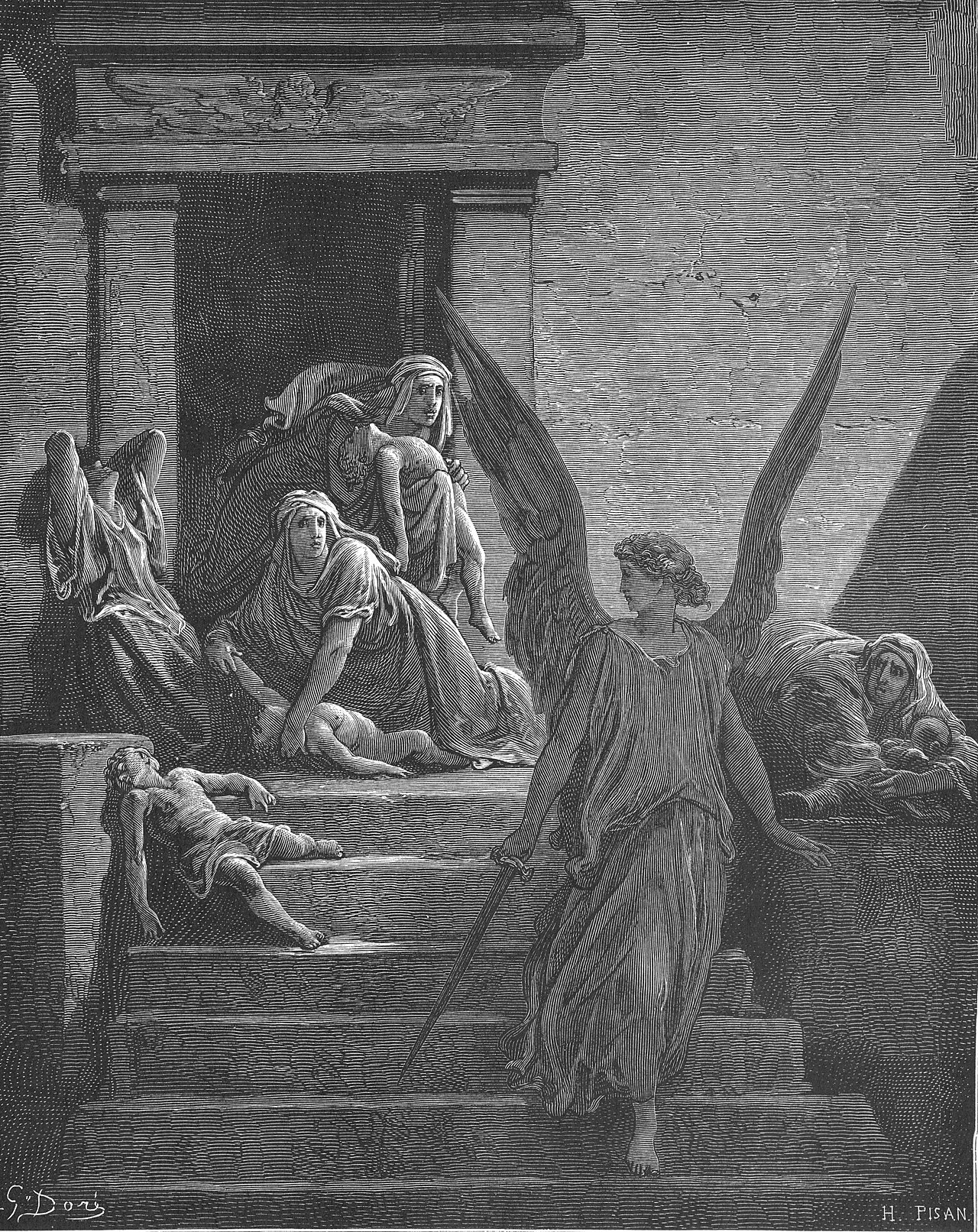
The verse names two actors, the LORD who passes through and the destroyer who is not suffered to come in, and commentators have long divided over whether these are one or two. The text does not settle it. What it does settle is the mechanism, since the blood is seen from outside the house, so a family is kept safe by something none of them can see while they eat.
The record, by era
The Church Fathers4 voices
[The Son of God's] cross is our victory, and his gibbet is our triumph. With joy let us take this sign on our shoulders, let us bear the banners of victory. Let us bear such an imperial banner, indeed, on our foreheads! When the devil …
We must also inquire who that being was of whom it is said in Exodus that he wished to kill Moses because he was setting out for Egypt. And afterwards, who is it that is called the "destroying angel"? And who also is he who in Leviticus is described as Apopompeus, that is, the Averter, of whom the Scripture speaks thus: "One lot for the Lord, and one lot for Apopompeus"?
And who else could be the destroyer in Exodus, which Moses wrote, except the one who is the cause of destruction to those who obey him and who do not resist and struggle against his wickedness?
I cull these few flowers in passing from the fair field of the Holy Scriptures. They will suffice to warn you that you must shut the door of your breast and fortify your brow by often making the sign of the cross. Thus alone will the destroyer of Egypt find no place to attack you. Thus alone will the firstborn of your soul escape the fate of the firstborn of the Egyptians. Thus alone will you be able with the prophet to say, "My heart is fixed, O God, my heart is fixed; I will sing and give praise."
The Medieval Church1 voice
This [cross] we have been given as a sign on our forehead, just as Israel was given the circumcision. For by it we faithful are set apart from the infidels and recognized. It is a shield and armor and a trophy against the devil. It is a seal that the destroyer may not strike us, as Scripture says.
3 more voices on this verse
The Puritans and the Awakening1 voice
For the Lord will pass though to smite the Egyptians,....
The Nineteenth Century2 voices
I WANTED, dear Friends, earnestly wanted, to continue the subject of last Lord's-Day morning, for I felt it important that we should bear again and again our witness to the doctrine of the vicarious Sacrifice of Jesus Christ our Lord. But, at the same time, I promised that I would endeavor to keep "the feast of the children" and have a sermon which should be specially addressed to Sunday school teachers.
I WANTED, dear Friends, earnestly wanted, to continue the subject of last Lord's-Day morning, for I felt it important that we should bear again and again our witness to the doctrine of the vicarious Sacrifice of Jesus Christ our Lord. But, at the same time, I promised that I would endeavor to keep "the feast of the children" and have a sermon which should be specially addressed to Sunday school teachers. I could not preach a school sermon at the appointed time, so as to open your children's week, but thought a discourse might come in, none the less suitably, if I brought up the rear by closing your meetings. How am I to fulfill both my purposes? I think the subject before us will enable me to do so. We shall preach of the sprinkled blood and of Jesus, the great Sacrifice for sin—and then we shall press upon all who know the value of the great Redemption that they teach the young in their earliest days what is meant by the death of Jesus and salvation through His blood. The Paschal lamb was a special type of our Lord Jesus Christ. We are not left to gather this from the general fact that all the ancient sacrifices were shadows of the one true and real Substance—we are assured in the New Testament that "Christ our Passover is sacrificed for us" (1 Cor 5:7). As the Paschal lamb must be without blemish, so was our Lord, and its killing and roasting with fire were typical of His death and sufferings. Even as to time our Lord fulfilled the type, for the time of His Crucifixion was the Passover. As the impression answers to the seal, so does the Sacrifice of our Lord correspond with all the items of the ceremonial Passover. We see Him "drawn out" from among men and led as a lamb to the slaughter. We see His blood shed and sprinkled. We see Him roasted in the fire of anguish. By faith we eat of Him and flavor the feast with the bitter herbs of penitence.
How the passage was read
On Exodus 12:1-51On Exodus 12:1-51
The night Israel still keeps
This chapter founds Passover, in Hebrew Pesach, the spring feast that remembers the night God struck Egypt's firstborn and passed over the blood-marked houses. Jewish families keep it to this day with a ceremonial meal called the seder (Hebrew for “order”): unleavened flatbread (matzah), bitter herbs, cups of wine, and the retelling of this chapter's story, with the children asking the questions.
Honesty about the timeline helps the reader: in the Bible's own period the center of the feast was the lamb, slain and eaten as this chapter commands. The seder as now practiced took its shape after the Temple fell in AD 70 and the lamb could no longer be offered; its oldest written outline is in the Mishnah, the first code of Jewish oral law (about AD 200), which already includes the four cups and the rule that “in every generation a person must see himself as if he personally came out of Egypt.”
This section is reception history: how the passage was read and kept in the Jewish tradition. Where a reading parts from an essential of the Christian faith, the section says so at that point.
Sources: Mishnah Pesachim 10 (the seder's oldest outline) · Mishnah Pesachim 10:5 (“in every generation”) · The Feasts of the LORD (this site's study)
The words behind it
24 Hebrew wordsEvery Hebrew word of this verse in the order it stands, with what it means and the door to its own study. The last column counts the times a word stands in the whole Bible: the rarer the word, the more the places it appears belong together.
| Hebrew | Sound | Meaning | Word study | In the Bible |
|---|---|---|---|---|
| וְעָבַ֣ר | veavar | and he will pass through | H5674 → | 556 times |
| יְהוָה֮ | yahweh | Yahweh | H3068 → | 6520 times |
| לִנְגֹּ֣ף | lingof | to strike | H5062 → | 49 times |
| אֶת־ | ʾet- | <obj.> | H853 → | 10935 times |
| מִצְרַיִם֒ | mitzrayim | Egypt | H4714 → | 641 times |
| וְרָאָ֤ה | veraah | and he will see | H7200 → | 1300 times |
| אֶת־ | ʾet- | <obj.> | H853 → | 10935 times |
| הַדָּם֙ | hadam | the blood | H1818 → | 360 times |
| עַל־ | ʾal- | on | H5921 → | 5755 times |
| הַמַּשְׁק֔וֹף | hamashkof | the lintels | H4947 → | 3 times |
| וְעַ֖ל | veal | and on | H5921 → | 5755 times |
| שְׁתֵּ֣י | shetei | [the] two | H8147 → | 768 times |
| הַמְּזוּזֹ֑ת | hamezuzot | the doorposts | H4201 → | 19 times |
| וּפָסַ֤ח | ufasach | and he will pass over | H6452 → | 7 times |
| יְהוָה֙ | yahweh | Yahweh | H3068 → | 6520 times |
| עַל־ | ʾal- | over | H5921 → | 5755 times |
| הַפֶּ֔תַח | hapetach | the doorway | H6607 → | 164 times |
| וְלֹ֤א | velo' | and not | H3808 → | 5168 times |
| יִתֵּן֙ | yiten | he will permit | H5414 → | 2011 times |
| הַמַּשְׁחִ֔ית | hamashchit | the destroyer | H7843 → | 146 times |
| לָבֹ֥א | lavo' | to come | H935 → | 2568 times |
| אֶל־ | ʾel- | into | H413 → | 5510 times |
| בָּתֵּיכֶ֖ם | bateikhem | houses your | H1004 → | 2046 times |
| לִנְגֹּֽף׃ | lingof | to strike [you] | H5062 → | 49 times |
וְעָבַ֣רand he will pass through
veavarH5674 →556 times
יְהוָה֮Yahweh
yahwehH3068 →6520 times
לִנְגֹּ֣ףto strike
lingofH5062 →49 times
אֶת־<obj.>
ʾet-H853 →10935 times
מִצְרַיִם֒Egypt
mitzrayimH4714 →641 times
וְרָאָ֤הand he will see
veraahH7200 →1300 times
אֶת־<obj.>
ʾet-H853 →10935 times
הַדָּם֙the blood
hadamH1818 →360 times
עַל־on
ʾal-H5921 →5755 times
הַמַּשְׁק֔וֹףthe lintels
hamashkofH4947 →3 times
וְעַ֖לand on
vealH5921 →5755 times
שְׁתֵּ֣י[the] two
sheteiH8147 →768 times
הַמְּזוּזֹ֑תthe doorposts
hamezuzotH4201 →19 times
וּפָסַ֤חand he will pass over
ufasachH6452 →7 times
יְהוָה֙Yahweh
yahwehH3068 →6520 times
עַל־over
ʾal-H5921 →5755 times
הַפֶּ֔תַחthe doorway
hapetachH6607 →164 times
וְלֹ֤אand not
velo'H3808 →5168 times
יִתֵּן֙he will permit
yitenH5414 →2011 times
הַמַּשְׁחִ֔יתthe destroyer
hamashchitH7843 →146 times
לָבֹ֥אto come
lavo'H935 →2568 times
אֶל־into
ʾel-H413 →5510 times
בָּתֵּיכֶ֖םhouses your
bateikhemH1004 →2046 times
לִנְגֹּֽף׃to strike [you]
lingofH5062 →49 times
A shaded row is a word that stands 400 times or fewer in the Bible.
The walk
8 stopsEach card is a verse this one points to, and under it the verses that one points to in turn. Where several paths arrive at the same place, that place is listed first: the text keeps returning to it.
Through
Revelation 7:3“Do not harm the land or sea or trees until we have sealed the foreheads of the servants of our God.”
it leads to
- Ezekiel 9:4
“Go throughout the city of Jerusalem,” said the LORD, “and put a mark on the foreheads of the men sighing and groaning over all the abominations committed there.”
Reached by 2 separate paths from here.
- Revelation 22:4
They will see His face, and His name will be on their foreheads.
- Revelation 9:4
They were told not to harm the grass of the earth or any plant or tree, but only those who did not have the seal of God on their foreheads.
- Ezekiel 9:4
Through
1 Corinthians 10:10And do not complain, as some of them did, and were killed by the destroying angel.
it leads to
- Numbers 14:2
All the Israelites grumbled against Moses and Aaron, and the whole congregation said to them, “If only we had died in the land of Egypt, or if only we had died in this wilderness!
- Numbers 16:41
The next day the whole congregation of Israel grumbled against Moses and Aaron, saying, “You have killed the LORD’s people!”
- Numbers 14:37
those men who had brought out the bad report about the land—were struck down by a plague before the LORD.
- Philippians 2:14
Do everything without complaining or arguing,
- Numbers 14:2
Through
Revelation 9:4They were told not to harm the grass of the earth or any plant or tree, but only those who did not have the seal of God on their foreheads.
it leads to
- Revelation 7:2–4
And I saw another angel ascending from the east, with the seal of the living God. And he called out in a loud voice to the four angels who had been given power to…
- Revelation 7:2–4
Where this verse is studied
About Exodus
This page draws on 9 works. Open the list of works
This page draws on Charles Spurgeon, The Metropolitan Tabernacle Pulpit, Sermon No. 1988: “The Blood of Sprinkling and the Children” (lightly modernized text, CCEL edition); Jerome, LETTER 130.9; John Damascene, ORTHODOX FAITH 4.11; John Gill, Exposition of the Old Testament; John Gill, Exposition of the Old Testament (1748-1763); Matthew Henry, Commentary on the Whole Bible; Maximus of Turin, SERMON 45.2; Origen of Alexandria, ON FIRST PRINCIPLES 3.2.1 and Origen of Alexandria, AGAINST CELSUS 6.43.