
Exodus 12:21
in Exodus 12Then Moses summoned all the elders of Israel and told them, “Go at once and select for yourselves a lamb for each family, and slaughter the Passover lamb.
BSB
The same verse in ASV and KJV ▾
ASV
Then Moses called for all the elders of Israel, and said unto them, Draw out, and take you lambs according to your families, and kill the passover.
KJV
Then Moses called for all the elders of Israel, and said unto them, Draw out and take you a lamb according to your families, and kill the passover.
⋯
This verse in Exodus 12
Commentary
8 notes on this verseA commentator
Albert Barnes1798–1870
Notes, Explanatory and Practical, on the Old and New Testaments (1832-1869)
Draw out - i. e. draw the lamb from the fold and then take it to the house. The passover - The word is here applied to the lamb; an important fact, marking the lamb as the sign and pledge of the exemption of the Israelites.
This site's exposition
Then Moses called for all the elders of Israel
on Exodus 12:21-22
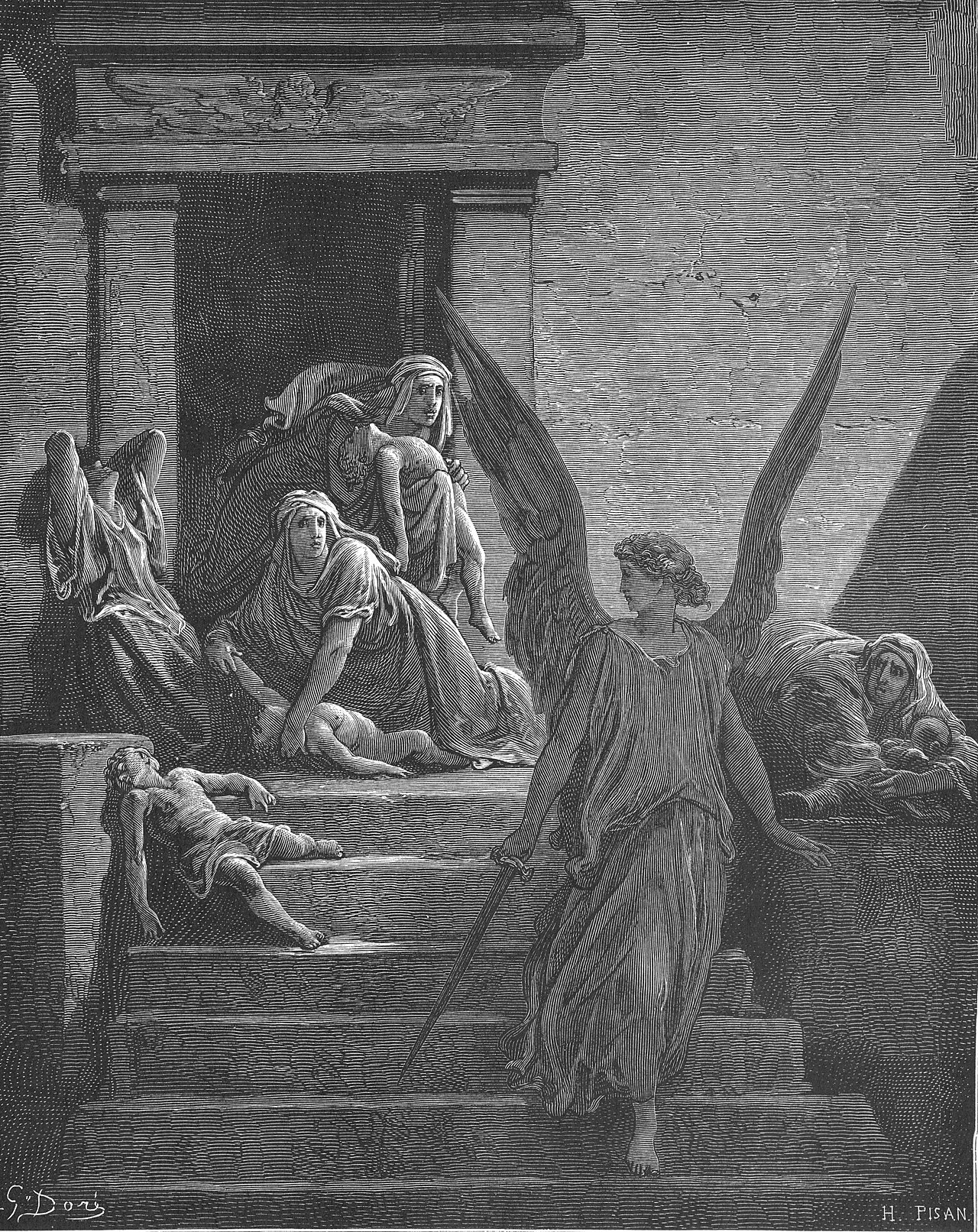
Moses turns the instruction into an order and supplies a detail the reader has not been given before, that the blood is applied with a bunch of hyssop. Hyssop returns for the cleansing of the leper and the house in Leviticus 14, in David's prayer at Psalm 51:7, and at the cross in John 19:29. The families are also shut in until morning, so the night is spent inside a house marked with blood.
The record, by era
The Church Fathers1 voice
What then did Moses do? "Sacrifice an unblemished lamb," he said, "and smear your doors with its blood." What do you mean? Can the blood of an irrational animal save one who expresses reason? "Yes," he says. "Not because it is blood but because it prefigures the Master's blood." Although statues of the emperor have neither life nor perception, they can save the men endowed with perception and life who flee to them for refuge, not because they are bronze but because they are images of the emperor. So too that blood which lacked life and perception saved the men who had life, not because it was blood but because it was an anticipatory type of the Master's blood.
The Puritans and the Awakening2 voices
30 And Pharaoh rose up in the night, he, and all his servants, and all the Egyptians; and there was a great cry in Egypt; for there was not a house where there was not one dead.
quarantine:scripture (2026-07-29) — verbatim-scripture
Then Moses called for all the elders of Israel,....
The Nineteenth Century2 voices
I WANTED, dear Friends, earnestly wanted, to continue the subject of last Lord's-Day morning, for I felt it important that we should bear again and again our witness to the doctrine of the vicarious Sacrifice of Jesus Christ our Lord. But, at the same time, I promised that I would endeavor to keep "the feast of the children" and have a sermon which should be specially addressed to Sunday school teachers.
I WANTED, dear Friends, earnestly wanted, to continue the subject of last Lord's-Day morning, for I felt it important that we should bear again and again our witness to the doctrine of the vicarious Sacrifice of Jesus Christ our Lord. But, at the same time, I promised that I would endeavor to keep "the feast of the children" and have a sermon which should be specially addressed to Sunday school teachers. I could not preach a school sermon at the appointed time, so as to open your children's week, but thought a discourse might come in, none the less suitably, if I brought up the rear by closing your meetings. How am I to fulfill both my purposes? I think the subject before us will enable me to do so. We shall preach of the sprinkled blood and of Jesus, the great Sacrifice for sin—and then we shall press upon all who know the value of the great Redemption that they teach the young in their earliest days what is meant by the death of Jesus and salvation through His blood. The Paschal lamb was a special type of our Lord Jesus Christ. We are not left to gather this from the general fact that all the ancient sacrifices were shadows of the one true and real Substance—we are assured in the New Testament that "Christ our Passover is sacrificed for us" (1 Cor 5:7). As the Paschal lamb must be without blemish, so was our Lord, and its killing and roasting with fire were typical of His death and sufferings. Even as to time our Lord fulfilled the type, for the time of His Crucifixion was the Passover. As the impression answers to the seal, so does the Sacrifice of our Lord correspond with all the items of the ceremonial Passover. We see Him "drawn out" from among men and led as a lamb to the slaughter. We see His blood shed and sprinkled. We see Him roasted in the fire of anguish. By faith we eat of Him and flavor the feast with the bitter herbs of penitence.
1 more voice on this verse
The Nineteenth Century1 voice
Kill the passover - That is, the lamb, which was called the paschal or passover lamb. The animal that was to be sacrificed on this occasion got the name of the institution itself: thus the word covenant is often put for the sacrifice offered in making the covenant; so the rock was Christ, 1Co 10:4; bread and wine the body and blood of Christ, Mar 14:22, Mar 14:24. St. Paul copies the expression, 1Co 5:7: Christ our passover (that is, our paschal lamb) is sacrificed for us.
How the passage was read
On Exodus 12:1-51On Exodus 12:1-51
The night Israel still keeps
This chapter founds Passover, in Hebrew Pesach, the spring feast that remembers the night God struck Egypt's firstborn and passed over the blood-marked houses. Jewish families keep it to this day with a ceremonial meal called the seder (Hebrew for “order”): unleavened flatbread (matzah), bitter herbs, cups of wine, and the retelling of this chapter's story, with the children asking the questions.
Honesty about the timeline helps the reader: in the Bible's own period the center of the feast was the lamb, slain and eaten as this chapter commands. The seder as now practiced took its shape after the Temple fell in AD 70 and the lamb could no longer be offered; its oldest written outline is in the Mishnah, the first code of Jewish oral law (about AD 200), which already includes the four cups and the rule that “in every generation a person must see himself as if he personally came out of Egypt.”
This section is reception history: how the passage was read and kept in the Jewish tradition. Where a reading parts from an essential of the Christian faith, the section says so at that point.
Sources: Mishnah Pesachim 10 (the seder's oldest outline) · Mishnah Pesachim 10:5 (“in every generation”) · The Feasts of the LORD (this site's study)
The words behind it
14 Hebrew wordsEvery Hebrew word of this verse in the order it stands, with what it means and the door to its own study. The last column counts the times a word stands in the whole Bible: the rarer the word, the more the places it appears belong together.
| Hebrew | Sound | Meaning | Word study | In the Bible |
|---|---|---|---|---|
| וַיִּקְרָ֥א | vaiyikra' | and he summoned | H7121 → | 733 times |
| מֹשֶׁ֛ה | mosheh | Moses | H4872 → | 765 times |
| לְכָל־ | lekhol | <to> all | H3605 → | 5413 times |
| זִקְנֵ֥י | ziknei | [the] elders of | H2205 → | 178 times |
| יִשְׂרָאֵ֖ל | yisrael | Israel | H3478 → | 2507 times |
| וַיֹּ֣אמֶר | vaiyomer | and he said | H559 → | 5305 times |
| אֲלֵהֶ֑ם | ʾalehem | to them | H413 → | 5510 times |
| מִֽשְׁכ֗וּ | mishkhu | draw | H4900 → | |
| וּקְח֨וּ | ukechu | and take | H3947 → | 966 times |
| לָכֶ֥ם | lakhem | for <the> yourselves | ||
| צֹ֛אן | tzon | sheep | H6629 → | 274 times |
| לְמִשְׁפְּחֹתֵיכֶ֖ם | lemishpechoteikhem | to clans your | H4940 → | 303 times |
| וְשַׁחֲט֥וּ | veshachatu | and slaughter | H7819 → | 81 times |
| הַפָּֽסַח׃ | hapasach | the passover | H6453 → | 49 times |
וַיִּקְרָ֥אand he summoned
vaiyikra'H7121 →733 times
מֹשֶׁ֛הMoses
moshehH4872 →765 times
לְכָל־<to> all
lekholH3605 →5413 times
זִקְנֵ֥י[the] elders of
zikneiH2205 →178 times
יִשְׂרָאֵ֖לIsrael
yisraelH3478 →2507 times
וַיֹּ֣אמֶרand he said
vaiyomerH559 →5305 times
אֲלֵהֶ֑םto them
ʾalehemH413 →5510 times
מִֽשְׁכ֗וּdraw
mishkhuH4900 →
וּקְח֨וּand take
ukechuH3947 →966 times
לָכֶ֥םfor <the> yourselves
lakhem
צֹ֛אןsheep
tzonH6629 →274 times
לְמִשְׁפְּחֹתֵיכֶ֖םto clans your
lemishpechoteikhemH4940 →303 times
וְשַׁחֲט֥וּand slaughter
veshachatuH7819 →81 times
הַפָּֽסַח׃the passover
hapasachH6453 →49 times
A shaded row is a word that stands 400 times or fewer in the Bible.
The walk
8 stopsEach card is a verse this one points to, and under it the verses that one points to in turn. Where several paths arrive at the same place, that place is listed first: the text keeps returning to it.
Through
Ezra 6:20All the priests and Levites had purified themselves and were ceremonially clean. And the Levites slaughtered the Passover lamb for all the exiles, for their priestly brothers, and for themselves.
it leads to
- 2 Chronicles 35:11
And they slaughtered the Passover lambs, while the priests sprinkled the blood handed to them and the Levites skinned the animals.
- 2 Chronicles 35:11
Through
2 Kings 23:21The king commanded all the people, “Keep the Passover of the LORD your God, as it is written in this Book of the Covenant.”
it leads to
- Deuteronomy 16:1–8
Observe the month of Abib and celebrate the Passover to the LORD your God, because in the month of Abib the LORD your God brought you out of Egypt by night.
- Numbers 9:2–5
“The Israelites are to observe the Passover at its appointed time.
- Deuteronomy 16:1–8
Through
Joshua 5:10On the evening of the fourteenth day of the month, while the Israelites were camped at Gilgal on the plains of Jericho, they kept the Passover.
it leads to
- Exodus 12:6
You must keep it until the fourteenth day of the month, when the whole assembly of the congregation of Israel will slaughter the animals at twilight.
- Numbers 9:1–5
In the first month of the second year after Israel had come out of the land of Egypt, the LORD spoke to Moses in the Wilderness of Sinai:
- Exodus 12:6
Through
Exodus 12:3Tell the whole congregation of Israel that on the tenth day of this month each man must select a lamb for his family, one per household.
it leads to
- 1 Corinthians 5:7
Get rid of the old leaven, that you may be a new unleavened batch, as you really are. For Christ, our Passover lamb, has been sacrificed.
- Leviticus 1:2
“Speak to the Israelites and tell them: When any of you brings an offering to the LORD, you may bring as your offering an animal from the herd or the flock.
- John 1:29
The next day John saw Jesus coming toward him and said, “Look, the Lamb of God, who takes away the sin of the world!
- 1 Corinthians 5:7
Where this verse is studied
On this page
Studies10
About Exodus
Who and where
1 name in this verse with a page on the site.
This page draws on Adam Clarke, Commentary on the Bible; Albert Barnes, Notes, Explanatory and Practical, on the Old and New Testaments (1832-1869); Alfred Edersheim, The Temple: Its Ministry and Services; Charles Spurgeon, The Metropolitan Tabernacle Pulpit, Sermon No. 1988: “The Blood of Sprinkling and the Children” (lightly modernized text, CCEL edition); John Chrysostom, BAPTISMAL INSTRUCTIONS 3.14; John Gill, Exposition of the Old Testament; John Gill, Exposition of the Old Testament (1748-1763) and Matthew Henry, Commentary on the Whole Bible.