
Judges 19 to 21 · Story · Featured Study
The Levite's concubine and the war on Benjamin
Judges 19 to 21, the three chapters that close the book of Judges, from Bethlehem to the vineyards of Shiloh.
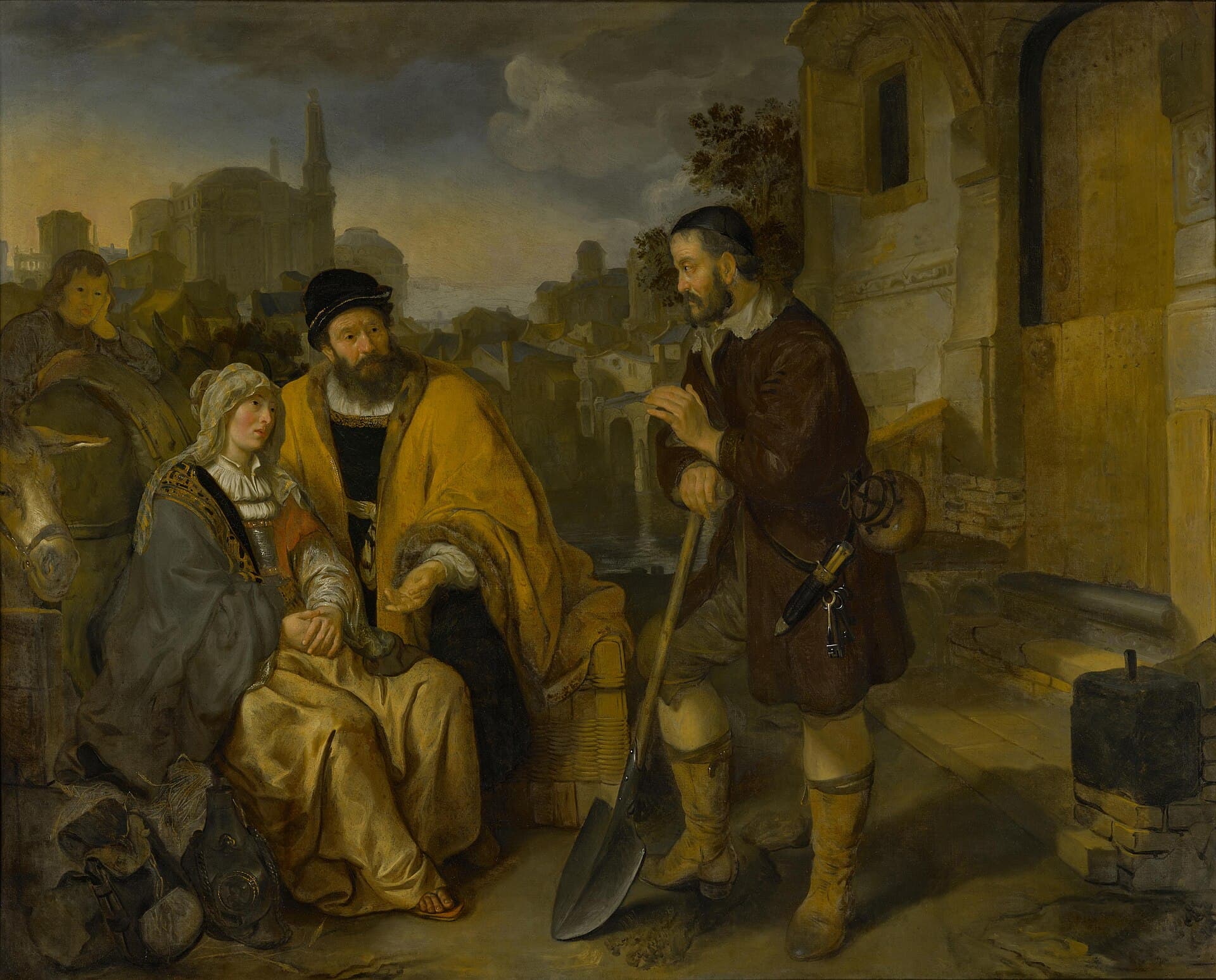
Gerbrand van den Eeckhout, The Field Worker from Gibeah Offers Shelter to the Levite and His Concubine, 1645, Gemäldegalerie, Staatliche Museen zu Berlin. Public domain, via Wikimedia Commons.
THE ARTWORKEeckhout painted the evening of Judges 19:16 to 20: the host with his spade, the Levite in his gold robe, the woman beside him, and the servant and the donkey behind. It is the last quiet hour of the story.
A Levite sent his concubine out to the men who had come for him at Gibeah, and Israel went to war over her death until one of its tribes was almost gone.
Summary
Judges 19 to 21 tells of a woman abused to death at Gibeah in Benjamin, the war Israel fought to punish the town, and the wives the elders found for the Benjamites who survived it. The book records every step and closes on the absence of a king.
- The Levite's report to the tribes leaves out that he sent her outside.
- The LORD answered Israel three times before the battles, and only the third answer promised victory.
- Two oaths Israel swore, one against giving Benjamin wives and one against any who stayed away from Mizpah, drove the raid on Jabesh-gilead and the plan at Shiloh.
- Hosea, centuries later, still named the days of Gibeah as the depth of Israel's corruption.
A Night in Gibeah, and a War on Benjamin
Judges 19 to 21 told plainly, in the text's order
A Levite of the hill country of Ephraim took a concubine from Bethlehem in Judah. She left him for her father's house, and after four months he went after her to speak kindly to her and bring her back. Her father kept him eating and drinking for days, and they set out late on the fifth day.
The Levite would not stop at Jebus, a city of foreigners, so they went on to Gibeah in Benjamin. No one there took them in until an old man from Ephraim, coming in from the field, gave them his house.
That night the wicked men of the town surrounded the house and demanded the guest. The old man offered them his virgin daughter and the concubine. The Levite sent the concubine out, and they abused her until dawn, when she fell at the door with her hands on the threshold. He told her to get up, and she gave no answer. At home he took a knife to her body and sent the pieces through all the territory of Israel.
And everyone who saw it said, “Nothing like this has been seen or done from the day the Israelites came out of the land of Egypt until this day. Think it over, take counsel, and speak up!”Israel judges the deed in its own words.
The tribes gathered at Mizpah and demanded the men of Gibeah, and Benjamin went to war rather than hand them over. Israel lost two battles and won the third, burned Benjamin's towns, and left only the men who escaped to the rock of Rimmon.
Israel had sworn to give Benjamin no wives, and now wept that a tribe was missing. The assembly struck Jabesh-gilead, which had sent no one to Mizpah, and gave its four hundred young women to the survivors. The rest were told to catch wives from the daughters of Shiloh as they danced at the yearly feast.
The book closes on the refrain of its last five chapters. Its four places and the dating of these chapters are taught on the page No King in Israel.
In those days there was no king in Israel; everyone did what was right in his own eyes.Judges ends on the refrain.
Two Accounts of One Night
What the narrator tells in Judges 19, beside what the Levite tells the tribes in Judges 20
| Point | The narrator | The Levite |
|---|---|---|
| What the men wanted | The guest, to have relations with him (19:22) | To kill me (20:5) |
| Who put her outside | The Levite sent her out (19:25) | Not said |
| What was done to her | Raped and abused all night (19:25) | They abused my concubine (20:5) |
| When she died | Not said; no answer at dawn (19:28) | She died (20:5) |
| What he did after | Cut her limb by limb into twelve pieces (19:29) | Cut her into pieces (20:6) |
But the men would not listen to him. So the Levite took his concubine and sent her outside to them, and they raped her and abused her throughout the night, and at dawn they let her go.The narrator names who put her outside.
So the Levite, the husband of the murdered woman, answered: “I and my concubine came to Gibeah in Benjamin to spend the night. And during the night, the men of Gibeah rose up against me and surrounded the house. They intended to kill me, but they abused my concubine, and she died.The Levite tells the tribes the men meant to kill him.
The narrator sets both accounts in the text and makes no comment on the difference. The reader is left to lay them side by side.
Three Battles, and the Count of the Dead
Judges 20 gives the numbers, and the inquiries at Bethel before each battle
Israel lost forty thousand men in two days; on the third, 25,100 Benjamites fell and six hundred fled.
The five counts as a table
| Who | Men | The text | Verse |
|---|---|---|---|
| Israel's dead, first assault | 22,000 | cut down 22,000 Israelites | Judges 20:21 |
| Israel's dead, second assault | 18,000 | cut down another 18,000 Israelites | Judges 20:25 |
| Israel's dead, third assault | 30 | killing about thirty men of Israel | Judges 20:31 |
| Benjamite dead | 25,100 | slaughtered 25,100 Benjamites | Judges 20:35 |
| Benjamite survivors | 600 | 600 men turned and fled | Judges 20:47 |
Bars from zero, one for each count of men that Judges 20 gives, each with the words of its verse.
The Israelites set out, went up to Bethel, and inquired of God, “Who of us shall go up first to fight against the Benjamites?” “Judah will be first,” the LORD replied.The first answer names who goes first.
And the Israelites inquired of the LORD. (In those days the ark of the covenant of God was there, and Phinehas son of Eleazar, the son of Aaron, served before it.) The Israelites asked, “Should we again go out to battle against our brothers the Benjamites, or should we stop?” The LORD answered, “Fight, for tomorrow I will deliver them into your hand.”The third answer adds a promise.
The tribes asked who should lead the attack, and the LORD named Judah, as at the start of the book (Judges 1:2). After losing the opening battle they wept and asked again, and were told to go up. Only after a day of weeping, fasting and offerings at Bethel did the answer promise victory.
“Went up to the house of God - Some think that a deputation was sent from Shiloh, where Phinehas the high priest was, to inquire, not concerning the expediency of the war, nor of its success, but which of the tribes should begin the attack. Having so much right on their side, they had no doubt of the justice of their cause. Having such a superiority of numbers, they had no doubt of success. See the note on Jdg 20:1. And the Lord said, Judah - But he did not say that they should conquer.”
Adam Clarke · Commentary on the Bible · on Judges 20:18Evangelical
“But they ought to have done it at the commencement of their proceedings. Instead of this, all their plans were formed, and never doubting, it would seem, that the war was just and inevitable, the only subject of their inquiry related to the precedency of the tribes--a point which it is likely was discussed in the assembly.”
Jamieson, Fausset & Brown · Commentary Critical and Explanatory on the Whole Bible · on Judges 20:18 to 28Reformed
The counts leave a gapJudges 20:15, 20:35 and 20:44 to 47
The tribe mustered 26,000 swordsmen and 700 select men of Gibeah (Judges 20:15). The fallen, 25,100 in Judges 20:35, and the men who fled to Rimmon leave about a thousand unaccounted for. The parts of 20:44 to 46 add to 25,000. Brenton's Septuagint reads 23,000 at 20:15, and Keil and Delitzsch explain the gap by losses on the first two days that the text does not count.
Where the Text Is Silent
Three questions the chapters leave open
The narrator reports and does not explain. Three of the gaps have drawn the most comment.
When did she die?Judges 19:28 gives only her silence
The Hebrew of 19:28 says only that there was no answer. The Septuagint adds that she was dead, the Levite tells the tribes that she died, and Josephus says she died at the door before her husband found her. The Hebrew leaves the moment of her death unstated.
“Get up,” he told her. “Let us go.” But there was no response. So the man put her on his donkey and set out for home.The Hebrew stops at her silence.
“Overcome by this cruelty or by grief at her wrong, she fell at the door of their host where her husband had entered, and died, with the last effort of her life guarding the feelings of a good wife so as to preserve for her husband at least her mortal remains.”
Ambrose of Milan · On the Duties of the Clergy 3.19.114 · on Judges 19:26Patristic
Why is she never named?Judges 19 to 21
The text never gives her name, and she speaks no word in the three chapters. The Levite, his servant, her father and the old man of Gibeah are unnamed as well, and the narrator gives no reason.
What did the LORD say of the Levite?Three answers about battle, and none about him
Where It Points: the King Israel Lacked
The refrain, Judah sent first, and a tribe kept alive
Judges explains its own disorder by the absence of a king, and the prophets look ahead to a King from David's line.
Behold, the days are coming, declares the LORD, when I will raise up for David a righteous Branch, and He will reign wisely as King and will administer justice and righteousness in the land.Jeremiah names the Branch who will reign.
Judah was sent first against Benjamin, and Matthew Henry reads the honour toward the tribe from which Christ would come.
“This honour was done to Judah because our Lord Jesus was to spring from that tribe, who was in all things to have the pre-eminence. The tribe that went up first had the most honourable post, but withal the most dangerous, and probably lost most in the engagement.”
Matthew Henry · Commentary on the Whole Bible · on Judges 20:18Puritan
From the tribe that was almost lost came Saul, Israel's first king, and later the apostle Paul. Jerome, writing of Paula's pilgrimage past Gibeah, says the men were spared so that Paul might be called a Benjamite. He gives the number as three hundred, where Judges 20:47 has six hundred.
“At Gibeah also, now a complete ruin, she stopped for a little while remembering its sin, and the cutting of the concubine into pieces, and how in spite of all this three hundred men of the tribe of Benjamin were saved that in after days Paul might be called a Benjamite.”
Jerome · LETTER 108.8 · on Judges 20:47Patristic
I ask then, did God reject His people? Certainly not! I am an Israelite myself, a descendant of Abraham, from the tribe of Benjamin.Paul names his tribe.
Husbands, love your wives, just as Christ loved the church and gave Himself up for herChrist gave Himself up for His bride.
The Levite sent his wife out to the men who had come for him, the reverse of the husband Ephesians 5:25 describes. Reading the two together is an application, offered as one.
The Voices on Gibeah
The fathers and the commentators, each with the work named
Basil of Caesarea took the closing line of Judges as the book's own reason for its disorder.
“After a long time spent in this state of indecision and while I was still busily searching for the cause I have mentioned, there came to my mind the book of Judges, which tells how each man did what was right in his own eyes and gives the reason for this in these words: ‘In those days there was no king in Israel.’”
Basil of Caesarea · Preface on the Judgment of God · on Judges 21:25Patristic
The scene follows Lot's night in Sodom step for step (Genesis 19:4 to 8), down to the host's plea to the mob as his brothers and his offer of the women of his house. Daniel Block studied Judges 19 as an echo of that story in the Westminster Theological Journal in 1990, and Barnes drew the moral in a sentence.
“This man is come into mine house - He appeals to the sacred rights of hospitality, just as Lot did Gen 19:8. Both cases betray painfully the low place in the social scale occupied by woman in the old world, from which it is one of the glories of Christianity to have raised her.”
Albert Barnes · Notes, Explanatory and Practical, on the Old and New Testaments (1832-1869) · on Judges 19:23Evangelical
The elders' plan at Shiloh kept the words of their oath. Henry held it was no breach, and Barnes answered that such reasoning condemns the system of oaths and shows the wisdom of the Lord's command in Matthew 5:33 to 37.
“In strictness it was not a breach of their vow; they had sworn not to give them their daughters, but they had not sworn to fetch them back if they were forcibly taken, so that if there was any fault the elders must be responsible, not the parents. And Quod fieri non debuit, factum valet -- That which ought not to have been done is yet valid when it is done.”
Matthew Henry · Commentary on the Whole Bible · on Judges 21:22Puritan
“Ye did not give ... - i. e., they had not broken the oath mentioned in Jdg 21:1, so as to be guilty of taking the Lord’s name in vain. They did not give their daughters to Benjamin: the Benjamites had taken them by force. Such casuistry as this condemns the system of oaths, and illustrates the wisdom of our Lord’s precept Mat 5:33-37.”
Albert Barnes · Notes, Explanatory and Practical, on the Old and New Testaments (1832-1869) · on Judges 21:22Evangelical
How this text has been taughtTwelve readers, from Josephus to Block
| Century | Reader | Work |
|---|---|---|
| First | Josephus | Antiquities of the Jews 5.2.8 |
| Fourth | Basil of Caesarea | Preface on the Judgment of God |
| Fourth | Ambrose of Milan | On the Duties of the Clergy 3.19 |
| Fifth | Jerome | Letter 108, the epitaph of Paula |
| Eighteenth | Matthew Henry | Commentary on the Whole Bible, 1710 |
| Eighteenth | John Gill | Exposition of the Old Testament |
| Eighteenth | John Wesley | Explanatory Notes upon the Old Testament, 1765 |
| Nineteenth | Adam Clarke | Commentary on the Bible, 1832 |
| Nineteenth | Albert Barnes | Notes on the Old Testament |
| Nineteenth | Jamieson, Fausset and Brown | Commentary Critical and Explanatory, 1871 |
| Nineteenth | Keil and Delitzsch | Joshua, Judges, Ruth, 1872 |
| Twentieth | Daniel I. Block | Echo Narrative Technique in Hebrew Literature, 1990 |
Two Questions the Readers Divide On
Why she left him, and whether the war could be justified, each reading with its holders
The text gives the facts and passes no verdict on either question, so each reading below is a position with the readers who hold it.
She was unfaithful to himThe Hebrew verb; John Wesley
The store's lexicon glosses the Hebrew verb of 19:2, zanah, as to commit adultery, and the Berean Standard Bible renders it unfaithful. Wesley reads her leaving as her sin, with her father conniving at it, and reads her death at the door as that sin coming back on her.
“Fell down - Namely, dead; killed partly with grief of heart, and partly with excessive abuse. Thus the sin she formerly chose, ver. 2, is now her destruction; and though her husband pardoned her, God would punish her, at least as to this life.”
John Wesley · Explanatory Notes upon the Old Testament · on Judges 19:26Evangelical
The other reading answers that a husband wronged by adultery would hardly go after her to speak to her heart (Judges 19:3).
She left him after a quarrelThe Greek; Josephus; Adam Clarke; Jamieson, Fausset and Brown
Brenton's English of the Greek says only that she departed from him, and Josephus says she left because they quarrelled constantly. Clarke reports that none of the Vulgate, the Septuagint, the Targum or Josephus reads the word as infidelity, and Jamieson, Fausset and Brown follow Josephus.
“Played the whore - Neither the Vulgate, Septuagint, Targum, nor Josephus, understand this word as implying any act of conjugal infidelity on the woman’s part. They merely state that the parties disagreed, and the woman returned to her father’s house. Indeed all the circumstances of the case vindicate this view of the subject. If she had been a whore, or adulteress, it is not very likely that her husband would have gone after her to speak friendly, literally, to speak to her heart, and entreat her to return.”
Adam Clarke · Commentary on the Bible · on Judges 19:2Evangelical
The first reading answers that the lexicon gives the Hebrew word no sense of anger, which rests on the Greek witnesses.
The slaughter may be partly justifiedJohn Wesley, on Judges 20:48
Wesley puts the burning of Benjamin's towns down to the fury of battle, or in part to the law of Deuteronomy 13:15 and to the oath Israel swore against any who stayed away from Mizpah.
“If this seem harsh and bloody, either it may be ascribed to military fury; or perhaps it may be partly justified, from that command of God in a parallel case, Deut. xiii, 15, and from that solemn oath by which they had devoted to death all that came not up to Mizpeh, chap. xxi, 5, which none of the Benjamites did.”
John Wesley · Explanatory Notes upon the Old Testament · on Judges 20:48Evangelical
Keil and Delitzsch answer that the law commanded no such war.
A war neither commanded nor justifiedKeil and Delitzsch; Albert Barnes
Keil and Delitzsch call it "a war of extermination which was neither commanded by the law nor justified by the circumstances". Barnes reads the refrain as the text's own explanation: these disorders came from the want of an authority to suppress them.
“The repetition of this characteristic phrase (compare Jdg 17:6; Jdg 18:1; Jdg 19:1) is probably intended to impress upon us the idea that these disorders arose from the want of a sufficient authority to suppress them. The preservation of such a story, of which the Israelites must have been ashamed, is a striking evidence of the divine superintendence and direction as regards the Holy Scriptures.”
Albert Barnes · Notes, Explanatory and Practical, on the Old and New Testaments (1832-1869) · on Judges 21:25Evangelical
Wesley's reading answers from the oath at Mizpah and from the law of the town given over to other gods.
Books on Judges 19 to 21
Biblical Commentary on the Old Testament: Joshua, Judges, Ruth
C. F. Keil and F. Delitzsch, translated by James Martin · 1872
The fullest older exegesis of the inquiries at Bethel and the war that followed.
Read it free at Archive.orgThe Antiquities of the Jews
Flavius Josephus, translated by William Whiston · 1737
Book 5, chapter 2 is the earliest retelling of the story outside Scripture.
Read it free at Project GutenbergCommentary on the Whole Bible
Matthew Henry · 1710
Henry reads the three chapters closely and weighs the elders' reasoning at Shiloh.
Read it free at CCELA Story Told Without Approval
Judges tells this story in plain words and gives no word of approval to any of it. Israel itself said nothing like it had been done since the exodus, and the book points past its judges to the King who would rule in justice.
Keep studying
Read it1
Studies4