
Markchapter 14
72 verses · Mark · AD 55 to 65 · The Gospels
“I am,” said Jesus, “and you will see the Son of Man sitting at the right hand of Power and coming with the clouds of heaven.”
Introduction
Mark, The Gospels, Mark Overview.
Mark wrote for believers in Rome who knew what it was to be questioned about their faith, and some had failed under it. The early church held that he heard this account from Peter, and Peter does not come out of it well. The chapter runs from an evening meal in Bethany through one night to the high priest's courtyard. It is the longest chapter in the book. Listen for what Jesus says will happen and then watch each word come true. Notice who stays awake, who runs, and who speaks when a servant girl asks a question.
Context
- Who
- Roman readers who knew what happens to a man under interrogation
- What
- The anointing at Bethany, the Passover meal and the new covenant, the prayer in Gethsemane, the arrest, the night hearing and Peter's three denials.
- Where
- Bethany, an upper room in Jerusalem, Gethsemane on the Mount of Olives, and the high priest's house.
- When
- The Wednesday and Thursday of Passover week and the night that followed, about AD 30 or 33.
- Why
- To show Jesus going to his death knowingly and willingly, and his followers failing him as he said they would.
Historical context
The perfume poured over his head was nard, imported from far to the east in sealed alabaster flasks that had to be broken open. The sum objected to, over three hundred denarii, is about a year's wages for a labourer.
Show the rest of the historical context, 4 more paragraphs
The signal for finding the room is a detail only an eyewitness would keep. A man carrying a water jar was conspicuous, because fetching water was women's work; that is precisely why it made a reliable prearranged sign in a crowded festival city where the arrangement had to stay quiet.
The Passover meal by this period followed a set order: cups of wine at fixed points, unleavened bread, bitter herbs, the retelling of the exodus, and a closing hymn from the festival psalms. Mark's brief note that they sang a hymn and went out to the Mount of Olives is the end of that liturgy.
Gethsemane means oil press, and the grove lay across the Kidron ravine on the slope of the Mount of Olives. The arrest party comes at night with clubs, and the hearing that follows is held before morning at the high priest's house, a speed and secrecy that later Jewish rules for capital trials would not have permitted.
Mark alone records the young man who ran away naked, leaving the linen cloth in the soldiers' hands. It has often been suggested that this is Mark's own quiet signature, though the text does not say so.
Significance
Roman believers being interrogated about their faith read this chapter as their own story told in advance. Peter is warming himself at the courtyard fire, questioned by a servant girl, and he denies knowing the man three times.
Show the rest of the significance, 1 more paragraph
That Mark, traditionally writing from Peter's own preaching, kept the denial in full and unsoftened is the point. A church whose members had failed under pressure was handed the memory of its greatest leader breaking down and weeping, and being restored.
The heads below are this chapter's scenes. The numbered points under each are its verses.
Anointed at Bethany; Judas Sells Him
Mark 14:1-2
looking for a covert way to arrest Jesus: Two days before the Passover, the chief priests and scribes wanted a covert arrest, fearing a riot among the people at the feast. Their caution shows the standing Jesus held with the ordinary people, so the arrest comes privately at night.
Mark 14:1
“Accordingly, "by the determinate counsel and foreknowledge of God, who is wonderful in counsel and excellent in working," it was so ordered that precisely at the passover season, "Christ our Passover should be sacrificed for us." On the day following the passover commenced "the feast of unleavened bread," so called because for seven days only unleavened bread was to be eaten (Ex 12:18-20).”
Jamieson, Fausset & Brown · Commentary Critical and Explanatory on the Whole Bible (1871)reformed
1 more voice on this verseWhat preachers and commentators have said about this verse, in their own words.
Mark 14:1
“This chapter begins that part of Mark's Gospel, which describes our Lord's sufferings and death. Hitherto we have chiefly seen our Savior as our prophet and teacher. We have now to see Him as our High Priest. Hitherto we have had to consider His miracles and sayings. We have now to consider His vicarious sacrifice on the cross. Let us first observe in these verses, how God can disappoint the designs of wicked men, and over-rule them to His own glory .”
Gill explains the fear: the Passover drew crowds from every part of the land, and many might rise to rescue Jesus. Jamieson, Fausset and Brown add that the rulers seem to have had no workable plan for a quiet arrest. Judas's offer in verse 10 gave them one.
Mark 14:2
“What plan, if any, these ecclesiastics fixed upon for seizing our Lord, does not appear. But the proposal of Judas being at once and eagerly gone into, it is probable they were till then at some loss for a plan sufficiently quiet and yet effectual.”
Jamieson, Fausset & Brown · Commentary Critical and Explanatory on the Whole Bible (1871)reformed
an alabaster jar of expensive perfume: At Bethany a woman broke open an alabaster jar of pure nard, worth about a year’s wages, and poured it on Jesus’ head. Kings were anointed on the head, and she anoints the one about to be crowned with thorns.
Mark 14:3
This woman has a very special message for you who are about to be baptized. She broke her alabaster jar that Christ may make you "christs," his anointed. Hear what it says in the Canticle of Canticles: "Your name spoken is a spreading perfume, therefore the maidens love you. We will follow you eagerly in the fragrance of your perfume!"
Jerome · written before 420 · Homilies of St. Jerome, Homily 84patristic
2 more voices on this verse
Mark 14:3
“Alabaster box - Among critics and learned men there are various conjectures concerning the alabaster mentioned by the evangelists: some think it means a glass phial; others, that it signifies a small vessel without a handle, from α negative and λαβη, a handle; and others imagine that it merely signifies a perfume or essence bottle. There are several species of the soft calcareous stone called alabaster, which are enumerated and described in different chemical works. Spikenard - Or nard. An Indian plant, whose root is very small and slender.”
Adam Clarke · Commentary on the Bible (1810-1826)evangelical
Mark 14:3
“Here was another friend, that was so kind as to anoint his head with very precious ointment as he sat at meat. This was an extraordinary piece of respect paid him by a good woman that thought nothing too good to bestow upon Christ, and to do him honour. Now the scripture was fulfilled, When the king sitteth at his table, my spikenard sendeth forth the smell thereof, Cant. i.”
Matthew Henry · Commentary on the Whole Bible (1707-1721)puritan
Mark 14:4-5
Some present said the perfume could have been sold for over three hundred denarii and the money given to the poor. Mark leaves the objectors unnamed, while John’s Gospel names Judas and says he kept the money bag and was a thief.
Mark 14:4
“And there were some that had indignation within themselves,.... The Syriac version reads, "some of the disciples": agreeably to Mat 26:8, particularly Judas, and others might be incensed by his means: and said, why was this waste of the ointment made? See Gill on Mat 26:8.”
1 more voice on this verse
Mark 14:4
“To him [Judas], it seemed to be wasting the ointment because the jar is broken, but, for us, it was a great good because the perfume spread throughout the world. Why are you indignant, Judas, because the alabaster jar is broken? God, who made you and all the nations, is blessing us with that precious perfume. You wanted to keep the perfume sealed up so that it would not reach others.”
Jerome · written before 420 · Homilies of Saint Jerome, Homily 84patristic
three hundred denarii: Gill reckoned three hundred denarii at more than nine pounds in the money of his day. Jamieson, Fausset and Brown point to John 12:6, where Judas voiced this complaint as a thief who kept the money bag. Bede reads Mark's plural as a way of speaking about Judas.
Mark 14:5
“The traitor Judas, who in appearance championed the cause of the poor, said with indignation, "This ointment might have been sold for more than three hundred denarii, and the money given to the poor." But in reality he "was a thief, and as he had the money box he used to take what was put into it." If, then, any one in our time who has the money box of the church speaks like Judas as if speaking for the poor, but steals what is placed there, let there be assigned to him the same portion along with Judas.”
Origen of Alexandria · written before 253 · Commentary on Matthew 11.9patristic
2 more voices on this verse
Mark 14:5
“It might have been sold - το μυρον, This ointment, is added by ABCDKL, thirty-five others, Ethiopic, Armenian, Gothic, all the Itala except one. Griesbach has received it into the text. The sum mentioned here would amount to nearly 10£ sterling.”
Adam Clarke · Commentary on the Bible (1810-1826)evangelical
Mark 14:5
“And they murmured against her--"This he said," remarks John (Joh 12:6), and the remark is of exceeding importance, "not that he cared for the poor but because he was a thief, and had the bag"--the scrip or treasure chest--"and bare what was put therein"--not "bare it off" by theft, as some understand it.”
Jamieson, Fausset & Brown · Commentary Critical and Explanatory on the Whole Bible (1871)reformed
Mark 14:6-7
The poor you will always have with you keeps almsgiving a standing duty. But you will not always have Me sets beside it His bodily presence before the cross, which will not come again.
Mark 14:6
“And Jesus said, Let her alone; why trouble ye her? she hath wrought a good work on me--It was good in itself, and so was acceptable to Christ; it was eminently seasonable, and so more acceptable still; and it was "what she could," and so most acceptable of all.”
Jamieson, Fausset & Brown · Commentary Critical and Explanatory on the Whole Bible (1871)reformed
1 more voice on this verse
Mark 14:6
“When the apostles pleaded that the ointment was being wasted, they were rebuked by the voice of the Lord. Christ did not need the ointment, nor do martyrs need the light of candles. Yet that woman freely poured out the ointment in honor of Christ, and her heart's devotion was accepted.… Hence throughout the whole Eastern Church, even when there are no relics of the martyrs, whenever the gospel is to be read the candles are lighted although the dawn may be reddening the sky, not of course to scatter the darkness, but by way of evidencing our joy.”
Jerome · written before 420 · Against Vigilantius 7patristic
you will not always have Me: Gill and Bede both take the last line to mean the bodily presence of Jesus, which would soon be taken from the disciples. Help for the poor stays open to them at any time. Theophylact warns readers who would set the poor against the honour owed to Christ.
Mark 14:8-9
She has done what she could: Jesus says, She has done what she could to anoint My body in advance of My burial, reading her act as preparation for His death. The promise reaches far: wherever the gospel is preached in all the world, what she has done will also be told in memory of her.
Mark 14:8
“She hath done what she could,.... What she had in her heart, and in the power of her hands to do; she hath done according to her ability, and her good will; and if she had not done it now, she could not have done it at all. She is come aforehand to anoint my body to the burying; or, "as if it was to bury me", as the Syriac version renders it.”
1 more voice on this verse
Mark 14:8
“To anoint my body to the burying - Εις τον ενταφιασμον, against, or in reference to, its embalmment, thus pointing out my death and the embalmment of my body, for the bodies of persons of distinction were wrapped up in aromatics to preserve them from putrefaction. See on Mat 26:12 (note).”
Adam Clarke · Commentary on the Bible (1810-1826)evangelical
Theophylact finds two prophecies here: the gospel will reach the whole world, and her deed will travel with it. Chrysostom saw both fulfilled, with a deed done in a private house in Judea told among Persians, Scythians and the people of the British isles. Mark leaves her unnamed.
Mark 14:9
“But the Lord makes a double prophecy; one that the Gospel shall be preached over the whole world, another that the deed of the woman shall be praised. Wherefore it goes on: Verily I say unto you, Wheresoever this gospel shall be preached throughout the whole world, this also that she hath done shall be spoken of for a memorial of her.”
Theophylact of Ohrid · written before 1107 · Catena Aurea by Aquinaspatristic
1 more voice on this verse
Mark 14:9
“She got by it that good name which is better than precious ointment. Those that honour Christ he will honour. Of the malice of Christ's enemies, and the preparation made by them to do him mischief.”
Matthew Henry · Commentary on the Whole Bible (1707-1721)puritan
Mark 14:10-11
went to the chief priests to betray Jesus to them: Judas Iscariot, one of the Twelve, went to the chief priests to betray Jesus, so the betrayer came from inside the inner circle. Mark sets his sale directly after the woman’s costly gift.
Mark 14:10
“In these verses, Mark tells us how our Lord was delivered into the hands of His enemies. It came to pass through the treachery of one of His own twelve disciples. The false apostle, Judas Iscariot, betrayed Him. We ought to mark, firstly, in this passage, to what lengths a man may go in a false profession of religion . It is impossible to conceive a more striking proof of this painful truth, than the history of Judas Iscariot.”
1 more voice on this verse
Mark 14:10
“Covetousness was Judas's master-lust, his own iniquity, and that betrayed him to the sin of betraying his Master; the devil suited his temptation to that, and so conquered him. It is not said, They promised him preferment (he was not ambitious of that), but, they promised him money. See what need we have to double our guard against the sin that most easily besets us.”
Matthew Henry · Commentary on the Whole Bible (1707-1721)puritan
look for an opportunity to: Theophylact explains what Judas offered: word of a time when Jesus would be alone, away from the crowds the priests feared. Matthew gives thirty pieces of silver, and Gregory of Nazianzus sets that cheap sale beside the blood by which Jesus buys back the world.
Mark 14:11
“And when they heard it, they were glad, and promised to give him money--Matthew alone records the precise sum, because a remarkable and complicated prophecy, which he was afterwards to refer to, was fulfilled by it.”
Jamieson, Fausset & Brown · Commentary Critical and Explanatory on the Whole Bible (1871)reformed
1 more voice on this verse
Mark 14:11
“He is sold, and cheap was the price—thirty pieces of silver; yet he buys back the world at the mighty cost of his own blood. A sheep, he is led to the slaughter—yet he shepherds Israel and now the whole world as well.”
Gregory of Nazianzus · written before 390 · Oration 29, on the Son 20patristic
The Upper Room and the Cup of the Covenant
Mark 14:12-13
On the first day of the Feast of Unleavened Bread: Jesus sends two disciples with a sign in place of an address: a man carrying a jug of water, which was ordinarily women’s work. The place stays unnamed before the meal, while Judas watches for his moment (verse 11).
Mark 14:12
“Go into the city, and there shall meet you a man - It was highly seasonable for our Lord to give them this additional proof both of his knowing all things, and of his influence over the minds of men.”
John Wesley · Explanatory Notes upon the New Testament (1755)evangelical
carrying a jug of water: Luke 22:8 names the two as Peter and John. Gill notes that the Passover could be eaten only in Jerusalem. He takes the man with the jug for a servant fetching water to mix with the wine.
Mark 14:13
“And he sendeth forth two of his disciples,.... Peter and John, as appears from Luk 22:8; and saith unto them, go ye into the city; the city of Jerusalem; for there only the passover might be eaten, Deu 26:2; and there shall meet you a man bearing a pitcher of water; a servant of the master of the house that was sent for water, to mix with the wine, at the passover: follow him; into the house to which he goes.”
1 more voice on this verse
Mark 14:13
“Nor will it be incongruous to interpret figuratively the fact that, when the Lord was about to celebrate the last Passover, He said to the disciples who were sent to make preparation, "Ye will meet a man bearing water." He points out the place for celebrating the Passover by the sign of water.”
Tertullian · written before 220 · On Baptismpatristic
Mark 14:14-16
say to the owner: The owner shows them a large upper room, furnished and ready, so an unnamed householder in Jerusalem already stood with Jesus. The disciples found everything as Jesus had described.
Mark 14:14
“And wheresoever he shall go in,.... Into whatsoever house he shall enter, go in after him: and say ye to the good man of the house; the owner, and master of it, who might be Nicodemus, or Joseph of Arimathea, or some man of note and wealth in Jerusalem, that might have some knowledge of Christ, and faith in him, though he did not openly profess him; since by only saying what follows, he would at once, as he did, direct them to a suitable and convenient room; the master saith.”
2 more voices on this verse
Mark 14:14
“Say ye to the good man of the house - ειπατε τῳ οικοδεσποτῃ - Say ye to the master of the house. The good man and the good woman mean, among us, the master and mistress of the house. A Hindoo woman never calls her husband by his name; but simply, the man of the house. Where is the guest chamber? - Respectable householders, says Mr. Ward, have a room which they call the strangers’ room, (utit' hu-shala), which is especially set apart for the use of guests. This appears to have been the custom in Judea also.”
Adam Clarke · Commentary on the Bible (1810-1826)evangelical
Mark 14:14
“As far as we know, out of the many thousands who had come to Jerusalem from the utmost ends of the earth to keep the Passover, none were left unaccommodated with a guest chamber except our Lord Jesus Christ. Jerusalem, at the time of the Passover, was one great inn—the whole of the houses were occupied not only by the regular tenants, but by their friends from the country parts of Judea. Each one had invited his own friends and all the houses were filled.”
a large upper room: Gill pictures a room on the top floor, large enough for thirteen, set with a table and couches. Clarke takes furnished to mean spread with carpets, or fitted with the couches on which guests reclined. By this time, Clarke adds, the meal was eaten reclining.
Mark 14:15
“And he will show you a large upper room,.... A room in the highest part of the house, large enough for such a company, for thirteen persons, which was the number of Christ and his disciples: furnished and prepared; with a table, and a sufficient number of couches to sit, or lie upon, and with all proper vessels necessary on such an occasion: there make ready for us; the passover.”
1 more voice on this verse
Mark 14:15
“Furnished - Spread with carpets - εστρωμενον - so this word is often used. See Wakefield. But it may also signify the couches on which the guests reclined when eating. It does not appear that the Jews ate the passover now, as their fathers did formerly, standing, with their shoes on, and their staves in their hands.”
Adam Clarke · Commentary on the Bible (1810-1826)evangelical
found everything as Jesus had described: Bede takes the exact match between the word and the event as a sign of divinity. In Barnes's note on verse 12, preparing meant obtaining the lamb, roasting it and setting out the usual dishes.
Mark 14:17-18
Jesus arrived with the Twelve: While they were reclining and eating, Jesus said that one of you who is eating with Me will betray Me. Eating together sealed a bond of loyalty, and the announcement at the meal echoes the friend of Psalm 41:9.
Mark 14:17
“These verses contain Mark's account of the institution of the Lord's Supper. The simplicity of the description deserves special observation. Well would it have been for the Church, if men had not departed from the simple statements of Scripture about this blessed sacrament! It is a mournful fact that it has been corrupted by false explanations and superstitious additions, until its real meaning, in many parts of Christendom, is utterly unknown. Let us however, at present, dismiss from our minds all matters of controversy, and study the words of Mark with a view to our own personal edification.”
one of you who is eating: Chrysostom explains why Jesus spoke without naming anyone. Naming Judas outright might have made him bolder, while saying nothing might have let him think his plan unknown. Cyprian dwells on the patience of a Lord who shared his table with his betrayer and gave no sign.
Mark 14:18
“And as they sat and did eat,.... Or "as they lay along"; for such was their posture at the eating of the passover; See Gill on Mat 26:20, Jesus said, verily I say unto you, one of you which eateth with me shall betray me; See Gill on Mat 26:21.”
1 more voice on this verse
Mark 14:18
“While he might have at once specially pointed out the betrayer, he did not do so, but said generally, "One of you will betray me," so the character of each might be tested by the witness of his astonished heart. This underscored the goodness of the disciples who believed Christ's words more than their own consciousness, and the wickedness of Judas because he did not believe the One who knew his plans. He embraced the obscurity by lying through his own teeth.”
Origen of Alexandria · written before 253 · Commentary on Matthew 50patristic
Mark 14:19-21
They began to be grieved: , each questioning himself, none accusing another. The Son of Man will go just as it is written about Him, but woe to that man by whom He is betrayed. Scripture fulfilled and Judas’s guilt stand together.
Mark 14:19
“If the eleven apostles were of good conscience, having not in any way betrayed their teacher, why were they grieved, as though it might have been that he was speaking of one of them? I think that each of them knew from Jesus' teaching that human freedom is infinitely changeable and may easily be turned toward evil. It may happen, in the struggle against principalities and powers and rulers of this world of darkness, that one may fall quite unexpectedly into evil, either being deceived or overcome by demonic powers.”
Origen of Alexandria · written before 253 · Commentary on Matthew 50patristic
1 more voice on this verse
Mark 14:19
“And another said, Is it I? - This clause is wanting in BCLP, seventeen others, Syriac, Persic, Arabic, Coptic, Ethiopic, Vulgate, and four of the Itala. Griesbach leaves it doubtful: others leave it out.”
Adam Clarke · Commentary on the Bible (1810-1826)evangelical
dipping his hand into the bowl: Clarke says only close friends were dipping into one bowl, so one of the Twelve eating with Jesus was betraying a friend. Origen hears Psalm 41:9, where a friend who had eaten bread with the psalmist turns on him. Bede sees Judas dipping his hand while the others held back.
Mark 14:20
“Seeing that the disciples were disturbed, Jesus called the betrayer to accountability by poignantly recalling the prophetic words of the psalmist: "Even my bosom friend in whom I trusted, who ate of my bread, has lifted up his heel against me." This corresponds to the Evangelist's report of him saying: "It is one of the twelve, one who is dipping bread into the dish with me." Judas the betrayer was thrusting his hand into the very same dish along with Jesus as they were eating the passover meal. This highlighted Judas' shamelessness.”
Origen of Alexandria · written before 253 · Commentary on Matthew 50patristic
1 more voice on this verse
Mark 14:20
“That dippeth with me in the dish - In the east, persons never eat together from one dish, except when a strong attachment subsists between two or more persons of the same caste; in such a case one invites another to come and sit by him and eat from the same dish. This custom seems to have existed among the Jews; and the sacred historian mentions this notice of our Lord’s, It is one of the twelve, that dippeth with me in the dish, to mark more strongly the perfidy of the character of Judas.”
Adam Clarke · Commentary on the Bible (1810-1826)evangelical
woe to that man by whom: Scripture's plan and Judas's guilt stand together here. Gill says the betrayal fulfilled what was written, yet the fulfilment did not excuse the sin. Theophylact and John Damascene both teach that God made Judas for good, so the woe falls on the evil he chose.
Mark 14:21
“But Judas having been once for all cast away, never returns into the number of the disciples; otherwise a different person would not have been chosen to fill his place. Besides, the Lord also declared regarding him, "Woe to the man by whom the Son of man shall be betrayed;" and, "It were better for him if he had never been born;" and he was called the "son of perdition" by Him.”
Irenaeus · written before 202 · Irenaeus Against Heresies Book 2patristic
1 more voice on this verse
Mark 14:21
“The son of man indeed goeth,.... Out of this world by death, as it is written; both in the book of God's decrees, and in the Scriptures of the Old Testament; but woe to that man by whom the son of man is betrayed! whose sin will not be excused, nor lessened by fulfilling the decrees of God, and by accomplishing the prophecies of the Bible: good were it for that man if he had never been born; so aggravating will be his crime, so dreadful his punishment; See Gill on Mat 26:24.”
Jesus took bread, spoke a blessing and broke it: Mark gives the institution in its plainest form: Jesus took bread, broke it, and said Take it; this is My body. The words have divided the churches for a thousand years, yet the text itself fixes that Jesus gave the bread this meaning.
Mark 14:22
“And as they did eat,.... The paschal lamb, and the unleavened bread, just at the conclusion of that feast: Jesus took bread, and blessed, and brake it; beginning and instituting a new feast, to be kept in aftertimes, in commemoration of his sufferings and death, now near at hand; and gave to them, the disciples, and said, take, eat: the word eat is not in the Vulgate Latin, Syriac, Arabic, Persic, and Ethiopic versions, and is wanting in some copies: this is body; a figure and representation of it; See Gill on Mat 26:26.”
2 more voices on this verse
Mark 14:22
“Giving directions to his disciples to offer to God the first fruits of his creatures—not as if he stood in need of them, but that they might be themselves neither unfruitful nor ungrateful—he took that created thing, bread, and gave thanks, and said, "This is my body." And the cup likewise, which is part of the creation to which we belong, he confessed to be his blood, and taught the new offering of the new covenant.”
Irenaeus · written before 202 · Against Heresies 4.17.5patristic
Mark 14:22
“Eat - This is omitted by many MSS. and versions, but I think without reason. It is found in the parallel places, Mat 26:26; 1Co 11:24. See the subject of the Lord’s Supper largely explained on Mat 26:26 (note), etc.”
Adam Clarke · Commentary on the Bible (1810-1826)evangelical
Mark 14:23-24
He took the cup, gave thanks: Jesus calls the cup My blood of the covenant, which is poured out for many, the words of Exodus 24:8 at Sinai. Mark adds no explanation and lets the covenant language carry the weight.
Mark 14:23
“And before the words of Christ, the cup is full of wine and water: when the words of Christ have been spoken, there the blood of Christ is made, which redeemed the people. Therefore, see how mighty is the word of Christ in converting all things. Then the Lord Jesus himself testifies to us that we should receive his body and blood. Should we doubt his faith and testimony?”
Ambrose of Milan · written before 397 · On the Sacraments, Book 4, Chapter 5patristic
1 more voice on this verse
Mark 14:23
“The death Christ died was a bloody death, and frequent mention is made of the blood, the precious blood, as the pride of our redemption; for the blood is the life, and made atonement for the soul, Lev. xvii.”
Matthew Henry · Commentary on the Whole Bible (1707-1721)puritan
My blood of the covenant: Bede sets the words beside Exodus 24:8, where Moses sealed the covenant at Sinai with the blood of calves and goats. Theophylact draws the same contrast with this cup. Chrysostom holds that the cup was offered even to the betrayer, so that he too might have been forgiven.
Mark 14:24
“And he said unto them,.... Not after they had drank of it, but before, and as he gave it to them: this is my blood of the New Testament, which is shed for many; in Matthew it is added, "for the remission of sins"; See Gill on Mat 26:28.”
2 more voices on this verse
Mark 14:24
“Jesus himself speaks of his blood. Before the consecration it is mentioned as something else; after the consecration it is called blood. And you say "Amen," that is, "It is true." Let the mind within confess what the mouth speaks. Let the heart feel what the words utter.”
Ambrose of Milan · written before 397 · On the Mysteries 1patristic
Mark 14:24
“This is my blood of the New Testament - That is, this I appoint to be a perpetual sign and memorial of my blood, as shed for establishing the new covenant, that all who shall believe in me may receive all its gracious promises.”
John Wesley · Explanatory Notes upon the New Testament (1755)evangelical
I will no longer drink of the fruit of the vine: Jesus binds Himself with a vow, like a Nazirite’s renunciation, to drink no more of the fruit of the vine. The words until that day look past the cross to a future feast, commonly joined to the marriage supper of the Lamb in Revelation 19.
Mark 14:25
“I will drink no more of the fruit of the vine, till I drink it new in the kingdom of God - That is, I shall drink no more before I die: the next wine I drink will not be earthly, but heavenly.”
John Wesley · Explanatory Notes upon the New Testament (1755)evangelical
1 more voice on this verse
Mark 14:25
“As if He had said, I will not drink wine until the resurrection; for He calls His resurrection the kingdom, as He then reigned over death. But after His resurrection He ate and drank with His disciples, showing that it was He Himself who had suffered. But He drank it new, that is, in a new and strange manner, for He had not a body subject to suffering, and requiring food, but immortal and incorruptible. We may also understand it in this way.”
Theophylact of Ohrid · written before 1107 · Catena Aurea by Aquinaspatristic
Gethsemane: Abba, Father, All Things Are Possible
when they had sung a hymn: By Passover custom the closing hymn was most likely the second half of the Hallel, Psalms 115 to 118. Jesus sings Psalm 118 on His way to betrayal, the psalm of the rejected stone He had applied to Himself in Mark 12:10.
Mark 14:26
“And when they had sung an hymn,.... The Hallell, used at the passover: they went out into the Mount of Olives; Christ, and eleven of his disciples; for Judas now separated from them, and went to the chief priests to acquaint them how things were, where Jesus was going, and where they might apprehend him; See Gill on Mat 26:30.”
1 more voice on this verse
Mark 14:26
“We see in these verses, how well our Lord foreknew the weakness and infirmity of His disciples. He tells them plainly what they were going to do: "All of you shall desert Me." He tells Peter in particular of the astounding sin which he was about to commit, "This night, before the rooster crows twice, you shall deny Me three times." Yet our Lord's fore-knowledge did not prevent His choosing these twelve disciples to be His apostles. He allowed them to be His intimate friends and companions, knowing perfectly well what they would one day do.”
Mark 14:27-28
Jesus grounds You will all fall away in Zechariah 13:7: I will strike the Shepherd, and the sheep will be scattered. He promises the reunion before the desertion has happened: after I have risen, I will go ahead of you into Galilee.
Mark 14:27
“And Jesus saith unto them,.... As they were going to the Mount of Olives. The Persic version reads, in this place; meaning the Mount of Olives, having got thither: all ye shall be offended because of me this night; See Gill on Mat 26:31; for it is written in Zec 13:7, I will smite the shepherd, and the sheep shall be scattered: Christ is meant by the shepherd, and the apostles by the sheep. The Syriac version reads, "his sheep".”
1 more voice on this verse
Mark 14:27
“Nor should we be discouraged from coming to the Lord's supper, by the fear of relapsing into sin afterward; but, the greater of our danger is, the more need we have to fortify ourselves by the diligent conscientious use of holy ordinances. Christ tells them that they would be offended in him, would begin to question whether he were the Messiah or no, when they saw him overpowered by his enemies.”
Matthew Henry · Commentary on the Whole Bible (1707-1721)puritan
Cross references
Mark 14:27
I will go ahead of you: The promise comes in the same breath as the warning of verse 27 that all would fall away. Theophylact calls it consolation, and Gill notes that Galilee was their home country, where Jesus had often talked with them. The messenger at the tomb repeats it in 16:7.
Mark 14:28
“But after that I am risen,.... From the dead, which, for their comfort, he assures them of; though they would be offended and discouraged at the seizing, and condemning, and crucifixion of him: I will go before you into Galilee; the place of their nativity, and where he had often conversed with them; See Gill on Mat 26:32.”
Mark 14:29-31
Peter declared, Even if all fall away, I never will. Papias traced this Gospel to Peter’s preaching, so this record of his fall is his own.
Mark 14:29
“There follows: But Peter said unto him, Although all shall be offended, yet will not I. Lo, a bird unfledged strives to raise itself on high; but the body weighs down the soul, so that the fear of the Lord is overcome by the fear of human death.”
Pseudo-Jerome · Catena Aurea by Aquinaspatristic
before the rooster crows twice: Mark alone records the rooster crowing twice. Augustine holds that this detail sharpens the other Gospels and agrees with them. Theophylact sets out the order: one denial, a first crow, two more denials, then the second crow.
Mark 14:30
“That Thou - Συ is added by ABEGHKLMS - V, eighty-eight others, Syriac, Arabic, Persic, Coptic, Ethiopic, Armenian, Slavonic, Vulgate, Saxon, Theophylact, and Euthymsus. It adds much to the energy of the passage, every word of which is deeply emphatical. Verily, I say unto thee, that Thou, This Day, in This Very Night, before the cock shall crow Twice, Thou wilt deny Me.”
Adam Clarke · Commentary on the Bible (1810-1826)evangelical
Mark's last line spreads the boast across the whole group, and every one of them fled at verse 50. Bede finds real love in Peter's promise, while Theophylact calls it a vain fervour that set itself against the word of Christ. Their confidence lasted a few hours.
Mark 14:31
One of twelve deserted; eleven remained loyal. The cross came; they fled; one remained—Peter, one with One. This one himself fled, and would that he had! He denied Christ. We may say, then, that the entire human race was lost. Because it had perished, the complaint of the Lord crucified is: "The wine press I have trodden alone, and of my people there was no one with me." Then was the Psalm fulfilled: "Help, O Lord! For no one now is dutiful." "There is none who does good, no not even one."
Jerome · written before 420 · On the Psalms, Homily 54patristic
Mark 14:32-34
a place called Gethsemane: Gethsemane means oil press, and there He took with Him Peter, James, and John, the three who saw the transfiguration in Mark 9:2. To them He says, My soul is consumed with sorrow to the point of death.
Mark 14:32
“And they came to a place which is named Gethsemane,.... At the foot of the Mount of Olives, where the olives, which grew in great plenty on the mount, were pressed: and where our Lord began to be bruised, for our sins: and be saith to his disciples: to eight of them: sit ye here while I shall pray; at some distance from hence; See Gill on Mat 26:36.”
1 more voice on this verse
Mark 14:32
“The history of our Lord's agony in the garden of Gethsemane is a deep and mysterious passage of Scripture. It contains things which the wisest divines cannot fully explain. Yet it has upon its surface plain truths of most momentous importance. Let us mark, in the first place, how keenly our Lord felt the burden of a world's sin . It is written that He began to be filled with horror and deep distress.”
Peter, James, and John: These three had seen his glory in chapter 9. Theophylact says they were brought to see his sorrow as well, and so to learn that he was truly man. Bede adds that his distress answers those who deny that the Son took a real body.
Mark 14:33
“And he taketh with him Peter, and James, and John. He takes only those who had been witnesses of His glory on Mount Tabor, that they who had seen His glory might also see His sufferings, and learn that He is really man, in that He is sorrowful. And began to be sore amazed, and very heavy. For since He had taken on Himself the whole of human nature, He took also those natural things which belong to man, amazement, heaviness, and sorrow; for men are naturally unwilling to die.”
Theophylact of Ohrid · written before 1107 · Catena Aurea by Aquinaspatristic
2 more voices on this verse
Mark 14:33
“By this also we are taught to fear and to be sorrowful before the judgment of death, for not by ourselves, but by Him only, can we say, The prince of this world cometh, and hath nothing in Me. (John 14:30) There follows: Tarry ye here, and watch.”
Pseudo-Jerome · Catena Aurea by Aquinaspatristic
Mark 14:33
“Was Christ in such an agony for our sins, and shall we never be in an agony about them? How should we look upon him whom we have pressed, whom we have pierced, and mourn, and be in bitterness! It becomes us to be exceeding sorrowful for sin, because Christ was so, and never to make a mock at it.”
Matthew Henry · Commentary on the Whole Bible (1707-1721)puritan
consumed with sorrow to the point: Gill hears in this sorrow a grief so heavy that he was ready to die of it. Hilary reads to the point of death as naming where the sorrow ends.
Mark 14:34
“He was troubled, as we are told, in the hour of death, as he himself confesses when he says, "My soul is sorrowful even unto death." He was finally led to that death which is considered the most shameful of all. On the third day he rose again.”
Origen of Alexandria · written before 253 · On First Principles 2.6.2patristic
Mark 14:35-36
the hour would pass from Him: Abba, Father keeps the Aramaic household word for father, which Paul later uses in Romans 8:15 and Galatians 4:6. The prayer closes, Yet not what I will, but what You will, the Son’s will yielded to the Father’s.
Mark 14:35
He has fully taken upon himself the flesh of humanity, and with it human affections. So you read in Scripture that "going a little farther, he fell on the ground and prayed that, if it were possible, the hour might pass from him." Here he speaks not in the voice of God but as fully human. For how could God be ignorant of the possibility or impossibility of anything? Or is anything beyond God's ability, when as Scripture itself says: "For you nothing is impossible?"
Ambrose of Milan · written before 397 · Exposition of the Christian Faith 2.5.42patristic
1 more voice on this verse
Mark 14:35
“He fell on the ground, and prayed. It was but a little before this, that in prayer he lifted up his eyes ( John xvii. 1 ); but here, being in an agony, he fell upon his face, accommodating himself to his present humiliation, and teaching us thus to abase ourselves before God; it becomes us to be low, when we come into the presence of the Most High.”
Matthew Henry · Commentary on the Whole Bible (1707-1721)puritan
Take this cup from Me: Hilary observes that the cup could pass away only by being drunk. Bede hears in the last line the human will Jesus took from the virgin yielding to the will of the Father. The request and the surrender stand in one breath.
Mark 14:36
“And the reason He prayed that the cup might be removed from Him, if that were possible, was that, though with God nothing is impossible, as Christ Himself says, Father, all things are possible to Thee, yet for man it is impossible to withstand the fear of suffering, and only by trial can faith be proved. Wherefore, as Man He prays for men that the cup may pass away, but as God from God, His will is in unison with the Father's effectual will.”
Hilary of Poitiers · written before 367 · On the Trinity 10.38patristic
1 more voice on this verse
Mark 14:36
“Sore amazed - The original word imports the most shocking amazement, mingled with grief: and that word in the next verse which we render sorrowful intimates, that he was surrounded with sorrow on every side, breaking in upon him with such violence, as was ready to separate his soul from his body.”
John Wesley · Explanatory Notes upon the New Testament (1755)evangelical
Mark 14:37-38
Jesus asks Simon by name, Were you not able to keep watch for one hour, though Simon had just promised to die with Him. Peter meets the temptation Jesus warns of within hours in the courtyard and falls.
Mark 14:37
“And coming, he found them sleeping, and said to Peter: Simon, are you sleeping? Could you not watch one hour? He who had previously said: Even if all are scandalized, I will never be scandalized, now, in the greatness of his sorrow, cannot overcome sleep.”
Bede · written before 735 · On the Gospel of Markpatristic
1 more voice on this verse
Mark 14:37
“And he cometh and findeth them sleeping,.... His three disciples, Peter, James, and John: and saith unto Peter; particularly, he having so lately asserted, with so much confidence, his love to Christ, and close attachment to him: Simon, sleepest thou? Christ calls him by the name he first went by, and not by that which he had given him, Cephas, or Peter; he not now having that firmness and constancy, though he boasted of it, which answers to that name: couldst thou not watch one hour?”
not enter into temptation: Bede and Origen both say the prayer asks to be kept from being overcome, since no one escapes temptation altogether. Augustine draws from the command that the will needs grace, or there would be no reason to pray. Tertullian points out that the willing spirit is named first.
Mark 14:38
“Let us, however, not take premature comfort in the Lord's acknowledgment of the weakness of the flesh. For note that he declared first of all that the spirit is willing. He wanted to show which one ought to be subject to the other: the flesh is called to be submissive to the spirit, the weaker to the stronger, so that the flesh may draw strength from the spirit. Let the spirit converse with the flesh on their common salvation. Do not despair over the hardships of prison. Rather think about the eventual outcome of the contest.”
Tertullian · written before 220 · To the Martyrs 4.12patristic
Mark 14:39-41
Again He went away and prayed, saying the same thing: Again Jesus returned and found them sleeping, for their eyes were heavy. On the third return He says That is enough, the hour has come, so His praying is finished before Judas appears.
Mark 14:39
“And again he went away,.... To the same place, or at much such a distance from them, as before: and prayed and spake the same words; or word, that is, the same matter; for λογος, here, answers to דבר, which signifies a thing, or matter, as well as word: Christ prayed to the same effect, for matter and substance the same as before, though not in the same express words, as is clear from Mat 26:39.”
1 more voice on this verse
Mark 14:39
“Though the answers to our prayers do not come quickly, yet we must renew our requests, and continue instant in prayer; for the vision is for an appointed time, and at the end it shall speak, and not lie, Hab. ii. Paul, when he was buffeted by a messenger of Satan, besought the Lord thrice, as Christ did here, before he obtained an answer of peace, 2 Cor. xii.”
Matthew Henry · Commentary on the Whole Bible (1707-1721)puritan
their eyes were heavy: They did not know what to answer, and Gill puts it down to shame and to eyes heavy with sleep and sorrow. Theophylact notes that Jesus returned without a rebuke this time. His lesson is that men who promised never to fall away could not keep watch for one hour.
Mark 14:40
“Susceptibilities to weakness and sloth are footprints of the devil. When God commanded Abraham to sacrifice his only son, it was not for the purpose of seducing him toward evil, but of proving his faith. Through Abraham God sought to offer a pattern of one who followed the precept that he should hold no pledge of affection dearer than God. Later when the Lord asked his disciples to "pray that you may not enter into temptation," the same pledge was required. Yet they were tempted. They deserted their Lord by giving way to sleep rather than persevering in prayer.”
Tertullian · written before 220 · On Prayer 8patristic
The hour has come: Gill and Theophylact hear irony in the question about sleeping and resting. Augustine suggests Jesus paused, and that enough meant their rest had lasted long enough. Henry names these sinners as the chief priests and elders.
Mark 14:41
“Therefore He goes away the third time to pray the prayer mentioned above. And he cometh the third time, and saith unto them, Sleep on now, and take your rest. He is not vehement against them, though after His rebuke they had done worse, but He tells them ironically, Sleep on now, and take your rest, because He knew that the betrayer was now close at hand. And that He spoke ironically is evident, by what is added: It is enough, the hour is come; behold, the Son of man is betrayed into the hands of sinners.”
Theophylact of Ohrid · written before 1107 · Catena Aurea by Aquinaspatristic
2 more voices on this verse
Mark 14:41
“And he cometh the third time,.... After he had prayed a third time, to the same purport as before: and saith unto them, sleep on now, and take your rest; which words are spoken ironically: it is enough; or "the end is come"; as the Syriac and Arabic versions render it, of watching and praying: the hour is come, behold the son of man is betrayed into the hands of sinners; both Jews and Gentiles, by one of his own disciples; See Gill on Mat 26:45.”
Mark 14:41
"Now the hour is come, in which I knew you would all forsake me, even take your course;" as he said to Judas, What thou doest, do quickly. The Son of man is now betrayed into the hands of sinners, the chief priests and elders; those worst of sinners, because they made a profession of sanctity.
Matthew Henry · Commentary on the Whole Bible (1707-1721)puritan
Rise, let us go: Jesus says Rise, let us go, and names what is coming: See, My betrayer is approaching. He goes toward the betrayer, and the command to rise answers the earlier command to watch.
Arrested; a Young Man Flees Away
Mark 14:43-46
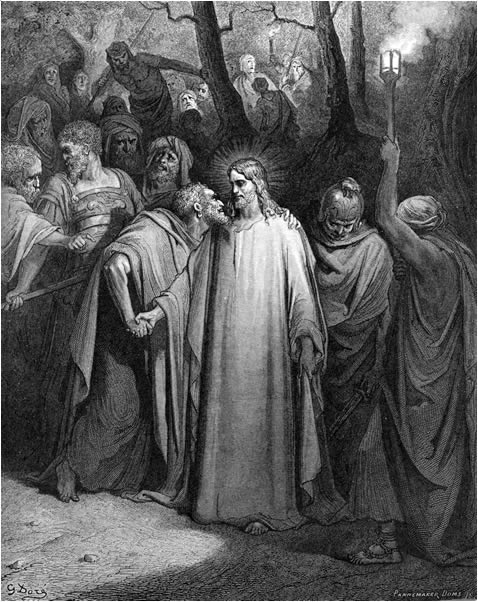
Judas, one of the Twelve, arrived: with a crowd armed with swords and clubs. His signal was a kiss: he said Rabbi and kissed Him, turning a disciple’s greeting against his teacher.
Mark 14:43
“Let us notice in these verses, how little our Lord's enemies understood the nature of His kingdom . We read that Judas came to take Him "with a great multitude, with swords and clubs." It was evidently expected that our Lord would be vigorously defended by His disciples, and that He would not be taken prisoner without fighting. The chief priests and scribes clung obstinately to the idea, that our Lord's kingdom was a worldly kingdom, and therefore supposed that it would be upheld by worldly means.”
arranged a signal with them: Bede thinks Judas kept a trace of a disciple's shame, since he chose a kiss over pointing Jesus out openly. Theophylact asks why a man who came as a friend came with enemies. Dionysius of Alexandria marvels that the Lord even kissed his traitor.
Mark 14:44
“But look at his madness, how he thought to hide from the Lord by a kiss, hoping to be received as a friend. If you are indeed a friend, why did you come with enemies? Truly, senseless cunning!”
Theophylact of Ohrid · written before 1107 · Commentary on Markpatristic
2 more voices on this verse
Mark 14:44
“Judas gives the kiss as a token, with poisonous guile, just as Cain offered a crafty, reprobate sacrifice.”
Pseudo-Jerome · Catena Aurea by Aquinaspatristic
Mark 14:44
“And he that betrayed him had given them a token,.... A common sign, in which they agreed; and so this same Greek word is used by the Jews (c): "said R. Phinehas in the name of R.”
Going directly to Jesus: Gill pictures Judas stepping ahead of the armed crowd alone, as though he were a friend concerned for the safety of Jesus. The greeting put on a show of respect. Bede says the Lord accepted the kiss so that he would not seem to shrink from betrayal.
Mark 14:45
“And as soon as he was come,.... To the place where Jesus was: he goeth straightway to him; alone; as if he had nothing to do with the company behind, and as if he was his friend, and concerned for his safety: and saith, Master, Master; expressing great affection for him, and respect to him, by repeating this word. The Ethiopic version has it but once, and so two exemplars of Beza's; and the Vulgate Latin reads, "hail, Master", as in Mat 26:49. and kissed him; See Gill on Mat 26:49.”
seized Jesus and arrested Him: Mark reports the arrest in one plain line. Gill places here the words that Matthew and Luke record Jesus speaking to Judas at the kiss. Pseudo-Jerome compares Jesus to Joseph, sold by his own brothers and bound in irons.
Mark 14:46
“And they laid hands on him, and took him. After Christ had said to Judas, "friend, wherefore art thou come?" as in Matthew; and also, "Judas, betrayest thou the son of man with a kiss?" as in Luk 22:48; See Gill on Mat 26:50.”
1 more voice on this verse
Mark 14:46
“PSEUDO-JEROME.w This is the Joseph who was sold by his brethren, (Ps. 105:18) and into whose soul the iron entered. There follows: And one of them that stood by drew a sword, and smote a servant of the High Priest, and cut off his ear.”
Pseudo-Jerome · Catena Aurea by Aquinaspatristic
drew his sword and struck the servant of the high priest: A bystander drew his sword and struck the servant of the high priest, cutting off his ear. Mark names neither man, while John’s Gospel names Peter and Malchus, and Luke records that Jesus healed the ear. Mark gives the blow without the healing.
Mark 14:47
“And one of them that stood by,.... One of the disciples that stood by Jesus, as Judas was betraying him, and the soldiers were laying hold on him, Peter by name: drew a sword, and smote a servant of the high priest, and cut off his ear; his right ear; the servant's name was Malchus; See Gill on Mat 26:51.”
1 more voice on this verse
Mark 14:47
“Mark conceals his name, lest he should seem to be praising his master for his zeal for Christ. Again, the action of Peter points out that they were disobedient and unbelieving, despising the Scriptures; for if they had had ears to hear the Scriptures, they would not have crucified the Lord of glory. But he cut off the ear of a servant of the High Priest, for the Chief Priests especially passed over the Scriptures, like disobedient servants.”
Theophylact of Ohrid · written before 1107 · Catena Aurea by Aquinaspatristic
Mark 14:48-49
Jesus sets the crowd's swords and clubs against His open teaching in the temple courts, where they had not arrested Him. He closes, But this has happened that the Scriptures would be fulfilled, so the arrest itself works out what was written.
Mark 14:48
“This, however, is a proof of His divinity, for when He taught in the temple they were unable to take Him, although He was in their power, because the time of His Passion had not yet come; but when He Himself was willing, then He gave Himself up, that the Scriptures might be fulfilled, for he was led as a lamb to the slaughter, not crying nor raising His voice, but suffering willingly.”
Theophylact of Ohrid · written before 1107 · Catena Aurea by Aquinaspatristic
teaching in the temple courts: Gill takes every day to mean the days after Jesus came into Jerusalem in chapter 11 and taught in the temple courts. Theophylact reads their failure to arrest Him there as a sign that His hour had not yet come. He links the arrest to Isaiah's silent lamb.
Cross references
Mark 14:49
- Quoted inMark 14:49Every day I was with you, teaching in the temple courts, and you did not arrest Me. But this has happened that the Scriptures would be fulfilled.”
all' hina plerothosin hai graphai ('but that the scriptures might be fulfilled'), Mark's bare, sourceless fulfillment frame at the arrest
Then everyone deserted Him and fled: , fulfilling the prediction of verse 27 within the hour. Peter’s promise in verse 31 and the others’ matching promise give way together at the first test.
Mark 14:50
“THIS little episode in the narrative of the Evangelist is very singular. One wonders why it is introduced, but a moment's reflection will, I think, suggest a plausible reason. It strikes me that this "certain young man" was none other than Mark, himself. He was probably asleep and, awakened by a great clamor, he asked what it was about. The information was speedily given, "The guards have come to arrest Jesus of Nazareth."”
Charles Spurgeon · written before 1892 · The Metropolitan Tabernacle Pulpit, Sermon No. 3023: “John Mark—or, Haste in Religion” (lightly modernized text, CCEL edition)Particular Baptist
2 more voices on this verse
Mark 14:50
“And they all forsook him and fled. That is, his disciples, as the Vulgate Latin, Syriac, Arabic, Persic, and Ethiopic versions read; and who seem to have transcribed it from Matthew, and lest it should be thought, that the multitude whom Christ addressed, were intended.”
Mark 14:50
“The disciples fled, for it was impossible for the Self-existent Truth and the prophets to lie.”
Theophylact of Ohrid · written before 1107 · Commentary on Markpatristic
Mark 14:51-52
One young man who had been following Jesus: Since the early church many have taken the young man who ran away naked to be Mark himself, recording his own escape. The detail shows how far the desertion of verse 50 reached, down to the last unnamed follower.
Mark 14:51
“A certain young man - Probably raised from his sleep by the noise which the rabble made who came to apprehend Jesus, having wrapped the sheet or some of the bed-clothing about him, became thereby the more conspicuous: on his appearing, he was seized; but as they had no way of holding him, but only by the cloth which was wrapped round him, he disengaged himself from that, and so escaped out of their hands. This circumstance is not related by any other of the evangelists.”
Adam Clarke · Commentary on the Bible (1810-1826)evangelical
1 more voice on this verse
Mark 14:51
THIS little episode in the narrative of the Evangelist is very singular. One wonders why it is introduced, but a moment's reflection will, I think, suggest a plausible reason. It strikes me that this "certain young man" was none other than Mark, himself. He was probably asleep and, awakened by a great clamor, he asked what it was about. The information was speedily given, "The guards have come to arrest Jesus of Nazareth."
Charles Spurgeon · written before 1892 · The Metropolitan Tabernacle Pulpit, Sermon No. 3023: “John Mark—or, Haste in Religion” (lightly modernized text, CCEL edition)Particular Baptist
pulled free of the linen: Gill hears Genesis 39:12, where Joseph left his garment in a woman's hand and ran away. Clarke explains that a linen cloth wrapped around the body could be pulled free in an instant. The young man fled naked, as everyone else had fled.
Mark 14:52
“And he left the linen cloth, and fled from them naked - It has often been intimated, by the inhabitants of India, that a European in strait clothes must be in great danger when his clothes take fire. From their loose clothing they can suddenly disengage themselves. When two Hindoos are engaged in a violent quarrel, and one seizes the clothing of the other, often the latter will leave his clothes in the hands of his opponent, and flee away naked. This seems to have been the case with the person mentioned above. See Ward’s Customs.”
Adam Clarke · Commentary on the Bible (1810-1826)evangelical
1 more voice on this verse
Mark 14:52
“And he left the linen cloth,.... "In their hands", so the Persic version renders it; just as Joseph left his garment in the hands of his mistress, Gen 39:12; and fled from them naked; to the house from whence he came. The Syriac, Arabic, Persic, and Ethiopic versions, leave out the words "from them".”
Before the Council: I Am
Mark 14:53-54
They led Jesus away to the high priest: Peter, who fled in verse 50, followed Him at a distance, right into the courtyard of the high priest. He sat with the officers by the fire, where verses 66 to 72 place the denials, so Mark sets the trial inside Peter’s story.
Mark 14:53
“And they led Jesus away to the high priest,.... Caiaphas, as is added in the Syriac, Arabic, and Persic versions.”
1 more voice on this verse
Mark 14:53
Solomon tells us in the book of Ecclesiastes, that one evil he has seen under the sun, is when "folly is set in great dignity, and the rich sit in low place." (Eccles. 10:6.) We can imagine no more complete illustration of his words than the state of things we have recorded in the passage before us. We see the Son of God, "in whom are hidden all the treasures of wisdom and knowledge," arraigned as a malefactor before "the chief priests, and elders, and scribes."
warmed himself by the fire: Pseudo-Jerome sees two pulls on Peter: love drew him on while fear held him back. Clarke notes that the Greek says he sat at the light, a fire bright enough for the servant girl in verse 67 to know him. The fire that warmed him also exposed him.
Mark 14:54
“It goes on: And Peter followed him afar off, even into the palace of the High Priest. For though fear holds him back, love draws him on. He warms himself at the fire in the hall, with the servants. The hall of the High-Priest is the enclosure of the world, the servants are the devils, with whom whosoever remains cannot weep for his sins; the fire is the desire of the flesh.”
Pseudo-Jerome · Catena Aurea by Aquinaspatristic
1 more voice on this verse
Mark 14:54
“Peter followed - On Peter’s denial, see Mat 26:57, etc. At the fire - Προς το φως, literally, at the light, i.e. a fire that cast considerable light, in consequence of which, the maid servant was the better able to distinguish him: see Mar 14:67.”
Adam Clarke · Commentary on the Bible (1810-1826)evangelical
Mark 14:55-59
seeking testimony against Jesus to put Him to death: The chief priests and the whole Sanhedrin were seeking testimony against Jesus to put Him to death, a verdict looking for evidence. Many bore false witness, but their testimony was inconsistent, so the trial stalls.
Mark 14:55
“But iniquity lied as the queen did against Joseph, and the priests against Susannah, but a flame goes out, if it has no fuel; wherefore it goes on, And found none. For many bare false witness against him, but their witness agreed not together. For whatever is not consistent is held to be doubtful.”
Pseudo-Jerome · Catena Aurea by Aquinaspatristic
their testimony was inconsistent: Wesley reads inconsistent as testimony too weak to put a man to death. The same word returns in verse 59. The Sanhedrin needed witnesses who agreed, and many false witnesses still gave them no testimony they could use.
Mark 14:56
“But at the very time when His enemies were saying, "God hath forsaken Him; persecute and take Him; for there is none to deliver Him" (Ps 71:11), He whose Witness He was and whose work He was doing was keeping Him as the apple of His eye, and while He was making the wrath of man to praise Him, was restraining the remainder of that wrath (Ps 76:10).”
Jamieson, Fausset & Brown · Commentary Critical and Explanatory on the Whole Bible (1871)reformed
1 more voice on this verse
Mark 14:56
“Their evidences were not sufficient - The Greek words literally rendered are, Were not equal: not equal to the charge of a capital crime: it is the same word in the 59th verse.”
John Wesley · Explanatory Notes upon the New Testament (1755)evangelical
testified falsely against Him: Matthew counts two of these witnesses, and Jamieson, Fausset and Brown think the court needed a matching pair before it could proceed. Gill explains that they stood up because Jewish law had witnesses stand while giving testimony. He cites Deuteronomy 19:17 and the rabbis on the point.
Mark 14:57
“And there arose certain,.... Two false witnesses, as in Mat 26:60, who stood up in court; for witnesses were obliged to stand, whilst they gave in their testimony: "says R. Bo, in the name of R. Hona, witnesses ought לעמוד, "to stand", whilst they bear witness; as it is said, Deu 19:17. "Both the men shall stand" (m), &c.'' And bare false witness against him, saying; as follows. (m) T. Herios. Sanhedrin, fol. 21. 3. & Yoma, fol. 43. 2. Maimon. Hilch. Sanhedrin, c. 21. sect. 3.”
1 more voice on this verse
Mark 14:57
“There follows, And there arose certain, and bare false witness against him, saying, We heard him say, I will destroy this temple that is made with hands, and within three days I will build another made without hands. It is usual with heretics out of the truth to extract the shadow; He did not say what they said, but something like it, of the temple of His body, which He raised again after two days.”
Pseudo-Jerome · Catena Aurea by Aquinaspatristic
The charge twists John 2:19, where Jesus told his hearers to destroy the temple and promised to raise it in three days. Theophylact notes that he never said I will destroy, and Origen adds that he was speaking of his body.
Mark 14:58
“The accusations they brought against our Lord Jesus Christ appear to have reference to this utterance of his, "Destroy this temple, and I will build it up in three days." Though he was speaking of the temple of his body, they supposed his words to refer to the temple of stone.”
Origen of Alexandria · written before 253 · Commentary on John 10.21patristic
1 more voice on this verse
Mark 14:58
“We heard him say - It is observable, that the words which they thus misrepresented, were spoken by Christ at least three years before, John ii, 19. Their going back so far to find matter for the charge, was a glorious, though silent attestation of the unexceptionable manner wherein he had behaved, through the whole course of his public ministry.”
John Wesley · Explanatory Notes upon the New Testament (1755)evangelical
even their testimony was inconsistent: Jamieson, Fausset and Brown note that the witnesses could not agree even on a saying of a few words. Gill reads it differently. He thinks the two agreed in substance, but the Greek word shows their testimony fell short of what a capital charge required.
Mark 14:59
“But, neither so did their witness agree together. Their witness did agree together, for they both witnessed the same thing; but not so as to found upon it the charge of a capital crime against him; their witness was not so, ιση, "equal", was not answerable to their desires, nor sufficient to convict him of a capital crime, for which they could condemn him to death, as before observed on Mar 14:56.”
Mark 14:60-62
Jesus meets the high priest's question with silence, as the silent lamb of Isaiah 53:7. Then He answered I am, joining Daniel 7:13 and Psalm 110:1 in one reply that the high priest called blasphemy.
Mark 14:60
“The high priest, rising up, questioned Jesus with the intention of provoking Him to answer, and then turning that answer into an accusation.”
Theophylact of Ohrid · written before 1107 · Commentary on Markpatristic
the Son of the Blessed: Clarke calls the Blessed One a Hebrew way of naming God. Theophylact explains the pairing of titles: many kings and priests were anointed, but none was called the Son of the Blessed. Augustine links the silence before this question to the silent lamb of Isaiah 53.
Mark 14:61
“If you will not learn Who Christ is from those that know Him, learn it at least from those that know Him not. So shall the confession, which their ignorance is forced to make, rebuke your blasphemy. The Jews did not recognise Christ, come in the body, though they knew that the true Christ must be the Son of God. And so, when they were employing false witnesses, without one word of truth in their testimony, against Him, their priest asked Him, Art Thou the Christ, the Son of the Blessed?”
Hilary of Poitiers · written before 367 · On the Trinity 6.50patristic
sitting at the right hand: Augustine notes that Matthew's form of the answer means the same as the plain answer Mark gives. Theophylact says Jesus answered directly so that no one could later claim they would have believed a plain word. He takes Power as a name for the Father.
Mark 14:62
“And Jesus said, I am,.... That is, the Son of God; in proof of which he adds, and ye shall see the son of man sitting on the right hand of power; that is, of God, who is all power, the Lord God Almighty: and coming in the clouds of heaven; either at the destruction of Jerusalem, or at the last day, referring to the prophecy in Dan 7:13; See Gill on Mat 26:64.”
1 more voice on this verse
Mark 14:62
Hear, too, how He was to ascend into heaven according to prophecy. It was thus spoken: "Lift up the gates of heaven; be ye opened, that the King of glory may come in. Who is this King of glory? The Lord, strong and mighty." And how also He should come again out of heaven with glory, hear what was spoken in reference to this by the prophet Jeremiah. His words are: "Behold, as the Son of man He cometh in the clouds of heaven, and His angels with Him."
Justin Martyr · written before 165 · The First Apology, Chapter LIpatristic
Cross references
Mark 14:62
- QuotingPsalms 110:1The LORD said to my Lord: “Sit at My right hand until I make Your enemies a footstool for Your feet.”
'on the right hand of power' (before the high priest, w/ Dan 7:13)
ConnectionsPsalms 110:1
Mark 14:63-65
the high priest tore his clothes: At this, the high priest tore his clothes, the legal sign of horror at blasphemy, and they all condemned Him as deserving of death. The spitting and blows that follow answer to Isaiah 50:6.
Mark 14:63
“Then the high priest rent his clothes,.... As was usual upon hearing blasphemy; which he now supposed the case, or at least would have it so thought: and saith, what need we any further witnesses? or trouble ourselves to see for any more, or to hear and take the depositions of any others; See Gill on Mat 26:65.”
Gill holds that all the Sanhedrin condemned Him except Joseph of Arimathea, who had not agreed to their verdict. Mark names him in 15:43. Pseudo-Jerome says they condemned Him as deserving of death so that His death might take away the guilt of others.
Mark 14:64
“Ye have heard the blasphemy,.... The "manifest" blasphemy, as the Arabic version renders it; and "out of his own mouth", as the Syriac version adds, agreeably to Luk 22:71, what think ye? what sentence is to, be passed upon him? And they all condemned him to be guilty of death; excepting Joseph of Arimathea, Luk 23:51; See Gill on Mat 26:66.”
1 more voice on this verse
Mark 14:64
“They condemned Him to be guilty of death, that by His guiltiness He might absolve our guilt.”
Pseudo-Jerome · Catena Aurea by Aquinaspatristic
They blindfolded Him: The blindfold explains the taunt. Bede says they mocked his wish to be taken for a prophet. Gill notes that some versions add a demand to name who struck him.
Mark 14:65
“And some began to spit on him,.... The men that held him, Luk 22:6, fulfilling the prophecy in Isa 50:6; and to cover his face; with a veil, or linen cloth, to blindfold: him, as a person unworthy to behold the light: or rather, in order to make sport with him: and to buffet him; with their double fists; and to say unto him, prophesy. The Arabic version adds, "unto us, O Christ, who it is that hath buffeted thee now?" that gave thee the last blow? and to the same purpose the Ethiopic.”
1 more voice on this verse
Mark 14:65
“Who is this strange one who says that he had been silent before, but would not always be silent? Who is he who was led as a sheep to the slaughter and who, like a lamb without making a sound before its shearer, did not open his mouth? Who is he who did not cry out and whose voice was not heard in the streets? Surely it was he who was not stubborn and who did not murmur when he offered his back to the scourges and his cheeks to blows.”
Cyprian · written before 258 · Treatise IX. On the Advantage of Patience 23patristic
Peter, the Fire, and the Crowing Cock
Mark 14:66-68
While Peter was in the courtyard below: One of the servant girls of the high priest said, You also were with Jesus the Nazarene. Peter denied it, and the rooster crowed, the first crowing that begins to fulfill Jesus’ word.
Mark 14:66
“At the upper end of this court, probably, would be the memorable chamber in which the trial was held--open to the court, likely, and not far from the fire (as we gather from Lu 22:61), but on a higher level; for (as our verse says) the court, with Peter in it, was "beneath" it. The ascent to the Council chamber was perhaps by a short flight of steps.”
Jamieson, Fausset & Brown · Commentary Critical and Explanatory on the Whole Bible (1871)reformed
1 more voice on this verse
Mark 14:66
“The Lord allowed this to happen to him by His providence, that is, lest he should be too much elated, and at the same time, that he might prove himself merciful to sinners, as knowing from himself the result of human weakness. There follows: And he went out into the porch; and the cock crew.”
Theophylact of Ohrid · written before 1107 · Catena Aurea by Aquinaspatristic
warming himself there: Gill identifies her as the woman who had let Peter in at the door, and says she studied his face before she spoke. Jamieson, Fausset and Brown take her word also to mean as well as the other disciple, whom she knew.
Mark 14:67
“The sense of this is given in John's report of it (Joh 18:17), "Art not thou also one of this man's disciples?" that is, thou as well as "that other disciple," whom she knew to be one, but did not challenge, perceiving that he was a privileged person.”
Jamieson, Fausset & Brown · Commentary Critical and Explanatory on the Whole Bible (1871)reformed
went out to the gateway: Peter's answer piles two verbs together, know and understand, in a flat refusal. Bede notes that only Mark records this first crow, and that the other Gospels pass over it without denying it. It fulfils the first half of the warning in verse 30.
Mark 14:68
“This, then, was the First Denial. Peter's SECOND DENIAL of His Lord (Mr 14:69, 70). There is here a verbal difference among the Evangelists, which without some information which has been withheld, cannot be quite extricated.”
Jamieson, Fausset & Brown · Commentary Critical and Explanatory on the Whole Bible (1871)reformed
Mark 14:69-70
the servant girl saw him and again said: The pressure widens from one servant girl to the bystanders, who said, Surely you are one of them, for you too are a Galilean. Peter denied it again, in nearly the words of his first denial.
Mark 14:69
“Accordingly, in Mt 26:71, she is expressly called "another [maid]." But in Luke (Lu 22:58) it is a male servant: "And after a little while [from the time of the first denial] another"--that is, as the word signifies, "another male" servant.”
Jamieson, Fausset & Brown · Commentary Critical and Explanatory on the Whole Bible (1871)reformed
Galileans and Judeans spoke the same language, Bede explains, but each region had its own way of pronouncing it. Jamieson, Fausset and Brown say the Galilean speech had a more Syrian sound. On this reading, Peter's own voice gave him away.
Mark 14:70
“And he denied it again--In Luke (Lu 22:58), "Man, I am not." But worst of all in Matthew--"And again he denied with an oath, I do not know the man" (Mt 26:72). This was the Second Denial, more vehement, alas! than the first.”
Jamieson, Fausset & Brown · Commentary Critical and Explanatory on the Whole Bible (1871)reformed
Mark 14:71-72
he began to curse and swear: The third denial rises to an oath, since he began to curse and swear, I do not know this man of whom you speak. At the rooster’s second crow Peter remembered Jesus’ word, and he broke down and wept.
Mark 14:71
“But he began to curse--"anathematize," or wish himself accursed if what he was now to say was not true. and to swear--or to take a solemn oath. saying, I know not this man of whom ye speak.”
Jamieson, Fausset & Brown · Commentary Critical and Explanatory on the Whole Bible (1871)reformed
1 more voice on this verse
Mark 14:71
“The second time he denied not simply but with an oath, the third time also with cursing. By this we are instructed never to promise without consideration anything above our human ability.”
Origen of Alexandria · written before 253 · Commentary on Matthew 86patristic
he broke down and wept: The Greek behind he broke down is hard to render. Clarke lists the guesses: he burst into tears, covered his head, or rushed from the place. Chrysostom marvels that Mark, Peter's disciple, tells this fall in more detail than the other Gospels.
Mark 14:72
“In this matter we must consider why Almighty God permitted him whom He had determined to place over the whole Church to fear the voice of a servant girl and to deny himself. This we recognize was done by a dispensation of great mercy, so that he who was to be the Pastor of the Church might learn through his own fault how he ought to show mercy to others.”
Gregory the Dialogist · written before 604 · 40 Homilies on the Gospels, Homily 21patristic
2 more voices on this verse
Mark 14:72
“And when he thought thereon, he wept - Or, he fell a weeping. This Mr. Wakefield thinks comes nearest to the original, επιβαλων εκλαιε. Others think it means the wrapping of his head in the skirts of his garment, through shame and anguish. Others think that επιβαλων rather refers to the violence, or hurry, with which he left the place, being impelled thereto by the terrors and remorse of his guilty conscience. Our own translation is as good as any.”
Adam Clarke · Commentary on the Bible (1810-1826)evangelical
Mark 14:72
“TRUE repentance is always the gift of God and the work of the Holy Spirit in the soul. Man, left to himself, continues in sin. If he turns from his iniquity, it is because God turns him. By nature, his mind is set on mischief and if that mind is changed, as it is in genuine repentance, it must be because the Lord Himself has changed it. That repentance which a man works in himself, without the Spirit of God, will turn out to be a repentance that needs to be repented of!”
Charles Spurgeon · written before 1892 · The Metropolitan Tabernacle Pulpit, Sermon No. 2735: “Fountains of Repentant Tears” (lightly modernized text, CCEL edition)Particular Baptist
Keep studying
Studies24
- The Son of Man in 1 Enoch
- Abba, Father
- The Major Prophets
- Daniel the Prophet
- Gethsemane (The Garden Called the Oil Press)
- Jesus on Himself
Show the next 6 titles
Places2
Sources for this chapter
The summary
Jamieson, Fausset & Brown, Commentary Critical and Explanatory; John Calvin, Commentaries; John Wesley, Explanatory Notes Upon the New Testament and Matthew Henry, Complete Commentary.
The context
C. F. Keil, Biblical Commentary on the Book of Daniel and Matthew Henry, Commentary on the Whole Bible.
The exposition
Adam Clarke, Commentary on the Bible; Albert Barnes; Alexander Maclaren, Expositions of Holy Scripture; Augustine of Hippo; Bede; Cyprian, Treatise IX. On the Advantage of Patience 6; Dionysius of Alexandria, EXEGETICAL FRAGMENTS; Gregory of Nazianzus, ORATION 29, ON THE SON 20; Hilary of Poitiers; J. C. Ryle, Expository Thoughts on the Gospels, Mark; Jamieson, Fausset & Brown, Commentary Critical and Explanatory on the Whole Bible; John Calvin, Commentary on a Harmony of the Evangelists; John Chrysostom; John Damascene, EXPOSITION OF THE ORTHODOX FAITH 4.21; John Gill; John Lightfoot, Horae Hebraicae et Talmudicae on Matthew; John Wesley, Explanatory Notes upon the New Testament; Matthew Henry, Commentary on the Whole Bible; Origen of Alexandria; Pseudo-Jerome, Catena Aurea by Aquinas; Tertullian, TO THE MARTYRS 4.12 and Theophylact of Ohrid.
The painting
The Judas Kiss, Gustave Doré (engraving), public domain