
Mark 14:43
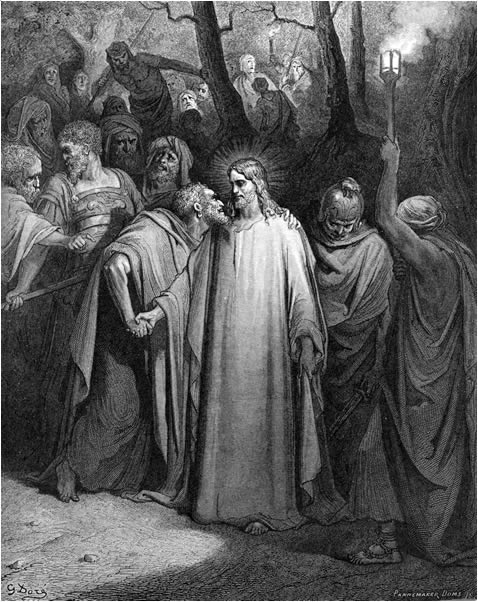
in Mark 14While Jesus was still speaking, Judas, one of the Twelve, arrived, accompanied by a crowd armed with swords and clubs, sent from the chief priests, scribes, and elders.
BSB
The same verse in ASV and KJV ▾
ASV
And straightway, while he yet spake, cometh Judas, one of the twelve, and with him a multitude with swords and staves, from the chief priests and the scribes and the elders.
KJV
And immediately, while he yet spake, cometh Judas, one of the twelve, and with him a great multitude with swords and staves, from the chief priests and the scribes and the elders.
⋯
This verse in Mark 14
Commentary
9 notes on this verseA commentator
J.C. Ryle1816–1900
Expository Thoughts on the Gospels: Mark (lightly modernized text, Grace Gems edition) (1857)
Let us notice in these verses, how little our Lord's enemies understood the nature of His kingdom . We read that Judas came to take Him "with a great multitude, with swords and clubs." It was evidently expected that our Lord would be vigorously defended by His disciples, and that He would not be taken prisoner without fighting. The chief priests and scribes clung obstinately to the idea, that our Lord's kingdom was a worldly kingdom, and therefore supposed that it would be upheld by worldly means.
The record, by era
The Church Fathers1 voice
Consider what befell him, how he simultaneously lost the money, committed the sin, and destroyed his own soul. Such is the tyranny of covetousness. He did not even enjoy the money in this life nor did he have any benefits in the life to come. He lost everything at once and, branded as a bad character even by his co-conspirators, hanged himself.
The Medieval Church4 voices
Not without reason was it added: "one of the twelve," but in condemnation of the betrayer, because he, being in the first rank of the apostles, plotted against his own Master.
(ubi sup.) After that our Lord had prayed three times, and had obtained by His prayers that the fear of the Apostles should be amended by future repentance, He, being tranquil as to His Passion, goes to His persecutors, concerning the coming of whom the Evangelist says, And immediately, while he yet spake, cometh Judas Iscariot, one of the twelve.
For he who despairs of help from God, has recourse to the power of the world.
This is not put without reason, but to the greater conviction of the traitor, since though he was of the chief company amongst the disciples, he turned himself to furious enmity against our Lord. And with him a great multitude with swords and staves from the Chief Priests and the Scribes and the elders.
3 more voices on this verse
The Puritans and the Awakening1 voice
And immediately, while he yet spake,.... The above words: cometh Judas one of the twelve: apostles of Christ, and which was an aggravation of his wickedness; the Vulgate Latin, Syriac, Arabic, Persic, and Ethiopic, versions add, "Iscariot"; and so it is read in one of Beza's copies.
The Nineteenth Century2 voices
A commentator
J.C. Ryle1816–1900
Expository Thoughts on the Gospels: Mark (lightly modernized text, Grace Gems edition) (1857)
proposed
Let us notice in these verses, how little our Lord's enemies understood the nature of His kingdom . We read that Judas came to take Him "with a great multitude, with swords and clubs." It was evidently expected that our Lord would be vigorously defended by His disciples, and that He would not be taken prisoner without fighting. The chief priests and scribes clung obstinately to the idea, that our Lord's kingdom was a worldly kingdom, and therefore supposed that it would be upheld by worldly means. They had yet to learn the solemn lesson contained in our Lord's words to Pilate, "My kingdom is not of this world." (John 18:36.) We shall do well to remember this in all our endeavors to extend the kingdom of true religion. It is not to be propagated by violence, or by an arm of flesh. "The weapons of our warfare are not carnal." "Not by might, nor by power, but by my Spirit, says the Lord of hosts." (2 Cor. 10:4. Zech. 4:6.) The cause of truth does not need force to maintain it. False religions, like Mohammedanism, have often been spread by the sword. False Christianity, like that of the Roman Church, has often been enforced on men by bloody persecutions. But the real Gospel of Christ requires no such aids as these. It stands by the power of the Holy Spirit. It grows by the hidden influence of the Holy Spirit on men's hearts and consciences. There is no clearer sign of a bad cause in religion than a readiness to appeal to the sword. Let us notice, secondly, in these verses, how all things in our Lord's passion happened according to God's Word . His own address to those who took Him, exhibits this in a striking manner — "the Scripture must be fulfilled." There was no accident or chance in any part of the close of our Lord's earthly ministry. The steps in which He walked from Gethsemane to Calvary were all marked out hundreds of years before.
A commentator
Albert Barnes1798–1870
Notes, Explanatory and Practical, on the Old and New Testaments (1832-1869)
proposed
See the notes at Mat 26:47-57. Mar 14:45 Master, Master - As if expressing great joy that he had found him again. Mar 14:51 A certain young man - Who this was we have no means of determining, but it seems not improbable that he may have been the owner of the garden, and that he may have had an understanding with Jesus that he should visit it for retirement when he withdrew from the city. That he was not one of the apostles is clear.
The words behind it
27 Greek wordsEvery Greek word of this verse in the order it stands, with what it means and the door to its own study. The last column counts the times a word stands in the whole Bible: the rarer the word, the more the places it appears belong together.
| Greek | Sound | Meaning | Word study | In the Bible |
|---|---|---|---|---|
| Καὶ | kai | And | G2532 → | 9120 times |
| εὐθὺς | euthus | immediately | G2112 → | 87 times |
| ἔτι | eti | while yet | G2089 → | 140 times |
| αὐτοῦ | autou | when he | G846 → | 5565 times |
| λαλοῦντος | lalountos | is speaking | G2980 → | 294 times |
| παραγίνεται | paraginetai | comes up | G3854 → | |
| Ἰούδας, | ioudas | Judas, | G2455 → | 41 times |
| εἷς | heis | one | G1520 → | 343 times |
| τῶν | ton | of the | G3588 → | 19766 times |
| δώδεκα, | dodeka | Twelve, | G1427 → | 75 times |
| καὶ | kai | and | G2532 → | 9120 times |
| μετ᾽ | met᾽ | with | G3326 → | 461 times |
| αὐτοῦ | autou | Him | G846 → | 5565 times |
| ὄχλος | ochlos | a crowd | G3793 → | 175 times |
| μετὰ | meta | with | G3326 → | 461 times |
| μαχαιρῶν | machairon | swords | G3162 → | 29 times |
| καὶ | kai | and | G2532 → | 9120 times |
| ξύλων | xulon | clubs | G3586 → | |
| παρὰ | para | from | G3844 → | 192 times |
| τῶν | ton | the | G3588 → | 19766 times |
| ἀρχιερέων | archiereon | chief priests | G749 → | 122 times |
| καὶ | kai | and | G2532 → | 9120 times |
| τῶν | ton | the | G3588 → | 19766 times |
| γραμματέων | grammateon | scribes | G1122 → | 62 times |
| καὶ | kai | and | G2532 → | 9120 times |
| τῶν | ton | the | G3588 → | 19766 times |
| πρεσβυτέρων. | presbuteron | elders. | G4245 → | 65 times |
ΚαὶAnd
kaiG2532 →9120 times
εὐθὺςimmediately
euthusG2112 →87 times
ἔτιwhile yet
etiG2089 →140 times
αὐτοῦwhen he
autouG846 →5565 times
λαλοῦντοςis speaking
lalountosG2980 →294 times
παραγίνεταιcomes up
paraginetaiG3854 →
Ἰούδας,Judas,
ioudasG2455 →41 times
εἷςone
heisG1520 →343 times
τῶνof the
tonG3588 →19766 times
δώδεκα,Twelve,
dodekaG1427 →75 times
καὶand
kaiG2532 →9120 times
μετ᾽with
met᾽G3326 →461 times
αὐτοῦHim
autouG846 →5565 times
ὄχλοςa crowd
ochlosG3793 →175 times
μετὰwith
metaG3326 →461 times
μαχαιρῶνswords
machaironG3162 →29 times
καὶand
kaiG2532 →9120 times
ξύλωνclubs
xulonG3586 →
παρὰfrom
paraG3844 →192 times
τῶνthe
tonG3588 →19766 times
ἀρχιερέωνchief priests
archiereonG749 →122 times
καὶand
kaiG2532 →9120 times
τῶνthe
tonG3588 →19766 times
γραμματέωνscribes
grammateonG1122 →62 times
καὶand
kaiG2532 →9120 times
τῶνthe
tonG3588 →19766 times
πρεσβυτέρων.elders.
presbuteronG4245 →65 times
A shaded row is a word that stands 400 times or fewer in the Bible.
The walk
5 stopsEach card is a verse this one points to, and under it the verses that one points to in turn. Where several paths arrive at the same place, that place is listed first: the text keeps returning to it.
Through
Acts 1:16“Brothers, the Scripture had to be fulfilled which the Holy Spirit foretold through the mouth of David concerning Judas, who became a guide for those who arrested Jesus.
it leads to
- Psalms 41:9
Even my close friend whom I trusted, the one who shared my bread, has lifted up his heel against me.
- John 13:18
I am not speaking about all of you; I know whom I have chosen. But this is to fulfill the Scripture: ‘The one who shares My bread has lifted up his heel against Me.’
- Psalms 55:12–15
For it is not an enemy who insults me; that I could endure. It is not a foe who rises against me; from him I could hide.
- Acts 1:20
“For it is written in the book of Psalms: ‘May his place be deserted; let there be no one to dwell in it,’ and, ‘May another take his position.’
- John 12:38–40
This was to fulfill the word of Isaiah the prophet: “Lord, who has believed our message? And to whom has the arm of the Lord been revealed?”
- Psalms 41:9
Where this verse is studied
On this page
Studies23
- The Son of Man in 1 Enoch
- Abba, Father
- The Major Prophets
- Daniel the Prophet
- Gethsemane (The Garden Called the Oil Press)
- Jesus on Himself
Show the next 6 titles
About Mark
This page draws on Albert Barnes, Notes, Explanatory and Practical, on the Old and New Testaments (1832-1869); Bede, Catena Aurea by Aquinas; J.C. Ryle, Expository Thoughts on the Gospels: Mark (lightly modernized text, Grace Gems edition); John Chrysostom, THE GOSPEL OF ST MATTHEW 85.2; John Gill, Exposition of the New Testament (1746-1748); Pseudo-Jerome, Catena Aurea by Aquinas; Theophylact of Ohrid, Commentary on Mark and Theophylact of Ohrid, Catena Aurea by Aquinas.