
Mark 14:16
in Mark 14So the disciples left and went into the city, where they found everything as Jesus had described. And they prepared the Passover.
BSB
The same verse in ASV and KJV ▾
ASV
And the disciples went forth, and came into the city, and found as he had said unto them: and they made ready the passover.
KJV
And his disciples went forth, and came into the city, and found as he had said unto them: and they made ready the passover.
⋯
This verse in Mark 14
Commentary
6 notes on this verseA commentator
J.C. Ryle1816–1900
Expository Thoughts on the Gospels: Mark (lightly modernized text, Grace Gems edition) (1857)
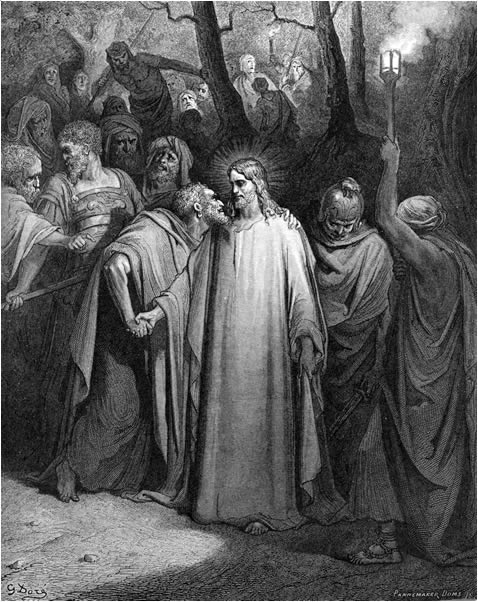
In these verses, Mark tells us how our Lord was delivered into the hands of His enemies. It came to pass through the treachery of one of His own twelve disciples. The false apostle, Judas Iscariot, betrayed Him. We ought to mark, firstly, in this passage, to what lengths a man may go in a false profession of religion . It is impossible to conceive a more striking proof of this painful truth, than the history of Judas Iscariot.
This site's exposition
say to the owner
on Mark 14:14-16
The owner shows them a large upper room, furnished and ready, so an unnamed householder in Jerusalem already stood with Jesus. The disciples found everything as Jesus had described.
This site's exposition
found everything as Jesus had described
Bede takes the exact match between the word and the event as a sign of divinity. In Barnes's note on verse 12, preparing meant obtaining the lamb, roasting it and setting out the usual dishes.
The record, by era
The Medieval Church1 voice
(ubi sup.) And it is a proof of the presence of His divinity, that in speaking with His disciples, He knows what is to take place elsewhere; wherefore it follows, And his disciples went forth, and came into the city, and found as he had said unto them; and they made ready the Passover.
The Puritans and the Awakening1 voice
And his disciples went forth,....
The Nineteenth Century1 voice
A commentator
J.C. Ryle1816–1900
Expository Thoughts on the Gospels: Mark (lightly modernized text, Grace Gems edition) (1857)
proposed
In these verses, Mark tells us how our Lord was delivered into the hands of His enemies. It came to pass through the treachery of one of His own twelve disciples. The false apostle, Judas Iscariot, betrayed Him. We ought to mark, firstly, in this passage, to what lengths a man may go in a false profession of religion . It is impossible to conceive a more striking proof of this painful truth, than the history of Judas Iscariot. If ever there was a man who at one time looked like a true disciple of Christ, and bade fair to reach heaven, that man was Judas. He was chosen by the Lord Jesus Himself to be an apostle. He was privileged to be a companion of the Messiah, and an eye-witness of His mighty works, throughout His earthly ministry. He was an associate of Peter, James and John. He was sent forth to preach the kingdom of God, and to work miracles in Christ's name. He was regarded by all the eleven apostles as one of themselves. He was so like his fellow disciples, that they did not suspect him of being a traitor. And yet this very man turns out at last a false-hearted child of the devil — departs entirely from the faith — assists our Lord's deadliest enemies, and leaves the world with a worse reputation than any one since the days of Cain. Never was there such a fall, such an apostasy, such a miserable end to a fair beginning — such a total eclipse of a soul! And how can this amazing conduct of Judas be accounted for? There is only one answer to that question. "The love of money" was the cause of this unhappy man's ruin. That same groveling covetousness, which enslaved the heart of Balaam, and brought on Gehazi a leprosy, was the destruction of Iscariot's soul. No other explanation of his behavior will satisfy the plain statements of Scripture. His act was an act of base covetousness, without a redeeming feature about it.
How the passage was read
On Mark 14:12-26On Mark 14:12-26
The meal on the table
Mark dates the meal precisely: “when they sacrificed the Passover lamb.” Passover (Pesach) was then a Temple feast: the lamb slain in the courts that afternoon, eaten that night with unleavened bread (matzah) and wine, in a room inside Jerusalem, in company: exactly the arrangements the disciples are sent to make. The hymn sung on the way out (14:26) would by long custom have been from the Hallel, Psalms 113–118, the Passover psalms: which means “the stone the builders rejected” (Psalm 118:22) was likely on His lips that night.
This section is reception history: how the passage was read and kept in the Jewish tradition. Where a reading parts from an essential of the Christian faith, the section says so at that point.
Sources: Mishnah Pesachim 10 (the meal's order) · Psalm 118:22 (the Hallel's rejected stone)
The words behind it
18 Greek wordsEvery Greek word of this verse in the order it stands, with what it means and the door to its own study. The last column counts the times a word stands in the whole Bible: the rarer the word, the more the places it appears belong together.
| Greek | Sound | Meaning | Word study | In the Bible |
|---|---|---|---|---|
| καὶ | kai | And | G2532 → | 9120 times |
| ἐξῆλθον | exelthon | went away | G1831 → | 216 times |
| οἱ | hoi | the | G3588 → | 19766 times |
| μαθηταὶ | mathetai | disciples | G3101 → | 260 times |
| καὶ | kai | and | G2532 → | 9120 times |
| ἦλθον | elthon | came | G2064 → | 628 times |
| εἰς | eis | into | G1519 → | 1755 times |
| τὴν | ten | the | G3588 → | 19766 times |
| πόλιν | polin | city | G4172 → | 163 times |
| καὶ | kai | and | G2532 → | 9120 times |
| εὗρον | heuron | found | G2147 → | 175 times |
| καθὼς | kathos | even as | G2531 → | 182 times |
| εἶπεν | eipen | He had said | G2036 → | 925 times |
| αὐτοῖς | autois | to them | G846 → | 5565 times |
| καὶ | kai | and | G2532 → | 9120 times |
| ἡτοίμασαν | hetoimasan | they prepared | G2090 → | 40 times |
| τὸ | to | the | G3588 → | 19766 times |
| πάσχα.¶ | pascha | Passover. | G3957 → | 29 times |
καὶAnd
kaiG2532 →9120 times
ἐξῆλθονwent away
exelthonG1831 →216 times
οἱthe
hoiG3588 →19766 times
μαθηταὶdisciples
mathetaiG3101 →260 times
καὶand
kaiG2532 →9120 times
ἦλθονcame
elthonG2064 →628 times
εἰςinto
eisG1519 →1755 times
τὴνthe
tenG3588 →19766 times
πόλινcity
polinG4172 →163 times
καὶand
kaiG2532 →9120 times
εὗρονfound
heuronG2147 →175 times
καθὼςeven as
kathosG2531 →182 times
εἶπενHe had said
eipenG2036 →925 times
αὐτοῖςto them
autoisG846 →5565 times
καὶand
kaiG2532 →9120 times
ἡτοίμασανthey prepared
hetoimasanG2090 →40 times
τὸthe
toG3588 →19766 times
πάσχα.¶Passover.
paschaG3957 →29 times
A shaded row is a word that stands 400 times or fewer in the Bible.
The walk
8 stopsEach card is a verse this one points to, and under it the verses that one points to in turn. Where several paths arrive at the same place, that place is listed first: the text keeps returning to it.
Through
John 16:4But I have told you these things so that when their hour comes, you will remember that I told you about them. I did not tell you these things from the beginning, because I…
it leads to
- John 14:29
And now I have told you before it happens, so that when it does happen, you will believe.
- Mark 13:23
So be on your guard; I have told you everything in advance.
- John 13:19
I am telling you now before it happens, so that when it comes to pass, you will believe that I am He.
- John 17:12–13
While I was with them, I protected and preserved them by Your name, the name You gave Me. Not one of them has been lost, except the son of destruction, so that the Scripture…
- Matthew 9:15
Jesus replied, “How can the guests of the bridegroom mourn while He is with them? But the time will come when the bridegroom will be taken from them; then they will fast.
- John 14:29
Through
Luke 22:35Then Jesus asked them, “When I sent you out without purse or bag or sandals, did you lack anything?” “Nothing,” they answered.
it leads to
- Matthew 10:9–10
Do not carry any gold or silver or copper in your belts.
- Luke 10:4
Carry no purse or bag or sandals. Do not greet anyone along the road.
- Psalms 37:3
Trust in the LORD and do good; dwell in the land and cultivate faithfulness.
- Matthew 10:9–10
Where this verse is studied
On this page
Studies23
- The Son of Man in 1 Enoch
- Abba, Father
- The Major Prophets
- Daniel the Prophet
- Gethsemane (The Garden Called the Oil Press)
- Jesus on Himself
Show the next 6 titles
About Mark
This page draws on Albert Barnes, Notes, Explanatory and Practical, on the Old and New Testaments (1832-1869); Bede, Catena Aurea by Aquinas; J. C. Ryle, Expository Thoughts on the Gospels, Mark; J.C. Ryle, Expository Thoughts on the Gospels: Mark (lightly modernized text, Grace Gems edition); John Gill, Exposition of the New Testament and John Gill, Exposition of the New Testament (1746-1748).