
Mark 14:12
in Mark 14On the first day of the Feast of Unleavened Bread, when the Passover lamb was to be sacrificed, Jesus’ disciples asked Him, “Where do You want us to prepare for You to eat the Passover?”
BSB
The same verse in ASV and KJV ▾
ASV
And on the first day of unleavened bread, when they sacrificed the passover, his disciples say unto him, Where wilt thou that we go and make ready that thou mayest eat the passover?
KJV
And the first day of unleavened bread, when they killed the passover, his disciples said unto him, Where wilt thou that we go and prepare that thou mayest eat the passover?
⋯
This verse in Mark 14
Commentary
15 notes on this verseA commentator
J.C. Ryle1816–1900
Expository Thoughts on the Gospels: Mark (lightly modernized text, Grace Gems edition) (1857)
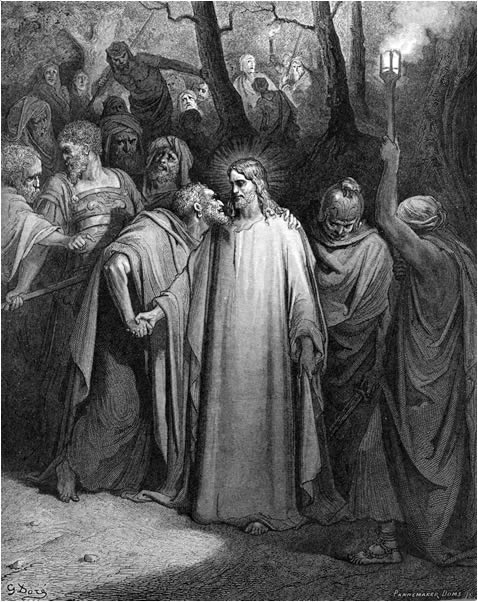
In these verses, Mark tells us how our Lord was delivered into the hands of His enemies. It came to pass through the treachery of one of His own twelve disciples. The false apostle, Judas Iscariot, betrayed Him. We ought to mark, firstly, in this passage, to what lengths a man may go in a false profession of religion . It is impossible to conceive a more striking proof of this painful truth, than the history of Judas Iscariot.
This site's exposition
On the first day of the Feast of Unleavened Bread
on Mark 14:12-13
Jesus sends two disciples with a sign in place of an address: a man carrying a jug of water, which was ordinarily women’s work. The place stays unnamed before the meal, while Judas watches for his moment (verse 11).
The record, by era
The Church Fathers4 voices
And the suffering of this "extermination" was perfected within the times of the lxx hebdomads, under Tiberius Caesar, in the consulate of Rubellius Geminus and Fufius Geminus, in the month of March, at the times of the passover, on the eighth day before the calends of April, on the first day of unleavened bread, on which they slew the lamb at even, just as had been enjoined by Moses. Accordingly, all the synagogue of Israel did slay Him, saying to Pilate, when he was desirous to dismiss Him, "His blood be upon us, and upon our children; " and, "If thou dismiss him, thou art not a friend of Caesar; " in order that all things might be fulfilled which had been written of Him.
For that you would do thus at the beginning of the first month of your new (years) even Moses prophesied, when he was foretelling that all the community of the sons of lsrµl was to immolate at eventide a lamb, and were to eat this solemn sacrifice of this day (that is, of the passover of unleavened bread) with bitterness; "and added that "it was the passover of the Lord," that is, the passion of Christ. Which prediction was thus also fulfilled, that "on the first day of unleavened bread" you slew Christ; and (that the prophecies might be fulfilled) the day hasted to make an "eventide,"-that is, to cause darkness, which was made at mid-day; and thus "your festive days God converted into grief, and your canticles into lamentation.
(ubi sup.) Whilst Judas was plotting how to betray Him, the rest of the disciples were taking care of the preparation of the Passover: wherefore it is said, And the first day of unleavened bread, when they killed the Passover, his disciples said unto him, Where wilt thou that we go and prepare where thou mayest eat the Passover. (ubi sup.) Not our Passover, but in the meanwhile that of the Jews; but He did not only appoint ours, but Himself became our Passover. Why too did He eat it? Because He was made under the Law, to redeem them that were under the Law, (Gal. 4:4) and Himself give rest to the Law. And lest any one should say that He did away with it, because He could not fulfil its hard and difficult obedience, He first Himself fulfilled it, and then set it to rest.
The Passover affords a more than usually solemn day for baptism; when, withal, the Lord's passion, in which we are baptized, was completed. Nor will it be incongruous to interpret figuratively the fact that, when the Lord was about to celebrate the last Passover, He said to the disciples who were sent to make preparation, "You will meet a man bearing water." He points out the place for celebrating the Passover by the sign of water.
The Medieval Church1 voice
The evangelist calls the first day of unleavened bread the Thursday which immediately preceded the feast of unleavened bread, for the Jews began to eat unleavened bread on Friday. The disciples approach and ask where they should eat the Passover. From this it is evident …
8 more voices on this verse
The Medieval Church4 voices
From the words of the disciples, Where wilt thou that we go? it seems evident that Christ had no dwelling-place, and that the disciples had no houses of their own; for if so, they would have taken Him thither.
On the first day of unleavened bread, when they sacrificed the Passover, the disciples said to Him: Where do You want us to go and prepare for You to eat the Passover? He calls the first day of unleavened bread the fourteenth day of the …
(ubi sup.) He means by the first day of the Passover the fourteenth day of the first month, when they threw aside leaven, and were wont to sacrifice, that is, to kill the lamb at even. The Apostle explaining this says, Christ our Passover is sacrificed for us. (1 Cor. 5:7) For although He was crucified on the next day, that is, on the fifteenth moon, yet on the night when the lamb was offered up, He committed to His disciples the mysteries of His Body and Blood, which they were to celebrate, and was seized upon and bound by the Jews; thus He consecrated the beginning of His sacrifice, that is, of His Passion.
But the unleavened bread which was eaten with bitterness, that is with bitter herbs, is our redemption, and the bitterness is the Passion of our Lord. For they say, Where wilt thou that we go? to show us that we should direct our steps according to the will of God.
The Puritans and the Awakening2 voices
Go into the city, and there shall meet you a man - It was highly seasonable for our Lord to give them this additional proof both of his knowing all things, and of his influence over the minds of men.
And the first day of unleavened bread,....
The Nineteenth Century2 voices
A commentator
J.C. Ryle1816–1900
Expository Thoughts on the Gospels: Mark (lightly modernized text, Grace Gems edition) (1857)
proposed
In these verses, Mark tells us how our Lord was delivered into the hands of His enemies. It came to pass through the treachery of one of His own twelve disciples. The false apostle, Judas Iscariot, betrayed Him. We ought to mark, firstly, in this passage, to what lengths a man may go in a false profession of religion . It is impossible to conceive a more striking proof of this painful truth, than the history of Judas Iscariot. If ever there was a man who at one time looked like a true disciple of Christ, and bade fair to reach heaven, that man was Judas. He was chosen by the Lord Jesus Himself to be an apostle. He was privileged to be a companion of the Messiah, and an eye-witness of His mighty works, throughout His earthly ministry. He was an associate of Peter, James and John. He was sent forth to preach the kingdom of God, and to work miracles in Christ's name. He was regarded by all the eleven apostles as one of themselves. He was so like his fellow disciples, that they did not suspect him of being a traitor. And yet this very man turns out at last a false-hearted child of the devil — departs entirely from the faith — assists our Lord's deadliest enemies, and leaves the world with a worse reputation than any one since the days of Cain. Never was there such a fall, such an apostasy, such a miserable end to a fair beginning — such a total eclipse of a soul! And how can this amazing conduct of Judas be accounted for? There is only one answer to that question. "The love of money" was the cause of this unhappy man's ruin. That same groveling covetousness, which enslaved the heart of Balaam, and brought on Gehazi a leprosy, was the destruction of Iscariot's soul. No other explanation of his behavior will satisfy the plain statements of Scripture. His act was an act of base covetousness, without a redeeming feature about it.
A commentator
Albert Barnes1798–1870
Notes, Explanatory and Practical, on the Old and New Testaments (1832-1869)
proposed
See the notes at Mat 26:17-19. Mar 14:12 They killed the passover - The “paschal lamb,” which was slain in keeping the Passover. Go and prepare - Go and provide a lamb, have it roasted, and properly prepared with the usual things to eat with it. Mar 14:13 The city - The city of Jerusalem. They were now in Bethany, about 2 miles from the city. A man bearing a pitcher of water - This could have been known only by the infinite knowledge of Christ.
How the passage was read
On Mark 14:12-26On Mark 14:12-26
The meal on the table
Mark dates the meal precisely: “when they sacrificed the Passover lamb.” Passover (Pesach) was then a Temple feast: the lamb slain in the courts that afternoon, eaten that night with unleavened bread (matzah) and wine, in a room inside Jerusalem, in company: exactly the arrangements the disciples are sent to make. The hymn sung on the way out (14:26) would by long custom have been from the Hallel, Psalms 113–118, the Passover psalms: which means “the stone the builders rejected” (Psalm 118:22) was likely on His lips that night.
This section is reception history: how the passage was read and kept in the Jewish tradition. Where a reading parts from an essential of the Christian faith, the section says so at that point.
Sources: Mishnah Pesachim 10 (the meal's order) · Psalm 118:22 (the Hallel's rejected stone)
The words behind it
23 Greek wordsEvery Greek word of this verse in the order it stands, with what it means and the door to its own study. The last column counts the times a word stands in the whole Bible: the rarer the word, the more the places it appears belong together.
| Greek | Sound | Meaning | Word study | In the Bible |
|---|---|---|---|---|
| Καὶ | kai | And | G2532 → | 9120 times |
| τῇ | tea | on the | G3588 → | 19766 times |
| πρώτῃ | prote | first | G4413 → | 152 times |
| ἡμέρᾳ | hemera | day | G2250 → | 389 times |
| τῶν | ton | <the> | G3588 → | 19766 times |
| ἀζύμων, | azumon | of unleavened [bread], | G106 → | |
| ὅτε | hote | when | G3753 → | 103 times |
| τὸ | to | the | G3588 → | 19766 times |
| πάσχα | pascha | Passover lamb | G3957 → | 29 times |
| ἔθυον, | ethuon | they were to sacrifice, | G2380 → | |
| λέγουσιν | legousin | say | G3004 → | 1325 times |
| αὐτῷ | auto | to Him | G846 → | 5565 times |
| οἱ | hoi | the | G3588 → | 19766 times |
| μαθηταὶ | mathetai | disciples | G3101 → | 260 times |
| αὐτοῦ· | autou | of Him; | G846 → | 5565 times |
| ποῦ | pou | Where | G4226 → | 47 times |
| θέλεις | theleis | do You desire [that] | G2309 → | 208 times |
| ἀπελθόντες | apelthontes | having gone | G565 → | 115 times |
| ἑτοιμάσωμεν | hetoimasomen | we may prepare | G2090 → | 40 times |
| ἵνα | ina | that | G2443 → | 668 times |
| φάγῃς | phages | You may eat | G5315 → | 93 times |
| τὸ | to | the | G3588 → | 19766 times |
| πάσχα; | pascha | Passover? | G3957 → | 29 times |
ΚαὶAnd
kaiG2532 →9120 times
τῇon the
teaG3588 →19766 times
πρώτῃfirst
proteG4413 →152 times
ἡμέρᾳday
hemeraG2250 →389 times
τῶν<the>
tonG3588 →19766 times
ἀζύμων,of unleavened [bread],
azumonG106 →
ὅτεwhen
hoteG3753 →103 times
τὸthe
toG3588 →19766 times
πάσχαPassover lamb
paschaG3957 →29 times
ἔθυον,they were to sacrifice,
ethuonG2380 →
λέγουσινsay
legousinG3004 →1325 times
αὐτῷto Him
autoG846 →5565 times
οἱthe
hoiG3588 →19766 times
μαθηταὶdisciples
mathetaiG3101 →260 times
αὐτοῦ·of Him;
autouG846 →5565 times
ποῦWhere
pouG4226 →47 times
θέλειςdo You desire [that]
theleisG2309 →208 times
ἀπελθόντεςhaving gone
apelthontesG565 →115 times
ἑτοιμάσωμενwe may prepare
hetoimasomenG2090 →40 times
ἵναthat
inaG2443 →668 times
φάγῃςYou may eat
phagesG5315 →93 times
τὸthe
toG3588 →19766 times
πάσχα;Passover?
paschaG3957 →29 times
A shaded row is a word that stands 400 times or fewer in the Bible.
The walk
8 stopsEach card is a verse this one points to, and under it the verses that one points to in turn. Where several paths arrive at the same place, that place is listed first: the text keeps returning to it.
Through
Exodus 12:6You must keep it until the fourteenth day of the month, when the whole assembly of the congregation of Israel will slaughter the animals at twilight.
it leads to
- Leviticus 23:5
The Passover to the LORD begins at twilight on the fourteenth day of the first month.
- Numbers 28:16
The fourteenth day of the first month is the LORD’s Passover.
- 2 Chronicles 30:15–18
And on the fourteenth day of the second month they slaughtered the Passover lamb. The priests and Levites were ashamed, and they consecrated themselves and brought burnt offerings to the house of the LORD.
- Numbers 9:1–3
In the first month of the second year after Israel had come out of the land of Egypt, the LORD spoke to Moses in the Wilderness of Sinai:
- Numbers 9:11
Such people are to observe it at twilight on the fourteenth day of the second month. They are to eat the lamb, together with unleavened bread and bitter herbs;
- Leviticus 23:5
Through
Exodus 12:18In the first month you are to eat unleavened bread, from the evening of the fourteenth day until the evening of the twenty-first day.
it leads to
- Exodus 12:15
For seven days you must eat unleavened bread. On the first day you are to remove the leaven from your houses. Whoever eats anything leavened from the first day through the seventh must be…
- Leviticus 23:5–8
The Passover to the LORD begins at twilight on the fourteenth day of the first month.
- Exodus 12:1–2
Now the LORD said to Moses and Aaron in the land of Egypt,
- Exodus 12:15
Where this verse is studied
On this page
Studies22
On this verse
On this chapter
- The Son of Man in 1 Enoch
- Abba, Father
- The Major Prophets
- Daniel the Prophet
- Gethsemane (The Garden Called the Oil Press)
- Jesus on Himself
Show the next 6 titles
About Mark
This page draws on 14 works. Open the list of works
This page draws on Adam Clarke, Commentary on the Bible; Albert Barnes, Notes, Explanatory and Practical, on the Old and New Testaments (1832-1869); Bede, On the Gospel of Mark; Bede, Catena Aurea by Aquinas; J.C. Ryle, Expository Thoughts on the Gospels: Mark (lightly modernized text, Grace Gems edition); Jamieson, Fausset & Brown, Commentary Critical and Explanatory on the Whole Bible; John Chrysostom, Catena Aurea by Aquinas; John Gill, Exposition of the New Testament (1746-1748); John Wesley, Explanatory Notes upon the New Testament; Pseudo-Jerome, Catena Aurea by Aquinas; Tertullian, An Answer to the Jews; Tertullian, On Baptism, Chapter 19; Theophylact of Ohrid, Commentary on Mark and Theophylact of Ohrid, Catena Aurea by Aquinas.