
Mark 14:34
in Mark 14Then He said to them, “My soul is consumed with sorrow to the point of death. Stay here and keep watch.”
BSB
The same verse in ASV and KJV ▾
ASV
And he saith unto them, My soul is exceeding sorrowful even unto death: abide ye here, and watch.
KJV
And saith unto them, My soul is exceeding sorrowful unto death: tarry ye here, and watch.
⋯
This verse in Mark 14
Commentary
13 notes on this verseHe was troubled, as we are told, in the hour of death, as he himself confesses when he says, "My soul is sorrowful even unto death." He was finally led to that death which is considered the most shameful of all. On the third day he rose again.
This site's exposition
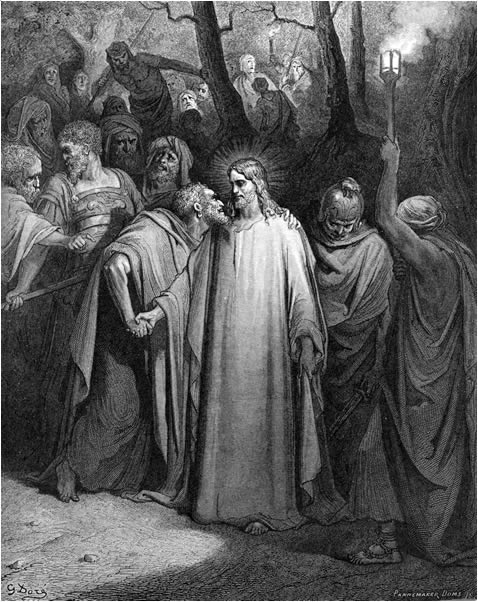
a place called Gethsemane
on Mark 14:32-34
Gethsemane means oil press, and there He took with Him Peter, James, and John, the three who saw the transfiguration in Mark 9:2. To them He says, My soul is consumed with sorrow to the point of death.
This site's exposition
consumed with sorrow to the point
Gill hears in this sorrow a grief so heavy that he was ready to die of it. Hilary reads to the point of death as naming where the sorrow ends.
The record, by era
The Church Fathers1 voice
But even now that we have proved what was the faith of the Apostle, the heretics think to meet it by the text, My soul is sorrowful even unto death. These words, they say, prove the consciousness of natural infirmity which made Christ begin to be sorrowful. Now, first, I appeal to common intelligence: what do we mean by sorrowful unto death? It cannot signify the same as `to be sorrowful because of death:' for where there is sorrow because of death, it is the death that is the cause of the sadness. But a sadness even to death implies that death is the finish, not the cause, of the sadness. If then He was sorrowful even to death, not because of death, we must enquire, whence came His sadness? He was sorrowful, not for a certain time, or for a period which human ignorance could not determine, but even unto death. So far from His sadness being caused by His death, it was removed by it.
The Medieval Church4 voices
And he saith unto them, My soul is exceeding sorrowful unto death. But some have understood this, as if He had said, I am sorrowful, not because I am to die, but because the Jews, my countrymen, are about to crucify me, and by these means to be shut out from the kingdom of God.
A commentator
BonaventureCollationes de Decem Praeceptis, Collation 7 · Written in the 13th century.
proposed
But who will deliver us from these plagues? Certainly there is one alone who came to deliver us, namely Christ, who made ten condescensions against the ten plagues. The first was down to our flesh. The second was down to our mortality. The third, to …
Endure here, and keep watch. And when he had gone on a little further, he fell to the ground. What he commands, endure here, and keep watch, does not forbid sleep, whose time had not come with impending danger, but the sleep of infidelity and …
He does not mean natural sleep by the sleep which He forbids, for the time of approaching danger did not allow of it, but the sleep of unfaithfulness, and the torpor of the mind.
5 more voices on this verse
The Medieval Church2 voices
The expression "My soul is sorrowful unto death" — some understand it thus: I grieve not because I must die, but because the Israelites — My own kinsmen — are crucifying Me, and for this they will be cast out from the Kingdom of God.
By this also we are taught to fear and to be sorrowful before the judgment of death, for not by ourselves, but by Him only, can we say, The prince of this world cometh, and hath nothing in Me. (John 14:30) There follows: Tarry ye here, and watch.
The Puritans and the Awakening1 voice
And saith unto them,.... The above three disciples; my soul is exceeding sorrowful unto death: he was surrounded with sorrow, and it pressed him so hard, and close, on every side, that he was just ready to die with it: tarry ye here, and watch: in Matthew it is added, "with me": See Gill on Mat 26:38.
The Nineteenth Century2 voices
A commentator
J.C. Ryle1816–1900
Expository Thoughts on the Gospels: Mark (lightly modernized text, Grace Gems edition) (1857)
The history of our Lord's agony in the garden of Gethsemane is a deep and mysterious passage of Scripture. It contains things which the wisest divines cannot fully explain. Yet it has upon its surface plain truths of most momentous importance. Let us mark, in the first place, how keenly our Lord felt the burden of a world's sin . It is written that He began to be filled with horror and deep distress.
A commentator
J.C. Ryle1816–1900
Expository Thoughts on the Gospels: Mark (lightly modernized text, Grace Gems edition) (1857)
proposed
The history of our Lord's agony in the garden of Gethsemane is a deep and mysterious passage of Scripture. It contains things which the wisest divines cannot fully explain. Yet it has upon its surface plain truths of most momentous importance. Let us mark, in the first place, how keenly our Lord felt the burden of a world's sin . It is written that He began to be filled with horror and deep distress. He told them, "My soul is crushed with grief to the point of death," and that "he fell on the ground, and prayed, that, if it were possible, the hour might pass from him." There is only one reasonable explanation of these expressions. It was no mere fear of the physical suffering of death, which drew them from our Lord's lips. It was a sense of the enormous load of human guilt, which began at that time to press upon Him in a peculiar way. It was a sense of the unutterable weight of our sins and transgressions which were then specially laid upon Him. He was being "made a curse for us." He was bearing our griefs and carrying our sorrows according to the covenant He came on earth to fulfill. He was being "made sin for us who Himself knew no sin." His holy nature felt acutely the hideous burden laid upon Him. These were the reasons of His extraordinary sorrow. We ought to see in our Lord's agony in Gethsemane the exceeding sinfulness of sin. It is a subject on which the thoughts of professing Christians are far below what they should be. The careless, light way in which such sins as swearing, Sabbath-breaking, lying, and the like, are often spoken of, is a painful evidence of the low condition of men's moral feelings. Let the recollection of Gethsemane have a sanctifying effect upon us. Whatever others do, let us never "make a mock at sin." Let us mark, in the second place, what an example our Lord gives us of the importance of prayer in time of trouble .
The words behind it
14 Greek wordsEvery Greek word of this verse in the order it stands, with what it means and the door to its own study. The last column counts the times a word stands in the whole Bible: the rarer the word, the more the places it appears belong together.
| Greek | Sound | Meaning | Word study | In the Bible |
|---|---|---|---|---|
| καὶ | kai | And | G2532 → | 9120 times |
| λέγει | legei | He says | G3004 → | 1325 times |
| αὐτοῖς· | autois | to them; | G846 → | 5565 times |
| περίλυπός | perilupos | Very sorrowful | G4036 → | |
| ἐστιν | estin | is | G1510 → | 2333 times |
| ἡ | he | the | G3588 → | 19766 times |
| ψυχή | psuche | soul | G5590 → | 103 times |
| μου | mou | of Mine | G3165 → | 1936 times |
| ἕως | he'os | until | G2193 → | 146 times |
| θανάτου. | thanatou | death. | G2288 → | 120 times |
| μείνατε | meinate | do remain | G3306 → | |
| ὧδε | hode | here | G5602 → | 61 times |
| καὶ | kai | and | G2532 → | 9120 times |
| γρηγορεῖτε. | gregoreite | do watch. | G1127 → | 22 times |
καὶAnd
kaiG2532 →9120 times
λέγειHe says
legeiG3004 →1325 times
αὐτοῖς·to them;
autoisG846 →5565 times
περίλυπόςVery sorrowful
periluposG4036 →
ἐστινis
estinG1510 →2333 times
ἡthe
heG3588 →19766 times
ψυχήsoul
psucheG5590 →103 times
μουof Mine
mouG3165 →1936 times
ἕωςuntil
he'osG2193 →146 times
θανάτου.death.
thanatouG2288 →120 times
μείνατεdo remain
meinateG3306 →
ὧδεhere
hodeG5602 →61 times
καὶand
kaiG2532 →9120 times
γρηγορεῖτε.do watch.
gregoreiteG1127 →22 times
A shaded row is a word that stands 400 times or fewer in the Bible.
The walk
8 stopsEach card is a verse this one points to, and under it the verses that one points to in turn. Where several paths arrive at the same place, that place is listed first: the text keeps returning to it.
Through
1 Peter 5:8Be sober-minded and alert. Your adversary the devil prowls around like a roaring lion, seeking someone to devour.
it leads to
- Ephesians 6:11
Put on the full armor of God, so that you can make your stand against the devil’s schemes.
- James 4:7
Submit yourselves, then, to God. Resist the devil, and he will flee from you.
- Ephesians 4:27
and do not give the devil a foothold.
- Job 2:2
“Where have you come from?” said the LORD to Satan. “From roaming through the earth,” he replied, “and walking back and forth in it.”
- 1 Peter 1:13
Therefore prepare your minds for action. Be sober-minded. Set your hope fully on the grace to be given you at the revelation of Jesus Christ.
- Ephesians 6:11
Through
John 12:27Now My soul is troubled, and what shall I say? ‘Father, save Me from this hour’? No, it is for this purpose that I have come to this hour.
it leads to
- John 12:23
But Jesus replied, “The hour has come for the Son of Man to be glorified.
- Isaiah 38:15
What can I say? He has spoken to me, and He Himself has done this. I will walk slowly all my years because of the anguish of my soul.
- Hebrews 5:7
During the days of Jesus’ earthly life, He offered up prayers and petitions with loud cries and tears to the One who could save Him from death, and He was heard because of His…
- John 12:23
Where this verse is studied
On this page
Studies23
- The Son of Man in 1 Enoch
- Abba, Father
- The Major Prophets
- Daniel the Prophet
- Gethsemane (The Garden Called the Oil Press)
- Jesus on Himself
Show the next 6 titles
About Mark
This page draws on 12 works. Open the list of works
This page draws on Albert Barnes, Notes, Explanatory and Practical, on the Gospels; Bede, Catena Aurea by Aquinas; Bede, On the Gospel of Mark; Bonaventure, Collationes de Decem Praeceptis, Collation 7; Hilary of Poitiers, ON THE TRINITY 10.36; J.C. Ryle, Expository Thoughts on the Gospels: Mark (lightly modernized text, Grace Gems edition); John Gill, Exposition of the New Testament (1746-1748); Matthew Henry, Commentary on the Whole Bible; Origen of Alexandria, ON FIRST PRINCIPLES 2.6.2; Pseudo-Jerome, Catena Aurea by Aquinas; Theophylact of Ohrid, Catena Aurea by Aquinas and Theophylact of Ohrid, Commentary on Mark.