
Mark 14:15
in Mark 14And he will show you a large upper room, furnished and ready. Make preparations for us there.”
BSB
The same verse in ASV and KJV ▾
ASV
And he will himself show you a large upper room furnished and ready: and there make ready for us.
KJV
And he will shew you a large upper room furnished and prepared: there make ready for us.
⋯
This verse in Mark 14
Commentary
11 notes on this verseAnd he will show you a large upper room,.... A room in the highest part of the house, large enough for such a company, for thirteen persons, which was the number of Christ and his disciples: furnished and prepared; with a table, and a sufficient number of couches to sit, or lie upon, and with all proper vessels necessary on such an occasion: there make ready for us; the passover.
This site's exposition
say to the owner
on Mark 14:14-16
The owner shows them a large upper room, furnished and ready, so an unnamed householder in Jerusalem already stood with Jesus. The disciples found everything as Jesus had described.
This site's exposition
a large upper room
Gill pictures a room on the top floor, large enough for thirteen, set with a table and couches. Clarke takes furnished to mean spread with carpets, or fitted with the couches on which guests reclined. By this time, Clarke adds, the meal was eaten reclining.
The record, by era
The Medieval Church5 voices
That is, him who leads to the lofty place, where is the refreshment prepared by Christ. (John 21:15) The lord of the house is the Apostle Peter, to whom the Lord has entrusted His house, that there may be one faith under one Shepherd. The large upper-room is the wide-spread Church, in which the name of the Lord is spoken of, prepared by a variety of powers and tongues.
(ubi sup.) Or else, the large upper-room is spiritually the Law, which comes forth from the narrowness of the letter, and in a lofty place, that is, in the lofty chamber of the soul, receives the Saviour. But it is designedly that the names both of the bearer of the water, and of the lord of the house, are omitted, to imply that power is given to all who wish to celebrate the true Passover, that is, to be embued with the sacraments of Christ, and to receive Him in the dwelling-place of their mind.
But this upper room is "furnished," that is, although it is lofty, it contains nothing harsh or proud; on the contrary, it is furnished and smoothed with humility. It is here, in such a mind, I say, that the Passover is prepared for Christ by …
And he will show you a large upper room furnished and prepared there for us, etc. The large upper room is the spiritual law, which leaving the narrowness of the letter, receives the Savior in a high place. For he who still observes the killing …
Or else, the lord of the house is the intellect, which points out the large upper room, that is, the loftiness of intelligences, and which, though it be high, yet has nothing of vain glory, or of pride, but is prepared and made level by humility. But there, that is, in such a mind Christ's Passover is prepared by Peter and John, that is by action and contemplation.
3 more voices on this verse
The Nineteenth Century3 voices
Furnished - Spread with carpets - εστρωμενον - so this word is often used. See Wakefield. But it may also signify the couches on which the guests reclined when eating. It does not appear that the Jews ate the passover now, as their fathers did formerly, standing, with their shoes on, and their staves in their hands.
A commentator
J.C. Ryle1816–1900
Expository Thoughts on the Gospels: Mark (lightly modernized text, Grace Gems edition) (1857)
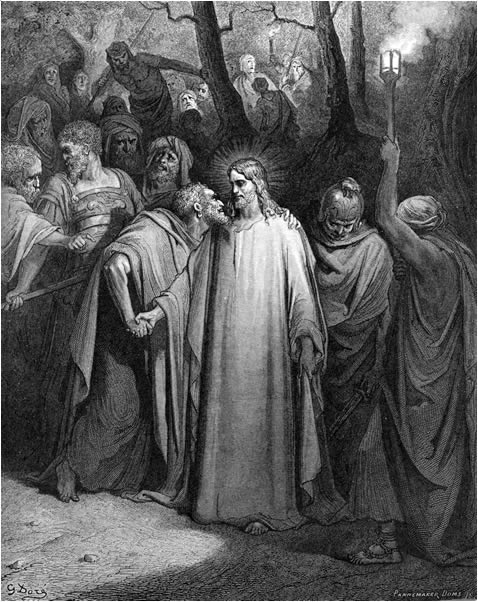
In these verses, Mark tells us how our Lord was delivered into the hands of His enemies. It came to pass through the treachery of one of His own twelve disciples. The false apostle, Judas Iscariot, betrayed Him. We ought to mark, firstly, in this passage, to what lengths a man may go in a false profession of religion . It is impossible to conceive a more striking proof of this painful truth, than the history of Judas Iscariot.
A commentator
J.C. Ryle1816–1900
Expository Thoughts on the Gospels: Mark (lightly modernized text, Grace Gems edition) (1857)
proposed
In these verses, Mark tells us how our Lord was delivered into the hands of His enemies. It came to pass through the treachery of one of His own twelve disciples. The false apostle, Judas Iscariot, betrayed Him. We ought to mark, firstly, in this passage, to what lengths a man may go in a false profession of religion . It is impossible to conceive a more striking proof of this painful truth, than the history of Judas Iscariot. If ever there was a man who at one time looked like a true disciple of Christ, and bade fair to reach heaven, that man was Judas. He was chosen by the Lord Jesus Himself to be an apostle. He was privileged to be a companion of the Messiah, and an eye-witness of His mighty works, throughout His earthly ministry. He was an associate of Peter, James and John. He was sent forth to preach the kingdom of God, and to work miracles in Christ's name. He was regarded by all the eleven apostles as one of themselves. He was so like his fellow disciples, that they did not suspect him of being a traitor. And yet this very man turns out at last a false-hearted child of the devil — departs entirely from the faith — assists our Lord's deadliest enemies, and leaves the world with a worse reputation than any one since the days of Cain. Never was there such a fall, such an apostasy, such a miserable end to a fair beginning — such a total eclipse of a soul! And how can this amazing conduct of Judas be accounted for? There is only one answer to that question. "The love of money" was the cause of this unhappy man's ruin. That same groveling covetousness, which enslaved the heart of Balaam, and brought on Gehazi a leprosy, was the destruction of Iscariot's soul. No other explanation of his behavior will satisfy the plain statements of Scripture. His act was an act of base covetousness, without a redeeming feature about it.
How the passage was read
On Mark 14:12-26On Mark 14:12-26
The meal on the table
Mark dates the meal precisely: “when they sacrificed the Passover lamb.” Passover (Pesach) was then a Temple feast: the lamb slain in the courts that afternoon, eaten that night with unleavened bread (matzah) and wine, in a room inside Jerusalem, in company: exactly the arrangements the disciples are sent to make. The hymn sung on the way out (14:26) would by long custom have been from the Hallel, Psalms 113–118, the Passover psalms: which means “the stone the builders rejected” (Psalm 118:22) was likely on His lips that night.
This section is reception history: how the passage was read and kept in the Jewish tradition. Where a reading parts from an essential of the Christian faith, the section says so at that point.
Sources: Mishnah Pesachim 10 (the meal's order) · Psalm 118:22 (the Hallel's rejected stone)
The words behind it
12 Greek wordsEvery Greek word of this verse in the order it stands, with what it means and the door to its own study. The last column counts the times a word stands in the whole Bible: the rarer the word, the more the places it appears belong together.
| Greek | Sound | Meaning | Word study | In the Bible |
|---|---|---|---|---|
| καὶ | kai | And | G2532 → | 9120 times |
| αὐτὸς | autos | he himself | G846 → | 5565 times |
| ὑμῖν | humin | you | G4771 → | 2973 times |
| δείξει | deixei | will show | G1166 → | |
| ἀνάγαιον | anagaion | an upper room | G508 → | |
| μέγα | mega | large | G3173 → | 243 times |
| ἐστρωμένον | estromenon | furnished | G4766 → | |
| ἕτοιμον· | hetoimon | [and] ready; | G2092 → | |
| καὶ | kai | And | G2532 → | 9120 times |
| ἐκεῖ | ekei | there | G1563 → | 105 times |
| ἑτοιμάσατε | hetoimasate | do prepare | G2090 → | 40 times |
| ἡμῖν. | hemin | for us. | G3165 → | 1936 times |
καὶAnd
kaiG2532 →9120 times
αὐτὸςhe himself
autosG846 →5565 times
ὑμῖνyou
huminG4771 →2973 times
δείξειwill show
deixeiG1166 →
ἀνάγαιονan upper room
anagaionG508 →
μέγαlarge
megaG3173 →243 times
ἐστρωμένονfurnished
estromenonG4766 →
ἕτοιμον·[and] ready;
hetoimonG2092 →
καὶAnd
kaiG2532 →9120 times
ἐκεῖthere
ekeiG1563 →105 times
ἑτοιμάσατεdo prepare
hetoimasateG2090 →40 times
ἡμῖν.for us.
heminG3165 →1936 times
A shaded row is a word that stands 400 times or fewer in the Bible.
The walk
8 stopsEach card is a verse this one points to, and under it the verses that one points to in turn. Where several paths arrive at the same place, that place is listed first: the text keeps returning to it.
Through
Proverbs 16:1The plans of the heart belong to man, but the reply of the tongue is from the LORD.
it leads to
- Proverbs 19:21
Many plans are in a man’s heart, but the purpose of the LORD will prevail.
- Proverbs 16:9
A man’s heart plans his course, but the LORD determines his steps.
- Luke 21:14–15
So make up your mind not to worry beforehand how to defend yourselves.
- Philippians 2:13
For it is God who works in you to will and to act on behalf of His good purpose.
- Proverbs 20:24
A man’s steps are from the LORD, so how can anyone understand his own way?
- Proverbs 19:21
Through
Acts 1:13When they arrived, they went to the upper room where they were staying: Peter and John, James and Andrew, Philip and Thomas, Bartholomew and Matthew, James son of Alphaeus, Simon the Zealot, and Judas…
it leads to
- Luke 22:12
And he will show you a large upper room, already furnished. Make preparations there.”
Reached by 2 separate paths from here.
- Acts 20:8
Now there were many lamps in the upper room where we were gathered.
- Luke 22:12
Through
Acts 20:8Now there were many lamps in the upper room where we were gathered.
it leads to
- Acts 1:13
When they arrived, they went to the upper room where they were staying: Peter and John, James and Andrew, Philip and Thomas, Bartholomew and Matthew, James son of Alphaeus, Simon the Zealot, and Judas…
- Acts 1:13
Where this verse is studied
On this page
Studies23
- The Son of Man in 1 Enoch
- Abba, Father
- The Major Prophets
- Daniel the Prophet
- Gethsemane (The Garden Called the Oil Press)
- Jesus on Himself
Show the next 6 titles
About Mark
This page draws on 10 works. Open the list of works
This page draws on Adam Clarke, Commentary on the Bible; Bede, Catena Aurea by Aquinas; Bede, On the Gospel of Mark; J. C. Ryle, Expository Thoughts on the Gospels, Mark; J.C. Ryle, Expository Thoughts on the Gospels: Mark (lightly modernized text, Grace Gems edition); John Gill, Exposition of the New Testament (1746-1748); John Gill, Exposition of the New Testament; Pseudo-Jerome, Catena Aurea by Aquinas; Theophylact of Ohrid, Commentary on Mark and Theophylact of Ohrid, Catena Aurea by Aquinas.