
Mark 14:10
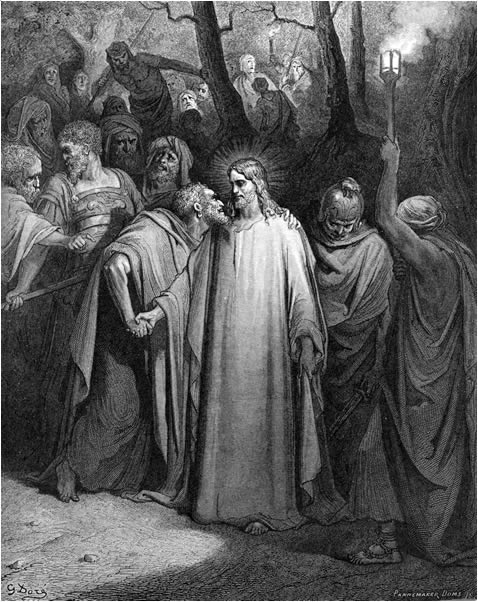
in Mark 14Then Judas Iscariot, one of the Twelve, went to the chief priests to betray Jesus to them.
BSB
The same verse in ASV and KJV ▾
ASV
And Judas Iscariot, he that was one of the twelve, went away unto the chief priests, that he might deliver him unto them.
KJV
And Judas Iscariot, one of the twelve, went unto the chief priests, to betray him unto them.
⋯
This verse in Mark 14
Commentary
12 notes on this verse(ὁ περὶ τὸν βασιλέα χορὸς ap. Chrys.) But he was one of the twelve in number, not in merit, one in body, not in soul. But he went to the Chief Priests after he went out and Satan entered into him. Every living thing unites with what is like itself. And he promises to betray Him, as his master the devil said before, All this power I will give thee. (Luke 4:6) It goes on, And when they heard it they were glad, and promised to give him money.
This site's exposition
went to the chief priests to betray Jesus to them
on Mark 14:10-11
Judas Iscariot, one of the Twelve, went to the chief priests to betray Jesus, so the betrayer came from inside the inner circle. Mark sets his sale directly after the woman’s costly gift.
The record, by era
The Church Fathers1 voice
(de Prod. Jud. Hom. 1) Why dost thou tell me of his country? would that I could also have been ignorant of his existence. But there was another disciple called Judas the zealot, the brother of James, and lest by calling him by this name there should arise a confusion between the two, he separates the one from the other. But he says not Judas the traitor, that he may teach us to be guiltless of detraction, and to avoid accusing others. In that however he says, one of the twelve, he enhanced the detestable guilt of the traitor; for there were seventy other disciples, these however were not so intimate with Him, nor admitted to such familiar intercourse. But these twelve were approved by Him, these were the regal band, out of which the wicked traitor came forth. (ubi sup.) Oh! the madness, yea, the avarice of the traitor, for his covetousness brought forth all the evil. For covetousness retains the souls which it has taken, and confines them in every way when it has bound them, and makes them forget all things, maddening their minds. Judas, taken captive by this madness of avarice, forgets the conversation, the table of Christ, his own discipleship, Christ's warnings and persuasion. For there follows, And he sought how he might conveniently betray him.
The Medieval Church4 voices
It is said, to betray him unto them, that is, to announce to them when He should be alone. But they feared to rush upon Him when He was teaching, for fear of the people.
And Judas Iscariot, one of the twelve, went to the chief priests to betray him to them. Unfortunate Judas! He believes he has suffered a loss from the pouring out of the ointment and wants to compensate it with the price of his master, not …
(ubi sup.) The unhappy Judas wishes to compensate with the price of his Master for the loss which he thought he had made by the pouring out of the ointment; wherefore it is said, And Judas Iscariot, one of the twelve, went unto the Chief Priests to betray him unto them. But by the words, he went out, it is shown that he was not invited by the Chief Priests, nor bound by any necessity, but entered upon this design from the spontaneous wickedness of his own mind. (ubi sup.) Many in this day shudder at the crime of Judas in selling his Master, his Lord and his God, for money, as monstrous and horrible wickedness; they however do not take heed, for when for the sake of gain they trample on the rights of charity and truth, they are traitors to God, who is Charity and Truth.
When the woman showed fitting honor to Christ, then a disciple wages war against Him, and moreover one of the twelve. For it is not without reason that it says "one of the twelve," but to show that he too was among the most chosen …
5 more voices on this verse
The Puritans and the Awakening2 voices
Covetousness was Judas's master-lust, his own iniquity, and that betrayed him to the sin of betraying his Master; the devil suited his temptation to that, and so conquered him. It is not said, They promised him preferment (he was not ambitious of that), but, they promised him money. See what need we have to double our guard against the sin that most easily besets us.
And Judas Iscariot, one of the twelve,....
The Nineteenth Century3 voices
A commentator
J.C. Ryle1816–1900
Expository Thoughts on the Gospels: Mark (lightly modernized text, Grace Gems edition) (1857)
In these verses, Mark tells us how our Lord was delivered into the hands of His enemies. It came to pass through the treachery of one of His own twelve disciples. The false apostle, Judas Iscariot, betrayed Him. We ought to mark, firstly, in this passage, to what lengths a man may go in a false profession of religion . It is impossible to conceive a more striking proof of this painful truth, than the history of Judas Iscariot.
A commentator
Jamieson, Fausset & Brown1802–1910
Commentary Critical and Explanatory on the Whole Bible (1871)
proposed
And they covenanted with him for thirty pieces of silver." The thirty pieces of silver were thirty shekels, the fine paid for man- or maid-servant accidentally killed (Ex 21:32), and equal to between four and five pounds sterling--"a goodly price that I was prized at of them!" (Zec 11:13).
quarantine:debris (2026-07-29) — odd-straight-quotes
A commentator
J.C. Ryle1816–1900
Expository Thoughts on the Gospels: Mark (lightly modernized text, Grace Gems edition) (1857)
proposed
In these verses, Mark tells us how our Lord was delivered into the hands of His enemies. It came to pass through the treachery of one of His own twelve disciples. The false apostle, Judas Iscariot, betrayed Him. We ought to mark, firstly, in this passage, to what lengths a man may go in a false profession of religion . It is impossible to conceive a more striking proof of this painful truth, than the history of Judas Iscariot. If ever there was a man who at one time looked like a true disciple of Christ, and bade fair to reach heaven, that man was Judas. He was chosen by the Lord Jesus Himself to be an apostle. He was privileged to be a companion of the Messiah, and an eye-witness of His mighty works, throughout His earthly ministry. He was an associate of Peter, James and John. He was sent forth to preach the kingdom of God, and to work miracles in Christ's name. He was regarded by all the eleven apostles as one of themselves. He was so like his fellow disciples, that they did not suspect him of being a traitor. And yet this very man turns out at last a false-hearted child of the devil — departs entirely from the faith — assists our Lord's deadliest enemies, and leaves the world with a worse reputation than any one since the days of Cain. Never was there such a fall, such an apostasy, such a miserable end to a fair beginning — such a total eclipse of a soul! And how can this amazing conduct of Judas be accounted for? There is only one answer to that question. "The love of money" was the cause of this unhappy man's ruin. That same groveling covetousness, which enslaved the heart of Balaam, and brought on Gehazi a leprosy, was the destruction of Iscariot's soul. No other explanation of his behavior will satisfy the plain statements of Scripture. His act was an act of base covetousness, without a redeeming feature about it.
The words behind it
15 Greek wordsEvery Greek word of this verse in the order it stands, with what it means and the door to its own study. The last column counts the times a word stands in the whole Bible: the rarer the word, the more the places it appears belong together.
| Greek | Sound | Meaning | Word study | In the Bible |
|---|---|---|---|---|
| Καὶ | kai | And | G2532 → | 9120 times |
| Ἰούδας | ioudas | Judas | G2455 → | 41 times |
| Ἰσκαριώθ, | iskarioth | Iscariot, | G2469 → | |
| ὁ | ho | <the> | G3588 → | 19766 times |
| εἷς | heis | one | G1520 → | 343 times |
| τῶν | ton | of the | G3588 → | 19766 times |
| δώδεκα, | dodeka | Twelve, | G1427 → | 75 times |
| ἀπῆλθεν | apelthen | went away | G565 → | 115 times |
| πρὸς | pros | to | G4314 → | 700 times |
| τοὺς | tous | the | G3588 → | 19766 times |
| ἀρχιερεῖς | archiereis | chief priests | G749 → | 122 times |
| ἵνα | ina | that | G2443 → | 668 times |
| αὐτὸν | auton | Him | G846 → | 5565 times |
| παραδοῖ | paradoi | he may betray | G3860 → | 119 times |
| αὐτοῖς. | autois | to them. | G846 → | 5565 times |
ΚαὶAnd
kaiG2532 →9120 times
ἸούδαςJudas
ioudasG2455 →41 times
Ἰσκαριώθ,Iscariot,
iskariothG2469 →
ὁ<the>
hoG3588 →19766 times
εἷςone
heisG1520 →343 times
τῶνof the
tonG3588 →19766 times
δώδεκα,Twelve,
dodekaG1427 →75 times
ἀπῆλθενwent away
apelthenG565 →115 times
πρὸςto
prosG4314 →700 times
τοὺςthe
tousG3588 →19766 times
ἀρχιερεῖςchief priests
archiereisG749 →122 times
ἵναthat
inaG2443 →668 times
αὐτὸνHim
autonG846 →5565 times
παραδοῖhe may betray
paradoiG3860 →119 times
αὐτοῖς.to them.
autoisG846 →5565 times
A shaded row is a word that stands 400 times or fewer in the Bible.
The walk
8 stopsEach card is a verse this one points to, and under it the verses that one points to in turn. Where several paths arrive at the same place, that place is listed first: the text keeps returning to it.
Through
Psalms 41:9Even my close friend whom I trusted, the one who shared my bread, has lifted up his heel against me.
it leads to
- John 13:18
I am not speaking about all of you; I know whom I have chosen. But this is to fulfill the Scripture: ‘The one who shares My bread has lifted up his heel against Me.’
- Psalms 55:12–14
For it is not an enemy who insults me; that I could endure. It is not a foe who rises against me; from him I could hide.
- Matthew 26:23
Jesus answered, “The one who has dipped his hand into the bowl with Me will betray Me.
- John 13:26–27
Jesus answered, “It is the one to whom I give this morsel after I have dipped it.” Then He dipped the morsel and gave it to Judas son of Simon Iscariot.
- Psalms 55:20–22
My companion attacks his friends; he violates his covenant.
- John 13:18
Through
John 13:2The evening meal was underway, and the devil had already put into the heart of Judas, the son of Simon Iscariot, to betray Jesus.
it leads to
- James 1:13–17
When tempted, no one should say, “God is tempting me.” For God cannot be tempted by evil, nor does He tempt anyone.
- Acts 5:3
Then Peter said, “Ananias, how is it that Satan has filled your heart to lie to the Holy Spirit and withhold some of the proceeds from the land?
- Luke 22:3
Then Satan entered Judas Iscariot, who was one of the Twelve.
- James 1:13–17
Where this verse is studied
On this page
Studies23
- The Son of Man in 1 Enoch
- Abba, Father
- The Major Prophets
- Daniel the Prophet
- Gethsemane (The Garden Called the Oil Press)
- Jesus on Himself
Show the next 6 titles
About Mark
This page draws on 12 works. Open the list of works
This page draws on Albert Barnes, Notes, Explanatory and Practical, on the Gospels; Bede, On the Gospel of Mark; Bede, Catena Aurea by Aquinas; J.C. Ryle, Expository Thoughts on the Gospels: Mark (lightly modernized text, Grace Gems edition); Jamieson, Fausset & Brown, Commentary Critical and Explanatory on the Whole Bible; John Chrysostom, Catena Aurea by Aquinas; John Gill, Exposition of the New Testament; John Gill, Exposition of the New Testament (1746-1748); Matthew Henry, Commentary on the Whole Bible; Pseudo-Jerome, Catena Aurea by Aquinas; Theophylact of Ohrid, Catena Aurea by Aquinas and Theophylact of Ohrid, Commentary on Mark.