
Mark 14:18
in Mark 14And while they were reclining and eating, Jesus said, “Truly I tell you, one of you who is eating with Me will betray Me.”
BSB
The same verse in ASV and KJV ▾
ASV
And as they sat and were eating, Jesus said, Verily I say unto you, One of you shall betray me, even he that eateth with me.
KJV
And as they sat and did eat, Jesus said, Verily I say unto you, One of you which eateth with me shall betray me.
⋯
This verse in Mark 14
Commentary
12 notes on this verseWhile he might have at once specially pointed out the betrayer, he did not do so, but said generally, "One of you will betray me," so the character of each might be tested by the witness of his astonished heart. This underscored the goodness of the disciples who believed Christ's words more than their own consciousness, and the wickedness of Judas because he did not believe the One who knew his plans. He embraced the obscurity by lying through his own teeth.
This site's exposition
Jesus arrived with the Twelve
on Mark 14:17-18
While they were reclining and eating, Jesus said that one of you who is eating with Me will betray Me. Eating together sealed a bond of loyalty, and the announcement at the meal echoes the friend of Psalm 41:9.
This site's exposition
one of you who is eating
Chrysostom explains why Jesus spoke without naming anyone. Naming Judas outright might have made him bolder, while saying nothing might have let him think his plan unknown. Cyprian dwells on the patience of a Lord who shared his table with his betrayer and gave no sign.
The record, by era
The Church Fathers2 voices
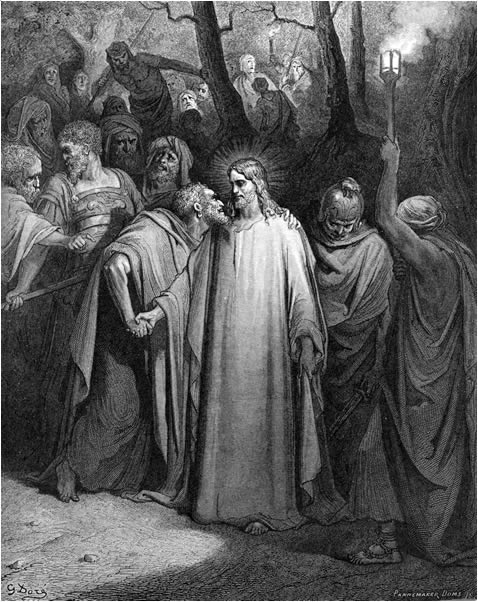
His wonderful patience is seen in the way he dealt with his disciples. He was even able to tolerate Judas to the end with enduring patience. He could eat calmly with his betrayer. He could patiently be aware of his enemy at his own table and not let on. He did not even refuse the kiss of the traitor.
(ubi sup.) Where it is evident that He did not proclaim him openly to all, lest He should make him the more shameless; at the same time He did not altogether keep it silent, lest thinking that he was not discovered, he should boldly hasten to betray Him.
The Medieval Church2 voices
But how could they eat reclining, when the law ordered that standing and upright they should eat the Passover? It is probable that they had first fulfilled the legal Passover, and had reclined, when He began to give them His own Passover.
How then were they reclining, when the Law commanded that the Passover be eaten standing? One must think that the Lord first performed the Passover according to the Law, and then reclined in order to impart His own Passover. The disciples began to grieve when …
The Puritans and the Awakening1 voice
And as they sat and did eat,.... Or "as they lay along"; for such was their posture at the eating of the passover; See Gill on Mat 26:20, Jesus said, verily I say unto you, one of you which eateth with me shall betray me; See Gill on Mat 26:21.
4 more voices on this verse
The Puritans and the Awakening2 voices
Christ's yoke is easy in comparison with that of the ceremonial law, and his ordinances are more spiritual. It was instituted by the example of Christ himself; not with the ceremony and solemnity of a law, as the ordinance of baptism was, after Christ's resurrection ( Matt. xxviii.
quarantine:debris (2026-07-29) — unbalanced-parens
); but by the practice of our Master himself, because intended for those who are already his disciples, and taken into covenant with him: but it has the obligation of the law, and was intended to remain in full force, power, and virtue, till his second coming. It was instituted with blessing and giving of thanks; the gifts of common providence are to be so received ( 1 Tim. iv.
quarantine:debris (2026-07-29) — leading-punctuation
The Nineteenth Century2 voices
A commentator
J.C. Ryle1816–1900
Expository Thoughts on the Gospels: Mark (lightly modernized text, Grace Gems edition) (1857)
These verses contain Mark's account of the institution of the Lord's Supper. The simplicity of the description deserves special observation. Well would it have been for the Church, if men had not departed from the simple statements of Scripture about this blessed sacrament! It is a mournful fact that it has been corrupted by false explanations and superstitious additions, until its real meaning, in many parts of Christendom, is utterly unknown. Let us however, at present, dismiss from our minds all matters of controversy, and study the words of Mark with a view to our own personal edification.
A commentator
J.C. Ryle1816–1900
Expository Thoughts on the Gospels: Mark (lightly modernized text, Grace Gems edition) (1857)
proposed
These verses contain Mark's account of the institution of the Lord's Supper. The simplicity of the description deserves special observation. Well would it have been for the Church, if men had not departed from the simple statements of Scripture about this blessed sacrament! It is a mournful fact that it has been corrupted by false explanations and superstitious additions, until its real meaning, in many parts of Christendom, is utterly unknown. Let us however, at present, dismiss from our minds all matters of controversy, and study the words of Mark with a view to our own personal edification. Let us learn from the passage before us, that self-examination should precede the reception of the Lord's Supper . We cannot doubt that this was one object of our Lord's solemn warning, "One of you who eats with me shall betray me." He meant to stir up in the minds of his disciples, those very searchings of heart which are here so touchingly recorded — "They began to be sorrowful, and to say unto Him one by one, Is it I?" He meant to teach His whole Church throughout the world, that the time of drawing near to the Lord's table should be a time for diligent self-inquiry. The benefit of the Lord's Supper depends entirely on the spirit and frame of mind in which we receive it. The bread which we there eat, and the wine which we there drink, have no power to do good to our souls, as medicine does good to our bodies, without the co-operation of our hearts and wills. They will not convey any blessing to us, by virtue of the minister's consecration, if we do not receive them rightly, worthily, and with faith. To assert, as some do, that the Lord's supper must do good to all communicants, whatever be the state of mind in which they receive it, is a monstrous and unscriptural figment of imagination, and has given rise to gross and wicked superstition.
How the passage was read
On Mark 14:12-26On Mark 14:12-26
The meal on the table
Mark dates the meal precisely: “when they sacrificed the Passover lamb.” Passover (Pesach) was then a Temple feast: the lamb slain in the courts that afternoon, eaten that night with unleavened bread (matzah) and wine, in a room inside Jerusalem, in company: exactly the arrangements the disciples are sent to make. The hymn sung on the way out (14:26) would by long custom have been from the Hallel, Psalms 113–118, the Passover psalms: which means “the stone the builders rejected” (Psalm 118:22) was likely on His lips that night.
This section is reception history: how the passage was read and kept in the Jewish tradition. Where a reading parts from an essential of the Christian faith, the section says so at that point.
Sources: Mishnah Pesachim 10 (the meal's order) · Psalm 118:22 (the Hallel's rejected stone)
The words behind it
21 Greek wordsEvery Greek word of this verse in the order it stands, with what it means and the door to its own study. The last column counts the times a word stands in the whole Bible: the rarer the word, the more the places it appears belong together.
| Greek | Sound | Meaning | Word study | In the Bible |
|---|---|---|---|---|
| καὶ | kai | And | G2532 → | 9120 times |
| ἀνακειμένων | anakeimenon | when were reclining | G345 → | |
| αὐτῶν | auton | they | G846 → | 5565 times |
| καὶ | kai | and | G2532 → | 9120 times |
| ἐσθιόντων | esthionton | were eating | G2068 → | 65 times |
| ὁ | ho | <the> | G3588 → | 19766 times |
| Ἰησοῦς | iesous | Jesus | G2424 → | 908 times |
| εἶπεν· | eipen | said: | G2036 → | 925 times |
| ἀμὴν | amen | Amen | G281 → | 127 times |
| λέγω | lego | I say | G3004 → | 1325 times |
| ὑμῖν | humin | to you | G4771 → | 2973 times |
| ὅτι | hoti | that | G3754 → | 1292 times |
| εἷς | heis | one | G1520 → | 343 times |
| ἐξ | ex | of | G1537 → | 911 times |
| ὑμῶν | humon | you | G4771 → | 2973 times |
| παραδώσει | paradosei | will betray | G3860 → | 119 times |
| με, | me | Me, | G3165 → | 1936 times |
| ὁ | ho | who | G3588 → | 19766 times |
| ἐσθίων | esthion | is eating | G2068 → | 65 times |
| μετ᾽ | met᾽ | with | G3326 → | 461 times |
| ἐμοῦ. | emou | Me. | G1473 → | 839 times |
καὶAnd
kaiG2532 →9120 times
ἀνακειμένωνwhen were reclining
anakeimenonG345 →
αὐτῶνthey
autonG846 →5565 times
καὶand
kaiG2532 →9120 times
ἐσθιόντωνwere eating
esthiontonG2068 →65 times
ὁ<the>
hoG3588 →19766 times
ἸησοῦςJesus
iesousG2424 →908 times
εἶπεν·said:
eipenG2036 →925 times
ἀμὴνAmen
amenG281 →127 times
λέγωI say
legoG3004 →1325 times
ὑμῖνto you
huminG4771 →2973 times
ὅτιthat
hotiG3754 →1292 times
εἷςone
heisG1520 →343 times
ἐξof
exG1537 →911 times
ὑμῶνyou
humonG4771 →2973 times
παραδώσειwill betray
paradoseiG3860 →119 times
με,Me,
meG3165 →1936 times
ὁwho
hoG3588 →19766 times
ἐσθίωνis eating
esthionG2068 →65 times
μετ᾽with
met᾽G3326 →461 times
ἐμοῦ.Me.
emouG1473 →839 times
A shaded row is a word that stands 400 times or fewer in the Bible.
The walk
8 stopsEach card is a verse this one points to, and under it the verses that one points to in turn. Where several paths arrive at the same place, that place is listed first: the text keeps returning to it.
Through
Psalms 41:9Even my close friend whom I trusted, the one who shared my bread, has lifted up his heel against me.
it leads to
- John 13:18
I am not speaking about all of you; I know whom I have chosen. But this is to fulfill the Scripture: ‘The one who shares My bread has lifted up his heel against Me.’
- Psalms 55:12–14
For it is not an enemy who insults me; that I could endure. It is not a foe who rises against me; from him I could hide.
- Matthew 26:23
Jesus answered, “The one who has dipped his hand into the bowl with Me will betray Me.
- John 13:26–27
Jesus answered, “It is the one to whom I give this morsel after I have dipped it.” Then He dipped the morsel and gave it to Judas son of Simon Iscariot.
- John 13:18
Through
Luke 4:24Then He added, “Truly I tell you, no prophet is accepted in his hometown.
it leads to
- Matthew 13:57
And they took offense at Him. But Jesus said to them, “Only in his hometown and in his own household is a prophet without honor.”
- John 4:44
Now He Himself had testified that a prophet has no honor in his own hometown.
- Matthew 13:57
Through
Luke 11:51from the blood of Abel to the blood of Zechariah, who was killed between the altar and the sanctuary. Yes, I tell you, all of it will be charged to this generation.
it leads to
- 2 Chronicles 24:20–22
Then the Spirit of God came upon Zechariah son of Jehoiada the priest, who stood up before the people and said to them, “This is what God says: ‘Why do you transgress the commandments…
- 2 Chronicles 24:20–22
Through
John 6:47Truly, truly, I tell you, he who believes has eternal life.
it leads to
- John 3:36
Whoever believes in the Son has eternal life. Whoever rejects the Son will not see life. Instead, the wrath of God remains on him.”
- John 3:36
Where this verse is studied
On this page
Studies23
- The Son of Man in 1 Enoch
- Abba, Father
- The Major Prophets
- Daniel the Prophet
- Gethsemane (The Garden Called the Oil Press)
- Jesus on Himself
Show the next 6 titles
About Mark
This page draws on 9 works. Open the list of works
This page draws on Albert Barnes, Notes, Explanatory and Practical, on the Gospels; Cyprian, Treatise IX. On the Advantage of Patience 6; J.C. Ryle, Expository Thoughts on the Gospels: Mark (lightly modernized text, Grace Gems edition); John Chrysostom, Catena Aurea by Aquinas; John Gill, Exposition of the New Testament (1746-1748); Matthew Henry, Commentary on the Whole Bible; Origen of Alexandria, COMMENTARY ON MATTHEW 50; Theophylact of Ohrid, Catena Aurea by Aquinas and Theophylact of Ohrid, Commentary on Mark.