
Mark 14:44
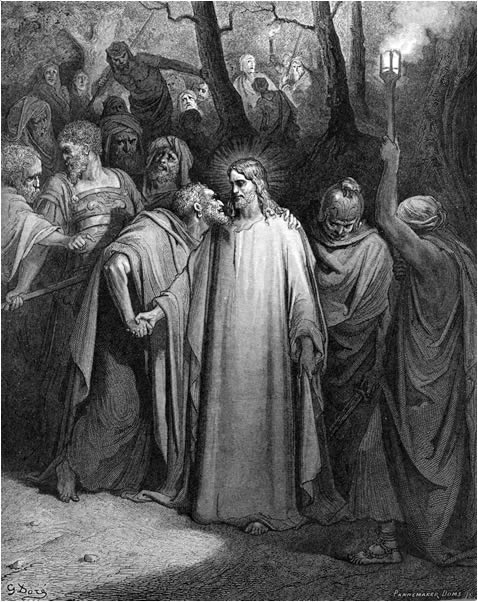
in Mark 14Now the betrayer had arranged a signal with them: “The One I kiss is the man; arrest Him and lead Him away securely.”
BSB
The same verse in ASV and KJV ▾
ASV
Now he that betrayed him had given them a token, saying, Whomsoever I shall kiss, that is he; take him, and lead him away safely.
KJV
And he that betrayed him had given them a token, saying, Whomsoever I shall kiss, that same is he; take him, and lead him away safely.
⋯
This verse in Mark 14
Commentary
10 notes on this verse(ubi sup.) But Judas had still something of the shame of a disciple, for he did not openly betray Him to his persecutors, but by the token of a kiss. Wherefore it goes on: And he that betrayed him had given them a token, saying, Whomsoever I shall kiss, that same is he; take him, and lead him away safely.
This site's exposition
cometh Judas, one of the twelve
on Mark 14:43-46
Cometh Judas, one of the twelve, immediately while Jesus yet spake, with a great multitude armed with swords and staves from the chief priests, scribes, and elders, and the token he had given them was a kiss, whomsoever I shall kiss, that same is he, take him, and lead him away safely. He goeth straightway to him, and saith, Master, master, and kissed him, the double address and the kiss itself, the bench notes, an intimacy weaponized against the one it should have honored. They laid their hands on him and took him, the arrest completed with a friend's gesture rather than a soldier's force.
The record, by era
The Church Fathers1 voice
How magnificent is the endurance of evil by the Lord who even kissed his own traitor, and then spoke words even softer than a kiss! For he did not say, O you abominable one, or traitor, is this what you do in return for great …
The Medieval Church4 voices
But look at his madness, how he thought to hide from the Lord by a kiss, hoping to be received as a friend. If you are indeed a friend, why did you come with enemies? Truly, senseless cunning!
See how in his blindness he thought to deceive Christ by the kiss, so as to be looked upon by Him as His friend. But if thou wert a friend, Judas, how didst thou come with His enemies? But wickedness is ever without foresight. And as soon as he was come, he goeth straightway to him, and saith, Master, master; and kissed him.
Now the betrayer had given them a sign, saying: Whomsoever I shall kiss, etc. Indeed, an impudent and wicked confidence, to call Him Master and to give a kiss to Him whom he was betraying. However, he still had something of the disciple's shame, since …
Judas gives the kiss as a token, with poisonous guile, just as Cain offered a crafty, reprobate sacrifice.
3 more voices on this verse
The Puritans and the Awakening1 voice
And he that betrayed him had given them a token,.... A common sign, in which they agreed; and so this same Greek word is used by the Jews (c): "said R. Phinehas in the name of R.
The Nineteenth Century2 voices
A commentator
J.C. Ryle1816–1900
Expository Thoughts on the Gospels: Mark (lightly modernized text, Grace Gems edition) (1857)
Let us notice in these verses, how little our Lord's enemies understood the nature of His kingdom . We read that Judas came to take Him "with a great multitude, with swords and clubs." It was evidently expected that our Lord would be vigorously defended by His disciples, and that He would not be taken prisoner without fighting. The chief priests and scribes clung obstinately to the idea, that our Lord's kingdom was a worldly kingdom, and therefore supposed that it would be upheld by worldly means.
A commentator
J.C. Ryle1816–1900
Expository Thoughts on the Gospels: Mark (lightly modernized text, Grace Gems edition) (1857)
proposed
Let us notice in these verses, how little our Lord's enemies understood the nature of His kingdom . We read that Judas came to take Him "with a great multitude, with swords and clubs." It was evidently expected that our Lord would be vigorously defended by His disciples, and that He would not be taken prisoner without fighting. The chief priests and scribes clung obstinately to the idea, that our Lord's kingdom was a worldly kingdom, and therefore supposed that it would be upheld by worldly means. They had yet to learn the solemn lesson contained in our Lord's words to Pilate, "My kingdom is not of this world." (John 18:36.) We shall do well to remember this in all our endeavors to extend the kingdom of true religion. It is not to be propagated by violence, or by an arm of flesh. "The weapons of our warfare are not carnal." "Not by might, nor by power, but by my Spirit, says the Lord of hosts." (2 Cor. 10:4. Zech. 4:6.) The cause of truth does not need force to maintain it. False religions, like Mohammedanism, have often been spread by the sword. False Christianity, like that of the Roman Church, has often been enforced on men by bloody persecutions. But the real Gospel of Christ requires no such aids as these. It stands by the power of the Holy Spirit. It grows by the hidden influence of the Holy Spirit on men's hearts and consciences. There is no clearer sign of a bad cause in religion than a readiness to appeal to the sword. Let us notice, secondly, in these verses, how all things in our Lord's passion happened according to God's Word . His own address to those who took Him, exhibits this in a striking manner — "the Scripture must be fulfilled." There was no accident or chance in any part of the close of our Lord's earthly ministry. The steps in which He walked from Gethsemane to Calvary were all marked out hundreds of years before.
The words behind it
18 Greek wordsEvery Greek word of this verse in the order it stands, with what it means and the door to its own study. The last column counts the times a word stands in the whole Bible: the rarer the word, the more the places it appears belong together.
| Greek | Sound | Meaning | Word study | In the Bible |
|---|---|---|---|---|
| δεδώκει | dedokei | Had given | G1325 → | 412 times |
| δὲ | de | then | G1161 → | 2765 times |
| ὁ | ho | the [one] | G3588 → | 19766 times |
| παραδιδοὺς | paradidous | delivering up | G3860 → | 119 times |
| αὐτὸν | auton | Him | G846 → | 5565 times |
| σύσσημον | sussemon | a sign | G4953 → | |
| αὐτοῖς | autois | to them | G846 → | 5565 times |
| λέγων· | legon | saying: | G3004 → | 1325 times |
| ὃν | hon | Whomever | G3739 → | 1405 times |
| ἂν | an | maybe | G302 → | 165 times |
| φιλήσω, | phileso | I may kiss, | G5368 → | |
| αὐτός | autos | He himself | G846 → | 5565 times |
| ἐστιν. | estin | is. | G1510 → | 2333 times |
| κρατήσατε | kratesate | do seize | G2902 → | 47 times |
| αὐτὸν | auton | Him | G846 → | 5565 times |
| καὶ | kai | and | G2532 → | 9120 times |
| ἀπάγετε | apagete | do lead [him] away | G520 → | 15 times |
| ἀσφαλῶς. | asphalos | securely. | G806 → |
δεδώκειHad given
dedokeiG1325 →412 times
δὲthen
deG1161 →2765 times
ὁthe [one]
hoG3588 →19766 times
παραδιδοὺςdelivering up
paradidousG3860 →119 times
αὐτὸνHim
autonG846 →5565 times
σύσσημονa sign
sussemonG4953 →
αὐτοῖςto them
autoisG846 →5565 times
λέγων·saying:
legonG3004 →1325 times
ὃνWhomever
honG3739 →1405 times
ἂνmaybe
anG302 →165 times
φιλήσω,I may kiss,
philesoG5368 →
αὐτόςHe himself
autosG846 →5565 times
ἐστιν.is.
estinG1510 →2333 times
κρατήσατεdo seize
kratesateG2902 →47 times
αὐτὸνHim
autonG846 →5565 times
καὶand
kaiG2532 →9120 times
ἀπάγετεdo lead [him] away
apageteG520 →15 times
ἀσφαλῶς.securely.
asphalosG806 →
A shaded row is a word that stands 400 times or fewer in the Bible.
The walk
8 stopsEach card is a verse this one points to, and under it the verses that one points to in turn. Where several paths arrive at the same place, that place is listed first: the text keeps returning to it.
Through
Exodus 12:13The blood on the houses where you are staying will distinguish them; when I see the blood, I will pass over you. No plague will fall on you to destroy you when I strike…
it leads to
- Hebrews 11:28
By faith he kept the Passover and the sprinkling of blood, so that the destroyer of the firstborn would not touch Israel’s own firstborn.
- Exodus 12:23
When the LORD passes through to strike down the Egyptians, He will see the blood on the top and sides of the doorframe and will pass over that doorway; so He will not allow…
- 1 John 1:7
But if we walk in the light as He is in the light, we have fellowship with one another, and the blood of Jesus His Son cleanses us from all sin.
- Joshua 2:12
Now therefore, please swear to me by the LORD that you will indeed show kindness to my family, because I showed kindness to you. Give me a sure sign
- Hebrews 11:28
Through
Proverbs 27:6The wounds of a friend are faithful, but the kisses of an enemy are deceitful.
it leads to
- Psalms 141:5
Let the righteous man strike me; let his rebuke be an act of loving devotion. It is oil for my head; let me not refuse it. For my prayer is ever against the deeds…
- Revelation 3:19
Those I love, I rebuke and discipline. Therefore be earnest and repent.
- Job 5:17–18
Blessed indeed is the man whom God corrects; so do not despise the discipline of the Almighty.
- Proverbs 26:23–26
Like glaze covering an earthen vessel are burning lips and a wicked heart.
- Psalms 141:5
Where this verse is studied
On this page
Studies16
- The Son of Man in 1 Enoch
- Abba, Father
- The Major Prophets
- Gethsemane (The Garden Called the Oil Press)
- Jesus on the Father
- Jesus: Titles & Roles
- Mary Magdalene: the Witness at the Tomb
- The Messianic Secret: Mark
- Passover
- Peter's Denial: Matthew 26 · Mark 14 · Luke 22 · John 18
- Scribes and the Sanhedrin
- The Son of God
- The Son of Man: Daniel 7:13-14
- The Ransom: Mark 10:45
- The Right Hand
- The Tree
About Mark
This page draws on 10 works. Open the list of works
This page draws on Bede, Catena Aurea by Aquinas; Bede, On the Gospel of Mark; Dionysius of Alexandria, EXEGETICAL FRAGMENTS; J.C. Ryle, Expository Thoughts on the Gospels: Mark (lightly modernized text, Grace Gems edition); John Gill, Exposition of the New Testament; John Gill, Exposition of the New Testament (1746-1748); Matthew Henry, Commentary on the Whole Bible; Pseudo-Jerome, Catena Aurea by Aquinas; Theophylact of Ohrid, Commentary on Mark and Theophylact of Ohrid, Catena Aurea by Aquinas.