
Study trail
Women of Faith
Ten women whose faith shaped the course of redemptive history.
Where this trail goes
Ten women, ten verses, one unbroken thread. This walk begins with a barren ninety-year-old receiving exactly what "Jehovah had spoken" and ends with a businesswoman in Philippi whose opened heart plants the first church in Europe. Between them: a mother who hid a baby from Pharaoh, a harlot inside Jericho's wall, a Moabite widow, a weeping woman at Shiloh, a queen in Persia, a virgin in Nazareth, a learner at Jesus' feet, and the first human being to see the risen Lord. None of these women held office. Most had nothing but a word from God, and they took Him at it. Redemptive history repeatedly turns on a woman's faith, and the texts press toward one point: the line these women guarded, carried, and announced leads to Jesus of Nazareth.
The route
The stops are in the order the Bible presents them.
The route: 10 stops, Genesis 21:1 to Acts 16:14
10 stops, in order
Stop 1 of 10: Genesis 21:1
Now the LORD attended to Sarah as He had said, and the LORD did for Sarah what He had promised.A covenant is a binding agreement, sworn once and kept for good.
The walk opens where God keeps an impossible promise: the covenant line begins through a barren woman.
Sarah laughed behind the tent door, and the child was named Laughter: the joke became the boy's name. Hebrews 11:11 lists her among the faithful anyway. The record keeps both the doubt and the faith, and the promise landed when she was ninety.
Show more on this stopthe exposition
The exposition on this verse
the LORD attended to Sarah as He had said: The verse says it twice, as He had said and what He had promised, and it stands after the closed wombs of 20:18. She conceived and bore Abraham a son at the time God had promised. Her barrenness stood at 11:30, one verse before the promise of descendants at 12:2.
This exposition draws on John Calvin, Commentary on Genesis and Matthew Henry, Commentary on the Whole Bible.
Stop 2 of 10: Exodus 2:1
Now a man of the house of Levi married a daughter of Levi,One mother's defiance of Pharaoh preserves Israel's deliverer: faith guarding the rescue before it begins.
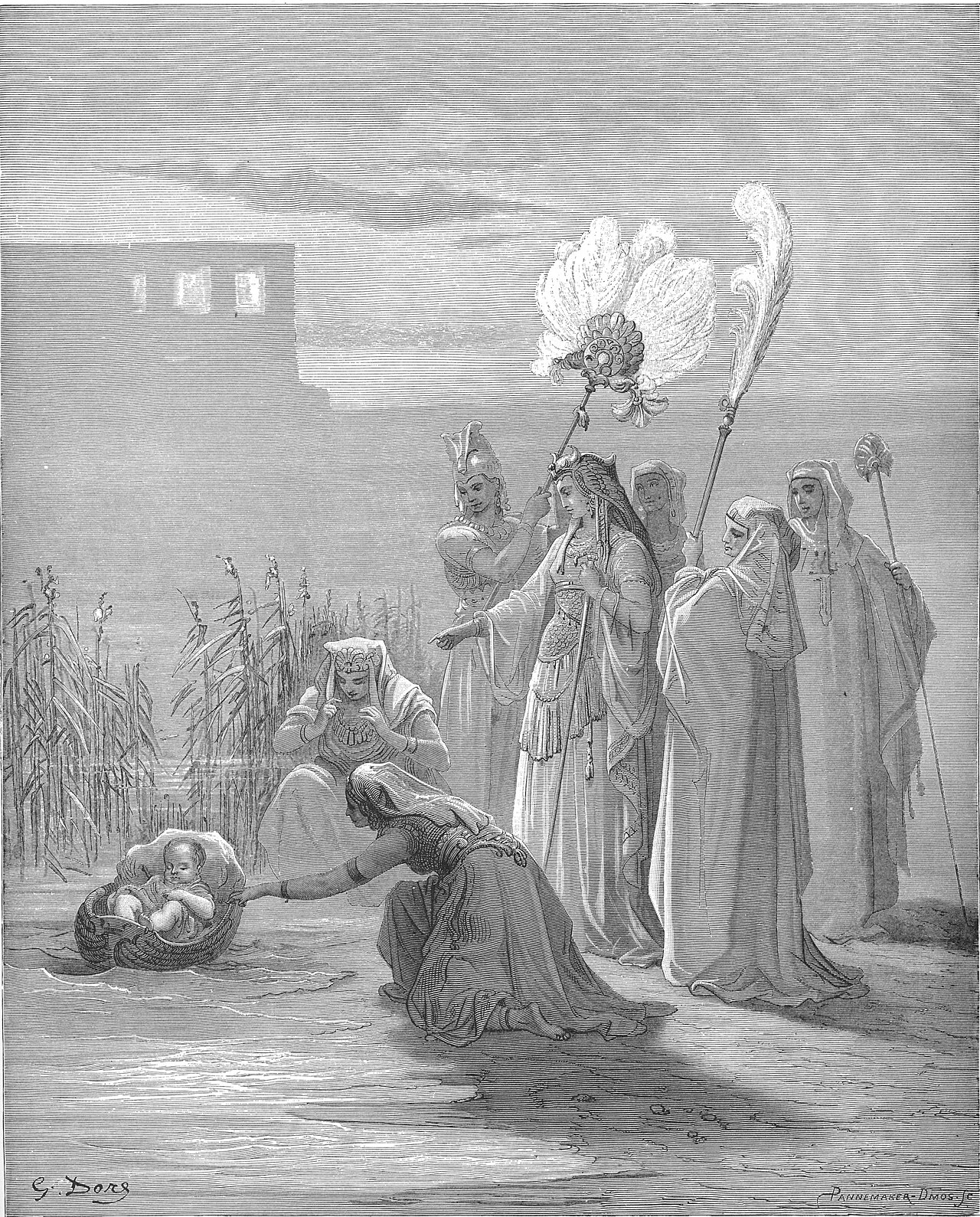
Jochebed hid Moses for three months against a royal execution order, then built him a tevah, the same word used for Noah's ark and nowhere else in the Hebrew Bible. She was paid Pharaoh's wages to nurse her own son. Hebrews 11:23 credits the parents' faith, not the basket.
Show more on this stopthe exposition
The exposition on this verse
a man of the house of Levi: The chapter leaves both parents unnamed, and the genealogy at Exodus 6:20 supplies Amram and Jochebed after the fact. The mother hides the child three months against a standing royal order.
This exposition draws on Keil and Delitzsch, Biblical Commentary on the Old Testament: The Pentateuch and Matthew Henry, Commentary on the Whole Bible.
Stop 3 of 10: Joshua 2:1
Then Joshua son of Nun secretly sent two spies from Shittim, saying, “Go, inspect the land, especially Jericho.” So they went and entered the house of a prostitute named Rahab and stayed there.A Gentile harlot in Jericho believes Israel's God, and the promise's door swings open to outsiders.
Rahab is called a harlot in the New Testament as plainly as in the Old, and she is commended twice: for faith (Hebrews 11:31) and for works (James 2:25). Her confession in Joshua 2:11 is better theology than the spies produced. She stands in Matthew's genealogy of Jesus, four names before David.
Show more on this stopthe exposition
The exposition on this verse
secretly sent two spies from Shittim: Shittim is the camp of Numbers 25:1, where Israel fell into immorality with the women of Moab, and the last stop before the river. Barnes answers Clarke’s reading of Rahab as an innkeeper from Leviticus 21:7 and Jeremiah 5:7, since the word is the ordinary Hebrew for a prostitute.
This exposition draws on Adam Clarke, Commentary on the Bible and Albert Barnes, Notes on the Old Testament.
Stop 4 of 10: Ruth 1:16
But Ruth replied: “Do not urge me to leave you or to turn from following you. For wherever you go, I will go, and wherever you live, I will live; your people will be my people, and your God will be my God.A covenant is a binding agreement, sworn once and kept for good.
A Moabite's vow, thy God my God, carries the line straight toward David and Bethlehem.
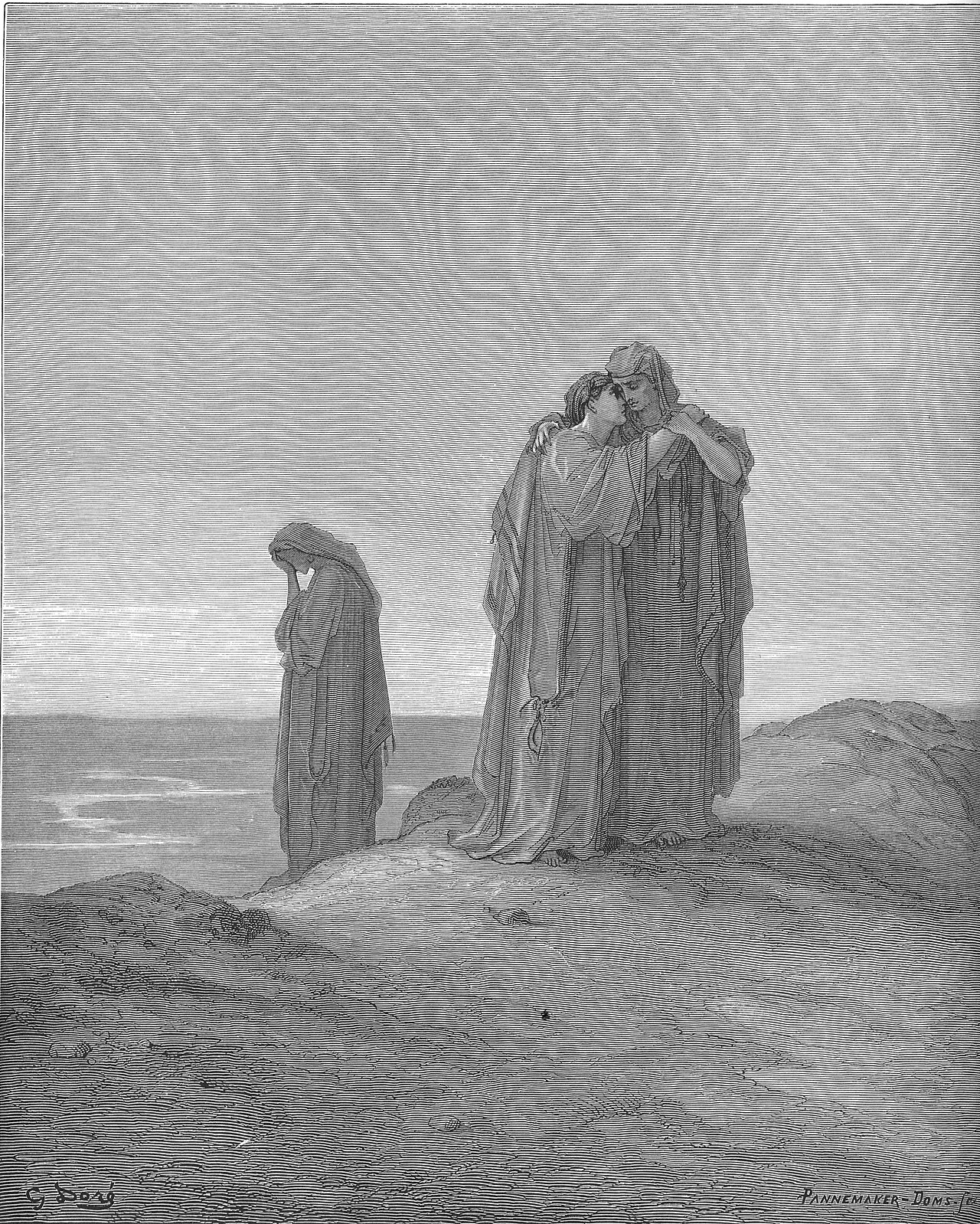
Ruth is a Moabitess, from a people barred from the assembly to the tenth generation (Deuteronomy 23:3), and she binds herself to Naomi's God with an oath.
"Whither thou goest, I will go"
is covenant language, not sentiment. Three generations later her great-grandson is king.
Show more on this stopthe exposition
The exposition on this verse
Do not urge me to leave you: Her vow climbs through six clauses, and its hinge is "your people will be my people, and your God will be my God". She closes with the oath "May the LORD punish me, and ever so severely", sworn by the God she adopts rather than by Chemosh.
This exposition draws on Keil and Delitzsch, Biblical Commentary on the Old Testament: Joshua, Judges, Ruth and Matthew Henry, Commentary on the Whole Bible.
Stop 5 of 10: 1 Samuel 1:20
So in the course of time, Hannah conceived and gave birth to a son. She named him Samuel, saying, “Because I have asked for him from the LORD.”A barren woman's answered prayer gives Israel the prophet who will anoint its king.
Hannah prayed so hard the priest took her for drunk, vowed back the son she was asking for, and kept the vow. Her song in chapter 2 is the template Mary's Magnificat follows almost line for line. She asked for one child, and Scripture records five more after him.
Show more on this stopthe exposition
The exposition on this verse
the LORD remembered her: The verse answers the vow in four words, “the LORD remembered her”. The boy's name ties him to the request that produced him: “Because I have asked for him from the LORD”. The root behind asked is the root of Saul's name, a play the narrator lets stand without comment.
So in the course of time, Hannah conceived: Hannah names her son for her asking. Adam Clarke hears a contraction of the words asked of God, and Albert Barnes reads it as heard of God, the root in Ishmael. Either way the name keeps the answered prayer before mother and son.
This exposition draws on Adam Clarke, Commentary on the Bible; Albert Barnes, Notes, Explanatory and Practical, on the Old and New Testaments (1832-1869); John Wesley, Explanatory Notes upon the Old Testament and Keil and Delitzsch, Biblical Commentary on the Books of Samuel.
Stop 6 of 10: Esther 4:14
For if you remain silent at this time, relief and deliverance for the Jews will arise from another place, but you and your father’s house will perish. And who knows if perhaps you have come to the kingdom for such a time as this?In exile, the people's survival hangs on one woman's courage for such a time as this.
Mordecai's argument is that deliverance will arise either way: the only question is whether Esther will be in it. God is never named in the book of Esther, and His fingerprints are on every reversal in it.
Show more on this stopthe exposition
The exposition on this verse
he sent back to her: Mordecai answers that relief "will arise from another place" if she stays silent. He ends, "who knows if perhaps you have come to the kingdom for such a time as this?" Most of the older commentators, with the Targums, read another place as a veiled reference to God.
For if you remain silent at this time: Barnes reads the warning that Esther and her father’s house will perish as judgment on a duty neglected. Spurgeon applied the verse to every believer and church, each placed where it stands for such a time. Henry calls Mordecai’s certainty of deliverance strong faith.
This exposition draws on Albert Barnes, Notes, Explanatory and Practical, on the Old and New Testaments (1832-1869); Charles Spurgeon, The Metropolitan Tabernacle Pulpit, Sermon No. 1777: “Esther's Exaltation—or, Who Knows?” (lightly modernized text, CCEL edition); Keil, The Books of Ezra, Nehemiah, and Esther and Matthew Henry, Commentary on the Whole Bible.
Stop 7 of 10: Luke 1:38
“I am the Lord’s servant,” Mary answered. “May it happen to me according to your word.” Then the angel left her.Every promise the walk has traced converges here: a willing handmaid, and the Word becomes flesh.
"Be it unto me according to thy word"
is spoken by a teenager who has just been told she will be pregnant before marriage, in a village that stoned for it. She asks one question, how, receives one answer, and consents. Her song then quotes Hannah's.
Show more on this stopthe exposition
The exposition on this verse
even Elizabeth your relative has conceived: For no word from God will ever fail recalls the word to Sarah at Genesis 18:14. The God who opened one old womb now works a greater wonder.
I am the Lord’s servant: Mary answers with the word servant, the humble term Bede notes, though she had just been chosen as mother. Barnes reads the reply as faith in the promise and readiness to obey. Wesley thinks the conception may have followed at this moment.
This exposition draws on Albert Barnes, Notes, Explanatory and Practical, on the Old and New Testaments (1832-1869); Ambrose of Milan, Exposition of the Gospel of Luke; Bede, On the Gospel of Luke; John Wesley, Explanatory Notes upon the New Testament and Matthew Henry, Commentary on the Whole Bible.
Stop 8 of 10: Luke 10:39
She had a sister named Mary, who sat at the Lord’s feet listening to His message.Faith's posture defined: before doing anything for the Lord, sitting at His feet, hearing His word.
Sitting
"at Jesus' feet"
is the posture and the phrase used of a rabbi's disciple (Paul says he was brought up at Gamaliel's feet) and it was not a seat offered to women in that culture. Jesus does not merely allow it; He defends it as
"that good part, which shall not be taken away from her."
Show more on this stopthe exposition
The exposition on this verse
a woman named Martha welcomed Him into her home: A woman named Martha welcomed Him into her home, the household John places at Bethany. Her sister Mary sat at the Lord’s feet, the posture of a disciple before a rabbi, a place then held by men.
sat at the Lord’s feet listening to His message: Augustine contrasts Martha preparing food for the Lord with Mary choosing to be fed by Him. Theophylact reads sitting at the feet as being firmly settled in active virtue. Mary listens.
This exposition draws on Adam Clarke, Commentary on the Bible; Augustine of Hippo, Catena Aurea by Aquinas; Matthew Henry, Commentary on the Whole Bible and Theophylact of Ohrid, Commentary on Luke.
Stop 9 of 10: John 20:18
Mary Magdalene went and announced to the disciples, “I have seen the Lord!” And she told them what He had said to her.The risen Jesus makes a woman the first witness in history: I have seen the Lord.
The first witness of the resurrection is a woman whose testimony would not have been admitted in a Jewish court, which is precisely why no one inventing the story would write it this way. She is sent to the apostles with the message before any of them have seen anything.
Show more on this stopthe exposition
The exposition on this verse
announced to the disciples: Mary Magdalene brings the news to the disciples with the words I have seen the Lord. A woman's testimony held no legal weight in the courts of that day, and the Gospel gives her the announcement all the same. The first herald of the risen Lord is a woman.
This exposition draws on Adam Clarke, Commentary on the Bible and Matthew Henry, Commentary on the Whole Bible.
Stop 10 of 10: Acts 16:14
Among those listening was a woman named Lydia, a dealer in purple cloth from the city of Thyatira, who was a worshiper of God. The Lord opened her heart to respond to Paul’s message.The Lord opens Lydia's heart, and the good news these women carried crosses into Europe.
Lydia deals in purple, the luxury dye trade, and is at a riverside prayer meeting because Philippi had no synagogue. Luke is precise about who acted:
"whose heart the Lord opened, that she attended."
Her household becomes the first church in Europe.
Show more on this stopthe exposition
The exposition on this verse
along the river: The place of prayer by the river suggests Philippi lacked the ten Jewish men needed for a synagogue. There Lydia, a dealer in purple cloth from Thyatira, became Europe's first convert, and her house its first church.
a dealer in purple cloth: Thyatira lay in the region of Lydia in the province of Asia, and inscriptions found there name a guild of dyers. The province the Spirit closed at verse 6 met Paul in Macedonia through a woman from Asia. Revelation 2:18 addresses a church at Thyatira.
This exposition draws on E. H. Plumptre, Ellicott's Commentary for English Readers, The Acts of the Apostles; John Chrysostom, Homilies on the Acts of the Apostles; Matthew Henry, Commentary on the Whole Bible and W. M. Ramsay, St. Paul the Traveller and the Roman Citizen.
What this trail means
Walk the ten stops back-to-back and one pattern stands out: God keeps choosing the impossible starting point. A barren Sarah, a barren Hannah, a harlot in a doomed city, a foreign widow, an orphaned exile, an unmarried girl. In every case the human contribution is the same, not power, but taking God at His word. Sarah receives what "Jehovah had spoken." Rahab shelters the spies before she has any proof. Ruth binds herself to a God she barely knows: "thy God my God." Mary answers, "be it unto me according to thy word."
The thread is also a bloodline. Sarah, Rahab, and Ruth stand inside the ancestry of Jesus; Jochebed guards Israel's deliverer; Hannah's son anoints the king whose greater Son is coming. Everything these women carried arrives in a Nazareth handmaid's yes.
Then the pattern turns outward. Mary of Bethany shows what faith looks like once Messiah has come, sitting at His feet, hearing His word. Mary Magdalene becomes the first person in history to announce the resurrection: "I have seen the Lord." Lydia's opened heart carries that announcement onto a new continent. From Genesis to Acts, God entrusts the hinge moments of redemption to women who simply believed Him, and the story they carried is not theirs alone. It is Christ's, and it is still being announced.
Show what you now know
- Scripture records the doubt as well as the faith (Sarah laughed) and still lists these women among the faithful.
- Three of them were outsiders by birth or trade, and two of those stand in the genealogy of Jesus.
- Their faith shows up as action under risk: a hidden baby, a hidden spy, an uninvited approach to a king, a vow kept.
- The resurrection was announced first to a woman whose testimony no court would have accepted, which is why it reads as report rather than invention.