
Joshua 6:20
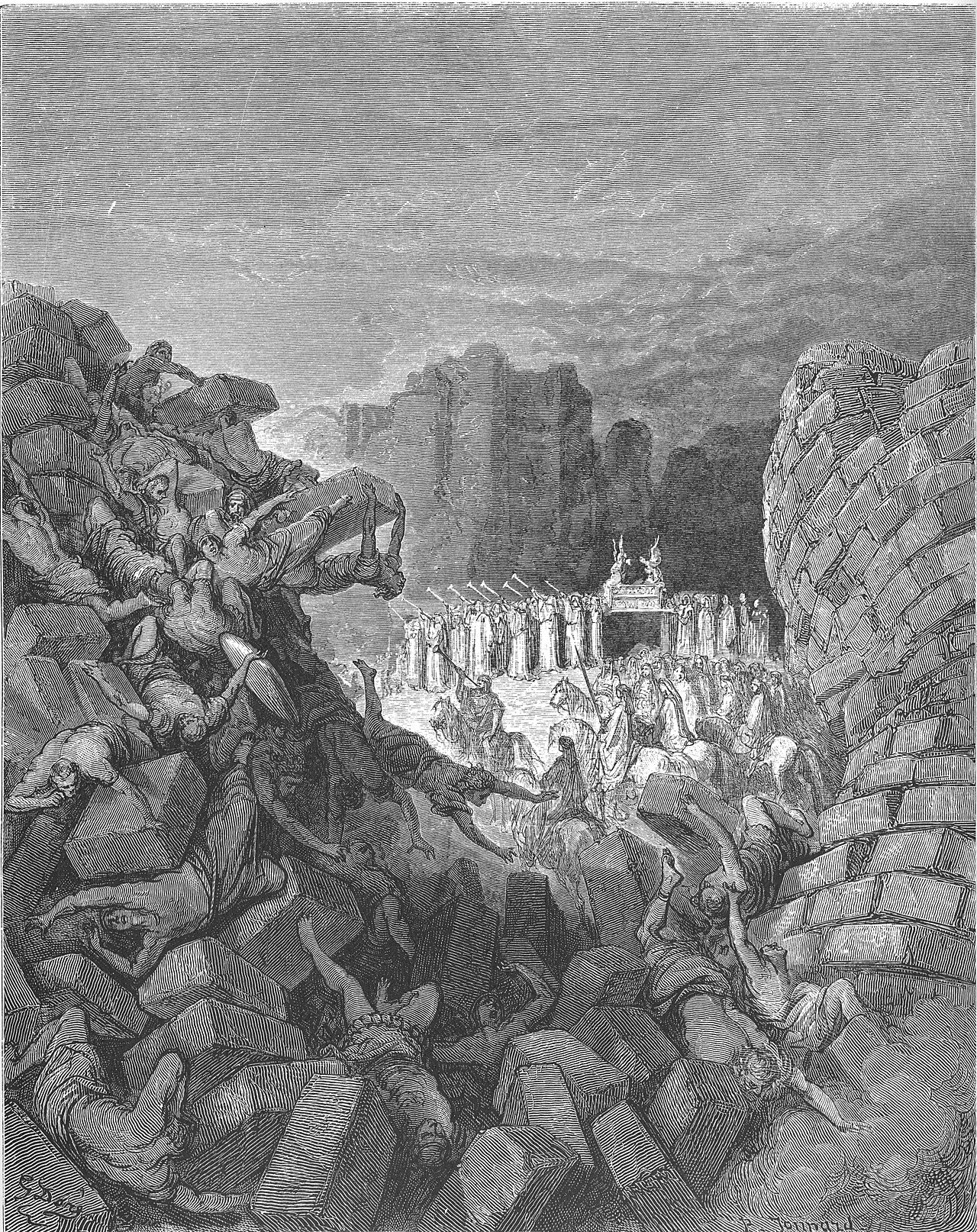
in Joshua 6So when the rams’ horns sounded, the people shouted. When they heard the blast of the horn, the people gave a great shout, and the wall collapsed. Then all the people charged straight into the city and captured it.
BSB
The same verse in ASV and KJV ▾
ASV
So the people shouted, and the priests blew the trumpets: and it came to pass, when the people heard the sound of the trumpet, that the people shouted with a great shout, and the wall fell down flat, so that the people went up into the city, every man straight before him, and they took the city.
KJV
So the people shouted when the priests blew with the trumpets: and it came to pass, when the people heard the sound of the trumpet, and the people shouted with a great shout, that the wall fell down flat, so that the people went up into the city, every man straight before him, and they took the city.
⋯
This verse in Joshua 6
Commentary
17 notes on this verseAnd did Joshua, the son of Nun, err in recognizing the leader of the heavenly host? But after he believed, he forthwith conquered, being found worthy to triumph in the battle of faith. Again, he did not lead forth his armed ranks into the fight, nor did he overthrow the ramparts of the enemy's walls, with battering rams or other engines of war, but with the sound of the seven trumpets of the priests. Thus the blare of the trumpet and the badge of the priest brought a cruel war to an end.
This site's exposition
So when the rams’ horns sounded, the people shouted
Hebrews 11:30 names the falling wall as an act of faith and 11:31 names Rahab. The date of Tell es-Sultan is disputed. Garstang read its fallen walls as Joshua’s Jericho near 1400 BC, Kathleen Kenyon redated them to about 1550, and Bryant Wood reopened Garstang’s case.
The record, by era
The Church Fathers5 voices
The consummation of the world will not happen in stages, but suddenly. With this ought to be compared, I think, what was written in Joshua, when by a single sound of a trumpet the crumbling city of Jericho suddenly perished; and like this example Babylon also in the consummation of the age will fall and suddenly be obliterated.
But when our Lord Jesus Christ comes, whose arrival that prior son of Nun designated, he sends priests, his apostles, bearing "trumpets hammered thin," the magnificent and heavenly instruction of proclamation. Matthew first sounded the priestly trumpet in his Gospel; Mark also; Luke and John each played their own priestly trumpets. Even Peter cries out with trumpets in two of his epistles; also James and Jude. In addition, John also sounds the trumpet through his epistles, and Luke, as he describes the Acts of the Apostles. And now that last one comes, the one who said, "I think God displays us apostles last," and in fourteen of his epistles, thundering with trumpets, he casts down the walls of Jericho and all the devices of idolatry and dogmas of philosophers, all the way to the foundations.
At the coming of Jesus [Joshua], the walls of Jericho were overthrown; at the coming of my Lord Jesus, the world is overcome. Yet I want to know more plainly how the world is overcome and to understand more clearly those things that are said. I myself, I who teach you, want to learn equally with you. Let us summon Paul as a teacher for all of us, for he is a fellow priest of Christ, so that he can disclose to us how Christ overcame the world. Therefore, hear him saying, "That which was opposed to us he took away from our midst and fixed to his own cross; and stripping principalities and authorities he exposed them openly, triumphing over them on the wood of the cross." From these words, therefore, I understand that when the heavenly powers saw the fight of Jesus—the principalities and hostile authorities stripped of their authorities, "the strong one bound and his goods plundered"22—they thundered with their heavenly trumpets, because with the prince of this world bound, the world was overcome and the heavenly army gave the joyful shout at the triumph of Christ. Truly, therefore, blessed are the people of the nations, those who know this joyful shout of the heavenly army and who begin to recognize the mysteries and believe.
How, therefore, is Jericho captured? The sword is not drawn against it; the battering ram is not arranged, nor is the spear hurled. The priestly trumpets alone are employed, and by these the walls of Jericho are overthrown.We frequently find Jericho to be placed in Scripture as a figure of this world.… Consequently, this Jericho (that is, the world) is about to fall; for indeed the consummation of the age has already been made known a little while ago by the sacred books. In what way, therefore, will the consummation be given to it? By what instruments? By the sound, it says, of trumpets. Of what trumpets? Let Paul make known the mystery of this secret to you. Hear what he himself says: "The trumpet will sound," he says, "and the dead who are in Christ will rise incorruptible," and, "The Lord himself with a command, with the voice of the archangel and with the trumpet of God, will descend from heaven." At that time, therefore, Jesus our Lord conquers Jericho with trumpets and overthrows it, so that out of it, only the prostitute is saved and all her house.
A commentator
Philoxenus of Mabbug13 Ascetic Discourses, Discourse 2 -- On Faith · Written before 523.
proposed
And why should I speak concerning the prophets [only] in the case of a nation in the whole of which—together with women and children—faith showed forth such mighty triumphs as these? For faith, as it had been commanded, cried out, and the walls [of Jericho] …
10 more voices on this verse
The Church Fathers4 voices
Human salvation is useless, and my strength lends me no strength if I lack the strength of God. What good was the boundless vigor of giants? Or the kings of Egypt? Or mighty Jericho? Their own inflated glory was the cause of death for all …
The divine reading attests that the walls of Jericho at once collapsed at the din of trumpets. So there is no doubt that the sounds of music, at the Lord's command or with his permission, have unleashed great forces.
Besides the signs just mentioned and the voices which could be heard in the neighborhood of the ark, other miraculous testimonies to the law were witnessed. For example, when the people were entering the promised land and the ark was crossing the Jordan, the river stood still above them and flowed on below them so that the ark and the people had a dry place for crossing. Again, when they came upon the first hostile city where the religion was pagan and polytheistic, the ark was carried around it seven times and then, suddenly, the walls collapsed before a hand was raised or a battering ram was used.
So the walls of that city, called Jericho, which in the Hebrew tongue is said to mean moon, fell when they had been encircled seven times by the ark of the covenant. What, then, does the announcement of the kingdom of heaven portend—signified by the encircling of the ark—except that all the battlements of mortal life, that is, all the hope of this world, which is opposed to the hope of the world to come, will be destroyed by the sevenfold gift of the Holy Spirit, working through the free will? For, those walls fell of their own accord, not by any violent push of the ark in its circuit. There are other references in Scripture which suggest the church to us under the symbolism of the moon, as it makes its pilgrimage in this mortal life, amid toils and labors, far from that Jerusalem whose citizens are the holy angels.
The Puritans and the Awakening3 voices
An abstract of this story we find among the trophies of faith, Heb. xi. "By faith the walls of Jericho fell down, after they were compassed about seven days." The Siege of Jericho. 1 Now Jericho was straitly shut up because of the children of Israel: none went out, and none came in.
So the people shouted when the priests blew with the trumpets,....
Gates of brass and bars of iron are, before him, but as straw and rotten wood, Isa. xlv. Who will bring me into the strong city? Thus shall Satan's kingdom fall, nor shall any prosper that harden themselves against God.
The Nineteenth Century3 voices
The people shouted with a great shout, that the wall fell down - There has been much learned labor spent to prove that the shouting of the people might be the natural cause that the wall fell down! To wait here, either to detail or refute any such arguments, would be lost time: enough of them may be seen in Scheuchzer.
The Lord divided the Jordan that His people might pass through dry-shod. This miracle greatly dispirited the Canaanites, and so prepared the way for an easy triumph for the invading Israelites. You would have naturally expected that the Lord would have bid His people avail themselves immediately of this terror to strike a heavy blow at once, and press on with might and main before the enemy could take a breath and so sweep the land clear of the adversaries in a single campaign. But it was not so.
The Lord divided the Jordan that His people might pass through dry-shod. This miracle greatly dispirited the Canaanites, and so prepared the way for an easy triumph for the invading Israelites. You would have naturally expected that the Lord would have bid His people avail themselves immediately of this terror to strike a heavy blow at once, and press on with might and main before the enemy could take a breath and so sweep the land clear of the adversaries in a single campaign. But it was not so. Instead of immediate activity, the children of Israel pitched their tents at Gilgal and there tarried for a considerable season. For God is in no hurry. His purposes can be accomplished without haste, and though He would have us redeem the time because our days are evil, yet in His eternity He can afford to wait and by His wisdom He so orders His delays that they prove to be far better than our hurries. Why were the people to delay? That they might be obedient to commands which had been forgotten. In the desert, for many reasons, circumcision and the Passover had been neglected. They were not visited with any chastisement on account of this neglect, for the Lord considered their position and condition, and winked at their error. But before He would use them He would have them fully obedient to His will. It cannot be expected that God should tolerate disobedient servants, and therefore they must stay awhile, till they had been attentive to the two great precepts of the Mosaic Covenant. Dear Friends, let us pause and ask ourselves, as Believers, whether we have been in all respects conscientiously attentive to our Master's commands. If not, we may not expect Him to send a blessing to the Church or to the world through us, until first of all we have yielded our willing obedience to that which He has prescribed for us.
The words behind it
25 Hebrew wordsEvery Hebrew word of this verse in the order it stands, with what it means and the door to its own study. The last column counts the times a word stands in the whole Bible: the rarer the word, the more the places it appears belong together.
| Hebrew | Sound | Meaning | Word study | In the Bible |
|---|---|---|---|---|
| וַיָּ֣רַע | vaiyara' | and it shouted | H7321 → | 44 times |
| הָעָ֔ם | haam | the people | H5971 → | 1873 times |
| וַֽיִּתְקְע֖וּ | vaiyitkeu | and they gave a blast | H8628 → | 69 times |
| בַּשֹּֽׁפָר֑וֹת | bashofarot | on the trumpets | H7782 → | 72 times |
| וַיְהִי֩ | vayhi | and it was | H1961 → | 3559 times |
| כִשְׁמֹ֨עַ | khishmoa' | when heard | H8085 → | 1159 times |
| הָעָ֜ם | haam | the people | H5971 → | 1873 times |
| אֶת־ | ʾet- | <obj.> | H853 → | 10935 times |
| ק֣וֹל | kol | [the] sound of | H6963 → | 506 times |
| הַשּׁוֹפָ֗ר | hashofar | the trumpet | H7782 → | 72 times |
| וַיָּרִ֤יעוּ | vaiyariu | and they shouted | H7321 → | 44 times |
| הָעָם֙ | haam | the people | H5971 → | 1873 times |
| תְּרוּעָ֣ה | teruah | a shout | H8643 → | |
| גְדוֹלָ֔ה | gedolah | loud | H1419 → | 526 times |
| וַתִּפֹּ֨ל | vatipol | and it fell | H5307 → | 435 times |
| הַֽחוֹמָ֜ה | hachomah | the city wall | H2346 → | 133 times |
| תַּחְתֶּ֗יהָ | tachteiha | in place its | H8478 → | 505 times |
| וַיַּ֨עַל | vaiyaal | and it went up | H5927 → | 890 times |
| הָעָ֤ם | haam | the people | H5971 → | 1873 times |
| הָעִ֙ירָה֙ | hairah | the city towards | H5892 → | 1090 times |
| אִ֣ישׁ | ʾish | everyone | H376 → | 1663 times |
| נֶגְדּ֔וֹ | negdo | before himself | H5048 → | 151 times |
| וַֽיִּלְכְּד֖וּ | vaiyilkedu | and they captured | H3920 → | 121 times |
| אֶת־ | ʾet- | <obj.> | H853 → | 10935 times |
| הָעִֽיר׃ | hair | the city | H5892 → | 1090 times |
וַיָּ֣רַעand it shouted
vaiyara'H7321 →44 times
הָעָ֔םthe people
haamH5971 →1873 times
וַֽיִּתְקְע֖וּand they gave a blast
vaiyitkeuH8628 →69 times
בַּשֹּֽׁפָר֑וֹתon the trumpets
bashofarotH7782 →72 times
וַיְהִי֩and it was
vayhiH1961 →3559 times
כִשְׁמֹ֨עַwhen heard
khishmoa'H8085 →1159 times
הָעָ֜םthe people
haamH5971 →1873 times
אֶת־<obj.>
ʾet-H853 →10935 times
ק֣וֹל[the] sound of
kolH6963 →506 times
הַשּׁוֹפָ֗רthe trumpet
hashofarH7782 →72 times
וַיָּרִ֤יעוּand they shouted
vaiyariuH7321 →44 times
הָעָם֙the people
haamH5971 →1873 times
תְּרוּעָ֣הa shout
teruahH8643 →
גְדוֹלָ֔הloud
gedolahH1419 →526 times
וַתִּפֹּ֨לand it fell
vatipolH5307 →435 times
הַֽחוֹמָ֜הthe city wall
hachomahH2346 →133 times
תַּחְתֶּ֗יהָin place its
tachteihaH8478 →505 times
וַיַּ֨עַלand it went up
vaiyaalH5927 →890 times
הָעָ֤םthe people
haamH5971 →1873 times
הָעִ֙ירָה֙the city towards
hairahH5892 →1090 times
אִ֣ישׁeveryone
ʾishH376 →1663 times
נֶגְדּ֔וֹbefore himself
negdoH5048 →151 times
וַֽיִּלְכְּד֖וּand they captured
vaiyilkeduH3920 →121 times
אֶת־<obj.>
ʾet-H853 →10935 times
הָעִֽיר׃the city
hairH5892 →1090 times
A shaded row is a word that stands 400 times or fewer in the Bible.
The walk
6 stopsEach card is a verse this one points to, and under it the verses that one points to in turn. Where several paths arrive at the same place, that place is listed first: the text keeps returning to it.
Through
Joshua 6:5And when there is a long blast of the ram’s horn and you hear its sound, have all the people give a mighty shout. Then the wall of the city will collapse and all…
it leads to
- 2 Corinthians 10:4–5
The weapons of our warfare are not the weapons of the world. Instead, they have divine power to demolish strongholds.
Reached by 2 separate paths from here.
- Hebrews 11:30
By faith the walls of Jericho fell, after the people had marched around them for seven days.
- Exodus 19:19
And as the sound of the ram’s horn grew louder and louder, Moses spoke and God answered him in the thunder.
- Joshua 6:16
After the seventh time around, the priests blew the horns, and Joshua commanded the people, “Shout! For the LORD has given you the city!
- 1 Samuel 4:5
When the ark of the covenant of the LORD entered the camp, all the Israelites raised such a great shout that it shook the ground.
- 2 Corinthians 10:4–5
Through
Hebrews 11:30By faith the walls of Jericho fell, after the people had marched around them for seven days.
it leads to
- Joshua 6:3–20
March around the city with all the men of war, circling the city one time. Do this for six days.
- Joshua 6:3–20
Where this verse is studied
On this page
Studies11
About Joshua
This page draws on 16 works. Open the list of works
This page draws on Adam Clarke, Commentary on the Bible; Albert Barnes, Notes on the Old Testament; Ambrose of Milan, Exposition of the Christian Faith 5.10.126; Augustine of Hippo, City of God 10.17; Augustine of Hippo, LETTER 55; Cassiodorus, EXPOSITION OF THE PSALMS 80.4; Charles Spurgeon, The Metropolitan Tabernacle Pulpit, Sermon No. 795: “Joshua's Vision” (lightly modernized text, CCEL edition); John Gill, Exposition of the Old Testament (1748-1763); Keil and Delitzsch, Biblical Commentary on the Old Testament: Joshua, Judges, Ruth; Matthew Henry, Commentary on the Whole Bible; Origen of Alexandria, HOMILIES ON JEREMIAH 28.11; Origen of Alexandria, HOMILIES ON JOSHUA 7.1; Origen of Alexandria, HOMILIES ON JOSHUA 7.3; Origen of Alexandria, HOMILIES ON JOSHUA 6.4; Paulinus of Nola, POEM 16.129 and Philoxenus of Mabbug, 13 Ascetic Discourses, Discourse 2 -- On Faith.