MANNAFEST

The Glory in Exile · Ezekiel

The Glory That Left — and Returns

A deported priest sits by a Babylonian canal in the year he should have entered temple service, and the heavens open. What he sees is a throne on wheels — proof that the God of Israel was never trapped in a building on a hill nine hundred miles away. Then Ezekiel is shown the unbearable thing: that same glory lifting off the defiled temple and leaving by the east gate, step by step, before a single Babylonian breaches the wall. God did not lose Jerusalem. God left it. And the last nine chapters exist to say what happens next — the glory comes back from the way of the east, a river runs out from under the threshold and heals a dead sea, and the city gets a new name: Jehovah is there.

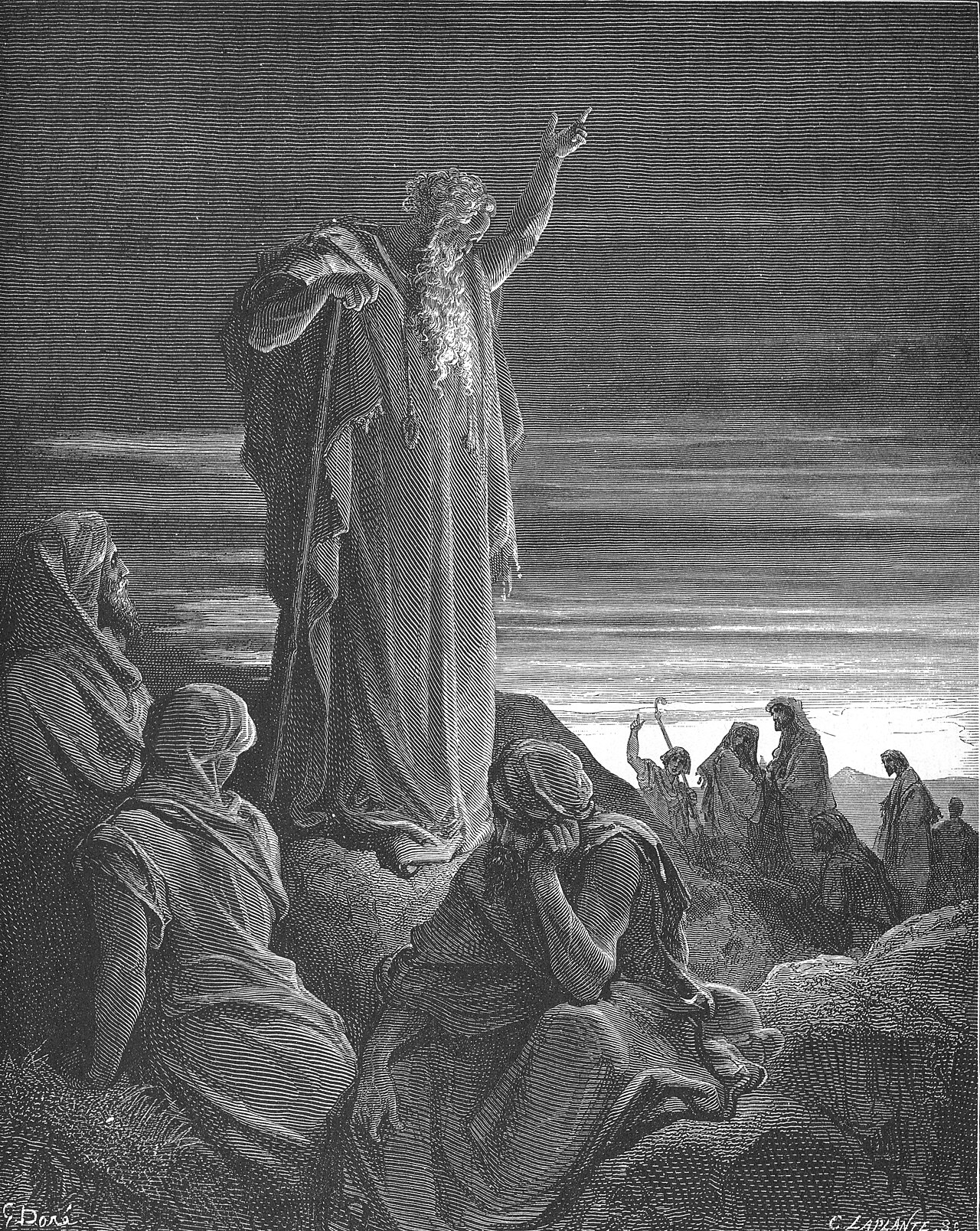
The Prophet Ezekiel — Gustave Doré
The prophet among the captives by the river Chebar — the heavens were opened — Gustave Doré, Doré’s English Bible (1866), public domain · Ezekiel 1:1

The Migration of the Glory

the book's own map — enthroned, departing eastward, absent, returning

Ezekiel does not describe God's presence as an idea. He gives it a position, and then he tracks it. Below, the vertical axis is the distance the text itself states — from over the cherub in the inner sanctuary, out to the threshold, over the cherubim, to the east gate, and finally to the mountain east of the city — and the horizontal axis is simply the order in which the book reports it. Nothing here is inferred. Every point is a verse, and every verse is a door.

Over the cherub — the inner sanctuaryThe threshold of the houseOver the cherubim, at the east doorThe east gate of the houseThe mountain on the east of the city8:49:310:410:1810:1911:2312–4243:243:443:544:448:35downward on this chart = eastward and away from the sanctuary
In the houseDeparting (8–11)Absent (12–42)Returning (43–48)
Ezekiel 8:4In the house

The vision-tour begins with the glory of the God of Israel still there, in the temple, exactly as Ezekiel had seen it in the plain.

Ezekiel 9:3The threshold

The glory goes up from the cherub where it rested, to the threshold of the house — the first step out, taken before a single Babylonian arrives.

Ezekiel 10:4The threshold

The move is repeated and confirmed: the glory stands over the threshold, and the house is filled with the cloud while the court blazes with brightness.

Ezekiel 10:18Over the cherubim

It goes forth from over the threshold and stands over the cherubim — the throne-chariot of chapter 1, waiting at the door to carry it away.

Ezekiel 10:19The east gate

The cherubim lift their wings and mount up, and the glory stands at the door of the east gate of Jehovah's house. The exit is deliberate, and it is eastward.

Ezekiel 11:23The mountain east

The glory goes up from the midst of the city and stands upon the mountain on the east side — the Mount of Olives ridge. God has left, and the city can now fall.

Ezekiel 12–42The long absence

Thirty chapters of sign-acts, allegories, oracles against the nations, the fall of the city, the shepherds, the new heart, the bones and Gog — and in all of them the glory is never once said to be in the temple.

Ezekiel 43:2From the east

The glory of the God of Israel comes from the way of the east, His voice “like the sound of many waters,” and the earth alight with His glory. It returns by the road it left.

Ezekiel 43:4In by the east gate

The glory comes into the house “by the way of the gate whose prospect is toward the east” — the same gate, in reverse.

Ezekiel 43:5Filling the house

The Spirit lifts the prophet into the inner court, and the glory of Jehovah fills the house. The circle closes.

Ezekiel 44:4Sealed

Ezekiel sees it once more and falls on his face: the glory of Jehovah filled the house of Jehovah. This time nothing drives it out.

Ezekiel 48:35Jehovah is there

The book's last line names the city for what has happened to it: YHWH Shammah — Jehovah is there. That is the whole book in two words.

Read the chart once more and notice what it does not show. There is no point at which the Babylonians push the glory out. Every step of the departure happens in chapters 8 to 11 — years before the siege engines arrive. The exile is not the story of a God who was defeated. It is the story of a God who withdrew, on the record, with reasons given, and then said where He was going and when He would come back.

The Shape of the Book

forty-eight chapters, hinged on the night the city fell
Author
Ezekiel son of Buzi — a priest in exile
Date
593–571 BC · the most precisely dated prophet
Setting
Tel-abib by the river Chebar, Babylonia
Shape
48 ch · 4 visions of God · 14 dated oracles
The call (1–3)Judgment on Judah (4–24)The nations (25–32)Restoration (33–39)The temple vision (40–48)
  1. The Call by the ChebarEzekiel 13

    A deported priest, thirty years old and five years into exile, sees the heavens opened by a Babylonian irrigation canal: living creatures, wheels within wheels, a crystal expanse, a sapphire throne, and on it the likeness as the appearance of a man. He eats a scroll, and is made a watchman.

  2. Judgment on Judah and JerusalemEzekiel 424

    The most concentrated block of sign-acts in Scripture — a brick besieged, a prophet bound, hair shaved and scattered, an exile's baggage dug through a wall — with the temple abominations and the departing glory (8–11), the foundling bride (16), and the soul that sinneth, it shall die (18).

  3. Oracles Against the NationsEzekiel 2532

    Ammon, Moab, Edom, Philistia; Tyre the merchant city lamented as a foundering ship, with the king of Tyre placed in Eden (28); Sidon; and seven oracles against Egypt and its Pharaoh, the great dragon in the midst of his rivers.

  4. The Turn to RestorationEzekiel 3339

    The watchman is recommissioned, the fugitive arrives with word that the city is smitten, and the mouth that was shut is opened. Then: the false shepherds indicted and one Shepherd promised, the new heart and the new spirit, the valley of dry bones, the two sticks, and Gog of Magog.

  5. The Visionary TempleEzekiel 4048

    A man with a line of flax and a measuring reed walks the prophet through a temple that has never been built, cubit by cubit. The glory returns from the east and fills it, a river runs from under the threshold and heals a dead sea, the land is reapportioned, and the city gets a new name.

The hinge — Ezekiel 33:21–22

Before the city falls, Ezekiel is a prophet with a shut mouth, opened only to pronounce judgment. Then a fugitive walks into the camp and says the city is smitten — and the hand of the LORD had been upon him the night before, and his mouth was opened, and he was no more dumb. Every chapter after that turns toward hope. The book physically changes direction on a single reported sentence.

They Shall Know That I Am Jehovah

the book's stated purpose, repeated until it cannot be missed

Ezekiel keeps answering a question nobody asked out loud: why is any of this happening? The answer is always the same clause, welded onto the end of oracle after oracle — and they shall know that I am Jehovah (ASV; the LORDin the KJV and most modern versions). It is attached to judgment and to salvation with equal ease, because both are doing the same work. The exact clause “know that I am Jehovah” falls 57 times in the ASV text of Ezekiel (verified against the floor); wider tallies that admit the variant forms run toward seventy.

Christ in Ezekiel

eight stops the New Testament picks up by name
Ezekiel 1:26–28The Enthroned ManAbove the expanse, a throne like sapphire, and upon it a likeness as the appearance of a man, wrapped in fire and rainbow. Revelation seats One on that throne with that rainbow (Rev 4:2–3) and fuses the imagery onto the glorified Son of Man (Rev 1:13–16).Ezekiel 17:22–24The Tender SprigAfter the allegory of the eagles, God plants a tender twig from the cedar's top on a high mountain, and it becomes a noble cedar sheltering every bird — the same family of shoot-and-branch promises as Isaiah 11:1 and Jeremiah 23:5.Ezekiel 21:27Whose Right It IsIn the middle of the sentence on Judah's last kings the crown is removed until he come whose right it is; and I will give it him — a messianic reservation of the throne, in the line of Genesis 49:10.Ezekiel 34:11–24The One ShepherdGod says He Himself will search for His sheep, and then that He will set up one shepherd over them, my servant David. Jesus takes the role Ezekiel assigns to Yahweh and says it in the first person: I am the good shepherd.Ezekiel 36:25–27The New HeartClean water sprinkled, the stony heart taken away, a heart of flesh given, and My Spirit put within you. This is the interior side of the new covenant, and the language behind born of water and of the Spirit (John 3:5).Ezekiel 37:26–28The Sanctuary ForeverMy tabernacle also shall be with them; and I will be their God, and they shall be my people — the sentence Revelation reissues at the end of the Bible: the tabernacle of God is with men (Rev 21:3).Ezekiel 43:1–5The Glory ReturningThe glory comes back from the way of the east and fills the house. John says the Word became flesh and tabernacled among us, and we beheld his glory — the returning glory, this time in a body.Ezekiel 47:1–12The River and the LeavesWater from under the threshold deepens to a river no one can cross, heals a dead sea, and lines its banks with trees bearing new fruit every month whose leaf is for healing — reworked in Revelation 22:1–2 for the healing of the nations.

One more line runs under all of these. God addresses Ezekiel as son of man— mortal, frail, a creature standing in front of the enthroned glory — through the whole book. That is not the source of Daniel 7's heavenly figure coming with the clouds, and MannaFest does not flatten the two. But when Jesus makes the Son of ManHis own standing self-title, He is fusing exactly those two things: Ezekiel's humanity before God, and Daniel's divine dominion.

Themes

nine load-bearing lines through the book
01

The glory — mobile, departing, returning

Ezekiel 1:28; 10:18; 11:23; 43:2–5

Ezekiel's distinctive contribution to biblical theology. The kavod is enthroned on a moving chariot, so it can come to exiles by a foreign canal; it leaves a defiled temple in stages; and it comes back. God's presence is not tethered to architecture — which is exactly the comfort a deported congregation needed and the terror Jerusalem refused to hear.

02

They shall know that I am Jehovah

Ezekiel 6:7; 20:44; 36:23; 38:23

The book's drumbeat. The fall of the city, the ruin of Tyre and Egypt, the raising of the bones and the destruction of Gog all serve one stated purpose: recognition. God acts to vindicate His own name — not for your sake, but for my holy name.

03

Holiness and the profaned Name

Ezekiel 36:20–23, 32

Israel profaned God's name among the nations, and the exile itself became the sneer: these are the people of Jehovah, and are gone forth out of his land. The restoration is therefore grounded in God's holiness rather than in human merit — grace with a granite floor.

04

Individual moral responsibility

Ezekiel 18:2–4, 20; 33:10–20

Against the fatalistic proverb about fathers eating sour grapes, Ezekiel insists that the soul that sinneth, it shall die — and that the wicked who turns shall live. A high-water mark of Old Testament personal ethics, and a direct answer to exiles claiming they were merely paying their parents' bill.

05

The watchman who must warn

Ezekiel 3:16–21; 22:30; 33:1–9

The prophet is a lookout on a wall, accountable for the trumpet. Chapter 22:30 adds the aching corollary: God sought for a man to stand in the gap for the land, and found none — the text behind the roster's whole intercessory-watchman theology.

06

Embodied prophecy — the sign-acts

Ezekiel 4; 5; 12; 24:15–27

Ezekiel performs his messages more than any prophet: a besieged brick, 390 and 40 days lying bound, rationed bread, shaved hair divided three ways, an exile's bag through a wall — and, most wrenching, refusing to mourn the sudden death of his wife, the desire of his eyes, as a sign that the exiles must not mourn the temple.

07

New heart, new spirit, indwelling Spirit

Ezekiel 36:25–27; 37:14

Ezekiel's counterpart to Jeremiah's new covenant, and the more interior of the two: not a better law but a replaced heart, with God's own Spirit put inside to move the obedience. MannaFest reads this as fulfilled in regeneration and at Pentecost, and as ongoing.

08

Resurrection, reunion, and one King

Ezekiel 37:1–14, 15–28

A valley of very dry bones stands up as an exceeding great army, and the text gives its own interpretation: these bones are the whole house of Israel. Then two sticks become one in the prophet's hand — Israel and Judah under one king, my servant David, in an everlasting covenant of peace.

09

The measured temple and the healed sea

Ezekiel 40–48; 47:1–12

Nine chapters of cubits, gates, courts, ordinances and tribal boundaries, with a river running out from under the threshold to make the Dead Sea live. Whatever one concludes about the fork at chapter 40, the point of the block is unmistakable: the presence that left has come back to stay.

Original Language

four Hebrew words carry the book — each a door to the word workbench

Kavod is built on a root meaning weight — glory in Hebrew is not brightness but heaviness, the felt mass of God's presence, which is why it can be said to arrive, to depart, and to fill a room. Ruachis the book's most versatile word: the stormy wind driving the chariot in chapter 1, the Spirit that lifts the prophet and carries him, the new spirit put within in chapter 36, and the breath that walks a valley of bones back onto its feet. Yada drives the refrain. And nasi— prince, not king — is the word Ezekiel insists on for the ruler of the restored community and even for the Davidic figure himself, a deliberate qualification of royal status under God's kingship, and a live datum in the argument over chapters 40 to 48.

The Approved Voices on Ezekiel

the roster applied — the specific work named, so you can go to it
Chuck Misslercite-only, 50 words or fewer

The Book of Ezekiel (Koinonia House commentary and briefing pack); Learn the Bible in 24 Hours (2002)

Marcus Brown's formative teacher, and this is the signature Missler prophecy book. Pre-trib premillennial dispensational throughout: Gog and Magog as a load-bearing end-times war with modern Israel at the centre, the temple of 40–48 taken literally, and the measured blueprint read through his integrated-design lens. His framework shapes the emphasis of this workbench; the anti-numerology soundness gate still governs.

A. W. Tozercite-only, 50 words or fewer

The Pursuit of God (1948); Whatever Happened to Worship? (1985)

The roster's voice on the manifest presence, and therefore the natural companion to chapters 8–11. Tozer's recurring burden is a church busy and successful and quietly abandoned by the glory — Ichabod applied to the modern congregation rather than to ancient Shiloh.

Derek Princecite-only, 50 words or fewer

Teaching and sermon material on Israel's restoration and the Spirit-filled life

Reads the dry bones of chapter 37 as the regathering of the modern Jewish nation, and 36:25–27 as the engine of new obedience rather than a mood. Tier 1 on Israel's prophetic significance.

Dutch Sheetscite-only, 50 words or fewer

Intercessory Prayer (1996)

The roster's watchman voice: 3:16–21, 33:1–9 and above all 22:30 — God looking for someone to stand in the gap — read as intercession that co-labours rather than merely petitions.

R. C. Sproulcite-only, 50 words or fewer

The Holiness of God (1985)

Frames Ezekiel's holiness-and-recognition theology: God acting for His name's sake (36:22) is not divine vanity but the only possible ground of a grace that does not depend on the people receiving it. Note the flag divergence — his amillennial, cessationist frame is not MannaFest's.

Charles Spurgeonpublic domain

A New Heart (Metropolitan Tabernacle Pulpit, on Ezekiel 36:26); sermons on the valley of dry bones (37) and on I will seek that which was lost (34)

The public-domain anchor of the Ezekiel quote pool. His sermon on the heart of stone is the strongest single candidate for a visible quote block on this book.

Bill Johnson · Mahesh Chavda · Vlad Savchukcite-only, 50 words or fewer

Glory-and-presence teaching across their published work

The continuationist register on the returning glory and the encounterable presence — carried for emphasis, held to the soundness gate.

Joel Richardsoncite-only, 50 words or fewer

Mideast Beast (2012)

Argues the Gog coalition is Islamic and Turkic rather than Russian, keeping Meshech and Tubal in their attested Anatolian geography. Tier 2, and the strongest in-roster challenge to the Cold-War reading.

Jonathan Cahncite-only, 50 words or fewer

The Harbinger (2011) and the pattern-reading successors

Carries the departing-glory motif as a national warning: what happened to a covenant people can happen again to a nation that has known God and turned. The emphasis is roster; the harbinger framework itself is flagged as speculative.

Patrick Fairbairnpublic domain

Ezekiel and the Book of his Prophecy (1851)

A classic conservative commentary devoted entirely to this book, unusually strong on typology and on the temple vision — the public-domain workhorse for chapters 40–48.

Keil & Delitzschpublic domain

Biblical Commentary on the Prophecies of Ezekiel (1868–69)

The standard conservative philological commentary: careful on Ezekiel's difficult Hebrew, on the composite creatures and the wheels, and on the temple measurements themselves.

PD ballastpublic domain

John Calvin, Commentaries on the First Twenty Chapters of Ezekiel; Matthew Henry; Jamieson-Fausset-Brown; E. W. Bullinger, The Companion Bible

The public-domain floor. Note the honest limit on Calvin: he lectured through chapters 1–20 before his death in 1564, so there is no Calvin on the dry bones or the temple — a gap MannaFest states rather than papers over.

Marcus Brown's own commentary leads above all; within a tier, all voices are equal.

Contested Points

presented at full strength, then MannaFest's flag

The visionary temple (40–48) — a future building, or a fulfilled picture?

Literal future — the dispensational reading

A real millennial temple with a functioning Zadokite priesthood, memorial offerings and a reapportioned land, in the coming earthly kingdom of Christ. The strength of the case is the measurements themselves: relentless, minute, cubit by cubit, gate by gate — and nothing in post-exilic history, neither Zerubbabel's temple nor Herod's, ever matched the blueprint. Voices: Missler, the Scofield and Ryrie tradition, Sir Robert Anderson's chronological school.

Fulfilled in Christ — the idealist reading

The temple is an idealized vision of God's restored presence, fulfilled in Christ (destroy this temple, said of His body, John 2:19–21) and in the Spirit-indwelt church. The strength of the case is Revelation's own consummation: John sees no temple in the city, because the Lord God Almighty and the Lamb are the temple (Rev 21:22) — and he reuses Ezekiel's river and trees there without any building at all. Voice: G. K. Beale.

Already, in the church — the amillennial reading

The same fulfilment, located now rather than later: the presence has returned in the Spirit to the people who are themselves the sanctuary, and chapters 40–48 are the vision of that reality in the only architecture the sixth century had available to picture it.

The sacrifice problem — the crux inside the crux

How can a future temple offer sin offerings (40:39; 43:19–27; 45:17) when Hebrews says Christ's one sacrifice was offered once for all, and there is no more offering for sin (Heb 10:10–18)? The dispensational answer is that the offerings are memorial, looking back to the cross as the Lord's Supper does. The honest critique is that Hebrews' language reads as absolute, and even memorial blood is hard to place under it. Both are kept on the page.

The tension: The two strongest readings are each anchored in something real. The measurements really are too specific to be decoration, and Revelation really does end without a temple. Anyone who finds this easy has stopped reading one of the two texts.

MannaFest flag — A literal future millennial temple. MannaFest is pre-trib premillennial dispensational, and chapters 40–48 are load-bearing for that framework — the fulfilled-in-Christ reading is presented at full strength as the strongest alternative, and the sacrifice problem is stated rather than dissolved.

Gog and Magog (38–39) — who, and when?

Where the names actually point

Gog, of the land of Magog, chief prince of Rosh, Meshech and Tubal (38:2–3). In the Assyrian records Meshech is Mushki and Tubal is Tabal — peoples of Anatolia and the Scythian north. That is the attested geography, and it is the starting point any identification has to work from.

Rosh = Russia — the popular reading, and why philologists reject it

A twentieth-century stream (Hal Lindsey and much Cold-War prophecy teaching) read Rosh as Russia, Meshech as Moscow and Tubal as Tobolsk. The sound-alikes are anachronistic, and rosh most plausibly means chief — yielding chief prince of Meshech and Tubal, which is how many translations render it. The caution here is presented at full strength, not brushed aside.

An Islamic and Turkic coalition — Richardson

Joel Richardson argues in Mideast Beast for a coalition drawn from the peoples actually named, in their actual Anatolian and Iranian territory, which today are largely Muslim nations. The reading keeps the geography honest while keeping the prophecy future.

The timing, and Revelation 20:8

Dispensational writers place the invasion before, at the start of, or near the end of the tribulation, and some at the threshold of the millennium. Complicating all of it, Revelation 20:8 names Gog and Magog in a revolt after the thousand years. Either the two texts describe one end-of-history event, or they are distinct and Revelation borrows the name as a type of the final revolt — the more common dispensational reading.

The tension: The identity question and the timing question are usually argued as if settling one settled the other. They do not: a firmly Anatolian Gog can still be future, and a Russian Gog would still have to answer Revelation 20.

MannaFest flag — Futurist: Gog is a real, still-future coalition destroyed by God directly, with regathered Israel at the centre. MannaFest declines the Rosh-equals-Russia etymology as unsound while keeping the futurist reading it was used to support, and presents Richardson's identification as the strongest in-roster alternative.

The king of Tyre in Eden (28:11–19) — a proud monarch, or Satan behind him?

MannaFest flag: Both columns kept. The oracle names its addressee as the king of Tyre and reads naturally as hyperbolic lament, the twin of Isaiah 14's taunt against Babylon's king. But the language — thou wast in Eden, the anointed cherub that covereth, perfect till unrighteousness was found in thee — strains past any Phoenician. MannaFest, unseen-realm-aware, presents the double reference as a live reading and flags the exegetical caution.

The thirtieth year (1:1)

MannaFest flag: Unresolved, and MannaFest adjudicates nothing. The most-cited and most theologically resonant option is Ezekiel's own age: thirty, the year a priest entered temple service (Num 4:3) — so the call replaces the altar he will never mount. Others count from Josiah's reform or a Jubilee, or read a Babylonian regnal reckoning.

Authorship and unity

MannaFest flag: A single sixth-century Ezekiel, with the dated first-person oracles taken at face value. Worth noting for its rarity: earlier criticism fragmented the book severely, and then largely reversed course — the striking stylistic and theological unity pushed major twentieth-century scholarship back toward a substantially unified sixth-century book.

Tyre, Nebuchadnezzar, and no wages (29:17–20)

MannaFest flag: Ezekiel prophesied Tyre's fall to Nebuchadnezzar (26), and then years later recorded that the long siege yielded no wages, so God gave him Egypt instead. Skeptics read a failed prophecy; the text's own candour is the answer, and the fuller ruin — many nations, the city scraped like the top of a rock — is commonly read as realized under Alexander's causeway in 332 BC.

The chariot-vision and Merkabah mysticism

MannaFest flag: Chapters 1 and 10 became the seedbed of Jewish Merkabah and Hekhalot mysticism, esoteric throne-ascent speculation the Mishnah restricted from public exposition. MannaFest notes the reception history as background, and does not endorse the mystical programme or read it back into the text.

The Hebrew never calls it a chariot

MannaFest flag: Ezekiel 1 describes wheels, creatures, an expanse and a throne — but the word merkabah does not appear there; it is applied to the cherub-vehicle only later, at 1 Chronicles 28:18. Merkabah is a useful shorthand and a post-biblical label, and MannaFest says which is which.

The Ground Under the Book

what the canal, the tablets, and the causeway have to say

The river Chebar

Not a river of Israel but the Akkadian naru kabari — a major irrigation canal near Nippur in southern Mesopotamia. Ezekiel's throne-vision happens at a locatable Babylonian waterway, which is precisely the theological point.

The Al-Yahudu tablets

A cuneiform archive of the sixth and fifth centuries BC documenting a community of Judean exiles farming and trading in Babylonia, in settlements named al-Yahudu, city of Judah, with recognizably Yahwistic names. Documentary corroboration of the exact milieu Ezekiel addresses.

The Jehoiachin ration tablets

Babylonian administrative tablets listing oil and grain rations for Yaukin, king of the land of Yahudu, and his sons — corroborating 2 Kings 25:27–30 and anchoring the very captivity by which Ezekiel dates every oracle.

Karibu and lamassu

The four-faced living creatures and winged composite guardians resonate with Mesopotamian temple and palace guardians — the visual vocabulary of the world Ezekiel was deported into. Cultural background the vision transcends, not a source it copies.

Tyre and Alexander's causeway

Nebuchadnezzar besieged Tyre for roughly thirteen years with meagre result, as 29:17–20 itself concedes. In 332 BC Alexander built a causeway to the island city out of the mainland's rubble — literally casting her stones and her timber into the water (26:12).

A temple with no counterpart

The blueprint of 40–48 matches nothing ever built. Zerubbabel's temple and Herod's rebuilding both differ, which is the historical fact that keeps the millennial-temple debate alive rather than settling it.

Papyrus 967 and a shorter Greek text

The Old Greek of Ezekiel, and especially Papyrus 967, runs shorter than the Masoretic text in stretches — notably around chapters 36 to 39, where 967 lacks part of 36 and orders 37–39 differently. A genuine text-critical crux, and it sits exactly where the Gog material is.

The most precisely dated prophet

Fourteen chronological headings run from 593 to 571 BC, ordering the oracles as a dated sequence — a priest's love of order made structural. The one displacement, 29:17, is the latest date in the book placed among the earlier Egypt oracles: topical grouping, not disorder.

People & Places

the cast of the visions and the map they are drawn on
Ezekiel son of BuziA Jerusalem priest deported in the 597 BC exile of Jehoiachin, called at thirty by a Babylonian canal in the year he would have entered temple service. His name means God strengthens. He never returns to the land, never serves at an altar, and is given the most visionary ministry in the Old Testament — twenty-two years of it, straddling the fall of the city he was taken from.
BuziEzekiel's father, and the reason the book opens in a priestly key: the prophet is a kohen of a Jerusalem family with Zadokite sympathies (1:3; cf. 44:15).
Ezekiel's wifeThe desire of thine eyes, taken with a stroke — and the prophet forbidden to mourn her, as a sign that the exiles must not mourn the temple when the news comes (24:15–27). The hardest sign-act in Scripture.
Jaazaniah and PelatiahJaazaniah son of Shaphan stands among seventy elders censing idols in the dark chamber (8:11); Pelatiah son of Benaiah, a wicked counsellor, drops dead mid-oracle (11:13).
NebuchadnezzarCalled king of kings and used as God's instrument against Tyre and Egypt — including the candid note that the Tyre campaign paid him nothing (26:7; 29:18–20).
The prince and king of TyreTwo oracles, escalating: a proud human ruler who says I am a god (28:2), and then a figure in Eden, an anointed cherub, perfect till iniquity was found in him (28:11–19).
Daniel, with Noah and JobNamed as a byword for righteousness (14:14, 20) and for wisdom (28:3) while the exilic Daniel was still alive — a small crux the Daniel workbench carries in full.
Gog of MagogChief prince of Rosh, Meshech and Tubal, with Persia, Cush, Put, Gomer and Togarmah behind him (38:2–6) — the coalition God destroys directly, so that the nations may know.
My servant DavidThe one Shepherd set over one flock (34:23–24) and the one King over one reunited nation (37:24–25) — called prince rather than king, in Ezekiel's deliberate idiom.

Also on the map, and opening as their pages are built: the river Chebar and Tel-abib among the exiles; the mountains of Israel, addressed in judgment (6) and again in restoration (36); Tyre and Sidon; Egypt and the Nile; Mount Seir; the valley of the bones; Hamon-gog, where the coalition is buried; the very high mountain of 40:2; the river running down to the Arabah with fishermen from En-gedi to En-eglaim; and the city whose name is the last word of the book.

Keep studying

— more from The Prophets

Artwork: Raphael, Ezekiel's Vision (c. 1518) — public domain. Drafted from MannaFest's research brief on Ezekiel — public-domain commentators (Fairbairn, Keil & Delitzsch, Calvin on chapters 1–20, Henry, JFB, Bullinger, Spurgeon) and the founder's approved-voices roster, cite-only for moderns. Scripture ASV. Every cited work — the sources registry →