

Leviticus 3 and 7 · Doctrine · Featured Study
The Peace Offering
Leviticus 3 and Leviticus 7, the meals of Genesis 31 and Exodus 24, and the readings of the word shelamim.
The worshipper who brought a peace offering sat down to eat its meat before the LORD.
- First taught
- Exodus 20:24 “…it your burnt offerings and peace offerings, your…”
- Fullest statement
- Leviticus 3:1 to 17 “If one’s offering is a peace offering and…”
Pietro da Cortona, The Alliance of Jacob and Laban, 1630 to 1635. Public domain.
Summary
The peace offering, shelamim in Hebrew, is the third of the five offerings of Leviticus 1 to 5. An animal from the herd or the flock was slain, and its blood was sprinkled on the altar and its fat burned. Its meat was shared between the priests and the household that brought it.
- It was brought in thanksgiving, to keep a vow or as a freewill offering.
- Genesis has the word zebach, a sacrifice eaten in a meal, at Genesis 31:54 and Genesis 46:1, and never the word shelamim.
- Readers divide over whether the peace offering made atonement or was a meal for those already at peace with God.
The Law of the Peace Offering
Leviticus 3 and Leviticus 7:11 to 34 hold the law of the offering.
Leviticus 3 tells the worshipper what to bring and what to do with it. The priests' law in Leviticus 7 tells them the rules of the meal that followed, and it is the last of the five offerings in their law.
“If one’s offering is a peace offering and he offers an animal from the herd, whether male or female, he must present it without blemish before the LORD. He is to lay his hand on the head of the offering and slaughter it at the entrance to the Tent of Meeting. Then Aaron’s sons the priests shall sprinkle the blood on all sides of the altar.Every peace offering began this way, before any part of it was burned or eaten.
Now this is the law of the peace offering that one may present to the LORD: If he offers it in thanksgiving, then along with the sacrifice of thanksgiving he shall offer unleavened cakes mixed with olive oil, unleavened wafers coated with oil, and well-kneaded cakes of fine flour mixed with oil.The priests' law opens with the first of the three occasions for the offering.
The Meal Before the LORD
The texts come from Genesis, the Law, the histories, a prophet and Paul.
From Jacob's meal on the mountain to the Lord's table, Scripture joins the sacrifice to a meal eaten before God.
1Jacob and Laban on the mountain
- What it adds
- Jacob offers a sacrifice and invites his relatives to eat a meal.
- What it adds
- Young bulls are sacrificed as peace offerings, and the elders of Israel see God and eat and drink.
- What it adds
- The household eats in the presence of the LORD and rejoices.
- What it adds
- David offers peace offerings and gives bread and cakes to every man and woman.
- What it adds
- Solomon offers 22,000 oxen and 120,000 sheep as peace offerings.
- What it adds
- The LORD will have no regard for peace offerings of fattened cattle.
- What it adds
- Paul sets the bread and the cup beside Israel's eating of the sacrifices.
Each text in canon order, with what it adds.
Who Received What
Leviticus 3 and Leviticus 7 name a place for every part of the offering.
The fat and the blood never reached the worshipper's table.
| Part of the offering | Where it goes |
|---|---|
| The blood | sprinkled on all sides of the altar |
| The fat over the entrails, both kidneys and the lobe of the liver | burned on the altar as a pleasing aroma |
| The fat tail of a lamb | burned with the other fat |
| The breast | waved before the LORD and given to Aaron and his sons |
| The right thigh | given to the priest who presents the blood and the fat |
| One cake of each kind of bread | given to the priest who sprinkles the blood |
| The rest of the meat | eaten by the household and anyone ceremonially clean |
ThanksgivingLeviticus 7:12 to 15
The meat of the sacrifice of his peace offering of thanksgiving must be eaten on the day he offers it; none of it may be left until morning.The thanksgiving offering keeps the strictest time of the three, a single day.
Rashi names those who were bound to bring it: a person who had crossed the sea or the wilderness, had been released from prison, or had been sick and was healed.
A vow or a freewill offeringLeviticus 7:16 to 18
If, however, the sacrifice he offers is a vow or a freewill offering, it shall be eaten on the day he presents his sacrifice, but the remainder may be eaten on the next day. But any meat of the sacrifice remaining until the third day must be burned up. If any of the meat from his peace offering is eaten on the third day, it will not be accepted. It will not be credited to the one who presented it; it shall be an abomination, and the one who eats of it shall bear his iniquity.These two may be eaten on a second day, and what is left on the third day is burned.
The Meal on the Mountain
Genesis 31:43 to 54, a covenant sealed with a sacrifice and a meal before the law was given.
When Jacob left Laban's house with his wives, his children and his flocks, Laban overtook him in the hill country of Gilead. The two men made a covenant, raised a heap of stones as its witness and ate beside it.
Cortona sets the household at the left and the covenant and its sacrifice at the right.
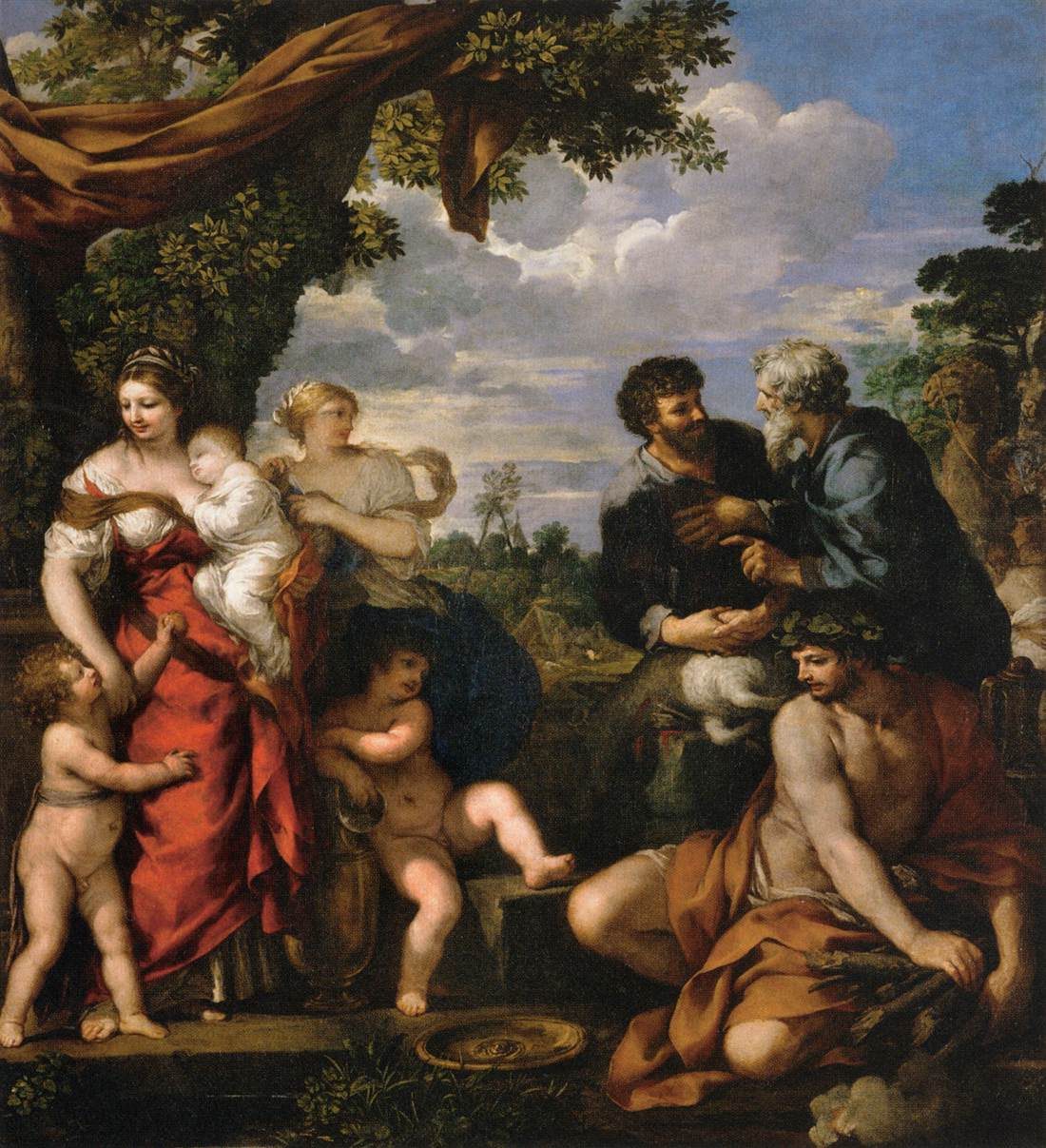
- Jacob and LabanThe two men clasp hands as they make their covenant.Genesis 31:44
- LabanThe old man with the white beard calls on the God of Abraham to judge between them.Genesis 31:53
- The lambA young man holds a white lamb for the sacrifice.Genesis 31:54
- The woodA man in front sits beside a bundle of sticks for the fire.Genesis 31:54
- Rachel and LeahRachel and Leah stand at the left with Jacob's children.Genesis 31:43
Pietro da Cortona, The Alliance of Jacob and Laban, 1630 to 1635. Public domain.
Five parts of the painting, each numbered where it stands, with the verse it answers to.
“Covenants of friendship were anciently ratified by the parties eating and drinking together. It was in the nature of a love-feast.”
Matthew Henry · Commentary on the Whole Bible · on Genesis 31:54Puritan
What the Law Leaves Unsaid
Leviticus 3 and 7 leave three questions open.
The law names no occasion for a freewill offering, which is brought when the worshipper wills it.
Leviticus 1:14 allows a bird for a burnt offering, and Leviticus 3 provides animals only from the herd and the flock, without giving a reason.
The text does not say how the household's share of the meat was to be cooked.
Peace Through the Blood of His Cross
Colossians 1, Ephesians 2 and Hebrews 13 take up the peace and the thanksgiving of the offering.
and through Him to reconcile to Himself all things, whether things on earth or things in heaven, by making peace through the blood of His cross.Paul ties the peace God makes to the blood of the cross.
For He Himself is our peace, who has made the two one and has torn down the dividing wall of hostilityPaul names Christ Himself as the peace between Jew and Gentile.
Through Jesus, therefore, let us continually offer to God a sacrifice of praise, the fruit of lips that confess His name.Hebrews keeps the thanksgiving of Leviticus 7:12 in the life of the church.
“Jesus Christ is our great peace-offering; for he made himself a sacrifice, not only to atone for sin, and so to save us from the curse, but to purchase a blessing for us, and all good. By our joyfully partaking of the benefits of redemption we feast upon the sacrifice, to signify which the Lord's supper was instituted.”
Matthew Henry · Commentary on the Whole Bible · on Leviticus 7:30 to 34Puritan
Hebrews 13:15, Matthew Henry
Voices on the Peace Offering
Three teachers from the sixth century to the nineteenth, each with the work named.
died 604 · Gregory the Dialogist
“And by the precept of the law, the tail of the victim is commanded to be offered in sacrifice. In the tail, of course, is the end of the body; and he sacrifices well who brings the sacrifice of a good work to the end of the required action.”
Gregory the Dialogist · 40 Homilies on the Gospels (Homily 25) · on Leviticus 3:9Patristic
1662 to 1714 · Matthew Henry
“They feasted upon the sacrifice, before God, in token of their cheerful consent to the covenant now made, their grateful acceptance of the benefits of it, and their communion with God, in pursuance of that covenant. Thus believers eat and drink with Christ at his table, Luke xxii.”
Matthew Henry · Commentary on the Whole Bible · on Exodus 24:11Puritan
1798 to 1870 · Albert Barnes
“It would appear that Moses, Aaron with his two sons, and seventy of the elders Exo 19:7 went a short distance up the mountain to eat the meal of the covenant (compare Gen 31:43-47), which must have consisted of the flesh of the peace offerings Exo 24:5. Joshua accompanied Moses as his servant Exo 24:13.”
Albert Barnes · Notes, Explanatory and Practical, on the Old and New Testaments (1832-1869) · on Exodus 24:9Evangelical
Did the Peace Offering Atone?
The question turns on Leviticus 3, Leviticus 17:11 and Ezekiel 45:15.
The blood on the altar made atonementMatthew Henry; Adam Clarke
Adam Clarke, in his Commentary on the Bible, takes shelamim as an offering to make peace between God and man.
“The priest must sprinkle the blood upon the altar, for it was the blood that made atonement for the soul; and, though this was not a sin-offering, yet we must be taught that in all our offerings we must have an eye to Christ as the propitiation for sin, as those who know that the best of their services cannot be accepted unless through him their sins be pardoned.”
Matthew Henry · Commentary on the Whole Bible · on Leviticus 3:2Puritan
And one sheep shall be given from each flock of two hundred from the well-watered pastures of Israel. These are for the grain offerings, burnt offerings, and peace offerings, to make atonement for the people, declares the Lord GOD.Ezekiel counts the peace offerings among the gifts that make atonement for the people.
The objection: Leviticus 3 never says that the peace offering makes atonement, the word Leviticus 1:4 uses of the burnt offering and Leviticus 4:20 of the sin offering.
A meal for those at peace with GodRashi; Albert Barnes
Rashi, on Leviticus 3:1, gives two reasons for the name. The offerings bring peace into the world, and in them there is peace for the altar, the priests and the owners, since all three receive a portion.
“The vow-offering appears to have been a peace-offering vowed upon a certain condition; the voluntary-offering, one offered as the simple tribute of a devout heart rejoicing in peace with God and man offered on no external occasion (compare Lev 22:17-25).”
Albert Barnes · Notes, Explanatory and Practical, on the Old and New Testaments (1832-1869) · on Leviticus 7:16Evangelical
The objection: Leviticus 17:11 gives the blood upon the altar to make atonement, and the blood of the peace offering is sprinkled on that altar.
Books to Read Next
Three works a student reads next, each free to read.
Commentary on the Whole Bible
Matthew Henry · 1708 to 1710
His notes on Leviticus 3 and 7 read each rule of the offering as a lesson for worship.
Read his Leviticus notesNotes, Explanatory and Practical
Albert Barnes · 1832 to 1869
His notes on Leviticus explain the names and the classes of the offerings.
Read Barnes on LeviticusCommentary on the Torah
Rashi · eleventh century
It reads Leviticus 3 and 7 phrase by phrase with the rabbis' rulings.
Read at SefariaA Meal Kept in Remembrance
Christians keep a meal of their own, and Luke records the words with which Jesus gave it.
And He took the bread, gave thanks and broke it, and gave it to them, saying, “This is My body, given for you; do this in remembrance of Me.” In the same way, after supper He took the cup, saying, “This cup is the new covenant in My blood, which is poured out for you.Jesus gives the meal its words at the Passover table before His death.
Sources
Scripture is the Berean Standard Bible.
- James Strong, Exhaustive Concordance of the Bible, 1890, entries H8002, H2077 and H8426, with their occurrence counts and their uses by verse.
- Rashi on Leviticus 3:1 and 7:12, Pentateuch with Rashi's commentary by M. Rosenbaum and A. M. Silbermann, 1929 to 1934 (public domain), via Sefaria.
- Adam Clarke, Commentary on the Bible, on Leviticus 3:1.
- Albert Barnes, Notes, Explanatory and Practical, on Leviticus 7:16.
- Albert Barnes, Notes, Explanatory and Practical, on Exodus 24:9.
- Matthew Henry, Commentary on the Whole Bible, 1708 to 1710.
- Gregory the Dialogist, 40 Homilies on the Gospels, Homily 25.
Keep Studying
Doctrines8
Values1