
Ezekiel 37:5
in Ezekiel 37This is what the Lord GOD says to these bones: I will cause breath to enter you, and you will come to life.
BSB
The same verse in ASV and KJV ▾
ASV
Thus saith the Lord Jehovah unto these bones: Behold, I will cause breath to enter into you, and ye shall live.
KJV
Thus saith the Lord God unto these bones; Behold, I will cause breath to enter into you, and ye shall live:
⋯
This verse in Ezekiel 37
Commentary
5 notes on this verseTherefore, the prophet prophesies to the spirit, and says: Thus says the Lord God: Come, O spirit, from the four winds; come, that is, from the four corners of the world, so that just as in the first creation of man God breathed into his face and he became a living soul (Genesis 2:7), so in the second creation, that is, the resurrection of the dead, being breathed upon by the spirit, they may be brought to life again; for when the spirit entered the human bodies, immediately they lived, and stood upon their feet.
This site's exposition
Prophesy upon these bones
on Ezekiel 37:4-8
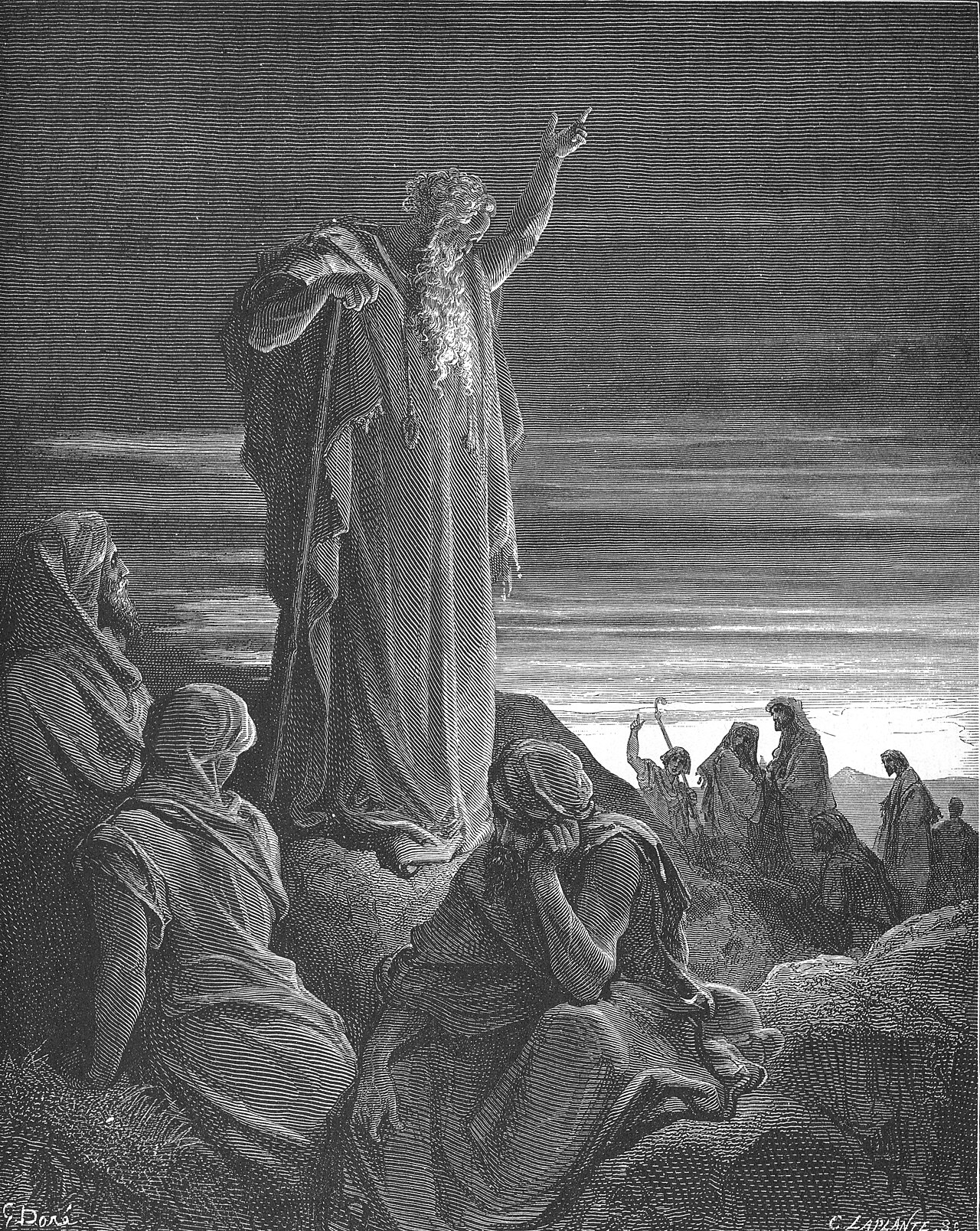
The means of the miracle is the point of it: prophesy upon these bones, and say unto them, O ye dry bones, hear the word of the Lord, preaching commanded to an audience that cannot hear. As the prophet obeys there is a noise and a shaking, bone to his bone, sinews and flesh and skin, and then the verse's deliberate halt: but there was no breath in them. The bench draws the two-stage shape as the text draws it, structure without life first, which guards the vision from meaning mere reorganization, as Fairbairn puts it: a nation can be reassembled and still be a corpse.
The record, by era
The Church Fathers1 voice
on Ezekiel 37:4-10
In minute detail the holy prophet Ezekiel teaches and describes how strength will be restored to our dry bones, feeling return and motion added; how, with the return of sinews, the whole structure of the human body will grow strong, and how the driest bones will be clothed with restored flesh and the openings of the veins and the streams of the blood will be concealed by a veil of skin drawn tautly over them.
The Nineteenth Century2 voices
Behold, I will cause breath - רוח ruach signifies both soul, breath, and wind; and sometimes the Spirit of God. Soul is its proper meaning in this vision, where it refers to the bones: “I will cause the Soul to enter into you.”
on Ezekiel 37:1-10
THIS vision has been used, from the time of Jerome onwards, as a description of the resurrection and certainly it may be so accommodated with much effect. What a vision of the great day the words picture before the mind's eye! The great army of the quick, who once were dead, seem to start up as we read. Here, too, we have a very fit and appropriate question to be asked in a tomb—"Son of man, can these bones live?"
The words behind it
12 Hebrew wordsEvery Hebrew word of this verse in the order it stands, with what it means and the door to its own study. The last column counts the times a word stands in the whole Bible: the rarer the word, the more the places it appears belong together.
| Hebrew | Sound | Meaning | Word study | In the Bible |
|---|---|---|---|---|
| כֹּ֤ה | koh | thus | H3541 → | 577 times |
| אָמַר֙ | ʾamar | he says | H559 → | 5305 times |
| אֲדֹנָ֣י | ʾadonai | [the] Lord | H136 → | 440 times |
| יְהוִ֔ה | yahweh | Yahweh | H3069 → | 306 times |
| לָעֲצָמ֖וֹת | laatzamot | to the bones | H6106 → | 126 times |
| הָאֵ֑לֶּה | haeleh | <the> these | H428 → | 746 times |
| הִנֵּ֨ה | hineh | here! | H2009 → | 843 times |
| אֲנִ֜י | ʾani | I | H589 → | 874 times |
| מֵבִ֥יא | mevi' | [am] about to bring | H935 → | 2568 times |
| בָכֶ֛ם | vakhem | in you | ||
| ר֖וּחַ | ruach | breath | H7307 → | 378 times |
| וִחְיִיתֶֽם׃ | vichyitem | and you will live | H2421 → | 282 times |
כֹּ֤הthus
kohH3541 →577 times
אָמַר֙he says
ʾamarH559 →5305 times
אֲדֹנָ֣י[the] Lord
ʾadonaiH136 →440 times
יְהוִ֔הYahweh
yahwehH3069 →306 times
לָעֲצָמ֖וֹתto the bones
laatzamotH6106 →126 times
הָאֵ֑לֶּה<the> these
haelehH428 →746 times
הִנֵּ֨הhere!
hinehH2009 →843 times
אֲנִ֜יI
ʾaniH589 →874 times
מֵבִ֥יא[am] about to bring
mevi'H935 →2568 times
בָכֶ֛םin you
vakhem
ר֖וּחַbreath
ruachH7307 →378 times
וִחְיִיתֶֽם׃and you will live
vichyitemH2421 →282 times
A shaded row is a word that stands 400 times or fewer in the Bible.
The walk
8 stopsEach card is a verse this one points to, and under it the verses that one points to in turn. Where several paths arrive at the same place, that place is listed first: the text keeps returning to it.
Through
Genesis 2:7Then the LORD God formed man from the dust of the ground and breathed the breath of life into his nostrils, and the man became a living being.
it leads to
- Job 33:4
The Spirit of God has made me, and the breath of the Almighty gives me life.
Reached by 2 separate paths from here.
- Ecclesiastes 12:7
before the dust returns to the ground from which it came and the spirit returns to God who gave it.
- 1 Corinthians 15:45
So it is written: “The first man Adam became a living being;” the last Adam a life-giving spirit.
- Isaiah 64:8
But now, O LORD, You are our Father; we are the clay, and You are the potter; we are all the work of Your hand.
- Acts 17:25
Nor is He served by human hands, as if He needed anything, because He Himself gives everyone life and breath and everything else.
- Job 33:4
Through
John 20:22When He had said this, He breathed on them and said, “Receive the Holy Spirit.
it leads to
- Genesis 2:7
Then the LORD God formed man from the dust of the ground and breathed the breath of life into his nostrils, and the man became a living being.
- Genesis 2:7
Through
Ezekiel 37:14I will put My Spirit in you and you will live, and I will settle you in your own land. Then you will know that I, the LORD, have spoken, and I will do…
it leads to
- Ezekiel 36:27
And I will put My Spirit within you and cause you to walk in My statutes and to carefully observe My ordinances.
- Joel 2:28–29
And afterward, I will pour out My Spirit on all people. Your sons and daughters will prophesy, your old men will dream dreams, your young men will see visions.
- Ezekiel 36:27
Where this verse is studied
On this page
Studies4
On this verse
About Ezekiel
This page draws on Adam Clarke, Commentary on the Bible; Ambrose of Milan, On the Death of Satyrus 2.69; Charles Spurgeon, The Metropolitan Tabernacle Pulpit, Sermon No. 582: “The Restoration And Conversion Of The Jews” (lightly modernized text, CCEL edition); Jerome, Commentary on Ezekiel; John Gill, Exposition of the Old Testament and Patrick Fairbairn, An Exposition of Ezekiel.