
Johnchapter 4
54 verses · John, by tradition · AD 85 to 95 · The Gospels
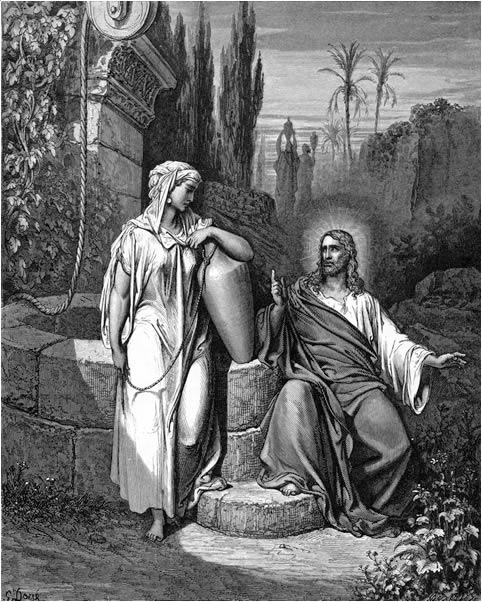
Since Jacob’s well was there, Jesus, weary from His journey, sat down by the well. It was about the sixth hour.
Introduction
John, by tradition, The Gospels, John Overview.
John wrote this chapter for readers from many peoples, some of whom had been outsiders to Israel. It is set among a people the Jews of Judea avoided, and much of it is a long conversation between two people who should not have been talking. The talk moves from ordinary thirst to worship and to the identity of the Messiah. Listen for the misunderstandings, since the woman and the disciples each take Jesus literally at first. Notice too who believes and on what grounds. Read it as the gospel crossing its first border.
Context
- Who
- Readers who had been taught that Samaritans were the wrong sort of neighbour
- What
- The conversation with the Samaritan woman at Jacob's well, the faith of her town, and the second sign at Cana, the healing of an official's son.
- Where
- Jacob's well near Sychar in Samaria, then Cana in Galilee, with the sick son at Capernaum.
- When
- The first year of the ministry, about AD 28, on the road north from Judea to Galilee.
- Why
- To show that Jesus is the Savior of the world and that worship in spirit and truth is open beyond Israel.
Historical context
The quarrel with Samaria was seven centuries old and still bleeding. After Assyria resettled the north, the population that emerged there kept only the five books of Moses and worshipped on Mount Gerizim rather than in Jerusalem. They built a temple there; a Jewish ruler, John Hyrcanus, destroyed it around 128 BC. When the woman says our fathers worshipped on this mountain, she is standing in its shadow.
Show the rest of the historical context, 3 more paragraphs
The well is a real, identifiable site and it is deep, well over a hundred feet, which is exactly why the woman points out that Jesus has nothing to draw with. Drawing water was women's work done in company at dawn or dusk; a woman coming alone at the sixth hour, the heat of the middle of the day, was avoiding other women.
Two social rules are broken at once. A Jewish teacher did not hold a public conversation with a woman he did not know, and a Jew did not share a drinking vessel with a Samaritan. The disciples' reaction when they return, they marvelled that he was talking with a woman, and nobody dared ask why, records the shock.
The second half moves to a royal official, a man in the service of Herod Antipas, whose son lies ill at Capernaum about twenty miles from Cana. The distance matters: he asks Jesus to come down, is told to go, and later matches the hour of the healing to the hour of the word. That check is the point of the story.
Significance
The woman's question about the right mountain was the live inter-ethnic dispute of her world, and the answer sidesteps both addresses: an hour is coming when true worshippers will worship the Father in spirit and truth. Place was being replaced by person.
Show the rest of the significance, 1 more paragraph
Then a Samaritan town believes, and says so in the broadest words in the Gospel so far: this is indeed the Saviour of the world. For readers in a mixed church arguing about who belonged, a despised woman was the first person in this book to bring a town to Jesus.
The heads below are this chapter's scenes. The numbered points under each are its verses.
A Weary Traveler and Living Water at Jacob's Well
John 4:1-3
gaining and baptizing more disciples than John: Word reaches the Pharisees that Jesus is drawing more followers than John the Baptist. John adds that the baptizing was done by the disciples, and Jesus withdraws from Judea into Galilee before the Pharisees can act. His hour had not yet come.
John 4:1
“The Lord knew - When Jesus knew. how he knew this we are not informed; whether by that power of omniscience by which he knew all things, or whether some person had informed him of it. How the Pharisees had heard - The Pharisees, here, seem to denote either the members of the Sanhedrin or those who were in authority. They claimed the authority to regulate the rites and ceremonies of religion, and hence they supposed they had a right to inquire into the conduct of both John and our Lord.”
2 more voices on this verseWhat preachers and commentators have said about this verse, in their own words.
John 4:1
“The souls which they had gotten, which they had made (so the word is), which they had made proselytes. Note, It is Christ's prerogative to make disciples, first to bring them to his foot, and then to form and fashion them to his will. Fit, non nascitur, Christianus--The Christian is made such, not born such.”
Matthew Henry · Commentary on the Whole Bible (1707-1721)puritan
John 4:1
“The Evangelist thus informs us that Christ did not come into Samaria with the intention of dwelling there, but because he had to pass through it on his way from Judea to Galilee; for until, by his resurrection, he should open up the way for the gospel, it was necessary that he should be employed in gathering the sheep of Israel to which he had been sent.”
John Calvin · Commentaries (1554)reformed
not Jesus who baptized: Tertullian answers readers who said He never baptized: what the disciples did at His word counts as His act, as an edict is the emperor's. Albert Barnes gives another reason, that no convert could boast of being baptized by His own hand. Paul met that boast at Corinth.
John 4:2
“Jesus baptized not--John being a servant baptized with his own hand; Christ as the Master, "baptizing with the Holy Ghost," administered the outward symbol only through His disciples.”
Jamieson, Fausset & Brown · Commentary Critical and Explanatory on the Whole Bible (1871)reformed
2 more voices on this verse
John 4:2
"But behold, "say some, "the Lord came, and baptized not; for we read, `And yet He used not to baptize, but His disciples!' " As if, in truth, John had preached that He would baptize with His own hands! Of course, his words are not so to be understood, but as simply spoken after an ordinary manner; just as, for instance, we say, "The emperor set forth an edict," or, "The prefect cudgelled him.
Tertullian · written before 220 · On Baptismpatristic
John 4:2
“Though Jesus himself baptized not - The reason why Jesus did not baptize was probably because, if He had baptized, it might have made unhappy divisions among his followers: those might have considered themselves most worthy or honored who had been baptized by Him. Compare 1Co 1:17.”
He left Judea: Albert Barnes reads the move as prudence, since His time to die had not come and Galilee lay farther from the Jerusalem leaders. John Gill counts about eight months spent in Jerusalem and Judea before He left. Theophylact reads the withdrawal as a lesson for His followers.
John 4:3
“He left Judea - The envy and malice of the Pharisees he might have known were growing so rapidly as to endanger his life. As his time to die had not yet come, he retired to Galilee, a country farther from Jerusalem, and much less under their control than Judea. See Mar 2:22; Luk 3:1. Though he feared not death and did not shrink from suffering, yet he did not needlessly throw himself into danger or provoke opposition. He could do as much good in Galilee, probably, as in Judea, and he therefore withdrew himself from immediate danger.”
had to pass through Samaria: The road from Judea to Galilee ran through Samaria, and many Jewish travelers crossed the Jordan to the east to avoid the Samaritans. John writes that Jesus had to pass through Samaria. Samaria held the people Assyria settled in the northern kingdom, and the Jews counted them foreigners.
John 4:4
“And he must needs go through Samaria - Or, It was necessary for him to pass through Samaria: for this plain reason, and no other, because it was the only proper road. Samaria lay northward of Judea, and between the great sea, Galilee, and Jordan; and there was therefore no going from Galilee to Jerusalem but through this province. See the note on Luk 17:11. From Jerusalem to Galilee through Samaria, according to Josephus, was three days’ journey. See his own life.”
Adam Clarke · Commentary on the Bible (1810-1826)evangelical
2 more voices on this verse
John 4:4
“Some think that Christ must needs go through Samaria because of the good work he had to do there; a poor woman to be converted, a lost sheep to be sought and saved. This was work his heart was upon, the therefore he must needs go this way. It was happy for Samaria that it lay in Christ's way, which gave him an opportunity of calling on them.”
Matthew Henry · Commentary on the Whole Bible (1707-1721)puritan
John 4:4
“O great readiness of mind and deep prudence! He prevents by his answers the things that would have been asked of him. For some one would straightway have said, either speaking to another, or secretly reasoning, Why did our Lord Jesus Christ, in not fit season, give illumination to the Samaritans? For once there came to Him the Syrophenician woman, with tears entreating mercy for her wretched daughter; and what said the Compassionate to her? It is not meet, saith He, to take the children's bread, and to cast it to dogs.”
Cyril of Alexandria · written before 444 · Commentary on the Gospel of John, Book 2patristic
John 4:5-6
a town of Samaria called Sychar: Sychar stood beside the ground Jacob bought at Shechem and left to his son Joseph, at Genesis 33:19 and 48:22. Jacob's well was there, and Jesus sat down by it, worn out from the walk. The sixth hour is about noon.
John 4:5
“The parcel of ground I conceive to have been left not so much to Joseph, as to Christ, of whom Joseph was a type; whom the sun, and moon, and all the stars truly adore. To this parcel of ground our Lord came, that the Samaritans, who claimed to be inheritors of the Patriarch Israel, might recognise Him, and be converted to Christ, the legal heir of the Patriarch.”
Alcuin of York · written before 804 · Catena Aurea by Aquinaspatristic
weary from His journey: Jamieson, Fausset and Brown see the human and the divine joined here, a tired traveler about to give light and life to a stranger. Noon counts six hours from six in the morning.
John 4:6
“Jacob’s well was there - Of this well Mr. Maundrell gives the following account. “About one-third of an hour from Naplosa, the ancient Sychar and Sychem, stood Jacob’s well.”
Adam Clarke · Commentary on the Bible (1810-1826)evangelical
1 more voice on this verse
John 4:6
“But with all that is human, how much also of the divine have we here, both blended in one glorious manifestation of the majesty, grace, pity, patience with which "the Lord" imparts light and life to this unlikeliest of strangers, standing midway between Jews and heathens. the sixth hour--noonday, reckoning from six A.M.”
Jamieson, Fausset & Brown · Commentary Critical and Explanatory on the Whole Bible (1871)reformed
John 4:7-9
Women drew water in the cool of the morning and the evening, and this one comes alone at noon. Jesus asks her for a drink, crossing the line a Jewish man kept from a Samaritan and from a woman alone. Jews and Samaritans kept apart.
John 4:7
“Of Samaria - Not of the “city” of Samaria, for this was at a distance of 8 miles, but a woman who was a Samaritan, and doubtless from the city of Sychar. Give me to drink - This was in the heat of the day, and when Jesus was weary with his journey.”
2 more voices on this verse
John 4:7
“This woman's meeting with Christ at the well may remind us of the stories of Rebekah, Rachel, and Jethro's daughter, who all met with husbands, good husbands, no worse than Isaac, Jacob, and Moses, when they came to the wells for water. Thirdly, How the preventing grace of God sometimes brings people unexpectedly under the means of conversion and salvation.”
Matthew Henry · Commentary on the Whole Bible (1707-1721)puritan
John 4:7
“The Saviour was not ignorant of the woman's coming. For right well did He know being Very God, that she would forthwith be there to draw the cold stream from the fountain. But when she was now come, He began to get His prey within the toils, and straightway holding forth the word of teaching, made His discourse from what was before Him. The Law appointed for the Jews that they must not be defiled in any way, and therefore ordered them to withdraw from every unclean thing, and not to mix themselves up with strangers, or uncircumcised.”
Cyril of Alexandria · written before 444 · Commentary on the Gospel of John, Book 2patristic
gone into the town to buy food.): John Gill reads the aside as the reason the conversation could happen at all. With the disciples away, Jesus could speak with a Samaritan woman free of the offense they might take. Their surprise at verse 27 shows the offense was real.
Matthew Henry notes that a Jew would bear any hardship before he would owe a Samaritan a kindness. So a Jew asking a Samaritan woman for a drink startled her. His dress and speech told her He was a Jew.
John 4:9
“Two things this woman wonders at, 1. That he should ask this kindness; for it was the pride of the Jews that they would endure any hardship rather than be beholden to a Samaritan. It was part of Christ's humiliation that he was born of the Jewish nation, which was now not only in an ill state, subject to the Romans, but in an ill name among the nations.”
Matthew Henry · Commentary on the Whole Bible (1707-1721)puritan
2 more voices on this verse
John 4:9
“No dealings with the Samaritans - For an account of the Samaritans, and of the differences between them and the Jews, see the notes at Mat 10:5.”
John 4:9
“How is it that thou--not altogether refusing, yet wondering at so unusual a request from a Jew, as His dress and dialect would at once discover Him to be, to a Samaritan. for, &c.--It is this national antipathy that gives point to the parable of the good Samaritan (Lu 10:30-37), and the thankfulness of the Samaritan leper (Lu 17:16, 18).”
Jamieson, Fausset & Brown · Commentary Critical and Explanatory on the Whole Bible (1871)reformed
the gift of God: Living water named water flowing from a spring. Jesus turns the request around and offers her the gift of God, which He alone gives. Jeremiah 2:13 calls the LORD the fountain of living waters His people abandoned.
John 4:10
“Jesus calls the quickening gift of the Spirit "living water" because mere human nature is parched to its very roots, now rendered dry and barren of all virtue by the crimes of the devil. But now human nature runs back to its pristine beauty, and drinking in that which is life-giving, it is made beautiful with a variety of good things and, budding into a virtuous life, it sends out healthy shoots of love toward God.”
Cyril of Alexandria · written before 444 · Commentary on the Gospel of John, Book 2patristic
3 more voices on this verse
John 4:10
“If thou knewest the gift of God - Δωρεαν signifies a free gift. A gift is any thing that is given, for which no equivalent has been or is to be returned: a free gift is that which has been given without asking or entreaty. Such a gift of kindness was Jesus Christ to the world, Joh 3:16; and through him comes the gift of the Spirit, which those who believe on his name were to receive.”
Adam Clarke · Commentary on the Bible (1810-1826)evangelical
John 4:10
“THE matter will turn, this morning, upon those few words, "If you knew the gift of God." The woman of Samaria, who was met by our Lord at the well, was an object of electing love but she was not yet regenerated. One difficulty alone lay in the way—she was willing to receive the Truth of God, perfectly willing to be obedient to it—but ignorance lay like a stone before the door of her sepulcher. "If you knew the gift of God," says Christ, "then you would have asked, and I would have given." There was the one barrier!”
John 4:10
“If thou knewest, &c.--that is, "In Me thou seest only a petitioner to thee; but if thou knewest who that Petitioner is, and the Gift that God is giving to men, thou wouldst have changed places with Him, gladly suing of Him living water--nor shouldst thou have sued in vain" (gently reflecting on her for not immediately meeting His request).”
Jamieson, Fausset & Brown · Commentary Critical and Explanatory on the Whole Bible (1871)reformed
John 4:11-12
The woman hears the offer at its surface and asks how He will reach water in a deep well. Her question about Jacob names the patriarch both Samaritans and Jews claimed as father, whose well stood as his gift. She measures Jesus against the largest gift she knows.
John 4:11
“Hast nothing to draw with - It seems that there were no means of drawing water affixed to the well, as with us. Probably each one took a pail or pitcher and a cord for the purpose. In traveling this was indispensable. The woman, seeing that Jesus had no means of drawing water, and not yet understanding his design, naturally inquired whence he could obtain the water. The well is deep - If the same one that is there now, it was about 100 feet deep.”
1 more voice on this verse
John 4:11
“This well is clearly the grace of the Spirit, a stream proceeding from the living fountain. The Holy Spirit, then, is also the fountain of eternal life.… This water, the grace of the Spirit, is so refreshing. Who will give this fountain to my breast? Let it spring up in me, let what gives eternal life flow on me. Let that fountain overflow on us and not flow away.… How shall I keep this water so that it does not flow or glide away?”
Ambrose of Milan · written before 397 · On the Holy Spirit 1.16.180-81patristic
greater than our father Jacob: Cyril of Alexandria says the Samaritans, as neighbors of the Jews, took up their worship and ancestors, and most in Samaria did spring from Jacob. Adam Clarke counts them a mixed race from the nations the Assyrian king settled there, as 2 Kings 17:24 records.
John 4:12
“The Samaritans then were aliens (for they were colonists of the Babylonians), but they call Jacob their father for two reasons. For as inhabiting a country bordering on, and the neighbour of the Jews' land, they were taking a little impression themselves of their worship, and were accustomed to boast of the Jews' ancestors. Besides, it was really true that the greater number of the inhabitants of Samaria were sprung from the root of Jacob.”
Cyril of Alexandria · written before 444 · Commentary on the Gospel of John, Book 2patristic
1 more voice on this verse
John 4:12
“Our father Jacob - The ancient Samaritans were undoubtedly the descendants of Jacob; for they were the ten tribes that revolted in the reign of Rehoboam: but those in our Lord’s time were not genuine Israelites, but a corrupted race, sprung from a mixture of different nations, sent thither by Salmanezer, king of the Assyrians. See 2Ki 17:24.”
Adam Clarke · Commentary on the Bible (1810-1826)evangelical
John 4:13-14
Water from this well answers thirst for a day, and the walk back begins again. Jesus promises water that ends thirst for good, becoming a fount in the one who drinks and springing up to eternal life. The supply sits inside the believer.
John 4:13
“Shall thirst again - Jesus did not directly answer her question, or say that he was greater than Jacob, but he gave her an answer by which she might infer that he was. He did not despise or undervalue Jacob or his gifts; but, however great might be the value of that well, the water could not altogether remove thirst.”
a fount of water springing up: Adam Clarke asks how anyone can lack water who carries a living spring inside him. He reads the water as the teaching of Jesus and the gifts of the Holy Spirit, given by Christ dwelling in the heart. Matthew Henry dwells on the motion, grace always rising.
John 4:14
“Springing up into everlasting life - On this account he can never thirst: - for how can he lack water who has in himself a living, eternal spring? By this water our Lord means also his doctrine, explaining and promising the gifts and graces of the Holy Ghost, which proceed from Jesus Christ their fountain, dwelling in a believing heart. There is no eternal life without the Spirit; no Spirit without Christ; and no Christ to give the Spirit, without dwelling in the heart: this his whole doctrine proclaims.”
Adam Clarke · Commentary on the Bible (1810-1826)evangelical
2 more voices on this verse
John 4:14
“The principles and affections which Christ's holy religion forms in the souls of those that are brought under the power of it are this well of water. [ a. ] It is springing up, ever in motion, which bespeaks the actings of grace strong and vigorous.”
Matthew Henry · Commentary on the Whole Bible (1707-1721)puritan
John 4:14
“YOU have been busy all the week with external things. You have had to deal with the questions, "What shall we eat and what shall we drink and with what shall we be clothed?" It is well that at least on this one day in seven we should turn our eyes away from the external to the internal—from the less to the greater—for as life is more than meat and the body than raiment, so is the soul more important than all that which surrounds it.”
The woman asks for the water and names her reason, an end to the daily trip to the well. She still hears the offer as something to carry home in a jar. Jesus answers by turning to her own life.
John 4:15
“The woman saith unto him, Sir,.... See Gill on Joh 4:11; give me this water, that I thirst not. The Syriac and Persic versions add, "again": neither come hither; the Ethiopic version adds here, "again"; to draw.”
2 more voices on this verse
John 4:15
“Give me this water, that I thirst not neither come hither to draw. Jesus saith unto her, Again does she both speak and imagine only ordinary things, and of the things that were said understands no whit; but she supposes that in being released from petty toils, will consist all the aim of our Saviour, and to thirsting no more does she bound the measure of the grace of God, not so much as in bare idea receiving things above the world.”
Cyril of Alexandria · written before 444 · Commentary on the Gospel of John, Book 2patristic
John 4:15
“Even those that are weak and ignorant may yet have some faint and fluctuating desires towards Christ and his gifts, and some good wishes of grace and glory. Carnal hearts, in their best wishes, look no higher than carnal ends. "Give it to me," saith she, "not that I may have everlasting life" (which Christ proposed), "but that I come not hither to draw. " 2.”
Matthew Henry · Commentary on the Whole Bible (1707-1721)puritan
Worship in Spirit and Truth: I That Speak Am He
John 4:16-18
The command reaches the one subject she had kept back, and her short answer is true as far as it goes. Jesus fills in the rest, five husbands and a sixth man she lives with now. He calls her words truthful and leaves the charge there.
John 4:16
“Call thy husband - Our Lord appears to have spoken these words for two purposes: 1. To make the woman consider her own state. 2. To show her that he knew her heart, and the secret actions of her life; and was therefore well qualified to teach her heavenly truths.”
Adam Clarke · Commentary on the Bible (1810-1826)evangelical
Albert Barnes takes her short answer as an attempt to leave the subject, and suggests she feared the truth would come out. Cyril of Alexandria says Jesus knew her state all along and asked about her husband to show His knowledge of hidden things.
John 4:17
“I have no husband - This was said, evidently, to evade the subject. Perhaps she feared that if she came there with the man that she lived with, the truth might be exposed. It is not improbable that by this time she began to suspect that Jesus was a prophet. Hast well said - Hast said the truth.”
1 more voice on this verse
John 4:17
“To whom is it not now evident that the Saviour was not ignorant that she was bereft of any rightful husband and that He made the enquiry about her husband who was not, a plea for making known hidden things? For He was, He was thus with difficulty able to help her no longer marvelling at Him as one of us, but as now above man, by reason of His wondrous knowledge of her circumstances.”
Cyril of Alexandria · written before 444 · Commentary on the Gospel of John, Book 2patristic
you have had five husbands: Readers weigh the five husbands differently. Adam Clarke notes that the law put an adulteress to death and divorce came easily, so she may have had five husbands lawfully. Origen reads the man she now has as a false law the soul lives under.
John 4:18
“Thou hast had five husbands - It is not clear that this woman was a prostitute: she might have been legally married to those five, and might have been divorced through some misbehavior of her own, not amounting to adultery; for the adulteress was to be put to death, both by the Jewish and Samaritan law, not divorced: or she might have been cast off through some caprice of her husband; for, in the time of our Lord, divorces were very common among the Jews, so that a man put away his wife for any fault.”
Adam Clarke · Commentary on the Bible (1810-1826)evangelical
John 4:19-20
You are a prophet: A stranger who knows her history is a prophet in her eyes, and she puts the old dispute to Him. This mountain is Gerizim, where the Samaritans held Moses had appointed the altar, against Jerusalem, where the temple stood. She asks a prophet to settle it.
John 4:19
“With difficulty does she brighten up to apprehension, and that again not yet perfect. For she still calls the Lord of Prophets a Prophet. But she has by degrees shown herself better than before, in no way ashamed at reproof, seizing to her own profit the force of the sign and so going forth from her effeminate understanding, attaining to some extent to a vigorous mind, and stretching forth the eye of her heart to an unwonted view of things.”
Cyril of Alexandria · written before 444 · Commentary on the Gospel of John, Book 2patristic
2 more voices on this verse
John 4:19
“A prophet - One sent from God, and who understood her life. The word here does not denote one who foretells future events, but one who knew her heart and life, and who must therefore have come from God. She did not yet suppose him to be the Messiah, Joh 4:25. Believing him now to be a man sent from God, she proposed to him a question respecting the proper place of worship. This point had been long a matter of dispute between the Samaritans and the Jews.”
John 4:19
“It was agreed between the Jews and the Samaritans that God is to be worshipped (even those who were such fools as to worship false gods were not such brutes as to worship none), and that religious worship is an affair of great importance: men would not contend about it if they were not concerned about it.”
Matthew Henry · Commentary on the Whole Bible (1707-1721)puritan
worshiped on this mountain: Adam Clarke ties the claim to Jacob's altar at Genesis 33:20 and to the temple Sanballat built on the mountain about 332 years before Christ. Gerizim stood close enough to point at, says John Gill.
John 4:20
“Worshipped in this mountain - Probably pointing to Mount Gerizim, at the foot of which Sychar was situated. The patriarchs had worshipped here-Jacob builded an altar on this mountain, and worshiped the true God: see Gen 22:2; Gen 33:20. Thus she could say, Our fathers worshipped in this mountain. On this mountain Sanballat had built them a temple, about 332 years before our Lord’s incarnation. See Joseph. Antiq. xi. c. viii. s. 4, and 2 Maccabees 6:2. Many heathens considered particular places as having a peculiar sanctity or fitness, for the worship of their deities, beyond others.”
Adam Clarke · Commentary on the Bible (1810-1826)evangelical
1 more voice on this verse
John 4:20
“Conceiving that the Lord is in truth a Prophet and a Jew, she boasts exceedingly of the customs of her country, and asserts that the Samaritans are far superior in wisdom to the Jews. For the Jews admitting too gross notions of the Divine and Incorporeal Nature, contended that in Jerusalem alone, or its neighbour Sion, ought the God over all to be worshipped, as though the whole Ineffable and Incomprehensible Nature had once for all there taken abode, and was enclosed in temples made with hands.”
Cyril of Alexandria · written before 444 · Commentary on the Gospel of John, Book 2patristic
John 4:21-22
you will worship the Father: Jesus tells her the hour comes when worship is bound to no mountain at all. Before He sets the quarrel aside He settles it. He names the Samaritans as worshiping what they do not know and the Jews as worshiping what they know.
John 4:21
“Believe me - As she had professed to believe that he was a prophet, it was right to require her to put faith in what he was about to utter. It also shows the importance of what he was about to say. The hour cometh - The time is coming, or is near. When neither in this mountain ... - Hitherto the public solemn worship of God has been confined to one place. It has been a matter of dispute whether that place should be Jerusalem or Mount Gerizim.”
2 more voices on this verse
John 4:21
“The Jews stand for those who think intelligently and salvation is from them. The Samaritans represent the heterodox. So they deify Gerizim, which means "separation" or "division." The Jews, on the other hand, revere Zion, which signifies "watchtower." … Inasmuch, then, as the hour mentioned by the Lord has not yet come when they worship the Father neither on this mountain nor in Jerusalem, one must flee the mountain of the Samaritans and worship God on Zion, where Jerusalem lies. Christ calls this Jerusalem the city of the great king.”
Origen of Alexandria · written before 253 · Commentary on the Gospel of John 13.81, 83, 85patristic
John 4:21
“Note, The worship of God is not now, under the gospel, appropriated to any place, as it was under the law, but it is God's will that men pray every where. Our reason teaches us to consult decency and convenience in the places of our worship: but our religion gives no preference to one place above another, in respect to holiness and acceptableness to God.”
Matthew Henry · Commentary on the Whole Bible (1707-1721)puritan
salvation is from the Jews: Adam Clarke explains the Samaritans' partial knowledge: they rejected the prophetic books and mixed idol worship into His worship, as 2 Kings 17 records. Jamieson, Fausset and Brown see salvation as revealed, prepared and entrusted to one people. It is sought as coming from them.
John 4:22
“Ye worship ye know not what,.... However, as to her question, he more directly replies by condemning the Samaritans, and their ignorance in worship, and by approving the Jews; and so manifestly gives the preference to the Jews, not only with respect to the place, and object of worship, but with respect to knowledge and salvation. As for the Samaritans, he suggests, that they were ignorant, not only of the true object of worship, but knew not what they themselves worshipped; or, at least, were not agreed in it.”
2 more voices on this verse
John 4:22
But the most glorious thing here is the reason assigned, for salvation is of the Jews--intimating to her that Salvation was not a thing left to be reached by any one who might vaguely desire it of a God of mercy, but something that had been revealed, prepared, deposited with a particular people, and must be sought in connection with, and as issuing from them; and that people, "the Jews."
Jamieson, Fausset & Brown · Commentary Critical and Explanatory on the Whole Bible (1871)reformed
John 4:22
“This was the place where the Samaritans used to worship in opposition to Jerusalem. And it was so near Sychar, that a man's voice might be heard from the one to the other. Our fathers worshipped - This plainly refers to Abraham and Jacob (from whom the Samaritans pretended to deduce their genealogy) who erected altars in this place: Gen. xii, 6, 7, and Gen. xxxiii, 18, 20.”
John Wesley · Explanatory Notes upon the New Testament (1755)evangelical
John 4:23-24
the true worshipers will worship the Father: The hour is coming and has now come, so the shift has already begun. Worship in spirit and in truth rises from the person himself and answers to what God has shown, at any place on earth. God is Spirit, and He seeks worshipers like these.
John 4:23
THE WOMAN’S CONSCIENCE had been aroused by Christ’s declaration of her sin. He was touching upon matters of the most vital importance, and her depraved heart naturally shrunk from the lancet, From the truth which was becoming inconveniently personal she flew to that natural resort of the carnal mind, namely, to religions discourse upon points of outward observance. Instead of confessing her sin, and asking how it may be forgiven, she must needs say, “Our fathers worshipped in this mountain; and ye say, that in Jerusalem is the place where men ought to worship.”
3 more voices on this verse
John 4:23
“The true worshippers shall worship the Father - Not here or there only, but at all times and in all places.”
John Wesley · Explanatory Notes upon the New Testament (1755)evangelical
John 4:23
“In the mystical doctrine, we understand that this well is also referred to there, because there the Samaritan woman, that is, the guardian (the guardian, however, of heavenly precepts), drew divine mysteries from that well, knowing that God is spirit, and is not worshipped in a place but in spirit; and because he is the Messiah, Christ. And therefore, he who is still expected by the Jews has already come. Having heard these things, that woman who appears to be of the Church, recognized the sacraments of the law, and believed.”
Ambrose of Milan · written before 397 · On Isaac and the Soul 4.26patristic
John 4:23
“But the hour cometh, and now is - The old dispensation is about to pass away, and the new one to commence. “Already” there is so much light that God may be worshipped acceptably in any place. The true worshippers - All who truly and sincerely worship God. They who do it with the heart, and not merely in form.”
God is Spirit: John Wesley draws a rule from the words God is Spirit. God has no body and holds every spiritual perfection, so His worshipers must worship Him in faith, love and holiness.
John 4:24
“God is a Spirit - This is one of the first, the greatest, the most sublime, and necessary truths in the compass of nature! There is a God, the cause of all things - the fountain of all perfection - without parts or dimensions, for he is Eternal - filling the heavens and the earth - pervading, governing, and upholding all things: for he is an infinite Spirit!”
Adam Clarke · Commentary on the Bible (1810-1826)evangelical
1 more voice on this verse
John 4:24
“God is a Spirit - Not only remote from the body, and all the properties of it, but likewise full of all spiritual perfections, power, wisdom, love, holiness. And our worship should be suitable to his nature. We should worship him with the truly spiritual worship of faith, love, and holiness, animating all our tempers, thoughts, words, and actions.”
John Wesley · Explanatory Notes upon the New Testament (1755)evangelical
John 4:25-26
He will explain everything: The Samaritans looked for a coming teacher they called the Taheb, the restorer promised in Deuteronomy 18:15. Jesus tells her outright that He is the one she is waiting for. He says it first to a Samaritan woman at a well.
John 4:25
“I know that Messias cometh - As the Samaritans acknowledged the five books of Moses, so they expected, also, the coming of the Messiah. Which is called Christ - These are probably the words of the evangelist, as it is not likely that the woman would explain the name on such an occasion. Will tell us all things - Jesus had decided the question proposed to him Joh 4:20 in favor of the Jews. The woman does not seem to have been satisfied with this answer, and said that the Messiah would tell them all about this question.”
1 more voice on this verse
John 4:25
“Upon Christ teaching that the hour and season will come, rather is already present, wherein the true worshippers shall offer to God the Father the worship in spirit; forthwith the woman is winged to thoughts above her wont unto the hope spoken of by the Jews.”
Cyril of Alexandria · written before 444 · Commentary on the Gospel of John, Book 2patristic
Adam Clarke notes that Jesus never spoke so directly of Himself to His own countrymen, nor to the disciples until near His death. John Wesley links that reserve to the Jews' hope of an earthly kingdom.
John 4:26
“Jesus saith - Hasting to satisfy her desire before his disciples came. l am He - Our Lord did not speak this so plainly to the Jews who were so full of the Messiah's temporal kingdom.”
John Wesley · Explanatory Notes upon the New Testament (1755)evangelical
3 more voices on this verse
John 4:26
“Jesus saith unto her, I - am he - Our Lord never spoke in such direct terms concerning himself to his own countrymen; nor even to his own disciples, till a little before his death. The reason given by Bishop Pearce is the following: The woman being alone when Jesus said it, and being a Samaritan, he had no reason to apprehend that the Samaritans, if they knew his claim, would disturb his ministry before the time of his suffering came; which seems to have been the reason why he concealed it so long from his own countrymen.”
Adam Clarke · Commentary on the Bible (1810-1826)evangelical
John 4:26
“Not to untutored or wholly ignorant souls doth Christ reveal Himself, bat shines upon and appears the rather to those who are more ready to desire to learn, and travailing with the beginning of the faith in simple words, press forward to the knowledge of what is more perfect. Such an one as this was the woman of Samaria also shown to us, giving her mind more grossly than she ought to the truly Divine ideas, but not entirely removed from the desire of understanding somewhat.”
Cyril of Alexandria · written before 444 · Commentary on the Gospel of John, Book 2patristic
John 4:26
“He had magnified them to the woman, and yet to themselves He is to the last far more reserved than to her--proving rather than plainly telling them He was the Christ. But what would not have been safe among them was safe enough with her, whose simplicity at this stage of the conversation appears from the sequel to have become perfect.”
Jamieson, Fausset & Brown · Commentary Critical and Explanatory on the Whole Bible (1871)reformed
Lift Up Your Eyes: The Fields Are White Already
surprised that He was speaking with a woman: The disciples come back and find their teacher talking with a woman in the open, which a rabbi of that day avoided. Their surprise stands in the two questions John records them holding back. No one asks Him anything.
John 4:27
“And upon this came his disciples,.... Just as he was saying the above words, and making himself known in this full manner, his disciples, who had been into the city to buy food, came up to them: and marvelled that he talked with the woman; or with a woman; for, according to the Jewish canons, it was not judged decent, right, and proper, nor indeed lawful, to enter into a conversation, or hold any long discourse with a woman.”
3 more voices on this verse
John 4:27
“We learn that he is meek and lowly in heart and does not disdain to speak of such great matters with a woman carrying water who goes out of the city because of her great poverty and labors to draw water for herself. When the disciples arrive they are amazed, for they previously beheld the greatness of the divinity in him, and they marvel that so great a man was speaking with a woman.”
Origen of Alexandria · written before 253 · Commentary on the Gospel of John 13.166-67patristic
John 4:27
“Upon this - At this time. Marvelled - Wondered. They wondered because the Jews had no contact with the Samaritans, and they were surprised that Jesus was engaged with her in conversation. Yet no man said - No one of the disciples. They had such respect and reverence for him that they did not dare to ask him the reason of his conduct, or even to appear to reprove him. We should be confident that Jesus is right, even if we cannot fully understand all that he does.”
John 4:27
“Behold our Lord and Master with divinely skillful art seeking after a single soul! We must have large Congregations or we are disinclined for soul-winning. The habit of the age is to do nothing but what is ostentatious—every work must be with beat of drum or sound of tambourine! I pray that the Lord may work in us the steadfast desire to do good on the quiet, by stealth, when no one looks on, when not a single disciple is near.”
John 4:28-30
left her water jar: She leaves the jar she came for and walks back into the town with her report. Her testimony is one fact about her own life and a question she puts to the town, whether this man is the Christ. The town goes out to see.
John 4:28
“Left her waterpot - She was so penetrated with the great truths which Jesus had announced that she forgot her errand to the well, and returned to the city without the water for which she came out!”
Adam Clarke · Commentary on the Bible (1810-1826)evangelical
1 more voice on this verse
John 4:28
“The woman now shows herself superior to and above the cares of the body, who two or three days ago was the wife of many, and she who ofttimes was easily taken captive by vain pleasures, now overreaches the flesh of its necessary want, disregarding alike thirst and drink, and is re-wrought unto another habit through faith. Forthwith doth she, exercising love the fairest of all virtues, and neighbourly-affection, diligently proclaiming to others also the good which appeared to her, hasten quickly into the city.”
Cyril of Alexandria · written before 444 · Commentary on the Gospel of John, Book 2patristic
John Wesley notes that Jesus had told her only a few things, and her own conscience supplied the rest. Albert Barnes hears modesty in her question, since she likely believed and still left the town to judge the evidence. Gill notes the word come: she was going back too.
John 4:29
“A man who told me all things that ever I did - Our Lord had told her but a few things. But his words awakened her conscience, which soon told her all the rest. Is not this the Christ? - She does not doubt of it herself, but incites them to make the inquiry.”
John Wesley · Explanatory Notes upon the New Testament (1755)evangelical
2 more voices on this verse
John 4:29
“Is not this the Christ? - Though she probably believed it, yet she proposed it modestly, lest she should appear to dictate in a case which was so important, and which demanded so much attention. The evidence on which she was satisfied that he was the Messiah was that he had told her all things that she had done - perhaps much more than is here recorded. The question which she submitted to them was whether this was not satisfactory proof that he was the Messiah.”
John 4:29
“Come, see a man,.... An uncommon, an extraordinary man, a prophet, and, who himself says, he is the Messiah, who is now at Jacob's well; come, go along with me, and see him and converse with him, and judge for yourselves, who, and what he is: she does not say, "go and see"; for she proposed to go along with them herself, that she might have more conversation with him, and knowledge of him, and grace from him: so such that have tasted that the Lord is gracious, desire more grace from him, and communion with him.”
made their way toward Jesus: Adam Clarke credits the woman's plain testimony with moving the town. He reads the verb as ongoing, so the people were still on the road while Jesus spoke with the disciples in verses 31 to 39. They were the ripe field He pointed to in verse 35.
John 4:30
“They went out of the city - Such effect had the simple testimony of the woman on their minds. And came unto him - Or, Were coming to him; for they did not reach him immediately; all that discourse between him and his disciples, mentioned Joh 4:31-39, inclusive, having taken place before the people of Sychar got to the well. See Joh 4:40.”
Adam Clarke · Commentary on the Bible (1810-1826)evangelical
John 4:31-34
The disciples press Him to eat, and He answers with food they know nothing about. They take Him at the level of bread, the same surface hearing Nicodemus and the woman gave. His food is the Father's will and work.
John 4:31
“THE disciples had gone away into the city to buy meat and for this they cannot be censured. It was necessary that food should be provided and it naturally fell to their lot to perform that duty. Do not say that they were carnal or un-spiritual because of this, for the most spiritual people must eat to live. When they came back from making their purchases, they found their Master sitting by the well, as they had left Him.”
1 more voice on this verse
John 4:31
“We have, for one thing, in these verses, an instructive pattern of zeal for the good of others. We read, that our Lord Jesus Christ declares, "My food is to do the will of him who sent me, and to finish his work." To do good was not merely duty and pleasure to Him. He counted it as His food and drink. Job, one of the holiest Old Testament saints, could say, that he esteemed God's word "more than his necessary food." (Job 23:12.) The Great Head of the New Testament Church went even further.”
John Gill and Cyril of Alexandria take the food to be the conversion of the Samaritans, already coming out from the town. Cyril sees God's love for people here, for the return of the lost is both meat and treat to Him.
John 4:32
“But he said unto them,.... That is, "Jesus", as the Persic, or the Lord Jesus, as the Ethiopic versions express it: I have meat to eat that ye know not of: meaning the conversion of the Samaritan woman, and of other Samaritans, who were flocking in great numbers to him, which he knew, though his disciples did not; and the harvest of souls he had a prospect of, see Joh 4:35, was as meat unto him, delightful and refreshing; and his mind and thoughts were so taken up with these things, that he had no inclination to any corporeal food.”
2 more voices on this verse
John 4:32
“I have meat to eat that ye know not of - Our blessed Lord seizes every opportunity to raise the minds of his apostles to heavenly things, through the medium of earthly matters. Nor does he force these things into such service. Properly understood, earthly substances are the types, representatives, and shadows of heavenly things.”
Adam Clarke · Commentary on the Bible (1810-1826)evangelical
John 4:32
“Skilfully does the Saviour fashion His answer from what was before Him. He all but says darkly, that if they knew that the conversion of the Samaritans was at the doors, they would have persuaded Him rather to cling to that as a delicacy than to nourish the flesh. From this again we may learn how great love for man the Divine Nature hath: for It considereth the return of the lost unto salvation as both meat and treat.”
Cyril of Alexandria · written before 444 · Commentary on the Gospel of John, Book 2patristic
Albert Barnes lists this among the many times the disciples were slow to understand. John Gill explains what puzzled them: Jesus was so taken up with the Samaritans coming to Him that He had no wish for bodily food. His answer comes in the next verse.
John 4:33
“Hath any man brought him ... - This is one of the many instances in which the disciples were slow to understand the Saviour.”
Jamieson, Fausset and Brown hear a servant speaking, sent to do and finish a set work. He had eaten his fill of it while the disciples were away. John Gill compares the delight to a hungry man's pleasure in eating.
John 4:34
“Jesus saith unto them,.... His disciples: my meat is to do the will of him that sent me. The Ethiopic version reads, "of my Father that sent me", and who is undoubtedly intended. Now as food is pleasant, and delightful, and refreshing to the body of man, so doing the will of God was as delightful and refreshing to the soul of Christ: he took as much pleasure in it, as an hungry man does in eating and drinking.”
3 more voices on this verse
John 4:34
“My meat is to do the will of him that sent me - In these words, our blessed Lord teaches a lesson of zeal and earnestness to his apostles, and to all their successors in the Christian ministry. Let the salvation of souls lie nearer your heart than life itself. Let eating and drinking, labor and rest, reading, thinking, study, prayer, and all things, be directed to the accomplishment of this great work. Ministers of Jesus! imitate your Lord!”
Adam Clarke · Commentary on the Bible (1810-1826)evangelical
John 4:34
“IT IS PECULIARLY PLEASING to the Christian to observe the interest which God the Father takes in the work of salvation. In our earlier days of childhood in grace, we conceived the idea that God the Father was only made propitious to us through the atonement of Christ that Jesus was the Savior, and that the Father was rather an austere Judge than a tender friend. But since then, we have learned the Father through the Son: for it was not possible we could come unto the Father except through Jesus Christ.”
John 4:34
“My meat is, &c.--"A Servant here to fulfil a prescribed work, to do and to finish, that is 'meat' to Me; and of this, while you were away, I have had My fill." And of what does He speak thus?”
Jamieson, Fausset & Brown · Commentary Critical and Explanatory on the Whole Bible (1871)reformed
John 4:35-36
look at the fields: Four months between sowing and harvest was a common saying about the farmer's year. Jesus points at the fields in front of them, where Samaritans are walking out of Sychar toward Him, and calls the crop ripe. The reaper is already drawing his wages.
John 4:35
For which reason the Lord declared to the disciples: "Behold, I say unto you, Lift up your eyes, and look upon the districts (regiones), for they are white [already] to harvest. For the harvest-man receiveth wages, and gathereth fruit unto life eternal, that both he that soweth and he that reapeth may rejoice together. For in this is the saying true, that one soweth and another reapeth. For I have sent you forward to reap that whereon ye bestowed no labour; other men have laboured, and ye have entered into their labours."
Irenaeus · written before 202 · Against Heresies Book IV, Chapter XXIIIpatristic
4 more voices on this verse
John 4:35
“Say not ye, there are yet four months,.... Our Lord had been in Jerusalem and Judea, about eight months from the last passover, and there remained four more to the next passover: and then cometh harvest? barley harvest, which began at that time. Now as the passover was in the middle of the month Nisan, which was about the latter end of our March; reckoning four months back from thence shows, that it was about the latter end of our November, or beginning of December, that Christ was in Samaria, and at Jacob's well.”
John 4:35
“Say not ye - This seems to have been a proverb. Ye say - that is, men say. Four months and ... - The common time from sowing the seed to the harvest, in Judea, was about “four months.” The meaning of this passage may be thus expressed: “The husbandman, when he sows his seed, is compelled to wait a considerable period before it produces a crop. He is encouraged in sowing it; he expects fruit; his labor is lightened by that expectation; but it is not “immediate” - it is remote. But it is not so with my preaching.”
John 4:35
“MANY unbelieving Christians have a very large stock of reasons for not expecting to see many conversions. They suppose that any present manifestation of the Divine power in connection with the Truth of God is not to be expected. They read the history of past ages and they wonder, and sometimes, when their eyes are sufficiently clear, they look forward with some sort of hope to the repetition of these scenes in future years, that is to say, when they, themselves, are dead and buried, and a new age shall have come upon the world.”
John 4:35
“The fields are white already - As if he had said, The spiritual harvest is ripe already. The Samaritans, ripe for the Gospel, covered the ground round about them.”
John Wesley · Explanatory Notes upon the New Testament (1755)evangelical
the sower and the reaper: The BSB begins this verse with already, the placement Adam Clarke preferred from some manuscripts and versions. He makes Christ both the sower and the reaper, while John Wesley takes the sower as Christ and the reaper as whoever saves souls.
John 4:36
“And he that reapeth receiveth wages - Or, And already the reaper receiveth wages. By making the word ηδη, already, the beginning of this verse, on the authority of some excellent MSS. and versions, a more consistent sense is obtained than from the common arrangement, where ηδη terminates the preceding verse. Already the heavenly sower, Jesus Christ, becomes the reaper of the produce of the seed which he had so lately sown; and receives the wages which he desired, the high gratification of saving immortal souls; and gathers in his fruit unto eternal life.”
Adam Clarke · Commentary on the Bible (1810-1826)evangelical
3 more voices on this verse
John 4:36
“He that reapeth - Whoever saves souls, receiveth wages - A peculiar blessing to himself, and gathereth fruit - Many souls: that he that soweth - Christ the great sower of the seed, and he that reapeth may rejoice together - In heaven.”
John Wesley · Explanatory Notes upon the New Testament (1755)evangelical
John 4:36
“And he that reapeth receiveth wages,.... Angels are sometimes called reapers, and so are ministers of the Gospel here.”
John 4:36
The joy, therefore, of the great harvest festivity will be the common joy of all who have taken any part in the work from the first operation to the last. What encouragement is here for those "fishers of men" who "have toiled all the night" of their official life, and, to human appearance, "have taken nothing!"
Jamieson, Fausset & Brown · Commentary Critical and Explanatory on the Whole Bible (1871)reformed
John 4:37-38
The saying names a common experience of farming, where the man who plants the field is often away when the grain is cut. Jesus applies it to the disciples, sent to gather a crop other men worked for. The prophets and John the Baptist had sown in this ground.
John 4:37
“For although Abraham was one, he did in himself prefigure the two covenants, in which some indeed have sown, while others have reaped; for it is said, "In this is the saying true, that it is one `people' who sows, but another who shall reap; " but it is one God who bestows things suitable upon both-seed to the sower, but bread for the reaper to eat. Just as it is one that planteth, and another who watereth, but one God who giveth the increase.”
Irenaeus · written before 202 · Against Heresies Book IV, Chapter XXVpatristic
2 more voices on this verse
John 4:37
“And herein is that saying true,.... This verifies that proverbial expression so much in use, and which may be applied to different persons and cases: one soweth, and another reapeth; the prophets sowed, and the apostles reaped.”
John 4:37
“That saying - That proverb. This proverb is found in some of the Greek writers (Grotius). Similar proverbs were in use among the Jews. See Isa 65:21-22; Lev 26:16; Mic 6:15. One soweth ... - One man may preach the gospel, and with little apparent effect; another, succeeding him, may be crowned with eminent success. The seed, long buried, may spring up in an abundant harvest.”
others have done the hard work: Albert Barnes names the others who did the hard work: the prophets, the Jewish teachers who read and explained the law, and John the Baptist. Jamieson, Fausset and Brown, quoting Olshausen, set Christ above sowers and reapers alike. He sent both to their labor.
John 4:38
“I sent you - In the commission given you to preach the gospel. You have not labored or toiled in preparing the way for the great harvest which is now to be gathered in. Other men laboured - (1) The prophets, who long labored to prepare the way for the coming of the Messiah. (2) The teachers among the Jews, who have read and explained the law and taught the people. (3) John the Baptist, who came to prepare the way.”
1 more voice on this verse
John 4:38
"Christ represents Himself as the Husbandman [rather the Lord of the laborers], who has the direction both of the sowing and of the harvest, who commissions all the agents--those of the Old Testament as well as of the New--and therefore does not stand on a level with either the sowers or the reapers" [OLSHAUSEN].
Jamieson, Fausset & Brown · Commentary Critical and Explanatory on the Whole Bible (1871)reformed
A Samaritan Town Believes for Itself
John 4:39-40
because of the woman’s testimony: Many in the town believe on the strength of her report alone. They then ask Jesus to stay, and a Jewish teacher accepts a Samaritan town's hospitality for two days. Her testimony carried them that far.
John 4:39
“And many of the Samaritans of that city believed on him, ... - There is seldom an instance of so remarkable success as this. From a single conversation, in circumstances, in a place, and with an individual little likely to be attended with such results, many sinners were converted; many believed on the testimony of the woman; many more came to hear, and believed because they heard him themselves. We should never despair of doing good in the most unpromising circumstances, and we should seize upon every opportunity to converse with sinners on the great subject of their souls’ salvation.”
1 more voice on this verse
John 4:39
“These Samaritans were the foundation of the Church afterwards built up there. No miracle appears to have been wrought there (but unparalleled supernatural knowledge displayed): "we have heard Him ourselves" (Joh 4:42) sufficed to raise their faith to a point never attained by the Jews, and hardly as yet by the disciples--that He was "the Saviour of the world" [ALFORD].”
Jamieson, Fausset & Brown · Commentary Critical and Explanatory on the Whole Bible (1871)reformed
He stayed two days: Adam Clarke observes that John records no miracle in Sychar. The Samaritans believed on His word alone, and Clarke holds that where the teaching is believed a miracle is unnecessary. The contrast with Galilee follows in verse 48.
John 4:40
“He abode there two days - We are not told that he wrought any miracles among them; this does not appear to have been necessary: they were a simple-hearted, teachable people, and they credited him on the evidence of his own eternal truth. Why are not miracles wrought now? Miracles were only for the establishment of the doctrines of Christianity, where they were first preached; we profess to believe these doctrines; therefore, to us, miracles would be useless.”
Adam Clarke · Commentary on the Bible (1810-1826)evangelical
John 4:41-42
many more believed because of His message: Two days of His teaching bring a faith that stands on what the town heard for itself. They tell the woman so, and then give Him the widest title in the Gospel so far, the Savior of the world. Samaritans say it first.
John 4:41
But as many as feared God, and were anxious about His law, these ran to Christ, and were all saved. For He said to His disciples: "Go ye to the sheep of the house of Israel, which have perished." And many more Samaritans, it is said, when the Lord had tarried among them, two days, "believed because of His words, and said to the woman, Now we believe, not because of thy saying, for we ourselves have heard [Him], and know that this man is truly the Saviour of the world."
Irenaeus · written before 202 · Against Heresies Book IV, Chapter IIpatristic
1 more voice on this verse
John 4:41
“And many more believed,.... The Vulgate Latin, and all the Oriental versions add, "on him": when he was come into the city, and had preached to the inhabitants in general, a larger multitude than before believed in him as the Messiah, and professed him, and became followers of him.”
Origen says the Samaritans leave behind a faith resting on the woman's speech once they find that hearing the Savior is better. Others believed who had never heard her, Clarke adds. In Adam Clarke's reading the title takes in the Samaritans and the whole Gentile world.
John 4:42
The Samaritans renounce their faith that was based on the speech of the woman when they discover that hearing the Savior himself is better than that faith, so that they, too, know "that this is truly the Savior of the world."
Origen of Alexandria · written before 253 · Commentary on the Gospel of John 13.353, 362-63patristic
1 more voice on this verse
John 4:42
“We have heard him ourselves - On seeing and hearing our Lord, the faith of those who had already believed on the woman’s testimony was abundantly confirmed; and, besides those, may others believed who had not heard the woman speak. This is indeed the Christ - The promised Messiah. The Savior of the world - Not of the Jews only, but of the Samaritans, and of the whole Gentile world.”
Adam Clarke · Commentary on the Bible (1810-1826)evangelical
The Nobleman's Son Healed From Twenty Miles Away
John 4:43-45
After two days, Jesus left for Galilee: Jesus goes on into Galilee, and John sets beside it the saying about a prophet without honor at home. The welcome He meets there comes from Galileans who had watched Him work in Jerusalem at the feast. Their welcome rested on what they had seen.
John 4:43
“Now after two days he departed thence,.... When he had stayed two days at Sychar conversing with, and discoursing to the Samaritans, which were the means of the conversion of many of them; he departed out of that country, and passed on his way: and went into Galilee; as he first intended; see Joh 4:3.”
3 more voices on this verse
John 4:43
“Into Galilee - Into some of the parts of Galilee, though evidently not into Nazareth, but probably direct to Cana, Joh 4:46.”
John 4:43
“He departs from Samaria, having now sown the Word of salvation, and like a husbandman hidden the faith in them that dwell there, not that it might be bound captive in the silence of them that received it, quiet and deep buried, but rather that it might grow in the souls of all, creeping on and advancing ever to the greater, and running to more evident might.”
Cyril of Alexandria · written before 444 · Commentary on the Gospel of John, Book 2patristic
John 4:43
“He went into Galilee - That is, into the country of Galilee: but not to Nazareth. It was at that town only that he had no honour. Therefore he went to other towns.”
John Wesley · Explanatory Notes upon the New Testament (1755)evangelical
a prophet has no honor: The saying has puzzled readers, since Jesus is heading into Galilee. Albert Barnes offers two readings: He went to Galilee and avoided Nazareth, or He went although a prophet has no honor at home. Origen takes the prophet's country to be Judea, where the prophets were stoned and killed.
John 4:44
For Jesus himself testified ... - See the notes at Mat 13:57. The connection of this verse with the preceding may be thus explained: “Jesus went to Galilee, but not to Nazareth, for he testified,” etc. Or, “Jesus went to Galilee, ‘although’ he had said that a prophet had no honor in his own country; yet, because he foreknew that the Galileans would many of them believe on him, he went at this time.”
2 more voices on this verse
John 4:44
“The country of the prophets, of course, was in Judea, and it is clear that they had had no honor among the Jews since they were stoned, sawn in two, tried and put to death by the sword. Because they were dishonored, they went about in sheepskins and goat skins, being in need, afflicted and ill-treated. … The truth of the Savior's statement is amazing.”
Origen of Alexandria · written before 253 · Commentary on the Gospel of John 13.372, 376, 378patristic
John 4:44
“For Jesus testified, &c.--This verse had occasioned much discussion. For it seems strange, if "His own country" here means Nazareth, which was in Galilee, that it should be said He came to Galilee because in one of its towns He expected no good reception.”
Jamieson, Fausset & Brown · Commentary Critical and Explanatory on the Whole Bible (1871)reformed
the Galileans welcomed Him: Adam Clarke says they received Him as Messiah because of the miracles they had seen at the Passover in Jerusalem, at John 2:23. Origen thinks some saw Him clear the temple. Jamieson, Fausset and Brown, citing Bengel, think the official of verse 46 had seen or heard the same things.
John 4:45
“It is possible … that a Galilean happened to be in Jerusalem, where the temple of God is located, to celebrate the festival and saw everything that Jesus did there. He may have especially seen how he cast out all those selling cattle, sheep and doves, along with the sheep, the cattle, and the rest, with the scourge he made from cords. For the feast in Jerusalem marks the beginning of the Galileans' reception of the Son of God when he came to them.”
Origen of Alexandria · written before 253 · Commentary on the Gospel of John 13.387-88patristic
1 more voice on this verse
John 4:45
“The Galileans received him - They received him as the promised Messiah, because of the miracles which they had seen him perform at Jerusalem, at the Passover. See Joh 2:23.”
Adam Clarke · Commentary on the Bible (1810-1826)evangelical
John 4:46-48
where He had turned the water into wine: John sets the second sign at Cana, where the first one happened. The royal official served the court of Herod Antipas, and his son lay dying at Capernaum. The word about signs and wonders answers the crowd.
John 4:46
“So Jesus came again unto Cana of Galilee,.... Where he had been once before; see Joh 2:1. The Syriac version here, as there, calls it "Kotne" of Galilee; and the Persic version, "Catneh" of Galilee: where he made the water wine; see Joh 2:9; there was a certain nobleman; the Vulgate Latin renders it, "a petty king"; the Arabic version, and Nonnus, call him, "a royal man"; and the Syriac version renders it, "a king's servant"; with which agrees the Ethiopic, calling him "a minister, a steward, the king's domestic".”
1 more voice on this verse
John 4:46
“Christ loveth to dwell among those that are well disposed, and to those who more readily advance unto the perception and knowledge of benefits done them, He poureth forth supplies of greater goods. He cometh then to work miracles in Cana, thinking it fit to confer an additional benefit on those therein, in that He had through His signs already wrought there, the idea previously implanted in their minds, that He could do all things.”
Cyril of Alexandria · written before 444 · Commentary on the Gospel of John, Book 2patristic
begged Him to come down: Cyril of Alexandria sees a partial faith in the official, who thinks Jesus must come down to the house to heal his son. Albert Barnes stresses the man's humility, a high officer traveling in person to plead as a father. Jesus tests that faith in the next verse.
John 4:47
“He went unto him - Though high in office, yet he did not refuse to go personally to Jesus to ask his aid. He felt as a father; and believing, after all that Jesus had done, that he could cure his son, he traveled to meet him. If men receive benefits of Christ, they must come in the same manner. The rich and the poor, the high and the low, must come personally as humble suppliants, and must be willing to bear all the reproach that may be cast on them for thus coming to him.”
1 more voice on this verse
John 4:47
“The nobleman cometh as to One able to heal, but he understandeth not yet that He is by Nature God: he calleth Him Lord, but giveth not at all the true dignity of Lordship. For he would have straightway fallen down and besought Him, not that he should by all means come to his house, and go down with him to the sick lad; but should rather with authority and God-befitting command drive away the sickness that fell on him.”
Cyril of Alexandria · written before 444 · Commentary on the Gospel of John, Book 2patristic
signs and wonders: John Gill hears a rebuke in it. Adam Clarke says the man had faith but too little, since he thought Jesus had to be present to heal. Jamieson, Fausset and Brown see a blunt answer meant to deepen his faith, like the one given Nicodemus.
John 4:48
“Then said Jesus unto him,.... With some degree of roughness in his speech, and severity in his countenance, in a way of reproof for his unbelief, as if he could not heal his son without going down to Capernaum along with him: except ye see signs and wonders ye will not believe.”
3 more voices on this verse
John 4:48
“Except ye see signs and wonders, etc. - Our Lord does not tell this man that he had no faith, but that he had not enough. If he had had none, he would not have come from Capernaum to Cana, to beg him to heal his son. If he had had enough, he would have been contented with recommending his son to our Lord, without entreating him to go to Capernaum to heal him; which intimates that he did not believe our Lord could do it at a distance.”
Adam Clarke · Commentary on the Bible (1810-1826)evangelical
John 4:48
“A mind yet hard dwelleth in them who are deceived, but mightier will be the more wonder-working power of Him That calleth them unto faith. Wherefore the Saviour says that they need wonders, that they may easily be re-instructed unto what is profitable, and acknowledge Him Who is by Nature God.”
Cyril of Alexandria · written before 444 · Commentary on the Gospel of John, Book 2patristic
John 4:48
“Except ye see signs, &c.--He did believe, both as his coming and his urgent entreaty show; but how imperfectly we shall see; and our Lord would deepen his faith by such a blunt and seemingly rough answer as He made to Nicodemus.”
Jamieson, Fausset & Brown · Commentary Critical and Explanatory on the Whole Bible (1871)reformed
John 4:49-50
The father presses his plea a second time, naming the one thing he has left, that the boy is dying. Jesus answers with one sentence spoken at Cana, miles from the sick boy's bed. The man takes Him at His word and goes.
John 4:49
“Feeble indeed unto understanding is the nobleman, for he is a child in his petition for grace, and almost dotes without perceiving it. For by believing that Christ had power not only when present, but that He would surely avail even absent, he would have had a most worthy conception of Him.”
Cyril of Alexandria · written before 444 · Commentary on the Gospel of John, Book 2patristic
The man took Jesus at His word: Adam Clarke explains why Jesus declined to go down to Capernaum. Had He gone, the father would still have thought His power could not reach from Cana to Capernaum. A cure at a distance removed that doubt at once.
John 4:50
“Go thy way; thy son liveth - Had our Lord gone with him, as he wished, his unbelief could not have been fully removed; as he would have still thought that our Lord’s power could not reach from Cana to Capernaum: in order to destroy his unbelief at once, and bring him into the fullness of the faith of his supreme power, he cures him, being apparently absent, by that energy through which he fills both the heavens and the earth.”
Adam Clarke · Commentary on the Bible (1810-1826)evangelical
John 4:51-53
his servants met him with the news: His servants meet him on the road with word that the boy is alive. He asks for the hour and is told the seventh, the same hour Jesus had spoken in Cana. He and his whole household believed.
John 4:51
“The one command of the Saviour healeth two souls. For in the nobleman it worketh unwonted faith, the child it rescueth from bodily death. Which is healed first it is hard to say. Both, I suppose, simultaneously, the disease taking its departure at the command of the Saviour. And his servants meeting him tell him of the healing of the child, shewing at the same time the swiftness of the Divine commands (Christ ordering this very wisely), and by the fulfilment of his hope, speedily confirming their master weak in faith.”
Cyril of Alexandria · written before 444 · Commentary on the Gospel of John, Book 2patristic
Adam Clarke says the father asked the hour to learn whether a natural cause or the power of Christ had healed the boy. Clarke sets the seventh hour at about one in the afternoon.
John 4:52
“Then inquired he of them the hour - The servants, overjoyed to find their master’s son so suddenly restored, set off to meet him, that they might impart to him tidings which they knew would be so very agreeable; and he, intent on having his faith settled, began immediately to inquire what time it was when the fever left him, to see whether his cure was the effect of some natural cause, or whether it was done by the power of Christ. Yesterday at the seventh hour - At the time we would call one o’clock.”
Adam Clarke · Commentary on the Bible (1810-1826)evangelical
2 more voices on this verse
John 4:52
“He enquires of them the hour of the turn for the better of the sick child, to prove whether it coincides with the time of the grace. When he had learnt that thus it was, and no otherwise, he is saved with his whole house, attributing the power of the miracle to the Saviour Christ, and bringing to Him a firmer faith as a fruit of thank-offering for these things.”
Cyril of Alexandria · written before 444 · Commentary on the Gospel of John, Book 2patristic
John 4:52
“He asked the hour when he amended - The more exactly the works of God are considered, the more faith is increased.”
John Wesley · Explanatory Notes upon the New Testament (1755)evangelical
he and all his household believed: Albert Barnes takes this as the point where the official's doubts were removed and he became a real disciple. A son's sickness led a whole family to faith, and Barnes draws from it the part a father plays in the salvation of his children.
John 4:53
“Himself believed - This miracle removed all his doubts, and he became a real disciple and friend of Jesus. His whole house - His whole family. We may learn from this, 1. That sickness or any deep affliction is often the means of great good. Here the sickness of the son resulted in the faith of all the family. God often takes away earthly blessings that he may impart rich spiritual mercies. 2. The father of a family may be the means of the salvation of his children. Here the effort of a parent resulted in their conversion to Christ.”
the second sign that Jesus performed: John numbers the sign and ties it back to the first, both done at Cana in Galilee. Water became wine at a wedding, and a dying boy recovered at a word spoken miles away. The Gospel counts the signs as it goes.
John 4:54
“The saying is ambiguous. On the one hand it means something like this: In coming from Judea into Galilee Jesus has performed two signs. The second sign is the one concerning the royal official's son. On the other hand it could mean something like this: While there are two signs that Jesus performed in Galilee, he did the second after he came from Judea to Galilee. The latter is the meaning to be accepted as correct.”
Origen of Alexandria · written before 253 · Commentary on the Gospel of John 13.434-35patristic
2 more voices on this verse
John 4:54
“This is again the second miracle that Jesus did,.... That is, in that place, in Cana of Galilee; for otherwise, in Jerusalem and Judea, he had done many miracles, between the former and this; see Joh 2:23; and so the following words explain it: when he was come out of Judea into Galilee; this was the first he wrought, after his coming out of Judea into Galilee, this time, and was the second that he wrought in Cana of Galilee; see Joh 2:11.”
John 4:54
“This - second miracle - The first miracle which Christ performed was in this same city of Cana, just after his baptism; and this second took place after his arrival here from Jerusalem, whence, we have seen, he was driven by the persecution raised against him by the scribes and Pharisees. By construing the word παλιν, again, with ελθων, he came, that confusion which is evident in the common version is entirely removed.”
Adam Clarke · Commentary on the Bible (1810-1826)evangelical
Keep studying
Studies17
People and groups1
Sources for this chapter
The summary
Jamieson, Fausset & Brown, Commentary Critical and Explanatory; John Calvin, Commentaries; John Wesley, Explanatory Notes Upon the New Testament and Matthew Henry, Complete Commentary.
The context
Jamieson, Fausset & Brown, Commentary Critical and Explanatory on the Whole Bible and Matthew Henry, Commentary on the Whole Bible.
The exposition
Adam Clarke, Commentary on the Bible; Albert Barnes; Brooke Foss Westcott, The Gospel according to St. John; Cyril of Alexandria, Commentary on the Gospel of John, Book 2; J. C. Ryle, Expository Thoughts on the Gospels, John; Jamieson, Fausset & Brown, Commentary Critical and Explanatory on the Whole Bible; John Calvin, Commentary on the Gospel according to John; John Gill; John Lightfoot, Horae Hebraicae et Talmudicae on John; John Wesley, Explanatory Notes upon the New Testament; Matthew Henry, Commentary on the Whole Bible; Origen of Alexandria; Tertullian, On Baptism and Theophylact of Ohrid, Commentary on John.
The painting
Jesus and the Woman of Samaria, Gustave Doré (engraving), public domain