
John 4:27
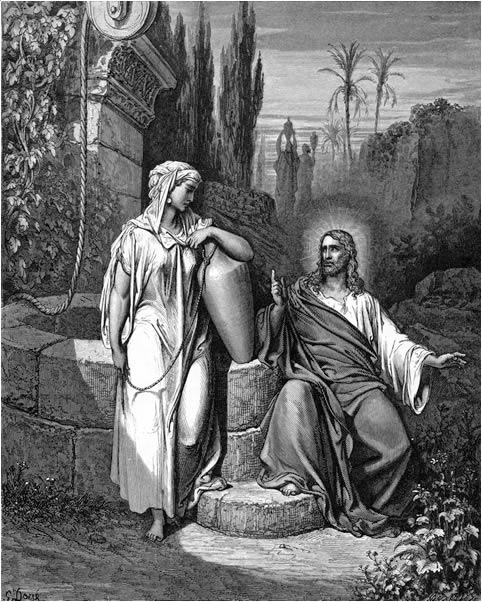
in John 4Just then His disciples returned and were surprised that He was speaking with a woman. But no one asked Him, “What do You want from her?” or “Why are You talking with her?”
BSB
The same verse in ASV and KJV ▾
ASV
And upon this came his disciples; and they marvelled that he was speaking with a woman; yet no man said, What seekest thou? or, Why speakest thou with her?
KJV
And upon this came his disciples, and marvelled that he talked with the woman: yet no man said, What seekest thou? or, Why talkest thou with her?
⋯
This verse in John 4
Commentary
21 notes on this verseWe learn that he is meek and lowly in heart and does not disdain to speak of such great matters with a woman carrying water who goes out of the city because of her great poverty and labors to draw water for herself. When the disciples arrive they are amazed, for they previously beheld the greatness of the divinity in him, and they marvel that so great a man was speaking with a woman.
This site's exposition
surprised that He was speaking with a woman
The disciples come back and find their teacher talking with a woman in the open, which a rabbi of that day avoided. Their surprise stands in the two questions John records them holding back. No one asks Him anything.
The record, by era
The Church Fathers5 voices
(Tr. xv. c. 29) He who came to seek that which was lost, sought the lost one. This was what they marvelled at: they marvelled at His goodness; they did not suspect evil.
"And immediately came His disciples, and marvelled that He talked with the woman." That He was seeking her that was lost, He who came to seek that which was lost: they marvelled at this. They marvelled at a good thing, they were not suspecting an evil thing. "Yet no man said, What seekest Thou, or why talkest Thou with her?"
And, not to extend our discourse to too great length, what shall we say concerning our Lord Jesus Christ? Our Lord Himself was constantly with His twelve disciples when He had come forth to the world. And not only so; but also, when He was …
A commentator
Cyril of AlexandriaCommentary on the Gospel of John, Book 2 · Written before 444.
proposed
and marvelled that He talked with the woman: The disciples again are astonished at the gentleness of the Saviour, and wonder at His meek way. For not after the manner of some who are fierce with unslacked religion, did He think right to shun conversation with the woman, but unfolds His Loving-kindness to all, and hereby shews, that He being wholly One Artificer, doth not to men alone impart the life through faith, but snareth the female race also thereto. Let him that teacheth in the Church gain this too as a pattern, and not refuse to help women. For one must in every thing follow not one's own will, but the service of preaching.
A commentator
Cyril of AlexandriaCommentary on the Gospel of John, Book 2 · Written before 444.
proposed
yet no man said, What seekest Thou? or, Why talkest Thou with her? It was the work of wise disciples, and knowing how to preserve their Master's honour, not to seem by their superfluous questions to be going off into strange surmises, because He was talking with a woman, but rather in reverence and fear to restrain their tongue within their teeth, and to await their Lord speaking of His own accord, and giving them a voluntary explanation. We must therefore herein marvel at Christ for His gentleness, at the disciples for their wisdom and understanding and knowledge of what is becoming.
14 more voices on this verse
The Church Fathers2 voices
A commentator
Cyril of AlexandriaCommentary on the Gospel of John, Book 2 · Written before 444.
proposed
And upon this came His disciples The presence of the disciples is the conclusion of His conversation with the woman. For the Saviour is at length silent, and having placed in the Samaritans the glowing spark of the faith, commits it to their inward parts to be kindled to a mighty flame. Thus you may understand what was said by Him, I am come to send fire on the earth, and what will I, if it be already kindled?
"And upon this came His disciples," (very seasonably did they come when the teaching was finished,) "and marveled that He talked with the woman, yet no man said, What seekest Thou? or, Why talkest Thou with her?" At what did they marvel? At His want of pride and exceeding humility, that looked upon as He was, He endured with such lowliness of heart to talk with a woman poor, and a Samaritan. Still in their amazement they did not ask Him the reason, so well were they taught to keep the station of disciples, so much did they fear and reverence Him. For although they did not as yet hold the right opinion concerning Him, still they gave heed unto Him as to some marvelous one, and paid Him much respect. Yet they frequently are seen to act confidently; as when John lay upon His bosom, when they came to Him and said, "Who is the greatest in the Kingdom of Heaven?", when the sons of Zebedee entreated Him to set one of them on His right hand, and the other on His left. Why then did they not here question Him? Because since all those instances related to themselves, they had need to enquire into them, while what here took place was of no such great importance to them.
The Medieval Church3 voices
"And immediately his disciples came and marveled that he was speaking with a woman." They admired his clemency and condescension. Augustine: "They admired the good; they did not suspect evil." And this admiration did not lead to questioning but to reverence and fear. Therefore he …
While the conversation with the woman and the teaching were already coming to an end, the disciples came and marveled at His humility, by which He spoke with such condescension to a woman who was poor and a Samaritan, whereas He was held in glory …
After presenting the teaching on spiritual water, the Evangelist now deals with the effect of this teaching. First, he sets down the effect itself. Secondly, he elaborates on it (v 31). The effect of this teaching is its fruit for those who believe. And first …
The Puritans and the Awakening2 voices
And upon this came his disciples,.... Just as he was saying the above words, and making himself known in this full manner, his disciples, who had been into the city to buy food, came up to them: and marvelled that he talked with the woman; or with a woman; for, according to the Jewish canons, it was not judged decent, right, and proper, nor indeed lawful, to enter into a conversation, or hold any long discourse with a woman.
His disciples marvelled that he talked with a woman - Which the Jewish rabbis reckoned scandalous for a man of distinction to do. They marvelled likewise at his talking with a woman of that nation, which was so peculiarly hateful to the Jews. Yet none said - To the woman, What seekest thou? - Or to Christ, Why talkest thou with her?
The Nineteenth Century7 voices
A commentator
Albert Barnes1798–1870
Notes, Explanatory and Practical, on the Old and New Testaments (1832-1869)
Upon this - At this time. Marvelled - Wondered. They wondered because the Jews had no contact with the Samaritans, and they were surprised that Jesus was engaged with her in conversation. Yet no man said - No one of the disciples. They had such respect and reverence for him that they did not dare to ask him the reason of his conduct, or even to appear to reprove him. We should be confident that Jesus is right, even if we cannot fully understand all that he does.
Behold our Lord and Master with divinely skillful art seeking after a single soul! We must have large Congregations or we are disinclined for soul-winning. The habit of the age is to do nothing but what is ostentatious—every work must be with beat of drum or sound of tambourine! I pray that the Lord may work in us the steadfast desire to do good on the quiet, by stealth, when no one looks on, when not a single disciple is near.
A commentator
Jamieson, Fausset & Brown1802–1910
Commentary Critical and Explanatory on the Whole Bible (1871)
proposed
marvelled that he talked with the woman--It never probably occurred to them to marvel that He talked with themselves; yet in His eye, as the sequel shows, He was quite as nobly employed. How poor, if not false, are many of our most plausible estimates! no man said . . .
quarantine:debris (2026-07-29) — starts-lowercase
A commentator
J.C. Ryle1816–1900
Expository Thoughts on the Gospels: John (lightly modernized text, Grace Gems edition) (1869)
proposed
These verses continue the well-known story of the Samaritan woman's conversion. Short as the passage may appear, it contains points of deep interest and importance. The mere worldling, who cares, nothing about experimental religion, may see nothing particular in these verses. To all who desire to know something of the experience of a converted person, they will be found full of food for thought. We see, firstly, in this passage, how marvelous in the eyes of man are Christ's dealings with souls. We are told that the disciples "marveled that he talked with the woman."
A commentator
J.C. Ryle1816–1900
Expository Thoughts on the Gospels: John (lightly modernized text, Grace Gems edition) (1869)
proposed
These verses continue the well-known story of the Samaritan woman's conversion. Short as the passage may appear, it contains points of deep interest and importance. The mere worldling, who cares, nothing about experimental religion, may see nothing particular in these verses. To all who desire to know something of the experience of a converted person, they will be found full of food for thought. We see, firstly, in this passage, how marvelous in the eyes of man are Christ's dealings with souls. We are told that the disciples "marveled that he talked with the woman." That their Master should take the trouble to talk to a woman at all, and to a Samaritan woman, and to an adulterous woman at a well, when He was wearied with His journey—all this was amazing to the eleven disciples. It was a sort of thing which they did not expect. It was contrary to their idea of what a religious teacher should do. It startled them and filled them with surprise. The feeling displayed by the disciples on this occasion, does not stand alone in the Bible. When our Lord allowed publicans and sinners to draw near to Him and be in His company, the Pharisees marveled. They exclaimed, "This man receives sinners and eats with them." (Luke 15:2.). When Saul came back from Damascus, a converted man and a new creature, the Christians at Jerusalem were astonished. "They did not believe that he was a disciple." (Acts 9:26.). When Peter was delivered from Herod's prison by an angel, and brought to the door of the house where disciples were praying for his deliverance, they were so taken by surprise that they could not believe it was Peter. "When they saw him they were astonished." (Acts 12:16.) But why should we stop short in Bible instances? The true Christian has only to look around him in this world in order to see abundant illustrations of the truth before us.
Behold our Lord and Master with divinely skillful art seeking after a single soul! We must have large Congregations or we are disinclined for soul-winning. The habit of the age is to do nothing but what is ostentatious—every work must be with beat of drum or sound of tambourine! I pray that the Lord may work in us the steadfast desire to do good on the quiet, by stealth, when no one looks on, when not a single disciple is near. Oh that we may have such an estimate of the value of a single soul that we count whole days well spent to bring one fallen woman or one drunk to the Savior's feet! Blessed is he who works on though he is never heard of and looks for his reward from his Master. In the heat of the day the Lord Jesus found rest and refreshment in speaking to one whom many would scarcely look upon except with eyes of scorn. Blessed Savior, we do not marvel, as the disciples did, that You did speak with the woman, but we do wonder with a higher kind of astonishment that You ever did speak to the likes of us who have so sadly fallen, done You dishonor and grieved Your heart! We are amazed that He who is the Glory of Heaven, "Light of light, very God of very God," should shroud Himself in the likeness of sinful flesh and, being found in fashion as a Man, should seek after us unworthy ones. Oh, the compassion of the Redeemer's heart! Read this chapter through carefully and see the skill which that compassion taught Him. How sweetly ready He was to converse with her and take up her questions. Never imagine that the 30 years of retirement at Nazareth were wasted. I would gladly go, if I were young, for 30 years to learn how to talk as He did, if His own Spirit would teach me the lesson. He was a perfect Teacher because as Man, He had lent a willing ear to the heavenly instruction of the Holy Spirit and, therefore, grew in knowledge and fitness for His work.
Came his disciples - From the town, whither they went to buy food, Joh 4:8. Marveled that he talked with the woman - Because it was contrary to the custom of the eastern countries; and there are many canons, among the rabbins, against it. To the present time, if a man meet even his own wife in the street, he does not speak to her; and this is done to keep up the appearance of a chastity and temperance of which the eastern world knows nothing. They might wonder how a Samaritan, in whom they could expect no spirituality, could listen to the conversation of their Master, who never spake but about heavenly things. Yet no man said, etc. - They were awed by his majesty, and knew that he must have sufficient reasons to induce him to act a part to which he was not at all accustomed. A great man has said, “Converse sparingly, if at all, with women; and never alone.” Every minister of the Gospel will do well to attend to this advice.
The words behind it
23 Greek wordsEvery Greek word of this verse in the order it stands, with what it means and the door to its own study. The last column counts the times a word stands in the whole Bible: the rarer the word, the more the places it appears belong together.
| Greek | Sound | Meaning | Word study | In the Bible |
|---|---|---|---|---|
| καὶ | kai | And | G2532 → | 9120 times |
| ἐπὶ | epi | upon | G1909 → | 883 times |
| τούτῳ | touto | this | G3778 → | 1381 times |
| ἦλθαν | elthan | came | G2064 → | 628 times |
| οἱ | hoi | the | G3588 → | 19766 times |
| μαθηταὶ | mathetai | disciples | G3101 → | 260 times |
| αὐτοῦ | autou | of Him | G846 → | 5565 times |
| καὶ | kai | and | G2532 → | 9120 times |
| ἐθαύμαζον | ethaumazon | were amazed | G2296 → | 43 times |
| ὅτι | hoti | that | G3754 → | 1292 times |
| μετὰ | meta | with | G3326 → | 461 times |
| γυναικὸς | gunaikos | a woman | G1135 → | 211 times |
| ἐλάλει· | elalei | He was speaking; | G2980 → | 294 times |
| οὐδεὶς | oudeis | no [one] | G3762 → | 232 times |
| μέντοι | mentoi | however | G3305 → | 8 times |
| εἶπεν· | eipen | said; | G2036 → | 925 times |
| τί | ti | What | G5101 → | 563 times |
| ζητεῖς, | zeteis | seek You? | G2212 → | 117 times |
| ἢ | e | Or | G2228 → | 342 times |
| τί | ti | Why | G5101 → | 563 times |
| λαλεῖς | laleis | speak You | G2980 → | 294 times |
| μετ᾽ | met᾽ | with | G3326 → | 461 times |
| αὐτῆς;¶ | autes | her? | G846 → | 5565 times |
καὶAnd
kaiG2532 →9120 times
ἐπὶupon
epiG1909 →883 times
τούτῳthis
toutoG3778 →1381 times
ἦλθανcame
elthanG2064 →628 times
οἱthe
hoiG3588 →19766 times
μαθηταὶdisciples
mathetaiG3101 →260 times
αὐτοῦof Him
autouG846 →5565 times
καὶand
kaiG2532 →9120 times
ἐθαύμαζονwere amazed
ethaumazonG2296 →43 times
ὅτιthat
hotiG3754 →1292 times
μετὰwith
metaG3326 →461 times
γυναικὸςa woman
gunaikosG1135 →211 times
ἐλάλει·He was speaking;
elaleiG2980 →294 times
οὐδεὶςno [one]
oudeisG3762 →232 times
μέντοιhowever
mentoiG3305 →8 times
εἶπεν·said;
eipenG2036 →925 times
τίWhat
tiG5101 →563 times
ζητεῖς,seek You?
zeteisG2212 →117 times
ἢOr
eG2228 →342 times
τίWhy
tiG5101 →563 times
λαλεῖςspeak You
laleisG2980 →294 times
μετ᾽with
met᾽G3326 →461 times
αὐτῆς;¶her?
autesG846 →5565 times
A shaded row is a word that stands 400 times or fewer in the Bible.
The walk
5 stopsEach card is a verse this one points to, and under it the verses that one points to in turn. Where several paths arrive at the same place, that place is listed first: the text keeps returning to it.
Through
Luke 7:39When the Pharisee who had invited Jesus saw this, he said to himself, “If this man were a prophet, He would know who this is and what kind of woman is touching Him—for she…
it leads to
- Luke 7:16
A sense of awe swept over all of them, and they glorified God. “A great prophet has appeared among us!” they said. “God has visited His people!”
- Luke 15:2
So the Pharisees and scribes began to grumble: “This man welcomes sinners and eats with them.”
- Isaiah 65:5
They say, ‘Keep to yourself; do not come near me, for I am holier than you!’ Such people are smoke in My nostrils, a fire that burns all day long.
- Mark 7:21
For from within the hearts of men come evil thoughts, sexual immorality, theft, murder, adultery,
- Proverbs 23:7
for he is keeping track, inwardly counting the cost. “Eat and drink,” he says to you, but his heart is not with you.
- Luke 7:16
Where this verse is studied
On this page
Studies8
About John
This page draws on 18 works. Open the list of works
This page draws on Adam Clarke, Commentary on the Bible; Albert Barnes, Notes, Explanatory and Practical, on the Gospels; Albert Barnes, Notes, Explanatory and Practical, on the Old and New Testaments (1832-1869); Augustine of Hippo, Catena Aurea by Aquinas; Augustine of Hippo, Tractates on John 15; Bonaventure, Commentary on John, Chapter 4; Charles Spurgeon, The Metropolitan Tabernacle Pulpit, Sermon No. 1678: “The Samaritan Woman and Her Mission” (lightly modernized text, CCEL edition); Cyril of Alexandria, Commentary on the Gospel of John, Book 2; J.C. Ryle, Expository Thoughts on the Gospels: John (lightly modernized text, Grace Gems edition); Jamieson, Fausset & Brown, Commentary Critical and Explanatory on the Whole Bible; John Chrysostom, Homily on the Gospel of John 33; John Gill, Exposition of the New Testament; John Gill, Exposition of the New Testament (1746-1748); John Wesley, Explanatory Notes upon the New Testament; Origen of Alexandria, COMMENTARY ON THE GOSPEL OF JOHN 13.166-67; Pseudo-Clement, Two Epistles on Virginity; Theophylact of Ohrid, Commentary on John and Thomas Aquinas, Commentary on John.