
John 4:19
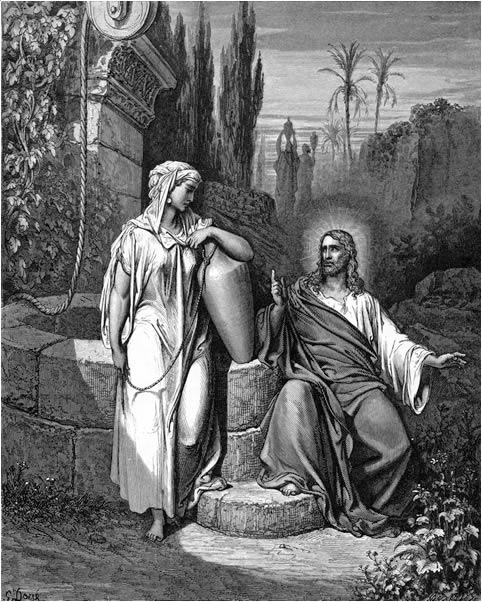
in John 4“Sir,” the woman said, “I see that You are a prophet.
BSB
The same verse in ASV and KJV ▾
ASV
The woman saith unto him, Sir, I perceive that thou art a prophet.
KJV
The woman saith unto him, Sir, I perceive that thou art a prophet.
⋯
This verse in John 4
Commentary
17 notes on this verseWith difficulty does she brighten up to apprehension, and that again not yet perfect. For she still calls the Lord of Prophets a Prophet. But she has by degrees shown herself better than before, in no way ashamed at reproof, seizing to her own profit the force of the sign and so going forth from her effeminate understanding, attaining to some extent to a vigorous mind, and stretching forth the eye of her heart to an unwonted view of things.
This site's exposition
You are a prophet
on John 4:19-20
A stranger who knows her history is a prophet in her eyes, and she puts the old dispute to Him. This mountain is Gerizim, where the Samaritans held Moses had appointed the altar, against Jerusalem, where the temple stood. She asks a prophet to settle it.
The record, by era
The Church Fathers5 voices
(Tr. xv. c. 23) The husband was beginning to come to her, though He had not yet fully come. She thought our Lord a prophet, and He was a prophet: for He says of Himself, A prophet is not without honour, save in his own country. (Mat. 13:57)
"The woman saith unto Him, Sir, I see that thou art a prophet." The husband begins to come, he is not yet fully come. She accounted the Lord a prophet, and a prophet indeed He was; for it was of Himself He said, that "a prophet is not without honor, save in his own country." Again, of Him it was said to Moses, "A Prophet will I raise up to them of their brethren, like unto thee." Like, namely, as to the form of the flesh, but not in the eminence of His majesty. Accordingly we find the Lord Jesus called a Prophet. Hence this woman is now not far wrong. "I see," she saith, "that thou art a prophet." She begins to call the husband, and to shut out the paramour.
Then when she suspected this, she asks Him nothing concerning this life, not concerning bodily health, or possessions, or wealth, but at once concerning doctrines. For what saith she? "Our fathers worshiped in this mountain," (meaning Abraham and his family, for thither they say that he led up his son,) "and how say ye that in Jerusalem is the place where men ought to worship?" Seest thou how much more elevated in mind she has become? She who was anxious that she might not be troubled for thirst, now questions concerning doctrines. What then doth Christ? He doth not resolve the question, (for to answer simply to men's words was not His care, for it was needless,) but leads the woman on to the greater height, and doth not converse with her on these matters, until she has confessed that He was a Prophet, so that afterwards she might hear His Word with abundant belief; for having been persuaded of this, she could no longer doubt concerning what should be said to her.
O how great the wisdom of the woman! how meekly doth she receive the reproof! "How should she not," saith some one? Tell me, why should she? Did He not often reprove the Jews also, and with greater reproofs than these? (for it is not the same to bring forward the hidden thoughts of the heart, as to make manifest a thing that was done in secret; the first are known to God alone, and none other knoweth them but he who hath them in his heart; the second, all who were sharers in it know;) but still when reproved did not bear it patiently. When He said, "Why seek ye to kill me?" (c. vii. 19), they not only did not admire as the woman did but even mocked at and insulted Him; yet they had a demonstration from other miracles, she had only heard this speech. Still they not only did not admire, but even insulted Him, saying, "Thou hast a demon, who seeketh to kill thee?" While she not only doth not insult but admires, and is astonished at Him, and supposes Him to be a Prophet. Yet truly this rebuke touched the woman more than the other touched them; for her fault was hers alone, theirs was a general one; and we are not so much stung by what is general as by what is particular. Besides they thought they should be gaining a great object if they could slay Christ, but that which the woman had done was allowed by all to be wicked; yet was she not indignant, but was astonished and wondered.
Christ having heard this, now seasonably introduces His reproof, mentioning accurately both points; for He enumerated all her former husbands, and reproved her for him whom she now would hide. What then did the woman? she was not annoyed, nor did she leave Him and fly, nor deem the thing an insult, but rather admired Him, and persevered the more. "I perceive," saith she, "that Thou art a Prophet." Observe her prudence; she did not straightway run to Him, but still considers Him, and marvels at Him. For, "I perceive," means, "Thou appearest to me to be a Prophet."
10 more voices on this verse
The Medieval Church3 voices
The second point is touched upon here: for after he revealed the secret, he makes clear the doubt. For the woman, seeing that the Lord was a knower of secrets, puts forward her own uncertainty to be resolved; on account of which she says: "The …
Now the Evangelist treats of the request by which the gift is obtained, which is prayer. First there is the woman's inquiry about prayer. Secondly, Christ's answer (v 21). Concerning the first the woman does two things. First, she admits that Christ is qualified to …
Did she not become annoyed upon hearing this? Did she not leave Him and run away? No, she was even more amazed, even more strengthened, and says: "Lord, I see that You are a prophet"; and she asks Him about divine matters, not about worldly …
The Puritans and the Awakening2 voices
It was agreed between the Jews and the Samaritans that God is to be worshipped (even those who were such fools as to worship false gods were not such brutes as to worship none), and that religious worship is an affair of great importance: men would not contend about it if they were not concerned about it.
The woman saith unto him, Sir,....
The Nineteenth Century4 voices
A commentator
Albert Barnes1798–1870
Notes, Explanatory and Practical, on the Old and New Testaments (1832-1869)
A prophet - One sent from God, and who understood her life. The word here does not denote one who foretells future events, but one who knew her heart and life, and who must therefore have come from God. She did not yet suppose him to be the Messiah, Joh 4:25. Believing him now to be a man sent from God, she proposed to him a question respecting the proper place of worship. This point had been long a matter of dispute between the Samaritans and the Jews.
A commentator
J.C. Ryle1816–1900
Expository Thoughts on the Gospels: John (lightly modernized text, Grace Gems edition) (1869)
proposed
Conversation With a Samaritan Woman But he had to pass through Samaria. Now he came to a Samaritan town called Sychar, near the plot of land that Jacob had given to his son Joseph. Jacob’s well was there, so Jesus, since he was tired from the journey, sat right down beside the well. It was about noon. A Samaritan woman came to draw water. Jesus said to her, "Give me some water to drink." (For his disciples had gone off into the town to buy supplies.)
A commentator
J.C. Ryle1816–1900
Expository Thoughts on the Gospels: John (lightly modernized text, Grace Gems edition) (1869)
proposed
Conversation With a Samaritan Woman But he had to pass through Samaria. Now he came to a Samaritan town called Sychar, near the plot of land that Jacob had given to his son Joseph. Jacob’s well was there, so Jesus, since he was tired from the journey, sat right down beside the well. It was about noon. A Samaritan woman came to draw water. Jesus said to her, "Give me some water to drink." (For his disciples had gone off into the town to buy supplies.) So the Samaritan woman said to him, "How can you—a Jew—ask me, a Samaritan woman, for water to drink?" (For Jews use nothing in common with Samaritans.) Jesus answered her, "If you had known the gift of God and who it is who said to you, ‘Give me some water to drink,’ you would have asked him, and he would have given you living water." "Sir," the woman said to him, "you have no bucket and the well is deep; where then do you get this living water? Surely you’re not greater than our ancestor Jacob, are you? For he gave us this well and drank from it himself, along with his sons and his livestock." Jesus replied, "Everyone who drinks some of this water will be thirsty again. But whoever drinks some of the water that I will give him will never be thirsty again, but the water that I will give him will become in him a fountain of water springing up to eternal life." The woman said to him, "Sir, give me this water, so that I will not be thirsty or have to come here to draw water." He said to her, "Go call your husband and come back here." The woman replied, "I have no husband." Jesus said to her, "Right you are when you said, ‘I have no husband,’ for you have had five husbands and the man you are living with now is not your husband. This you said truthfully!" The woman said to him, "Sir, I see that you are a prophet.
I perceive that thou art a prophet - And therefore thought him well qualified to decide the grand question in dispute between the Jews and the Samaritans: but she did not perceive him to be the Messiah.
Modern Voices1 voice
In John 4, Jesus' encounter with the Samaritan woman is itself a Purim-style reversal the rejected becomes chosen, the overlooked becomes entrusted, and the outsider becomes the first to hear a clear declaration of Messiah.
The words behind it
10 Greek wordsEvery Greek word of this verse in the order it stands, with what it means and the door to its own study. The last column counts the times a word stands in the whole Bible: the rarer the word, the more the places it appears belong together.
| Greek | Sound | Meaning | Word study | In the Bible |
|---|---|---|---|---|
| Λέγει | legei | Says | G3004 → | 1325 times |
| αὐτῷ | auto | to Him | G846 → | 5565 times |
| ἡ | he | the | G3588 → | 19766 times |
| γυνή· | gune | woman; | G1135 → | 211 times |
| κύριε, | kurie | Sir, | G2962 → | 711 times |
| θεωρῶ | theoro | I understand | G2334 → | 58 times |
| ὅτι | hoti | that | G3754 → | 1292 times |
| προφήτης | prophetes | a prophet | G4396 → | 144 times |
| εἶ | ei | are | G1510 → | 2333 times |
| σύ. | su | You yourself. | G4771 → | 2973 times |
ΛέγειSays
legeiG3004 →1325 times
αὐτῷto Him
autoG846 →5565 times
ἡthe
heG3588 →19766 times
γυνή·woman;
guneG1135 →211 times
κύριε,Sir,
kurieG2962 →711 times
θεωρῶI understand
theoroG2334 →58 times
ὅτιthat
hotiG3754 →1292 times
προφήτηςa prophet
prophetesG4396 →144 times
εἶare
eiG1510 →2333 times
σύ.You yourself.
suG4771 →2973 times
A shaded row is a word that stands 400 times or fewer in the Bible.
The walk
8 stopsEach card is a verse this one points to, and under it the verses that one points to in turn. Where several paths arrive at the same place, that place is listed first: the text keeps returning to it.
Through
John 6:14When the people saw the sign that Jesus had performed, they began to say, “Truly this is the Prophet who is to come into the world.”
it leads to
- Matthew 21:11
The crowds replied, “This is Jesus, the prophet from Nazareth in Galilee.”
Reached by 3 separate paths from here.
- Deuteronomy 18:15–18
The LORD your God will raise up for you a prophet like me from among your brothers. You must listen to him.
- Acts 7:37
This is the same Moses who told the Israelites, ‘God will raise up for you a prophet like me from among your brothers.’
- Matthew 11:3
to ask Him, “Are You the One who was to come, or should we look for someone else?”
- Acts 3:22–24
For Moses said, ‘The Lord your God will raise up for you a prophet like me from among your brothers. You must listen to Him in everything He tells you.
- Matthew 21:11
Through
Luke 7:39When the Pharisee who had invited Jesus saw this, he said to himself, “If this man were a prophet, He would know who this is and what kind of woman is touching Him—for she…
it leads to
Through
Luke 7:16A sense of awe swept over all of them, and they glorified God. “A great prophet has appeared among us!” they said. “God has visited His people!”
it leads to
- Matthew 9:8
When the crowds saw this, they were filled with awe and glorified God, who had given such authority to men.
- Matthew 9:8
Where this verse is studied
About John
This page draws on 15 works. Open the list of works
This page draws on Adam Clarke, Commentary on the Bible; Albert Barnes, Notes, Explanatory and Practical, on the Old and New Testaments (1832-1869); Augustine of Hippo, Catena Aurea by Aquinas; Augustine of Hippo, Tractates on John 15; Bonaventure, Commentary on John, Chapter 4; Cyril of Alexandria, Commentary on the Gospel of John, Book 2; J.C. Ryle, Expository Thoughts on the Gospels: John (lightly modernized text, Grace Gems edition); Jamieson, Fausset & Brown, Commentary Critical and Explanatory on the Whole Bible; Jane Hamon, PURIM – A TIME FOR REVERSALS!!; John Chrysostom, Homily on the Gospel of John 32; John Gill, Exposition of the New Testament (1746-1748); John Lightfoot, Horae Hebraicae et Talmudicae on John; Matthew Henry, Commentary on the Whole Bible; Theophylact of Ohrid, Commentary on John and Thomas Aquinas, Commentary on John.