
John 4:16
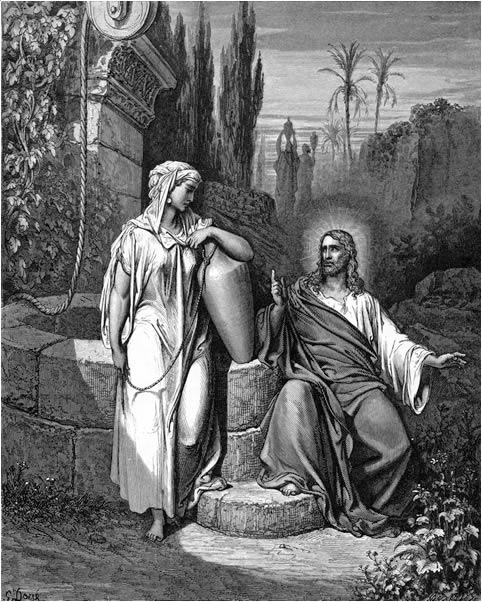
in John 4Jesus told her, “Go, call your husband and come back.”
BSB
The same verse in ASV and KJV ▾
ASV
Jesus saith unto her, Go, call thy husband, and come hither.
KJV
Jesus saith unto her, Go, call thy husband, and come hither.
⋯
This verse in John 4
Commentary
21 notes on this verseCall thy husband - Our Lord appears to have spoken these words for two purposes: 1. To make the woman consider her own state. 2. To show her that he knew her heart, and the secret actions of her life; and was therefore well qualified to teach her heavenly truths.
This site's exposition
Go, call your husband and come back
on John 4:16-18
The command reaches the one subject she had kept back, and her short answer is true as far as it goes. Jesus fills in the rest, five husbands and a sixth man she lives with now. He calls her words truthful and leaves the charge there.
The record, by era
The Church Fathers5 voices
At length, wishing her to understand, "Jesus saith unto her, Go, call thy husband, and come hither." What means this, "Call thy husband"? Was it through her husband that He wished to give her that water? Or, because she did not understand, did He wish to teach her through her husband? Perhaps it was as the apostle says concerning women, "If they wish to learn anything, let them ask their husbands at home." But this the apostle says of that where there is no Jesus present to teach. It is said, in short, to women whom the apostle was forbidding to speak in the Church. But when the Lord Himself was at hand, and in person speaking to her, what need was there that He should speak to her by her husband? Was it through her husband that he spoke to Mary, while sitting at His feet and receiving His word; while Martha, wholly occupied with much serving, murmured at the happiness of her sister? Wherefore, my brethren, let us hear and understand what it is that the Lord says to the woman, "Call thy husband." For it may be that He is saying also to our soul, "Call thy husband." Let us inquire also concerning the soul's husband. Why, is not Jesus Himself already the soul's real husband? Let the understanding be present, since what we are about to say can hardly be apprehended but by attentive hearers: therefore let the understanding be present to apprehend, and perhaps that same understanding will be found to be the husband of the soul.
Now Jesus, seeing that the woman did not understand, and willing her to understand, says to her, "Call thy husband." "For the reason why thou knowest not what I say is, because thy understanding is not present: I am speaking after the Spirit, and thou art hearing after the flesh. The things which I speak relate neither to the pleasure of the ears, nor to the eyes, nor to the smell, nor to the taste, nor to the touch; by the mind alone are they received, by the understanding alone are they drawn up: that understanding is not with thee, how canst thou apprehend what I am saying? `Call thy husband,' bring thy understanding forward. What is it for thee to have a soul? It is not much, for a beast has a soul. Wherein art thou better than the beast? In having understanding, which the beast has not." Then what is "Call thy husband"? "Thou dost not apprehend me, thou dost not understand me: I am speaking to thee of the gift of God, and thy thought is of the flesh; thou wishest not to thirst in a carnal sense, I am addressing myself to the spirit: thy understanding is absent. `Call thy husband.' Be not as the horse and mule, which have no understanding." Therefore, my brethren, to have a soul, and not to have understanding, that is, not to use it, not to live according to it, is a beast's life. For we have somewhat in common with the beasts, that by which we live in the flesh, but it must be ruled by the understanding. For the motions of the soul, which moves after the flesh, and longs to run unrestrainedly loose after carnal delights, are ruled over by the understanding. Which is to be called the husband?-that which rules, or that which is ruled? Without doubt, when the life is well ordered the understanding rules the soul, for itself belongs to the soul. […]
A commentator
Origen of AlexandriaCOMMENTARY ON THE GOSPEL OF JOHN 13.50 · Written before 253.
proposed
She already had, as it were, something of the water that leaps into eternal life since she had said … "I have no husband," having condemned herself on the basis of her association with such a husband.
But further, if Christ reproves the scribes and Pharisees, sitting in the official chair of Moses, but not doing what they taught, what kind of (supposition). is it that He Himself withal should set upon His own official chair men who were mindful rather to enjoin-(but) not likewise to practise-sanctity of the flesh, which (sanctity) He had in all ways recommended to their teaching and practising?-first by His own example, then by all other arguments; while He tells (them) that "the kingdom of heavens" is "children's; " while He associates with these (children) others who, after marriage, remained (or became)virgins; " while He calls (them) to (copy) the simplicity of the dove, a bird not merely innocuous, but modest too, and whereof one male knows one female; while He denies the Samaritan woman's (partner to be) a husband, that He may show that manifold husbandry is adultery; while, in the revelation of His own glory, He prefers, from among so many saints and prophets, to have with him Moses and Elias -the one a monogamist, the other a voluntary celibate (for Elias was nothing else than John, who came "in the power and spirit of Elias" ); while that "man gluttonous and toping," the "frequenter of luncheons and suppers, in the company of publicans and sinners," sups once for all at a single marriage, though, of course, many were marrying (around Him); for He willed to attend (marriages) only so often as (He willed) them to be.
(Hom. xxxii. 2) The woman then being urgent in asking for the promised water, Jesus saith unto her, Go call thy husband; to show that he too ought to have a share in these things.
14 more voices on this verse
The Church Fathers2 voices
"And what kind of connection," saith some one, "is there in the saying, `Go, call thy husband'?" The discourse was concerning a gift and grace surpassing mortal nature: the woman was urgent in seeking to receive it. Christ saith, "Call thy husband," showing that he also must share in these things; but she, eager to receive (the gift), and concealing the shamefulness of the circumstances, and supposing that she was conversing with a man, said, "I have no husband." Christ having heard this, now seasonably introduces His reproof, mentioning accurately both points; for He enumerated all her former husbands, and reproved her for him whom she now would hide.
A commentator
Cyril of AlexandriaCommentary on the Gospel of John, Book 2 · Written before 444.
proposed
Go call thy husband, and come hither. Well and not untruly might one say, that the minds of woman are womanish, and that an effeminate soul is in them, never having the power of understanding readily. But the nature of man somehow is apter for learning, and far more ready for reasoning, having a mind awake to wisdom, and (so to say) warm, and of matured manhood.
The Medieval Church3 voices
Seeing that she insists on receiving, and urges Him to give, He says: "Call your husband," as if showing that he too must share with you in this gift of Mine.
"Jesus says to her: Go, call your husband," not through marriage, but through misuse, "and come here." He was not saying this because he believed she had a husband, but so that he might reveal the secret about her husband to her as she responded.
Then (v 16), the answer of Jesus is given. Here we should note that our Lord answered her in a spiritual way, but she understood in a sensual way. Accordingly, this can be explained in two ways. One way is that of Chrysostom, who says …
The Puritans and the Awakening3 voices
And this is the method of dealing with souls; they must first be made weary and heavy-laden under the burden of sin, and then brought to Christ for rest; first pricked to the heart, and then healed. This is the course of spiritual physic; and if we proceed not in this order we begin at the wrong end. Observe, (1.) How discreetly and decently Christ introduces this discourse (
quarantine:debris (2026-07-29) — unbalanced-parens
Call thy husband, that he may be witness to what passes between us." Christ would thus teach us to provide things honest in the sight of all men, and to study that which is of good report. [2.] As it had a good colour, so it had a good design; for hence he would take occasion to call her sin to remembrance.
quarantine:debris (2026-07-29) — odd-straight-quotes
Jesus saith unto her,....
The Nineteenth Century5 voices
A commentator
Jamieson, Fausset & Brown1802–1910
Commentary Critical and Explanatory on the Whole Bible (1871)
proposed
give me this water, &c.--This is not obtuseness--that is giving way--it expresses a wondering desire after she scarce knew what from this mysterious Stranger.
quarantine:debris (2026-07-29) — starts-lowercase
A commentator
Jamieson, Fausset & Brown1802–1910
Commentary Critical and Explanatory on the Whole Bible (1871)
proposed
He will be able to settle that interminable dispute between us and the Jews. Sir, you must know all about such matters--our fathers hold to this mountain here," pointing to Gerizim in Samaria, "as the divinely consecrated place of worship, but ye Jews say that Jerusalem is the proper place--which of us is right?" How slowly does the human heart submit to thorough humiliation!
quarantine:debris (2026-07-29) — odd-straight-quotes
A commentator
J.C. Ryle1816–1900
Expository Thoughts on the Gospels: John (lightly modernized text, Grace Gems edition) (1869)
proposed
Conversation With a Samaritan Woman But he had to pass through Samaria. Now he came to a Samaritan town called Sychar, near the plot of land that Jacob had given to his son Joseph. Jacob’s well was there, so Jesus, since he was tired from the journey, sat right down beside the well. It was about noon. A Samaritan woman came to draw water. Jesus said to her, "Give me some water to drink." (For his disciples had gone off into the town to buy supplies.)
A commentator
J.C. Ryle1816–1900
Expository Thoughts on the Gospels: John (lightly modernized text, Grace Gems edition) (1869)
proposed
Conversation With a Samaritan Woman But he had to pass through Samaria. Now he came to a Samaritan town called Sychar, near the plot of land that Jacob had given to his son Joseph. Jacob’s well was there, so Jesus, since he was tired from the journey, sat right down beside the well. It was about noon. A Samaritan woman came to draw water. Jesus said to her, "Give me some water to drink." (For his disciples had gone off into the town to buy supplies.) So the Samaritan woman said to him, "How can you—a Jew—ask me, a Samaritan woman, for water to drink?" (For Jews use nothing in common with Samaritans.) Jesus answered her, "If you had known the gift of God and who it is who said to you, ‘Give me some water to drink,’ you would have asked him, and he would have given you living water." "Sir," the woman said to him, "you have no bucket and the well is deep; where then do you get this living water? Surely you’re not greater than our ancestor Jacob, are you? For he gave us this well and drank from it himself, along with his sons and his livestock." Jesus replied, "Everyone who drinks some of this water will be thirsty again. But whoever drinks some of the water that I will give him will never be thirsty again, but the water that I will give him will become in him a fountain of water springing up to eternal life." The woman said to him, "Sir, give me this water, so that I will not be thirsty or have to come here to draw water." He said to her, "Go call your husband and come back here." The woman replied, "I have no husband." Jesus said to her, "Right you are when you said, ‘I have no husband,’ for you have had five husbands and the man you are living with now is not your husband. This you said truthfully!" The woman said to him, "Sir, I see that you are a prophet.
A commentator
Albert Barnes1798–1870
Notes, Explanatory and Practical, on the Old and New Testaments (1832-1869)
proposed
Go call thy husband - We may admire the manner which our Saviour took to lead her to perceive that he was the Christ. His instructions she did not understand. He therefore proceeded to show her that he was acquainted with her life and with her sins. His object, here, was to lead her to consider her own state and sinfulness - a delicate and yet pungent way of making her see that she was a sinner. By showing her, also, that he knew her life, though a stranger to her, he convinced her that he was qualified to teach her the way to heaven, and thus prepared her to admit that he was the Messiah, Joh 4:29.
Modern Voices1 voice
In John 4, Jesus' encounter with the Samaritan woman is itself a Purim-style reversal the rejected becomes chosen, the overlooked becomes entrusted, and the outsider becomes the first to hear a clear declaration of Messiah.
The words behind it
10 Greek wordsEvery Greek word of this verse in the order it stands, with what it means and the door to its own study. The last column counts the times a word stands in the whole Bible: the rarer the word, the more the places it appears belong together.
| Greek | Sound | Meaning | Word study | In the Bible |
|---|---|---|---|---|
| λέγει | legei | He says | G3004 → | 1325 times |
| αὐτῇ | autea | to her | G846 → | 5565 times |
| ὕπαγε | hupage | do go | G5217 → | 79 times |
| φώνησον | phoneson | do call | G5455 → | 43 times |
| τὸν | ton | the | G3588 → | 19766 times |
| ἄνδρα | andra | husband | G435 → | 216 times |
| σου | sou | of you | G4771 → | 2973 times |
| καὶ | kai | and | G2532 → | 9120 times |
| ἐλθὲ | elthe | do come | G2064 → | 628 times |
| ἐνθάδε. | enthade | here. | G1759 → |
λέγειHe says
legeiG3004 →1325 times
αὐτῇto her
auteaG846 →5565 times
ὕπαγεdo go
hupageG5217 →79 times
φώνησονdo call
phonesonG5455 →43 times
τὸνthe
tonG3588 →19766 times
ἄνδραhusband
andraG435 →216 times
σουof you
souG4771 →2973 times
καὶand
kaiG2532 →9120 times
ἐλθὲdo come
eltheG2064 →628 times
ἐνθάδε.here.
enthadeG1759 →
A shaded row is a word that stands 400 times or fewer in the Bible.
The walk
8 stopsEach card is a verse this one points to, and under it the verses that one points to in turn. Where several paths arrive at the same place, that place is listed first: the text keeps returning to it.
Through
Hebrews 4:13Nothing in all creation is hidden from God’s sight; everything is uncovered and exposed before the eyes of Him to whom we must give account.
it leads to
- 1 Corinthians 4:5
Therefore judge nothing before the appointed time; wait until the Lord comes. He will bring to light what is hidden in darkness and will expose the motives of men’s hearts. At that time each…
- Psalms 33:13–15
The LORD looks down from heaven; He sees all the sons of men.
- Proverbs 15:3
The eyes of the LORD are in every place, observing the evil and the good.
- Ecclesiastes 12:14
For God will bring every deed into judgment, along with every hidden thing, whether good or evil.
- Jeremiah 17:10
I, the LORD, search the heart; I examine the mind to reward a man according to his way, by what his deeds deserve.
- 1 Corinthians 4:5
Through
John 21:17Jesus asked a third time, “Simon son of John, do you love Me?” Peter was deeply hurt that Jesus had asked him a third time, “Do you love Me?” “Lord, You know all things,”…
it leads to
- John 13:38
“Will you lay down your life for Me?” Jesus replied. “Truly, truly, I tell you, before the rooster crows, you will deny Me three times.
- John 16:30
Now we understand that You know all things and that You have no need for anyone to question You. Because of this, we believe that You came from God.”
- John 13:38
Through
Revelation 2:23Then I will strike her children dead, and all the churches will know that I am the One who searches minds and hearts, and I will repay each of you according to your deeds.
it leads to
- Matthew 16:27
For the Son of Man will come in His Father’s glory with His angels, and then He will repay each one according to what he has done.
- Matthew 16:27
Where this verse is studied
About John
This page draws on 16 works. Open the list of works
This page draws on Adam Clarke, Commentary on the Bible; Albert Barnes, Notes, Explanatory and Practical, on the Old and New Testaments (1832-1869); Augustine of Hippo, Tractates on John 15; Bonaventure, Commentary on John, Chapter 4; Cyril of Alexandria, Commentary on the Gospel of John, Book 2; J.C. Ryle, Expository Thoughts on the Gospels: John (lightly modernized text, Grace Gems edition); Jamieson, Fausset & Brown, Commentary Critical and Explanatory on the Whole Bible; Jane Hamon, PURIM – A TIME FOR REVERSALS!!; John Chrysostom, Catena Aurea by Aquinas; John Chrysostom, Homily on the Gospel of John 32; John Gill, Exposition of the New Testament (1746-1748); Matthew Henry, Commentary on the Whole Bible; Origen of Alexandria, COMMENTARY ON THE GOSPEL OF JOHN 13.50; Tertullian, On Monogamy; Theophylact of Ohrid, Commentary on John and Thomas Aquinas, Commentary on John.